Here’s a free etsy ads roi tool that actually works — no signup, no email capture wall, no “results hidden behind paywall” nonsense. Enter your numbers below and get instant results. If you want the full version with charts and reports, that’s available too.
Use the Free Etsy Ads ROI Tool
Before you scroll: the calculator below is running in your browser right now. For the full feature set — saved scenarios, history, exports — open the dashboard.
Why I Made This Instead of Recommending Something Else
Most free tools online are either broken, outdated, or just a landing page pretending to be a tool. I wanted something that gives you a real answer in under 60 seconds — no account required, no friction. The tool below does exactly that.
If you need more depth — historical tracking, scenario comparison, PDF exports — the full version inside Digital Dashboard Hub covers all of that. But the lite version below handles the basics right now.
Inside the Complete Dashboard
| Option | Cost | Time Investment | Customizable? | Best For |
|---|---|---|---|---|
| DIY approach | Free | High | Fully | Those with time to build from scratch |
| Generic tool | $5-$50/mo | Medium | Limited | Standard use cases |
| DDH Free Tool | Free trial | 5-10 min setup | Yes | Getting real answers without spreadsheet hell |
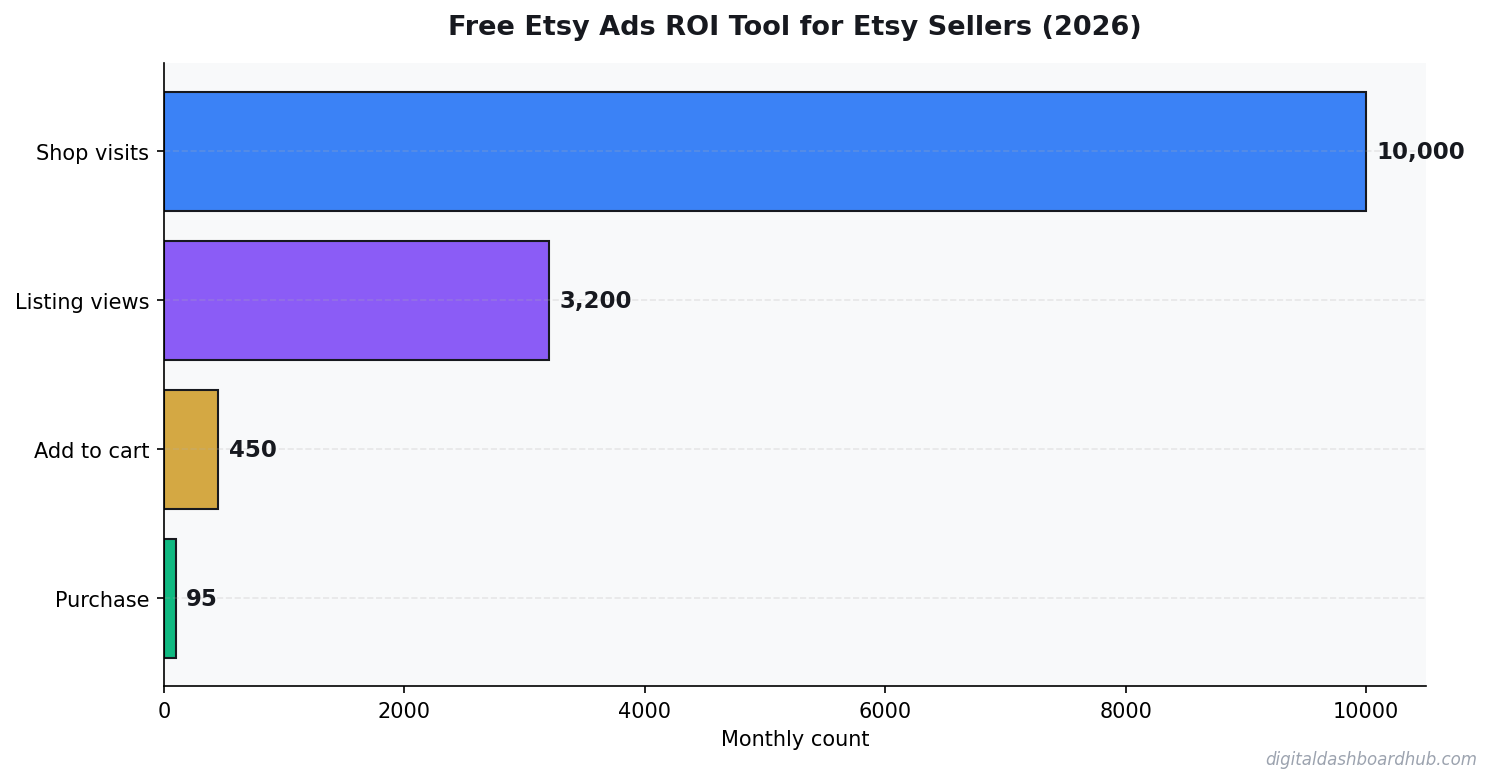
The lite tool above gives you a quick answer. The full Etsy Ads ROI Calculator Pro inside Digital Dashboard Hub goes way deeper:
- Historical tracking — log your numbers weekly and watch trends emerge over months
- Visual charts — bar graphs, trend lines, and breakdowns that make patterns impossible to miss
- Scenario modeling — run “what if” comparisons side by side before making decisions
- PDF reports — export clean reports for partners, lenders, or your own records
- — one subscription covers every calculator and tracker in the library
Getting Real Results From This Tool
Step 1: Enter your real numbers above. Estimates work, but real data from your bank statements or business records gives you something you can actually act on.
Step 2: Change one variable at a time and watch what happens. You’ll quickly see which lever moves your results the most — that’s where to focus your energy.
Step 3: If you want to save these results or track them over time, start a free 14-day trial of the full dashboard. No credit card required. Cancel anytime.
The Next Step
- Right now (30 seconds): Bookmark this page so you can rerun the numbers next month
- This week: Gather your actual data and run it through the tool with real numbers instead of estimates
- Long game: Try the full DDH dashboard — 261 tools, 14 days free, cancel anytime
Related Tools and Articles
- The Side Hustle Tax Trap: How to Track Every Dollar So April Doesn’t Destroy You
- How to Track Variable Expenses When Your Budget Never Looks the Same Twice
- How to Calculate Your Freelance Rate (So You Stop Undercharging)
Common Questions About Free Etsy Ads ROI Tool for Etsy Sellers (2026)
How long does it take to see results?
Most people see meaningful progress within 30-90 days when they apply these strategies consistently. The key is tracking your numbers from day one so you have a baseline to measure against.
What’s the biggest mistake people make?
Trying to do everything at once. Pick one or two strategies from this guide, implement them fully, then layer in additional tactics. Spreading yourself thin is the fastest way to see no results from any of it.
Do I need special tools or software?
Not necessarily to start — but the right tools eliminate hours of manual work. Our free calculators and trackers at Digital Dashboard Hub are a good starting point before you invest in paid software.
Etsy Ads ROI: The Real Math Behind What Works
Here’s the reality most Etsy sellers learn the hard way: Etsy Ads are not a way to make an unprofitable listing profitable. They’re a way to accelerate a profitable listing. If your organic conversion rate is under 2%, running ads on that listing will lose you money.
Let’s run the actual numbers. You set a $5/day Etsy Ads budget on a $35 item. At Etsy’s typical CPC of $0.35-$0.50, you’re getting 10-14 clicks per day. At a 2% conversion rate, that’s 0.2-0.28 sales per day from ads — roughly 1 sale per 4-5 days. Revenue from that sale: $35. Minus Etsy’s transaction fees, processing fees, and COGS, let’s call it $18 net. You spent $20-$25 in ads. You’re losing money.
At a 4% conversion rate with the same setup: 0.4-0.56 sales per day, roughly 1 sale every 2 days. Revenue: $35 every 2 days from $10 in ad spend. Now you’re at a 3.5x ROAS before fees — profitable.
The Listings Worth Running Ads On
Before spending a dollar on Etsy Ads, look at your organic conversion rate in Etsy’s shop stats. A listing converting at 3%+ organically is worth advertising — the ads will amplify something that’s already working. Under 2%, fix the listing first: photos, title, price, or positioning.
The listings that almost always perform well with Etsy Ads: items with a clear gift-giving occasion (birthday, wedding, Mother’s Day), items that photograph extremely well against white backgrounds, and items in niches where search intent is high and competition is moderate. Generic items with hundreds of competing listings need dramatically better conversion rates to be ad-profitable.
The Biggest Etsy Ads Mistake
Running ads on your entire shop instead of your top 3-5 listings. Etsy lets you advertise individual listings — use that control. Identify your top-performing listings by conversion rate and average sale value, run ads exclusively on those, and reinvest the profit before expanding to new listings.
Most sellers who say “Etsy Ads don’t work” ran them on everything at once, couldn’t figure out what was profitable, and turned them off. The tool works when you treat it like a real ad channel — with targeting, optimization, and metrics — not a “boost everything and hope” button.
How to Read Your Etsy Ads Dashboard Without Being Misled by It
The Etsy Ads dashboard shows ROAS, clicks, orders, and attributed revenue. It does not show your net profit margin on those orders, your effective cost per acquisition, or how your paid conversion rate compares to your organic conversion rate. Without those three numbers, you’re reading a partial picture that Etsy has commercial incentives to make look positive.
The calculation that actually matters: take your total ad spend for the period, divide it by the number of orders attributed to ads. That’s your cost per acquisition (CPA). Compare it to your average profit per order — average order value multiplied by your net margin after Etsy fees, materials, and any labor. If CPA is below profit per order, the campaign is cash-flow positive. If CPA is above profit per order, you’re paying more to acquire each customer than you’re making on them. The Etsy dashboard will not show you this comparison. You have to calculate it yourself, or use the ROI tool.
The break-even CPA is your campaign management guardrail. Calculate it once per product category and save it somewhere visible. When a campaign’s CPA drifts above break-even, pause it. When CPA is well below break-even, scale the daily budget by 20-30%. When CPA is borderline, review the listing conversion rate first — if the listing itself converts better than it did when you last checked, the campaign might be worth keeping even at marginal CPA. If conversion rate has dropped, fix the listing before spending more on traffic to it.
One more thing the dashboard hides: attribution lag. Etsy Ads attributes a sale to a click that happened within 30 days. A customer who clicked your ad on day 1 and bought on day 28 shows up as an ad conversion. A customer who clicked on day 1, left, found you via organic search on day 5, and bought shows up as an organic conversion. This attribution model means your ad ROAS is slightly overstated and your organic performance is slightly understated. Keep that in mind when comparing the two channels.
Keep reading (related guides):
- Etsy Seller Revenue Calculator: Project Your Monthly Shop Income
- How Much Do Etsy Sellers Really Make? 2026 Revenue Data
- Etsy Seller Profit Margins: What Owners Actually Take Home (2026)
- Free Etsy Shop Revenue Tool for Etsy Sellers (2026)
- How Journaling Rewires an Anxious Brain: A Science-Backed Guide
14-day trial · Stripe checkout · Cancel anytime
What Most People Get Wrong
The single biggest mistake is treating revenue as the headline number. Revenue is vanity — margin is sanity, and cash-in-bank is reality. Two operators with identical top-lines routinely end the year $80K apart in take-home, because one priced for volume and the other priced for sustainability. The calculator above forces you to surface that gap before it hits your bank account.
The second mistake is modeling a “best case” and planning around it. The number you should plan around is the 30th-percentile scenario — enough demand to matter, but slower than you hoped. If the business still covers your living expenses there, you have real margin of safety. If it only works in the 80th-percentile case, you are building on sand.
The third mistake is ignoring your time as a cost. If you would otherwise earn $55/hr at a day job and this operation pays you effectively $18/hr for 60-hour weeks, the gap is the real price of running it. Plug your opportunity cost into the calculator and the picture often flips.
How to Pressure-Test Your Numbers
Start with the calculator, then stress-test three levers independently:
- Pricing: What happens to your take-home if you raise prices 10%, but lose 15% of volume? Most operators are surprised to find net income goes up.
- Costs: What happens if your largest input cost rises 20%? This is not hypothetical — it is a typical 12-month swing in most industries.
- Volume: What happens at 70% of your planned volume for 90 days? If that still covers fixed costs, you have a real business. If not, the model is fragile.
Running the calculator three ways takes about ten minutes. The clarity on the other side of those ten minutes is usually the difference between a confident operating plan and guessing for another six months.
Frequently Asked Questions
How accurate is this calculator?
The underlying math uses industry-standard margin and cost ranges sourced from the Free Etsy Ads ROI Tool for Etsy Sellers space. Your actual numbers depend on location, seasonality, and operating style, so treat this as a directional benchmark, not a guarantee. The more precisely you enter your inputs, the tighter the output range becomes.
Can I save my results?
A free Digital Dashboard Hub account saves every scenario you run, lets you compare side-by-side, and unlocks the full dashboard with expense tracking and month-over-month charts. The 14-day trial includes the complete tool library — no credit card required to start.
Who is this tool for?
It’s built for anyone pressure-testing a real decision — existing operators auditing their margins, side-hustlers deciding whether to go full-time, and prospective owners trying to sanity-check a business plan before signing a lease. You do not need any accounting background to use it.
What should I do with the results?
Start by comparing the output against your current (or projected) monthly take-home. If the gap is big, walk back the inputs and identify which lever — pricing, volume, or cost structure — is doing the damage. That is usually where the highest-leverage fix lives.
The Bottom Line
Most operators lose money not because the math is impossible, but because they never actually ran it. Fifteen minutes with the calculator beats three months of guessing. Run your numbers, screenshot the output, and use it as the baseline for every pricing and cost decision over the next quarter.
When you are ready to go deeper, the full Digital Dashboard Hub workspace lets you save scenarios, track actuals month-over-month, and see the trend before problems compound. That is the version that actually compounds the effort — spreadsheets forgotten in a Google Drive folder do not.
Next Steps
- Run the calculator above with your best current estimates.
- Re-run it with a pessimistic scenario (lower volume, higher costs) and a stretch scenario (better pricing, more efficient ops).
- Screenshot all three outputs so you have a baseline to compare against when reality arrives.
- Revisit monthly — the number that matters is the one that changes with your real P&L.
Ready for the full dashboard?
Unlock all 255 tools across business, creator, and health workflows.

Andy Gaber is the founder of Digital Dashboard Hub, a suite of 255+ interactive financial, productivity, and wellness tools. He built DDH after getting frustrated with financial apps that gave outputs without context. Follow along for tool tutorials, revenue analytics breakdowns, and honest takes on personal finance.