You’ve got a 401k, a Roth IRA, maybe a brokerage account, possibly some I-bonds you bought during the inflation spike. They all live in different apps, update on different schedules, and the only time you see the full picture is when you manually add up four different numbers — which means you almost never see the full picture. This fragmentation is why most people genuinely don’t know if they’re on track to retire.
A portfolio tracker that only shows you one account isn’t a portfolio tracker. It’s an account viewer. Here’s how to actually measure whether your total investment picture is working.
Most investors know what they own but have no idea if it’s actually working. This investment portfolio tracker shows you real returns vs. benchmarks, your true allocation, and whether you’re building wealth or just moving money around.
How Do You Know If Your Investment Portfolio Is Actually Growing?
Before DDH, I was doing this manually in spreadsheets. Here’s the faster way:
Most people track their portfolio the wrong way. They log into each account, check the balance, mentally add them up, and call it done. What they’re missing:
- Total allocation breakdown — what percentage is stocks vs bonds vs cash vs real estate across ALL accounts
- Performance vs benchmark — are you beating a simple index fund, matching it, or underperforming it?
- Contribution rate tracking — are you on pace for your annual contribution targets?
- Projected balance at retirement age — given current balance + contributions + expected returns, when does the math work?
- Rebalancing signals — when asset allocation drifts 5%+ from target, the tracker flags it
If your current “tracking” doesn’t include all five of these, you’re flying blind on the most important financial project of your life.
Asset Allocation: The One Decision That Determines 90% of Your Returns
Research from Brinson, Hood, and Beebower (1986, updated multiple times since) consistently shows that asset allocation explains roughly 90% of portfolio return variability. Stock picking explains maybe 5%. Market timing explains the rest — and market timing is net negative for most individual investors.
This means the most important question your portfolio tracker should answer is: what is my actual allocation, and is it appropriate for my time horizon?
| Age Range | Typical Stock Allocation | Bond/Cash Allocation | Rationale |
|---|---|---|---|
| 20s-30s | 90-100% | 0-10% | Maximum growth phase, time absorbs volatility |
| 40s | 80-90% | 10-20% | Still growth-focused, slight stability shift |
| 50s | 70-80% | 20-30% | Begin capital preservation phase |
| 60s+ | 50-70% | 30-50% | Sequence-of-returns risk management |
The standard “110 minus your age” rule (or “120 minus your age” for more aggressive investors) gives you a starting point, but your actual target allocation should be based on your specific risk tolerance and timeline — not a generic formula.
How the VVS Portfolio Tracker Dashboard Works
The Vault & Vessel Portfolio Tracker consolidates all your accounts into one dashboard. You manually enter balances (or update them monthly — this isn’t automated, which is actually a feature: the monthly ritual of entering numbers forces engagement with the actual numbers).
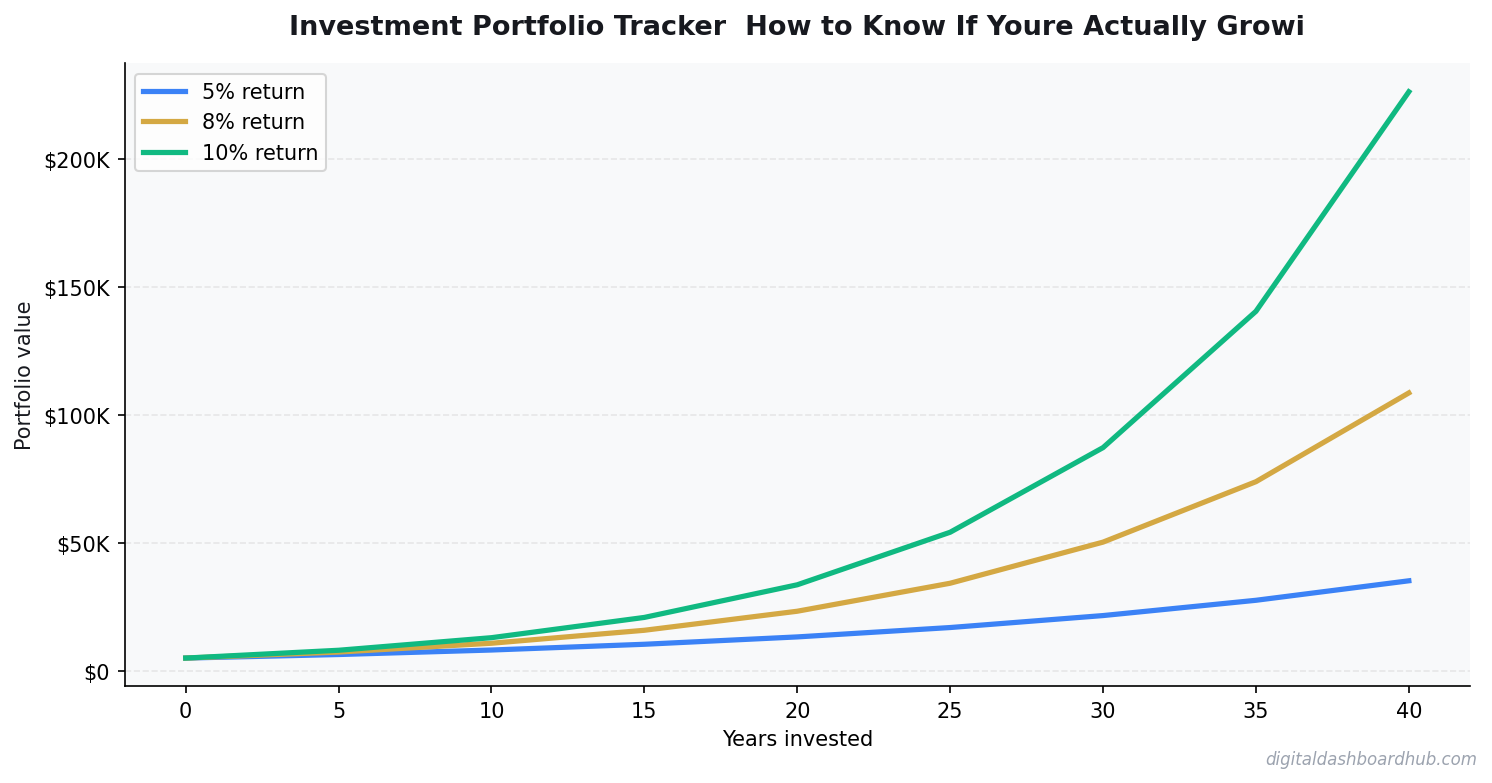
The dashboard shows: total portfolio value, allocation breakdown by asset class with a visual chart, your current projected retirement balance, month-over-month growth rate, and a rebalancing signal that fires when any asset class drifts more than 5% from your target allocation.
The “performance vs benchmark” section compares your portfolio’s year-to-date return against a simple VTI (total US stock market) position. Most actively managed portfolios underperform this benchmark. Seeing the comparison monthly is motivating in the right direction — either your picks are working and you see it confirmed, or they’re not working and you have data to justify simplifying.
🎁 Free Portfolio Snapshot Template
Before you move on — download the free Portfolio Snapshot template. It’s a one-page view that shows all your accounts, allocation, and projected retirement balance in under 5 minutes of setup.
The Biggest Portfolio Tracking Mistakes
Tracking too frequently. Daily portfolio checking increases anxiety and impulsive decisions. Weekly minimum, monthly ideal. The market’s daily noise is irrelevant to a 30-year portfolio — but it feels urgent, which is the trap.
Ignoring fees. A 1% expense ratio in an actively managed fund costs you 20-30% of your final portfolio value over 30 years compared to a 0.03% index fund. Your tracker should show you exactly how much each fund’s fees are costing you annually.
Not accounting for all accounts. That old 401k from your job four years ago? It’s still compounding — or it’s sitting in a money market fund earning 4% when it should be in equities. Old accounts are the most common source of allocation drift.
For the savings foundation that supports investing, our emergency fund guide covers how much cash to keep outside your portfolio. And our net worth tracker article explains how portfolio value fits into your complete financial picture alongside debt and real assets.
Track your portfolio like a business tracks its assets: consistently, completely, and with your eyes on the long-term numbers — not the daily noise.
What Good Portfolio Performance Actually Looks Like
The S&P 500 has returned about 10.5% annually over the past 30 years. With inflation averaging around 3%, your real return is roughly 7.5%. Any simple three-fund portfolio (total US market, total international, bonds) should be within 1-2 percentage points of that over a decade if you’re in a similar allocation.
What concerns me more than underperformance is misattribution. If your portfolio was up 22% in one year, that’s probably the market, not skill. If it was up 4% in a year the S&P returned 18%, something is structurally wrong — either your allocation is too conservative for your timeline, you have high-fee funds dragging returns, or you’re holding too much cash.
The Numbers Most People Don’t Track But Should
Expense ratio. Paying 1.2% annually in fund fees versus 0.04% (a cheap Vanguard index fund) costs roughly $75,000 over 30 years on a $100,000 investment, assuming 7% real returns. It’s invisible year-to-year and devastating over time. Every percentage point of fees is a percentage point of return you’ll never see.
Asset allocation drift. If you started 80/20 stocks/bonds and didn’t rebalance for 5 years, you might be sitting at 90/10 without realizing it — meaning you’re carrying more risk than intended. Annual rebalancing isn’t about optimizing returns; it’s about maintaining the risk profile you actually chose.
Savings rate vs returns. In the first 10 years of investing, your savings rate matters far more than your investment returns. A 1% better return on a $25,000 portfolio is $250/year. An extra $250/month in contributions is $3,000/year. At the start, save harder. Later, optimize returns.
One Metric That Tells You If You’re On Track for Retirement
The “25x rule”: to retire on a given income, you need roughly 25 times that annual income in invested assets (based on a 4% withdrawal rate). Want $60,000/year in retirement? You need $1.5 million. Want $80,000/year? $2 million. This isn’t a guarantee — it’s a calibration tool. It tells you whether your current savings trajectory, at your expected rate of return, gets you to the number you need by when you need it.
Most people don’t run this calculation until their 50s. Running it in your 30s gives you time to adjust — either save more, plan to work longer, or lower your expected retirement spend. All three are adjustable when you have time. At 58, the only lever left is “work longer,” which is exactly the position nobody wants to be in.
The Rebalancing Rule That Actually Works
Annual rebalancing on a fixed date (your birthday, January 1st, whatever) outperforms most active strategies and requires exactly one afternoon per year. The research on rebalancing frequency is clear: more frequent isn’t better, and the transaction costs of over-rebalancing erode the gains. Pick a date, review your allocation versus your target, make adjustments, and leave it alone for another year. That’s the whole system.
Finally: automate your contributions. A manually funded investment account gets skipped during expensive months. An automatic transfer set to your payday date doesn’t. Automating your investing removes the decision friction that derails most people’s plans. Set it once, revisit the amount annually, and leave it alone.
Keep reading (related guides):
- Never Work Again Calculator: The Exact Number by Age
- How Much Money You Need to Retire Early at 40, 45, and 50 (Real Numbers by Age)
- How to Calculate Your Net Worth (And Why Its the Only Financial Number That Matters)
- Investing for Beginners: How to Start With Just $50 (And Actually Understand What Youre Doing)
- Free Sinking Fund Calculator — Try It Now
255+ interactive tools for your money, time, and health.
Instant signup · Stripe-secure · Cancel in one click
Disclaimer: This article is for educational purposes only and does not constitute financial advice. Consult a qualified financial advisor for personalized investment guidance.
Keep Reading
- I Tested 9 Expense Tracker Apps for 3 Months — Here’s What Actually Worked
- Side Hustle Income & Tax Tracker: The Free Dashboard That Keeps April From Destroying You
- How Sinking Funds Saved Me From Financial Emergencies — Free Template Inside

Andy Gaber is the founder of Digital Dashboard Hub, a suite of 255+ interactive financial, productivity, and wellness tools. He built DDH after getting frustrated with financial apps that gave outputs without context. Follow along for tool tutorials, revenue analytics breakdowns, and honest takes on personal finance.