Most FBA “Gurus” Skip the Part Where You Lose Money for Six Months
Bottom Line
In This Article
- Most FBA “Gurus” Skip the Part Where You Lose Money for Six Months
- Step 1: Pre-Launch Investment (Month 0) — What It Actually Costs to Start
- Step 2: Month 1-2 — Launch and the PPC Cash Burn
- Step 3: Month 3-4 — The Slow Climb
- Step 4: Month 5-7 — Organic Traction
- Step 5: Month 8-12 — Scaling or Stalling
- The Fee Structure Most Beginners Underestimate
- How the DDH Amazon FBA Revenue Tracker Handles This
- The 5 Mistakes That Kill First-Year FBA Businesses
- Year 1 Realistic P&L Summary
- Three Steps to Get Started
The sellers who scale past $5K/month typically have 2-3 products, have optimized their supply chain to improve margins, and have built enough review velocity to maintain rankings.
You’ve watched the YouTube videos. Someone shows their Amazon dashboard — $30K in a month! — and makes it sound like ordering inventory from Alibaba is basically printing money. What they don’t show you is the six months of negative ROI, the PPC campaigns that bled cash, and the three products that flopped before one worked.
Why This Matters
Most people overestimate short-term results and underestimate long-term compounding.
I’m going to walk you through what a realistic first year of Amazon FBA actually looks like, month by month, with real numbers on revenue, expenses, and profit. No hype. Just the trajectory that actual data supports.
Step 1: Pre-Launch Investment (Month 0) — What It Actually Costs to Start
Before you sell a single unit, you’re spending money. Here’s the realistic startup budget:
Source: Jungle Scout’s 2025 State of the Seller Report, author’s research March 2026.
The median startup cost for a successful FBA business is about $3,500-$5,000 according to Jungle Scout’s annual survey. If someone tells you you can start for $500, they’re selling a course, not teaching you business.
Step 2: Month 1-2 — Launch and the PPC Cash Burn
Your product is live. Nobody knows it exists. Amazon’s algorithm hasn’t indexed you yet. You’re on page 8 of search results. Welcome to the grind.
Revenue expectation: $200-$800/month
PPC ad spend: $300-$800/month
Net profit: Negative $200-$600/month
In these early months, you’re paying Amazon to show your listing via PPC (Pay-Per-Click) advertising. Your ACoS (Advertising Cost of Sales) will be brutal — typically 40-80%. That means for every $100 in ad-driven sales, you’re spending $40-$80 on ads alone. Before cost of goods, Amazon fees, and shipping.
This is the phase where most sellers quit. They see negative margins and think they failed. They didn’t — this is what launch looks like.
Your goals in months 1-2: get your first 15-25 reviews (through Amazon’s Vine program or organic purchases), optimize your listing based on search term reports, and identify which keywords convert.
Step 3: Month 3-4 — The Slow Climb
Revenue expectation: $800-$2,500/month
PPC ad spend: $400-$1,000/month
Net profit: Negative $100 to positive $200/month
You’re starting to get organic rankings for long-tail keywords. Your review count is hitting 25-50, which makes a huge difference in conversion rate. Amazon’s algorithm is starting to trust your listing.
Your ACoS should be dropping to 25-40% range as you’ve killed the non-converting keywords and doubled down on winners. You might be approaching breakeven on ad spend.
This is also when you’ll discover if your product has a real market. If you’re not seeing organic sales starting to supplement your PPC sales by month 4, your product selection might be the problem.
Step 4: Month 5-7 — Organic Traction
Revenue expectation: $2,000-$5,000/month
PPC ad spend: $500-$1,200/month
Net profit: $200-$1,000/month
This is where it starts to feel real. Organic sales should now represent 40-60% of your total sales. Your review count is 50-100+. You’ve probably reordered inventory at least once (and learned the hard way about lead time planning).
Your profit margins on a typical private label product at this stage: 15-25% after all fees, COGS, shipping, and advertising. On a $25 product, that’s $3.75-$6.25 profit per unit.
Most sellers at this point are starting to think about product #2. This is the right instinct — single-product businesses are fragile. One competitor, one negative review campaign, or one algorithm change can tank you.
Step 5: Month 8-12 — Scaling or Stalling
Revenue expectation: $3,000-$10,000/month
PPC ad spend: $600-$2,000/month
Net profit: $500-$2,500/month
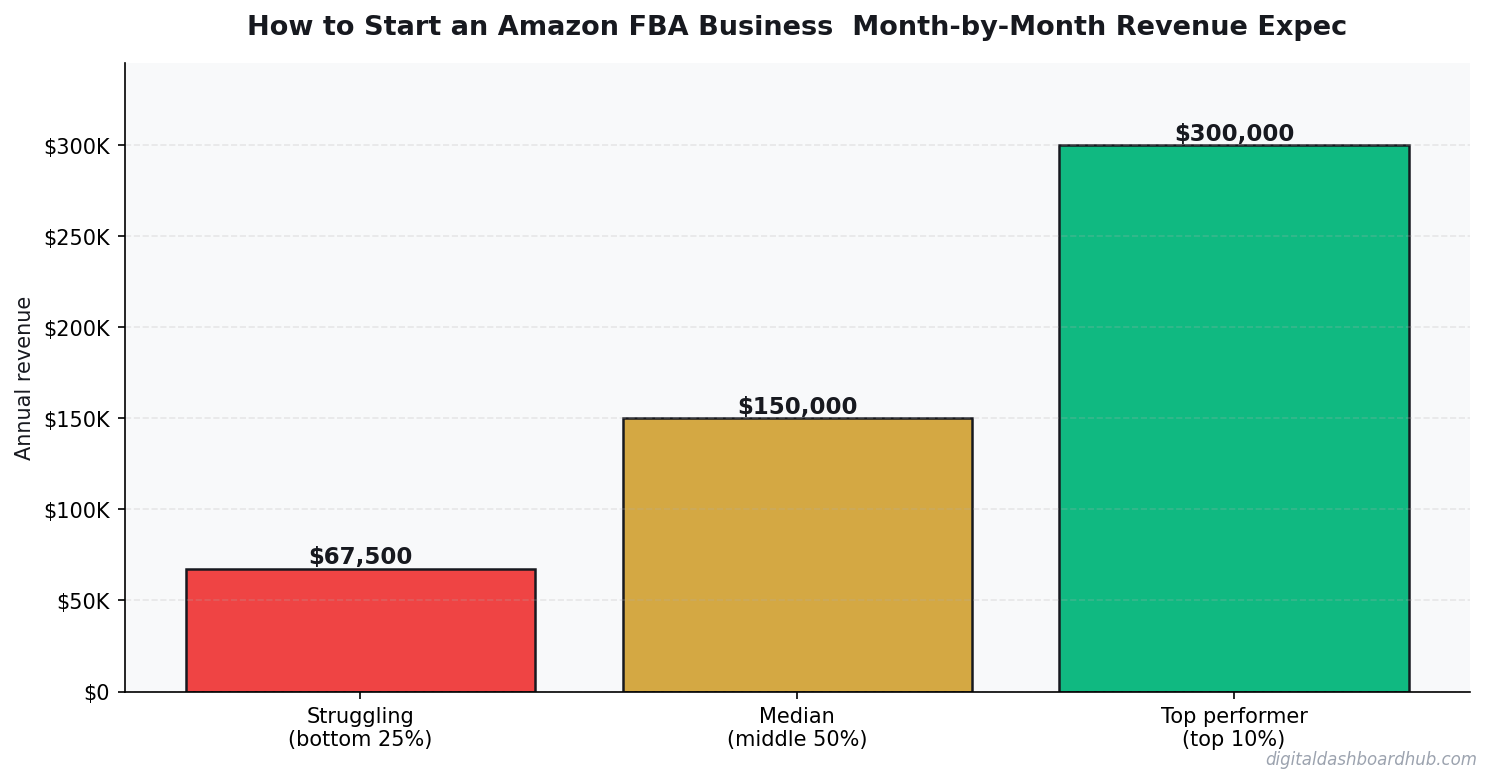
By month 8-12, the trajectory splits. About 40% of new FBA sellers are profitable and growing. About 35% are breaking even or slightly profitable but stuck. And about 25% have either quit or are losing money, according to Jungle Scout’s data.
The sellers who scale past $5K/month typically have 2-3 products, have optimized their supply chain to improve margins, and have built enough review velocity to maintain rankings.
The Fee Structure Most Beginners Underestimate
Amazon takes a lot of your revenue. Here’s the breakdown for a typical $25 product:
Source: Amazon FBA Fee Schedule 2026, Jungle Scout margin calculations.
That’s right — Amazon and your suppliers take 54-86% of every sale. Your profit lives in a narrow band, and it’s determined by your sourcing costs, your PPC efficiency, and your sell-through rate (which affects storage fees).
How the DDH Amazon FBA Revenue Tracker Handles This
Amazon’s Seller Central dashboard shows you revenue and fees, but it doesn’t model your trajectory or help you forecast. You’re always looking backward.
The DDH Amazon FBA Revenue Tracker lets you input your product data, landed costs, ad spend, and current sales velocity, then projects your revenue and profit over the next 6-12 months. It factors in seasonal trends (Q4 surge, Q1 dip), estimated organic ranking improvements, and inventory reorder timing.
The tool also tracks your True ACoS (total ad spend divided by total revenue, not just ad-attributed revenue) — which is the number that actually matters for profitability. Most sellers obsess over regular ACoS without realizing their organic sales subsidize their ad spend.
Free resource: Start a trial and access the “FBA Month-by-Month Revenue Planner” — a pre-built template with all Amazon 2026 fee structures and realistic growth curves for new product launches.
The 5 Mistakes That Kill First-Year FBA Businesses
1. Ordering Too Much Inventory Upfront
Start with 200-500 units, not 2,000. Long-term storage fees and cash tied up in slow-moving inventory kills more new sellers than anything else. Prove demand before you scale.
2. Ignoring PPC Data for Too Long
Check your search term reports weekly. Kill keywords with high spend and zero conversions after 15-20 clicks. Every wasted click is $0.80-$2.00 down the drain.
3. Choosing Oversaturated Niches
If the top 10 results all have 1,000+ reviews, you’re bringing a knife to a gunfight. Look for niches where page-one sellers have 50-300 reviews — that’s achievable in 6-12 months.
4. Not Budgeting for Cash Flow Gaps
Amazon pays you every two weeks, but you need to reorder inventory before you’ve collected on the current batch. This cash flow gap trips up new sellers constantly. Budget for 2-3 months of inventory and operating costs beyond your initial order.
5. Treating It Like Passive Income
FBA is a real business that requires 10-20 hours/week of active management in year one. PPC optimization, listing improvements, review management, inventory planning, supplier negotiation. Anyone selling it as “passive income” is selling you a fantasy.
Year 1 Realistic P&L Summary
For a seller with one product launched at month 1 and a second product at month 7:
Total Year 1 Revenue: $25,000-$55,000
Total COGS + Amazon Fees: $15,000-$35,000
Total PPC Spend: $5,000-$12,000
Net Profit Year 1: $2,000-$10,000
Hours Invested: 600-1,000+
That’s $2-$10/hour for your first year. Not glamorous. But year 2 is where the compounding kicks in — existing products generate organic revenue while you launch new ones. Established sellers with 5-10 products typically see $3,000-$15,000/month in profit by year 2-3.
255+
Interactive Tools
Three Steps to Get Started
- Build your product research shortlist. Use Jungle Scout or Helium 10 to identify 5-10 product opportunities with monthly revenue of $5,000-$20,000, fewer than 300 reviews on page-one listings, and sourcing costs under 25% of selling price.
- Budget for 6 months of negative/breakeven. Have $5,000-$8,000 ready beyond your initial inventory order. Use the DDH FBA Revenue Tracker to model your cash flow month by month.
- Set your “kill switch” criteria. Before you launch, decide what metrics would cause you to cut a product vs. double down. Write them down. Emotion-driven decisions in business are expensive.
Over 6,000 e-commerce sellers use DDH tracking tools to monitor their real profit margins — not just revenue. The ones who succeed aren’t necessarily the ones who pick the best products — they’re the ones who know their numbers and make decisions based on data.
Keep reading (related guides):
- Amazon FBA Revenue Calculator: What Sellers Actually Make in 2026
- Business Expense Tracker: Categorize and Export for Tax Time
- Small Business Finance Basics: The Only 5 Numbers You Need to Track Weekly
- The Small Business Owners Guide to Expense Tracking (Without Losing Your Mind at Tax Time)
- Spreadsheets vs. Dedicated Dashboards for Micro-Business Management: Which Actually Saves You Time?
255+ interactive tools for your money, time, and health.
Instant signup · Stripe-secure · Cancel in one click
Keep Reading
- The Side Hustle Tax Trap: Track Every Dollar
- Freelancer Finance Dashboard: Track Income, Taxes, and Cash Flow
- Side Hustle Income & Tax Tracker (Free Tool)

Andy Gaber is the founder of Digital Dashboard Hub, a suite of 255+ interactive financial, productivity, and wellness tools. He built DDH after getting frustrated with financial apps that gave outputs without context. Follow along for tool tutorials, revenue analytics breakdowns, and honest takes on personal finance.