Opening
Living with PCOS means navigating a condition that affects your body, your emotions, and often your sense of control over your own health. Some months your cycle disappears. Other times your skin flares up unexpectedly. Your energy crashes. Your weight shifts despite your best efforts. It can feel like your body is working against you—and that’s because PCOS fundamentally changes how your body manages hormones and metabolism.
But here’s what many people with PCOS discover: tracking what’s actually happening in your body is one of the most powerful tools for reclaiming control. Not control in the harsh, restrictive sense. Rather, the informed, empowered kind where you understand your patterns, communicate effectively with your healthcare team, and make decisions based on real data instead of guesswork.
PCOS Management Tracker
Monitor PCOS symptoms, medications, cycle data & management score with auto-calculating dashboard
Get the PCOS Tracker →
This guide will walk you through why symptom tracking matters for PCOS management, what to monitor, and how to build a tracking practice that actually fits into your life.
Understanding PCOS and Why Tracking Matters
| Tracking Method | Setup | Data Quality | Doctor-Shareable? | Best For |
|---|---|---|---|---|
| Paper journal | Immediate | Inconsistent | Sometimes | Low-tech preference |
| Generic health app | 5 min | Medium | Export only | Basic logging |
| DDH Symptom Tracker | 5 min | High (structured fields) | Yes — generates patterns | Chronic conditions, complex symptom tracking |
Polycystic Ovary Syndrome (PCOS) is a hormonal condition affecting 8-13% of reproductive-age women worldwide, though many don’t receive a diagnosis until years of symptoms. It involves insulin resistance, elevated androgen levels, and reproductive system changes that create a ripple effect throughout your body.
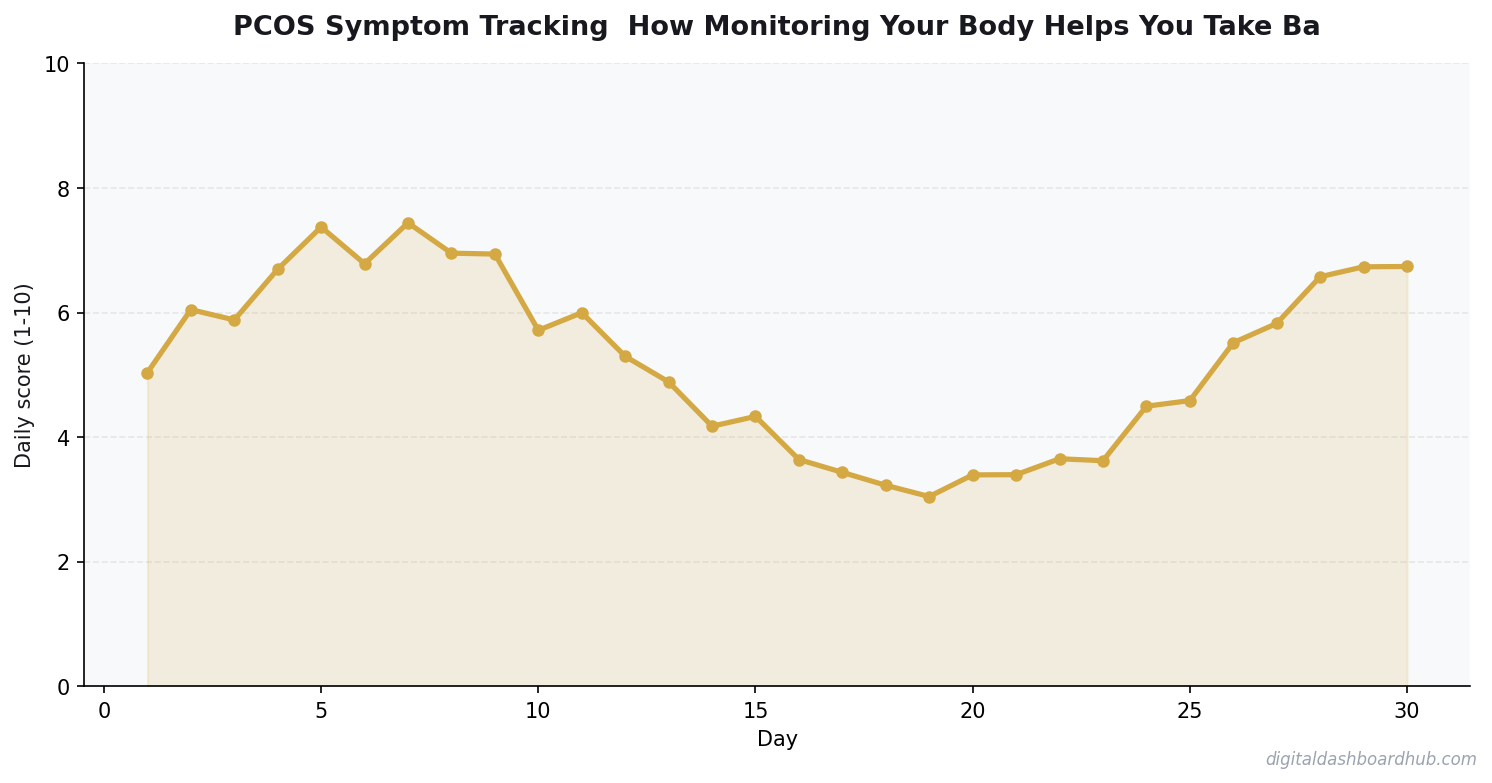
The challenge with PCOS is that it manifests differently in almost every person. Two women with PCOS diagnoses might have completely different symptom profiles. For one, irregular periods are the primary issue. For another, severe acne and hair growth dominate. A third might struggle mainly with weight management and fatigue.
This is precisely why tracking is so valuable. Your PCOS is unique to you, and your tracker becomes a personalized map of how your body behaves across months and seasons. Instead of vague observations (“I think my skin has been worse lately”), you have documented patterns. Instead of forgetting details between doctor visits, you arrive with specific, date-stamped information. Instead of wondering if dietary changes actually helped, you can look at your logged data and see the correlation.
Tracking transforms PCOS from something that happens to you into something you actively manage with intention and information.
The Key PCOS Symptoms Worth Monitoring
PCOS affects multiple body systems simultaneously. Here are the symptoms most worth tracking, and why each one matters:
Menstrual Cycle Irregularity
Irregular, absent, or extremely heavy periods are hallmark PCOS symptoms. Track the start date of your period, how many days it lasts, and whether you spot between cycles. Patterns help your doctor assess whether your current management strategy is working. Over time, you may notice that certain lifestyle changes or treatments genuinely improve regularity—and you’ll have the data to prove it.
Weight Fluctuations
PCOS-related insulin resistance makes weight management uniquely challenging. Rather than tracking obsessively, log your weight weekly or monthly (same day, same time works best). More importantly, note what you’re doing: your exercise routine, major dietary changes, stress levels, and sleep quality. This contextual data helps you understand whether weight changes correlate with your efforts or with hormonal fluctuations you can’t control through willpower alone.
Skin Changes and Acne
Elevated androgens often cause acne, particularly on the jaw, chin, and neck—sometimes into your 30s, 40s, and beyond. Track where breakouts appear, their severity, and any triggers you notice (certain foods, specific times in your cycle, high-stress periods). This information guides conversations with dermatologists and helps you identify which management strategies actually work for your skin.
Hair Growth Patterns
Hirsutism (excess facial and body hair) and alopecia (hair loss or thinning) are common PCOS symptoms driven by elevated androgens. Track where you notice increased growth or thinning, and how it fluctuates. Changes in hair patterns often correlate with treatment effectiveness, making this a meaningful metric to monitor.
Energy and Fatigue
PCOS fatigue isn’t laziness—it’s often tied to insulin dysregulation and hormonal imbalances. Rate your energy levels daily or note when you experience significant fatigue. Look for patterns: Does energy crash during certain cycle phases? After high-sugar meals? With inadequate sleep? These observations guide practical changes that genuinely improve your quality of life.
Mood and Emotional Wellbeing
PCOS doesn’t just affect your body; hormonal imbalances significantly impact mood, anxiety, and emotional resilience. Track mood patterns, anxiety levels, or emotional shifts throughout your cycle. Many people with PCOS experience pronounced emotional symptoms during certain cycle phases. Recognizing these patterns helps you prepare, seek support when you need it, and communicate your experience to healthcare providers.
Physical Symptoms and Pain
Log any pelvic pain, headaches, breast tenderness, or joint aches. While not everyone experiences these, they’re real for many people with PCOS. Tracking helps you recognize whether they’re cyclical, triggered by specific foods, or related to other factors.
How Documentation Strengthens Your Healthcare Conversations
One of the most underrated benefits of symptom tracking is how it transforms your interactions with doctors. Many people with PCOS describe feeling dismissed or unheard by healthcare providers. Walking into an appointment with documented patterns changes that dynamic entirely.
Instead of saying “I’ve been having a lot of breakouts,” you can say: “I track my acne daily, and I noticed breakouts increased 40% during my higher-insulin-resistant phases, particularly after high-carb meals. Here’s my log.” This isn’t just more compelling—it’s clinically useful information that helps your doctor make better treatment decisions.
Documentation also prevents the frustrating experience of forgetting what you wanted to mention. You arrive with a clear picture of what’s been happening, making appointments more productive. You can discuss what’s actually working and what isn’t based on evidence rather than impressions.
For people seeking diagnosis or a second opinion, detailed symptom tracking is invaluable. It provides the evidence base many doctors want to see, and it demonstrates that you’ve been paying serious attention to your health.
Building Your PCOS Tracking Framework
Effective tracking doesn’t require perfection—it requires consistency and relevance. Here’s how to build a system that works for you:
Daily Tracking Elements
Each day, note:
– Energy level (1-10 scale)
– Mood and emotional state (brief note or 1-5 rating)
– Skin condition (breakouts, redness, sensitivity)
– Sleep quality and duration
– Major foods/meals (especially helpful for identifying trigger foods)
– Exercise or movement (type and duration)
– Stress level (1-10)
– Notable symptoms (fatigue, pain, hair changes, etc.)
Daily tracking doesn’t mean writing paragraphs. Simple check-boxes, brief notes, or one-to-ten ratings work perfectly.
Weekly Review Elements
Once weekly, step back and assess:
– Energy patterns – Did energy crash on particular days?
– Mood trends – Any notable emotional shifts?
– Skin changes – Overall improvement or decline?
– Weight (if tracking this) – Any shifts, and in what context?
– Cycle observations – Any spotting or changes?
– Food patterns – Any particular foods or eating patterns affecting your symptoms?
Monthly Analysis Points
Review your full month to identify:
– Cycle phase timing – How consistently do your cycles repeat, if at all?
– Symptom clustering – Do certain symptoms appear together?
– Effectiveness patterns – Are your current management strategies working?
– Triggers and correlations – What consistently makes symptoms worse or better?
– Actionable insights – What should you try differently next month?
This tiered approach means you’re not overwhelmed with daily data entry, but you’re still capturing meaningful patterns.
Identifying Patterns That Inform Your Choices
After 4-6 weeks of tracking, patterns start emerging. These patterns become your personalized PCOS manual.
You might discover that your skin dramatically improves when you reduce processed carbohydrates. Or that your mood stabilizes when you move your body consistently, even gently. Or that cycle regularity improves with stress management practices. Or that your energy crashes specifically on days following poor sleep.
The power of these insights is that they’re based on your body, not general advice. When you see clear correlation between actions and outcomes in your own data, you’re more likely to stick with helpful habits because you have proof they work for you.
Beyond individual patterns, tracking helps you distinguish between hormone-related symptoms you need to manage through treatment and symptoms you can meaningfully influence through lifestyle. For instance, if your acne consistently worsens despite perfect skincare and diet optimization, it may signal that you need adjusted medical management. But if you notice breakouts appear specifically after stressful events or poor sleep, you have actionable targets for improvement.
The Emotional Dimension of PCOS Management
PCOS is not just a physical condition—it’s an emotional one. Many people with PCOS experience grief about infertility challenges, frustration with weight management despite genuine effort, shame about visible symptoms like facial hair, and anxiety about long-term health implications.
Tracking can feel like a way to reclaim agency in the face of this emotional burden. It’s concrete action you can take on a day when your body feels out of control. It’s proof that you’re doing something, taking responsibility, and paying attention—which itself can be emotionally settling.
That said, tracking should not become a source of additional stress. If daily logging feels punitive or obsessive, simplify it. If reviewing your data feels discouraging, focus instead on patterns that show improvement. The goal is empowerment, not perfectionism.
Many people find that tracking also helps them communicate their experience to loved ones. When your partner, family member, or close friend sees documented patterns of what you’re managing, it deepens their understanding and compassion. It transforms PCOS from an invisible condition they hear you mention into a tangible reality they can comprehend.
Tools and Resources to Support Your Practice
You don’t need expensive or complicated tools to track PCOS symptoms effectively. Here are several approaches that work:
Spreadsheets: Simple, customizable, and free. Create columns for each symptom and enter data daily. Many people appreciate the flexibility to design exactly what they need.
Dedicated tracking apps: Several apps are designed specifically for cycle tracking and PCOS management, offering visualization features and pattern detection.
Printable tracking journals: Some people prefer the tactile experience of handwriting daily observations. Printable templates provide structure without digital overwhelm.
Templates and guided frameworks: Pre-built templates remove the burden of designing your own system, letting you focus on consistent data entry.
The best tracking tool is the one you’ll actually use consistently. If you love spreadsheets, use those. If you prefer apps, download one that resonates with you. If handwriting feels most natural, keep a dedicated journal.
Managing Stress as a PCOS Management Strategy
Stress and PCOS create a difficult cycle: hormonal imbalances increase anxiety and stress sensitivity, while stress worsens PCOS symptoms and triggers insulin resistance. Breaking this cycle requires intentional stress management.
This is where tracking stress levels becomes clinically valuable. The Stress Management Spreadsheet is built specifically for this — it lets you log daily stress triggers, coping strategies, and outcomes so you can see exactly how stress correlates with your other PCOS symptoms over time.
Beyond logging stress, consider stress management practices that research supports for PCOS specifically: mindfulness meditation, gentle movement (walking, yoga, swimming), time in nature, creative expression, and social connection. These aren’t add-ons—they’re core components of PCOS management.
For many people, meditation practices paired with symptom tracking create a powerful feedback loop: you see stress patterns in your data, you dedicate yourself to a meditation practice, you track the results, you see improvement documented — which motivates continued practice. The Meditation Practice Spreadsheet helps you build and maintain that consistency by logging sessions, tracking benefits, and visualizing your practice streak.
From Tracking to Action: Building Your PCOS Management Plan
Effective tracking is only valuable when it informs action. Here’s how to move from documentation to decision-making:
- Review your data monthly and identify 1-2 patterns or concerns worth addressing.
- Discuss findings with your healthcare provider during appointments, bringing your documentation.
- Make one or two small changes based on your insights—not overhauls, just incremental improvements.
- Track the results of those changes over 4-6 weeks.
- Assess effectiveness honestly, then adjust or double down based on what you observe.
This cycle of tracking, analysis, action, and reassessment is how PCOS management becomes truly personalized. You’re not following generic advice—you’re running mini-experiments on your own body and learning what works for you.
Your Next Step: Taking Control Today
PCOS is complex, but your response to it doesn’t have to be. Starting with simple symptom tracking is one of the most impactful first steps you can take toward understanding your body, communicating with your healthcare team, and making informed decisions about your health.
You don’t need a perfect system or endless time. You need consistency, honesty, and the willingness to pay attention to what your body is telling you.
If you’re ready to start tracking but unsure how to structure it, the PCOS Management Bundle provides comprehensive templates specifically designed for PCOS symptom monitoring. It includes daily tracking sheets, monthly analysis frameworks, and visualization tools that make pattern recognition easy—even when you’re tired and overwhelmed.
Alternatively, if you prefer a straightforward spreadsheet approach, the PCOS Management Spreadsheet offers a simpler, customizable option that many people find less intimidating as a starting point.
For those who prefer interactive, digital tracking, the PCOS Management Tracker (HTML) provides a modern interface where data entry feels effortless and patterns pop visually.
The key is starting. Not sometime, not when you have perfect conditions—now. Today. With whatever tool feels most accessible to you.
Get Your Free PCOS Symptom Tracking Starter Guide
Want a simple starting point for tracking your PCOS symptoms? We created a free PCOS Symptom Tracking Starter Guide that breaks down exactly what to monitor, when to check it, and how to spot patterns—in plain language.
👉 Download the Free PCOS Symptom Tracking Starter Guide — Delivered straight to your inbox. No spam, ever.
Living Better With PCOS
PCOS is a marathon, not a sprint. Some months will feel manageable; others will feel overwhelming. Your tracking practice becomes the thread that connects these months—evidence that you’re not imagining patterns, proof that your efforts matter, and data that helps you and your healthcare team make decisions from a place of knowledge rather than guesswork.
You deserve to feel informed about your own body. You deserve healthcare providers who listen to your documented observations. You deserve to recognize your own patterns and act on them with intention. Tracking is how you claim that right.
Start today. Track what matters most to you. Review your data honestly. Adjust based on what you learn. And remember—progress with PCOS looks like understanding your body better, not perfection. That’s something worth tracking.
Keep reading (related guides):
- Free Menopause Symptom Tracker — Try It Now
- Free PCOS Symptom Tracker Dashboard — Try It Now
- IVF Cycle Tracking: How to Stay Organized Through the Most Overwhelming Process of Your Life
- Postpartum Recovery Tracking: What to Monitor in the First 12 Weeks (That Nobody Talks About)
- Bakery Revenue Calculator
255+ interactive tools for your money, time, and health.
14-day trial · Stripe checkout · Cancel anytime
Medical Disclaimer: This article is for informational purposes only and does not constitute medical advice, diagnosis, or treatment. PCOS is a complex medical condition requiring individualized care from qualified healthcare providers. Always consult with your doctor before starting new treatments, supplements, or significant lifestyle changes. The information provided is based on current medical understanding but should not replace professional medical guidance. If you suspect you have PCOS or are experiencing concerning symptoms, seek evaluation from a healthcare provider qualified in reproductive endocrinology or women’s health.
Keep Reading
- I Tested 9 Expense Tracker Apps for 3 Months — Here’s What Actually Worked
- How to Regulate Your Nervous System: 8 Steps to Move From Chronic Stress to Calm
- I Tracked My Nervous System for 90 Days — Here’s What I Learned About My Stress, Sleep, and Sanity

Andy Gaber is the founder of Digital Dashboard Hub, a suite of 255+ interactive financial, productivity, and wellness tools. He built DDH after getting frustrated with financial apps that gave outputs without context. Follow along for tool tutorials, revenue analytics breakdowns, and honest takes on personal finance.