therapy-in-2026-costs-anywhere-from-0-to-350-per-session-depending-on-where-you-live-and-how-you-pay”>Therapy in 2026 Costs Anywhere From $0 to $350 Per Session — Depending on Where You Live and How You Pay
The dashboard below loads instantly in your browser. Plug in your numbers, see your answer. No signup to try the basics.
Running a SaaS business means I track these numbers obsessively. Here’s what the data actually shows:
What to Remember
In This Article
- Therapy in 2026 Costs Anywhere From $0 to $350 Per Session — Depending on Where You Live and How You Pay
- The Three Ways to Pay for Therapy
- State-by-State Cost Comparison: The Data
- The In-Network Problem: Cheap but Unavailable
- Out-of-Pocket: Expensive but Flexible
- Online Therapy: The 2026 Value Play
- How the DDH Healthcare Cost Calculator Handles This
- Which States Are Cheapest for Therapy?
- Mid-Article Bonus: The HSA/FSA Play for Therapy
- The Hidden Cost: Session Frequency vs. Outcomes
- Making the Decision: A Framework
- The Quick-Start Version
- Explore More
The in-network model works if you can get in. For many people in 2026, that’s a big if. The shortage is worst in child/adolescent therapy, psychiatry, and specialized trauma treatment.
I started researching therapy costs after a friend in Texas told me she pays $45/session through her insurance. I’m in New York. My copay is $65, and that’s the in-network rate. A colleague in California pays $250 out-of-pocket because she couldn’t find an in-network therapist accepting new patients.
Save This
Screenshot your results. Compare again in 30 days to see if you’re on track.
Same service. Same country. Wildly different costs. And that’s before you factor in online therapy platforms like BetterHelp and Talkspace, which have completely changed the pricing space in the past two years.
This is the most comprehensive therapy cost comparison I could build: in-network vs. out-of-pocket vs. online, with real state-by-state data, so you can make an informed decision about how to access mental healthcare without destroying your budget.
The Three Ways to Pay for Therapy
Before we get into numbers, let’s define the three models clearly, because the differences matter more than most people realize.
In-network insurance: Your therapist has a contract with your insurance company. You pay a copay ($20-$75 typically) and insurance covers the rest. The therapist accepts a lower rate in exchange for patient volume from the insurance company’s network. This is the cheapest option per session, but finding an in-network therapist with availability can take weeks or months.
Out-of-pocket (with or without out-of-network benefits): You pay the therapist’s full rate. If you have out-of-network benefits, you can submit for partial reimbursement (typically 50-80% after meeting your deductible). Costs range from $120-$350 per session depending on location, specialization, and the therapist’s experience level.
Online therapy platforms: Subscription-based services like BetterHelp ($65-$100/week), Talkspace ($69-$109/week), or Cerebral ($85-$325/month). You get matched with a licensed therapist and meet via video. Pricing is standardized regardless of location, which makes these platforms especially cost-effective in expensive markets.
State-by-State Cost Comparison: The Data
I compiled average therapy session costs across 15 representative states to show the range. These are 2026 averages for a standard 50-minute individual therapy session with a licensed clinical social worker (LCSW) or licensed professional counselor (LPC).
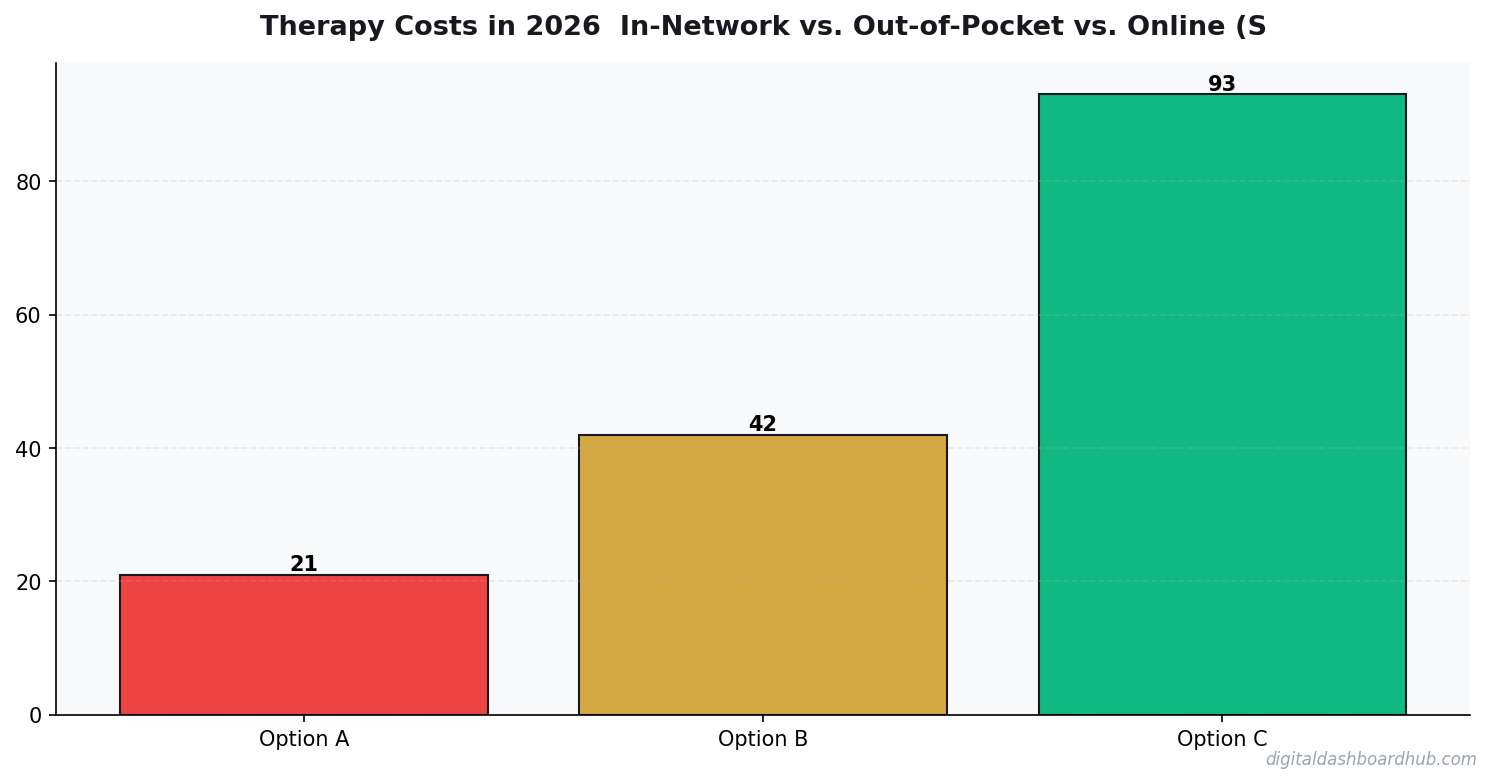
The pattern is clear: coastal and urban states cost significantly more. Mississippi’s average out-of-pocket rate is less than half of New York’s. But online therapy prices are nearly identical regardless of state — that’s the arbitrage opportunity.
The In-Network Problem: Cheap but Unavailable
In-network therapy is the best deal on paper. A $35 copay for a $180 service is incredible. The problem is access. The American Psychological Association’s 2025 survey found that 63% of in-network therapists were not accepting new patients, and the average wait time for a new patient appointment was 47 days.
In some areas, particularly rural counties and states with fewer licensed providers per capita, the wait is three months or more. And when you do get in, you’re choosing from whoever’s available, not necessarily a therapist who specializes in what you need.
The in-network model works if you can get in. For many people in 2026, that’s a big if. The shortage is worst in child/adolescent therapy, psychiatry, and specialized trauma treatment.
Out-of-Pocket: Expensive but Flexible
Paying out-of-pocket gives you the widest selection of therapists, the fastest access, and the most flexibility. You can choose based on specialization, approach, personality fit, and availability instead of just “who takes my insurance.”
The cost is the obvious downside. At $175/session weekly, that’s $9,100 per year. Even biweekly, you’re looking at $4,550. For a household earning $75,000, that’s 6-12% of gross income on therapy alone.
Out-of-network reimbursement helps, but it’s complicated. You typically need to meet a deductible ($500-$2,000), then submit superbills for reimbursement at 50-80% of a “reasonable and customary” rate that your insurance company determines. If your therapist charges $200 but your insurer’s R&C rate is $150, you’re getting reimbursed on the $150, not the $200.
Online Therapy: The 2026 Value Play
Here’s where the math gets interesting. BetterHelp charges $260-$400/month for weekly sessions. That’s $3,120-$4,800/year. In New York, where an in-network copay runs $55-$75 per session ($2,860-$3,900/year for weekly therapy), online therapy costs roughly the same. But in New York, where out-of-pocket rates are $200-$350/session, online therapy saves $6,000-$14,000 annually.
The value proposition of online therapy is strongest in high-cost states and for people who can’t find in-network availability. If you’re in Ohio with a $30 copay and a therapist you like, online therapy doesn’t save you money. If you’re in California with no in-network availability and $250 sessions, it absolutely does.
Quality concerns are valid but diminishing. A 2024 meta-analysis in the Journal of Clinical Psychology found that video-based therapy produced equivalent outcomes to in-person therapy for depression, anxiety, and general stress. It was slightly less effective for complex trauma and severe personality disorders, where in-person is still preferred.
How the DDH Healthcare Cost Calculator Handles This
Comparing therapy costs is more complex than it looks because you’re comparing different payment structures (copay vs. full rate vs. subscription), different frequencies, and different ancillary costs (like driving to appointments vs. logging in from your couch).
The DDH Healthcare Cost Calculator lets you input your specific insurance plan details, your state, your preferred therapy frequency, and your out-of-network benefits, then shows you the true annual cost of each option side by side. It accounts for deductibles, co-insurance percentages, and out-of-pocket maximums — all the variables that make “which is cheaper?” a harder question than it should be.
The calculator also includes a break-even analysis: at what session frequency does out-of-pocket therapy become cheaper than maintaining a higher-tier insurance plan just for mental health coverage? For some people, dropping to a bronze plan and paying out-of-pocket is actually cheaper than a gold plan’s copay structure. The math varies wildly by plan and state, which is exactly why a calculator beats napkin math.
Which States Are Cheapest for Therapy?
Based on the data, the five cheapest states for out-of-pocket therapy in 2026 are Mississippi ($90-$150/session), Arkansas ($95-$155), West Virginia ($95-$160), Kentucky ($100-$165), and Tennessee ($100-$175). These states also tend to have lower costs of living generally, which correlates strongly with professional service pricing.
The five most expensive: New York ($200-$350), California ($180-$300), Massachusetts ($185-$310), Connecticut ($175-$290), and Washington ($170-$280). No surprises there. High cost of living, high demand for services, and in several of these states, higher licensing requirements that reduce provider supply.
If you’re in a high-cost state and considering online therapy, the financial argument is strong. You’re essentially accessing a therapist at Midwest rates while living in a coastal market.
Mid-Article Bonus: The HSA/FSA Play for Therapy
If you have a Health Savings Account (HSA) or Flexible Spending Account (FSA), therapy is an eligible expense. That means you’re paying with pre-tax dollars, which effectively gives you a 22-35% discount depending on your tax bracket.
A $175 therapy session paid with HSA funds costs you about $131 in real after-tax dollars if you’re in the 25% bracket. Over a year of weekly sessions, that’s a $2,288 tax savings. Most people I talk to who are paying out-of-pocket for therapy aren’t routing it through their HSA. Free money, left on the table.
Online therapy platforms increasingly accept HSA/FSA cards directly. BetterHelp and Talkspace both do. If your platform doesn’t accept the card, you can usually pay with a regular card and submit for HSA reimbursement with the receipt.
The Hidden Cost: Session Frequency vs. Outcomes
One factor people overlook when comparing costs is session frequency and duration of treatment. Weekly therapy at $45/session for 40 sessions ($1,800) might resolve an issue faster than biweekly therapy at $35/session for 60 sessions ($2,100). The per-session cost is lower biweekly, but the total cost is higher because treatment takes longer.
Research consistently shows that weekly sessions produce faster outcomes than biweekly for most conditions. If you’re choosing biweekly purely for cost reasons, you might be extending your total treatment time and spending more overall. This is another area where the cost calculator helps — it models total treatment cost, not just per-session cost.
Making the Decision: A Framework
Choose in-network if: you have a PPO or HMO with in-network therapists accepting patients, your copay is under $50, and you’re flexible on therapist selection. This is the cheapest option when available.
Choose online therapy if: you can’t find in-network availability, you’re in a high-cost state, you prefer the convenience of video sessions, or you want to start immediately without a waitlist. Best value in expensive markets.
Choose out-of-pocket if: you need a specific specialization (EMDR, DBT, specific trauma work), you’ve tried other options and need the right fit, or you have out-of-network benefits that cover 70%+ after a low deductible. Best for specialized needs.
The Quick-Start Version
Step 1: Call your insurance company and ask three specific questions: What’s my copay for in-network therapy? What are my out-of-network benefits? How many in-network therapists within 20 miles are accepting new patients?
Step 2: Get a quote from one online platform (BetterHelp and Talkspace both offer financial aid for lower incomes) and compare the monthly cost to your in-network annual cost.
Step 3: Use the DDH Healthcare Cost Calculator to run all three options with your actual insurance details and see the true annual cost side by side — including HSA tax savings.
162+
Revenue Calculators
Built for real business decisions
Explore More
- Why Traditional Budgets Fail ADHD Brains
- How Sinking Funds Saved Me From Financial Emergencies
- Sinking Fund Savings Goal Planner (Free Tool)
Keep reading (related guides):
255+ interactive tools for your money, time, and health.
Full dashboard access · Stripe-secure checkout · Cancel anytime

Andy Gaber is the founder of Digital Dashboard Hub, a suite of 255+ interactive financial, productivity, and wellness tools. He built DDH after getting frustrated with financial apps that gave outputs without context. Follow along for tool tutorials, revenue analytics breakdowns, and honest takes on personal finance.