Americans Spent $186 Billion on Pets in 2025. Here’s How to Get Your Cut.
Enter your own numbers in the interactive tool below and get a real-time read. The dashboard version adds saved scenarios, history, and full feature access.
I launched Digital Dashboard Hub because the tools I found online were either too generic or too complicated. Here’s the honest breakdown:
TL;DR
In This Article
- Americans Spent $186 Billion on Pets in 2025. Here’s How to Get Your Cut.
- Step 1: Understand the Five Main Pet Business Niches
- Step 2: Dog Grooming — The Workhorse of Pet Businesses
- Step 3: Pet Boarding — High Revenue, High Commitment
- How the DDH Pet Business Revenue Calculator Handles This
- Step 4: Dog Training — The Highest-Margin Pet Business
- Step 5: Pet Sitting and Dog Walking — The Gateway Business
- Step 6: Licensing, Insurance, and Legal Requirements
- Step 7: Pricing Strategy That Reflects Your Value
- The Decision Framework: Which Pet Business Is Right for You?
- Your Action Plan
- Dig Deeper
This guide walks you through each niche step by step, with the real revenue math, so you can choose the one that matches your capital, skills, and the life you actually want to live.
The pet industry is one of the few sectors that grew through every recession in the last 30 years. People cut their own budgets before they cut their dog’s. That makes pet services one of the most recession-resistant business categories you can enter — if you pick the right niche and price it correctly.
Insider Insight
The tool below uses the same formulas financial advisors charge $200/hour to calculate.
But “start a pet business” is hopelessly vague. Grooming, boarding, dog training, pet sitting, and dog walking are fundamentally different businesses with different startup costs, different revenue models, and different lifestyle implications. A dog groomer works 8-10 hour shifts in a fixed location. A dog walker works outdoors in 2-3 hour blocks. A boarding facility operator is on call 24/7.
This guide walks you through each niche step by step, with the real revenue math, so you can choose the one that matches your capital, skills, and the life you actually want to live.
Step 1: Understand the Five Main Pet Business Niches
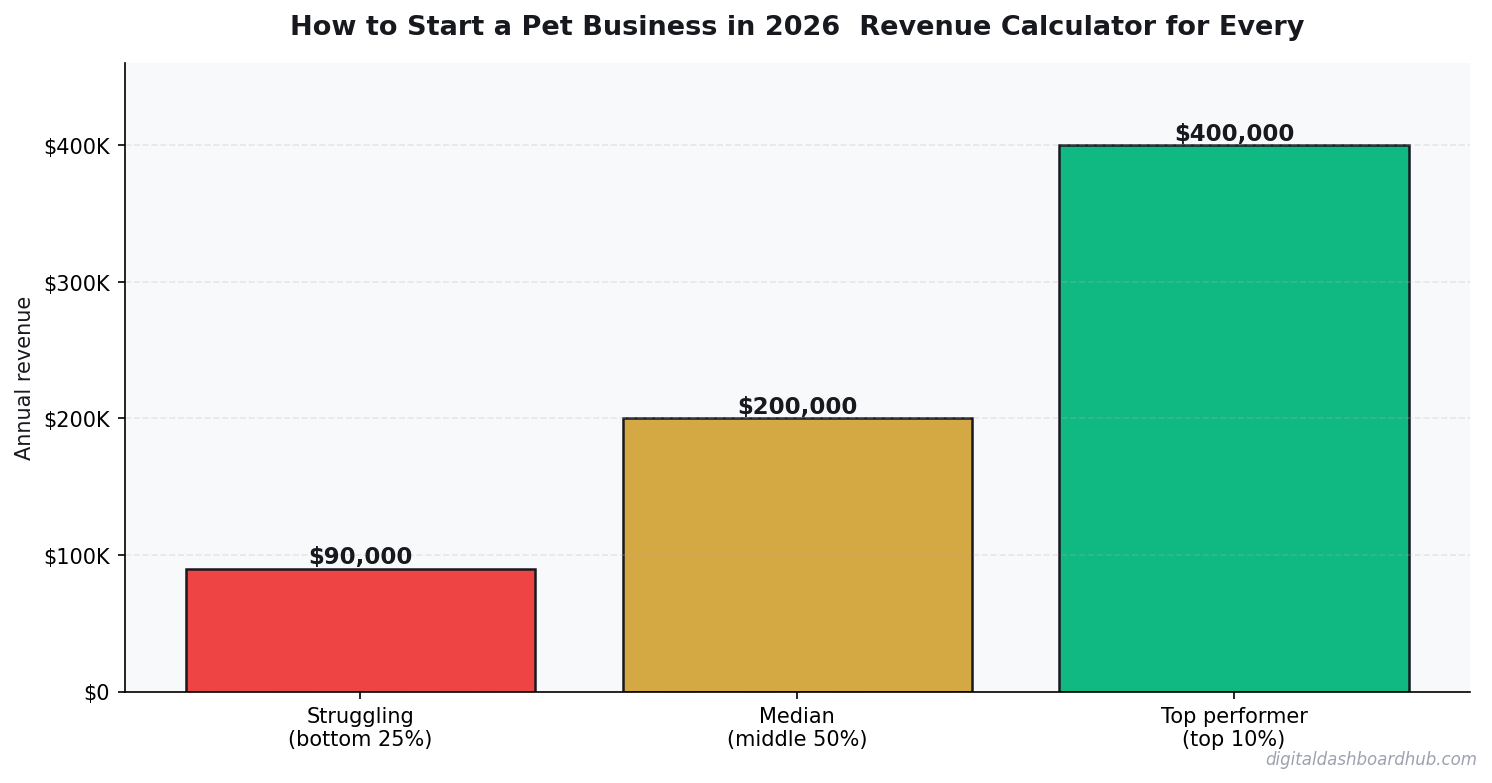
Two things stand out. First, the lowest-capital businesses (training, sitting/walking) have the highest margins. Second, the highest-capital businesses (boarding, shop grooming) have the highest raw revenue but much thinner margins because of facility costs. This pattern repeats across every service industry — overhead kills margins.
Step 2: Dog Grooming — The Workhorse of Pet Businesses
Dog grooming is the largest revenue segment in pet services. The average dog grooming session runs $50-$90 for a standard bath, haircut, nail trim, and ear cleaning. Large or difficult breeds can be $100-$150+. A skilled groomer can complete 5-8 dogs per day.
Mobile grooming has become the fastest-growing segment. You buy or outfit a van with a tub, dryer, grooming table, and water system (total van outfitting: $15,000-$40,000 on top of the vehicle cost). You drive to the client’s home, groom the dog in the van, and drive to the next appointment. No rent payments. No facility overhead.
A mobile groomer doing 6 dogs/day at $75 average = $450/day = $9,900/month (22 working days). Expenses: van payment ($400-$600/month), fuel ($400-$600/month), insurance ($200-$400/month), supplies ($300-$500/month). Monthly profit: $7,400-$8,400. That’s a strong solo income.
Shop grooming has higher revenue potential but significant overhead. Rent for a 1,000-1,200 sq ft grooming shop: $1,200-$3,000/month depending on market. Utilities, equipment maintenance, and cleaning supplies add another $500-$800/month. But a shop can handle 10-15 dogs/day with 2-3 groomers, generating $15,000-$25,000/month in revenue. After rent, labor, and expenses, profit is typically $3,000-$7,000/month for the owner — less than mobile grooming solo, but with scaling potential.
Step 3: Pet Boarding — High Revenue, High Commitment
Pet boarding is the big-money play in the pet industry, but it requires serious capital and 24/7 commitment. A boarding facility with 20-30 runs charges $35-$65/night per dog. At 70% average occupancy (accounting for weekday dips), a 25-run facility generates: 25 runs × 0.70 occupancy × $45 average × 30 nights = $23,625/month.
The capital requirement is the barrier. Building or converting a space for boarding requires: zoning approval (many residential areas don’t allow kennels), kennel runs or suites ($500-$1,500 each to build), commercial HVAC for air quality, drainage systems, fencing, fire suppression, and ADA compliance. Total buildout: $50,000-$200,000+ depending on whether you’re converting an existing space or building new.
Ongoing costs are heavy too: staff (you can’t leave 25 dogs unattended, even overnight), cleaning supplies, food (if included), insurance ($2,000-$5,000/year for a boarding facility), and constant maintenance. Net margins run 20-35%, and the owner is often on call for emergencies at 2 AM.
The modern evolution of boarding is “cage-free” or “home-style” boarding, where dogs stay in a home environment rather than a kennel facility. This can be run from a private home with proper licensing (similar to a home daycare), starting with 3-5 dogs at $50-$70/night. Lower capital, higher per-dog revenue, but limited capacity.
How the DDH Pet Business Revenue Calculator Handles This
Every pet business niche has different revenue drivers: a groomer calculates by dogs-per-day, a boarder by occupancy rate, a walker by walks-per-day. The DDH Pet Business Revenue Calculator has separate models for each niche so you’re calculating with the right variables.
The grooming model lets you set your average service price, dogs per day, and working days per month — then shows you revenue with seasonal adjustments (grooming demand drops slightly in winter, spikes before holidays). The boarding model uses occupancy rate and nightly rate with weekend/weekday splits. The walking model calculates by walks per day with a group walking option (walking 3-4 dogs simultaneously at $15-$20 each).
The feature that matters most: the break-even calculator for equipment-heavy businesses. If you’re spending $35,000 on a mobile grooming van, how many dogs do you need to groom before that investment pays for itself? The calculator shows you the payback period at different volume levels, so you know whether you’ll recoup your investment in 8 months or 24.
Step 4: Dog Training — The Highest-Margin Pet Business
Dog training has the best economics of any pet service niche. Startup costs are minimal (training treats, leashes, a long line, and possibly cones or agility equipment — $500-$2,000 total). Revenue per session is high: private training sessions run $75-$150/hour. Group classes: $150-$300 for a 6-week course per dog, with 4-8 dogs per class.
A solo dog trainer doing 5 private sessions per day at $100 each = $500/day = $11,000/month (22 working days). Add two group classes per week at $200/dog with 6 dogs per class = $2,400/week from classes alone. Combined potential: $15,000-$20,000/month.
Of course, booking 5 private sessions every day takes time to build up to. Most trainers start with 1-2 sessions per day and grow through referrals and reviews. The ramp to full bookings typically takes 6-12 months of consistent marketing and excellent results.
The credibility factor matters more in training than other pet niches. A CPDT-KA certification (Certified Professional Dog Trainer — Knowledge Assessed) costs about $400 for the exam and requires 300 hours of training experience. It’s not legally required, but it significantly increases what you can charge and how quickly you book. Certified trainers consistently charge 30-50% more than uncertified ones.
Step 5: Pet Sitting and Dog Walking — The Gateway Business
Pet sitting and dog walking have the lowest barrier to entry of any pet business. You need: a business license ($50-$200), bonding/insurance ($200-$500/year), a smartphone, and reliable transportation. Total startup: $300-$800.
Dog walking rates vary significantly by market: $15-$30 per 30-minute walk. In urban areas (NYC, SF, Chicago), rates can be $25-$35 per walk. Group walks (2-4 dogs simultaneously) at $15-$20 each multiply your hourly rate. A walker doing 4 group walks of 3 dogs each = 12 walks × $18 = $216/day.
Pet sitting (in-home visits while owners are away) typically pays $20-$35 per visit or $50-$85 per overnight stay. Holiday periods are peak season — rates can increase 25-50% around Christmas, Thanksgiving, and summer vacation.
The challenge with walking and sitting is the income ceiling. A solo walker/sitter maxes out at about $4,000-$6,000/month because there are only so many hours between 7 AM and 7 PM, and travel time between appointments eats into billable time. Scaling requires hiring walkers, which introduces management overhead and typically drops your margin to 30-40% of the walker’s revenue.
Step 6: Licensing, Insurance, and Legal Requirements
Every pet business needs at minimum: a business license (check with your city/county), general liability insurance ($400-$1,500/year depending on the niche), and a business bank account. Beyond that, requirements vary by niche and state.
Boarding facilities need: kennel license (state-issued, $100-$500/year), zoning approval, fire inspection, and regular health inspections. Some states require staff to have animal first aid training. Grooming shops need: occupancy permits, health department compliance in some states, and may need wastewater permits (dog hair + shampoo going into drains). Dog trainers have no universal licensing requirement, but certifications (CPDT-KA, IAABC) add credibility and may be required by some insurance carriers.
Don’t skip insurance. One dog bite, one escaped pet, one allergic reaction to a grooming product — any of these can produce a lawsuit that costs more than your entire business is worth. General liability insurance for pet businesses is affordable ($30-$100/month) and absolutely non-negotiable.
Step 7: Pricing Strategy That Reflects Your Value
The biggest mistake new pet business owners make is underpricing. They look at the cheapest competitor in their market and price 10% below. This attracts the most price-sensitive clients (who are also the most demanding and least loyal) while leaving money on the table from clients who would happily pay premium rates.
Here’s the pricing framework I recommend:
- Find the average rate in your market (check Rover, Thumbtack, Google, and local competitors).
- Price at or slightly above average if you’re new. Below average signals “cheap” not “value.”
- After 6 months with strong reviews, raise rates 15-20%. You’ll lose some price-sensitive clients and replace them with higher-paying ones.
- Offer packages and bundles. A 10-walk package at a 10% discount locks in recurring revenue. A “groom every 6 weeks” subscription keeps clients on schedule.
The pet owners who spend $75+ on grooming and $50+ on training are not the same people comparing prices across 10 providers. They’re looking for competence, reliability, and their pet’s comfort. Price signals quality in this industry more than almost any other.
The Decision Framework: Which Pet Business Is Right for You?
You want to work solo, love dogs, and have $20K-$50K to invest: Mobile grooming. Highest solo income potential, no rent, flexible schedule.
You want high margins with minimal startup cost: Dog training. Get certified, start with private sessions, add group classes as you build a client base.
You want to test the waters with near-zero risk: Pet sitting/dog walking. Start this weekend. Build clients on Rover and locally while keeping your day job. Graduate to grooming or training if you love the industry.
You want to build a facility-based business with employees: Boarding or shop grooming. Be prepared for $50K+ in startup costs and 12-18 months to profitability. This is a real business, not a side gig.
Your Action Plan
- Pick your niche and run the numbers. Open the DDH Pet Business Revenue Calculator and model your chosen niche with local pricing, realistic client counts, and honest expense estimates. Know your break-even point before you invest.
- Get insured this week. Whether you’re walking one dog or grooming ten, get general liability insurance before you take your first client. It costs $30-$100/month and protects everything you own.
- Book your first 3 clients before buying equipment. Validate demand in your area by getting commitments from real pet owners. If you can’t find 3 paying clients through your personal network, marketing is going to be your biggest challenge — figure that out before investing in a grooming van or training equipment.
The pet industry is growing and recession-resistant. But growing industries attract competition, which means the operators who win are the ones who understand their numbers, price correctly, and pick the niche that matches their situation. Start with the math — your pets-loving heart will handle the rest.
14-Day
Free Trial
No credit card required to start
Dig Deeper
- The Side Hustle Tax Trap: Track Every Dollar
- Freelancer Tax Guide 2026: What to Track All Year So April Doesn’t Destroy You
- How Sinking Funds Saved Me From Financial Emergencies
Keep reading (related guides):
255+ interactive tools for your money, time, and health.
Full features for 14 days · Secure payment · Stop anytime

Andy Gaber is the founder of Digital Dashboard Hub, a suite of 255+ interactive financial, productivity, and wellness tools. He built DDH after getting frustrated with financial apps that gave outputs without context. Follow along for tool tutorials, revenue analytics breakdowns, and honest takes on personal finance.