A Car Wash Can Make $50K or $500K — The Model You Pick Decides Everything
Before you scroll: the calculator below is running in your browser right now. For the full feature set — saved scenarios, history, exports — open the dashboard.
About this article: I’m Andy, founder of Digital Dashboard Hub. I built DDH’s 255 free interactive tools to solve the specific financial, productivity, and wellness tracking gaps I kept seeing — starting with the problem this article covers. The free tool below is available without signup and works instantly. Try it and see your numbers in real time.
Key Takeaway
In This Article
- A Car Wash Can Make $50K or $500K — The Model You Pick Decides Everything
- Three Models Compared
- Self-Service Car Wash: The Passive Income Play
- In-Bay Automatic: The Middle Ground
- Full-Service Tunnel: Big Revenue, Big Headaches
- Mobile Detailing: Lowest Barrier, Highest Margins
- Location: The Variable That Trumps Everything
- The Membership Model: Recurring Revenue Changes Everything
- The Quick-Start Version
An automatic wash (think: touchless or soft-touch machines) bridges the gap. Higher ticket price ($10–$15 average), still minimal labor, but equipment costs more and breaks down more expensively.
Car wash businesses look simple from the outside: cars go in dirty, come out clean, money goes in the register. But the revenue spread between a 4-bay self-service wash and a full-service tunnel is enormous, and the startup costs are even more different. Picking the wrong model for your location is a six-figure mistake.
Pro Tip
The numbers in this article come from real data — not projections or best-case scenarios.
Let me walk you through the three main models with real numbers so you can figure out which one matches your budget, your market, and your income goals.
Three Models Compared
The pattern: higher startup = higher revenue but lower margin percentage. Self-service has the best margins because there’s almost no labor. Full-service has the highest revenue but labor eats 35–45% of gross.
Self-Service Car Wash: The Passive Income Play
A well-located 4-bay self-service wash with 2 vacuum stations can gross $150K–$250K/year. Your main costs: water ($15K–$25K), chemicals ($8K–$12K), equipment maintenance ($10K–$15K), rent/mortgage ($24K–$60K), utilities ($12K–$18K), and insurance ($3K–$5K).
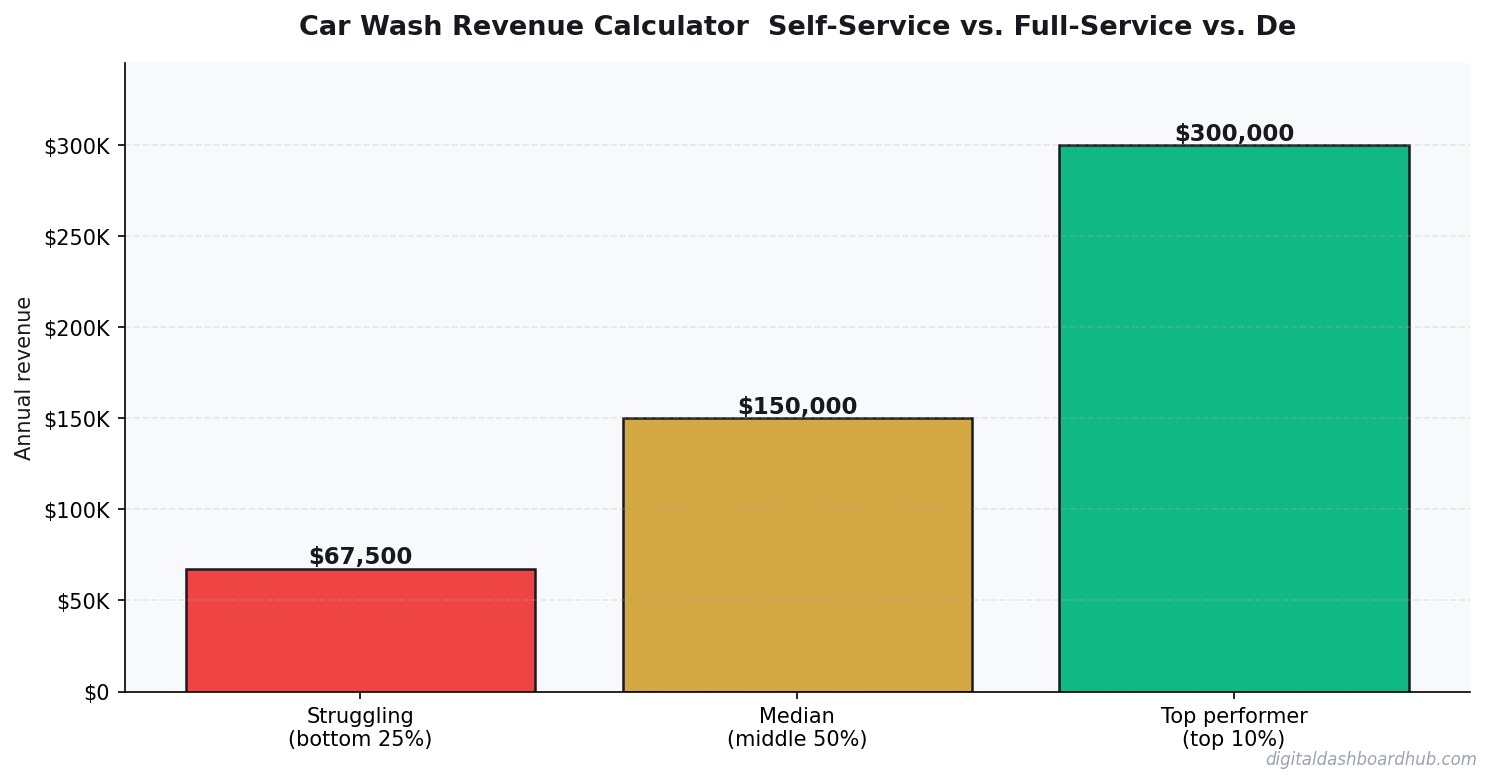
Net profit: $50K–$120K/year. The magic: you don’t need employees. Maybe a part-time attendant to collect coins and clean ($15K/year), but many owners check in twice a day and otherwise do nothing. This is as close to passive income as brick-and-mortar gets.
The downside: your revenue ceiling is low. Each bay handles about 20–30 cars/day, and you can’t charge more than $6–$8 per wash in most markets. Growth means buying more locations, not extracting more from one.
In-Bay Automatic: The Middle Ground
An automatic wash (think: touchless or soft-touch machines) bridges the gap. Higher ticket price ($10–$15 average), still minimal labor, but equipment costs more and breaks down more expensively.
A single-bay automatic doing 80 cars/day at $12 average = $350,000/year gross. Two bays: $600K–$700K. After expenses (equipment leases, water, chemicals, electricity, maintenance, rent), net margin: 30–40%.
The membership model is transforming this category. Unlimited monthly wash plans ($20–$40/month) create predictable recurring revenue. A wash with 500 members at $30/month = $180,000/year in guaranteed revenue before a single walk-in customer.
How would your location perform? Our car wash revenue calculator lets you model cars per day, average ticket, and operating costs for your specific situation.
Full-Service Tunnel: Big Revenue, Big Headaches
A conveyor tunnel wash doing 250 cars/day at $20 average generates $1.8 million/year. Sounds incredible. Now the costs:
- Labor (20–30 employees): $400K–$600K
- Chemicals and supplies: $100K–$150K
- Equipment maintenance: $50K–$80K
- Utilities: $60K–$100K
- Rent/mortgage: $80K–$150K
- Insurance: $15K–$25K
- Marketing: $20K–$40K
Net profit: $250K–$500K. Great money, but you’re managing a crew of 25+ people, dealing with HR, workers’ comp claims, and equipment that costs $10K–$50K per repair. This is a real operating business, not a side investment.
Mobile Detailing: Lowest Barrier, Highest Margins
A solo mobile detailer with a van, a water tank, and quality products can start with $10K–$20K. Doing 3–4 cars/day at $150 average = $1,800–$2,400/week = $90K–$120K/year. After supplies ($8K), fuel ($6K), insurance ($2K), and marketing ($3K), net: $70K–$100K.
The scale play: hire detailers at $15–$20/hour, charge $150–$250 per detail. Each detailer does 3 cars/day, your profit per car: $70–$120. Two detailers = $140K–$240K in additional revenue with $50K–$80K net to you.
Detailing is also the gateway drug to full-service. Many successful car wash owners started with a mobile detailing operation, built a client base, then invested profits into a physical location.
Location: The Variable That Trumps Everything
A mediocre car wash on a busy road outperforms a great car wash on a quiet street. The key metrics:
- Traffic count: Minimum 20,000 vehicles/day passing your location for a full-service wash. 10,000+ for self-service.
- Visibility: Can drivers see your sign from 500+ feet? If not, your capture rate drops dramatically.
- Easy access: Right-hand turn entry from the main road. Left turns across traffic cut volume by 30–40%.
- Demographics: Median household income $50K+ in a 3-mile radius. Wealthier neighborhoods get more washes and pay for premium packages.
- Competition: Count every car wash within 5 miles. More than 3 competitors per 50,000 population means the market is saturated.
I built a car wash location scorecard that rates potential sites on these 5 factors. Download it free with your trial.
The Membership Model: Recurring Revenue Changes Everything
Unlimited wash memberships ($25–$45/month) are the biggest trend in car washing because they solve two problems: unpredictable revenue for you, and price anxiety for customers. A customer who washes twice a month at $15 ($30/month) becomes a $30 member who washes 4 times a month. You get a guaranteed payment; they feel like they’re getting a deal.
Target: 40–60% of revenue from memberships. At that level, you know your monthly floor before any walk-ins arrive.
14-Day
Free Trial
No credit card required to start
The Quick-Start Version
- Run the numbers for your market. Open the car wash revenue calculator and model your chosen format with local pricing and traffic estimates. The difference between self-service and full-service might surprise you.
- Scout 3 locations. Drive by during peak hours (Saturday 10am–2pm) and count cars at existing washes. If they’re busy, the market can support another. If they’re empty, look elsewhere.
- Start with detailing. If you don’t have $200K+ to invest, mobile detailing lets you learn the business, build customers, and save capital for a fixed location.
Over 2,000 entrepreneurs use our business calculators to validate ideas before investing. Start your free trial and see if your car wash idea holds water.
Keep reading (related guides):
Car Wash Formats Ranked by Real Economics
Every format has a different revenue ceiling, margin profile, and startup cost. Here is the honest comparison before you sign any commercial lease.
Self-serve bay wash: lowest revenue, highest margin per dollar
A 4-bay self-serve facility grosses $90K-$180K per year depending on location. But margins run 55-70% because there’s essentially no labor. Great as a passive secondary income — bad as a primary business unless you own the real estate.
In-bay automatic: the middle option
One or two automatic bays at a gas station or standalone site. Gross $150K-$320K. Margin 35-50%. Lower customer throughput than tunnels but simpler to operate with one attendant. Equipment costs $75K-$180K per bay.
Express tunnel wash: highest revenue potential
Express tunnels with membership models gross $800K-$2.2M per location. The unit economics work because $25-$35/month unlimited memberships convert one-time customers into recurring revenue. Startup: $3M-$6M including land, building, and equipment. Not a starter business.
Mobile detailing: easiest to start, income-capped
$3K-$8K to start. One operator grosses $60K-$110K working 35-45 hours a week. Scaling past solo requires hiring, branded vehicles, and operations management. Great cash-generating start while you save for a real facility.
The membership lever
Across every format, the one variable that separates top-quartile car washes from average is membership penetration. 35-55% of customers on monthly memberships doubles effective revenue per visit and dramatically improves cash flow predictability.
Quick FAQ: Car Wash Revenue
How much land do I need for a tunnel wash?
0.75-1.5 acres minimum. You need space for the tunnel building (120-180 feet long), stacking lanes for wait traffic, vacuum pads, and entrance/exit flow. Tight sites compress throughput and directly hurt revenue.
What’s a realistic car count?
Self-serve: 100-250 washes per day per bay in season. In-bay automatic: 80-150 washes per day per bay. Express tunnel: 200-500+ washes per day depending on market. Underperforming locations usually see 50-60% of these numbers.
How much of revenue comes from memberships?
At well-run express tunnels, 55-75% of revenue is membership. Each member averages 3-5 washes per month, so retention matters enormously. Churn above 8% monthly kills unit economics.
What are the big operating expenses?
Labor (15-30% of revenue at attended facilities, near-zero at unattended). Water and chemicals (5-8%). Utilities (8-12%). Marketing (4-8%). Maintenance and equipment repair (5-10%). Debt service on financed buildouts can be another 15-25%.
Is used equipment worth buying?
For self-serve bays and in-bay automatics, yes — used equipment 5-8 years old at 40-60% of new cost, plus rebuild, can work. For tunnels, generally no — tunnel equipment is so location-specific that reused pieces rarely fit right and constant breakdowns destroy revenue.
Common Car Wash Revenue Mistakes
Even well-located car washes regularly underperform their revenue potential. These five operational mistakes are the most common culprits — and all of them are fixable without major capex.
1. Underpriced unlimited memberships
$15-$20/month memberships attract the wrong customer — the one who washes 8x/month and costs you money. Price at $25-$35/month for basic tier, $45-$55 for premium. You’ll have fewer members but much better economics per member.
2. Poor on-site signage
Most customers can’t figure out how to pay, where to drive, what package they bought. Clear signage + visible pricing + intuitive lane flow increases throughput 15-25% without any other change.
3. No membership-to-retail conversion funnel
Retail washers convert to members 8-15% of the time with zero effort — and 30-45% of the time with an active conversion process (attendant ask, offer at entry, promotional membership trial). Most washes never ask.
4. Maintenance deferral
Equipment downtime is revenue death. A single bad brush can rate-limit your throughput by 20-30%. Preventive maintenance on schedule (not on breakdown) is the single highest-ROI operational discipline in the car wash business.
5. Weak digital presence
Customers find car washes via Google Maps and Waze reviews. Low review volume or poor average ratings directly reduce car count 10-25%. Building a simple review solicitation process (text after visit) typically doubles review volume in 90 days.
255+ interactive tools for your money, time, and health.
14-day trial · Stripe checkout · Cancel anytime
Keep Reading
- How Sinking Funds Saved Me From Financial Emergencies
- The Side Hustle Tax Trap: Track Every Dollar
- Sinking Fund Savings Goal Planner
Common Questions About Car Wash Revenue Calculator: Self-Service vs. Full-Service vs. Detailing
How long does it take to see results?
Most people see meaningful progress within 30-90 days when they apply these strategies consistently. The key is tracking your numbers from day one so you have a baseline to measure against.
What’s the biggest mistake people make?
Trying to do everything at once. Pick one or two strategies from this guide, implement them fully, then layer in additional tactics. Spreading yourself thin is the fastest way to see no results from any of it.
Do I need special tools or software?
Not necessarily to start — but the right tools eliminate hours of manual work. Our free calculators and trackers at Digital Dashboard Hub are a good starting point before you invest in paid software.

Andy Gaber is the founder of Digital Dashboard Hub, a suite of 255+ interactive financial, productivity, and wellness tools. He built DDH after getting frustrated with financial apps that gave outputs without context. Follow along for tool tutorials, revenue analytics breakdowns, and honest takes on personal finance.