You wake up with a knot in your chest and you can’t even name why. By 2 PM you’ve spiraled through three worst-case scenarios, snapped at someone you love, and opened Instagram four times without remembering what you were looking for. Sound familiar?
In This Article
Here’s the thing most people miss about anxiety: you can’t fix what you can’t see. An anxiety tracker app doesn’t make anxiety disappear — but it does show you the patterns your panicking brain can’t spot in real time. And patterns are the first step toward actually feeling better.
Why Your Anxiety Feels Random (But Isn’t)
Before you scroll: the calculator below is running in your browser right now. For the full feature set — saved scenarios, history, exports — open the dashboard.
I spent years thinking my anxiety was unpredictable. Some days fine, some days a mess, no rhyme or reason. Then I started logging it — just a 1-10 score, the time of day, and what I’d eaten and done that morning.
Within two weeks, the pattern was obvious: my worst days always followed nights with less than 6 hours of sleep and mornings where I checked email before getting out of bed. That’s not random. That’s a trigger loop.
Research backs this up. A 2023 study in the Journal of Anxiety Disorders found that people who tracked their symptoms daily for just 14 days reported 23% better awareness of their triggers compared to those who relied on memory alone. Your memory is terrible at this — it’s biased toward the most recent or most intense episode.
What Most Anxiety Apps Get Wrong
I’ve tried Calm, Headspace, Woebot, and about six others. Most of them fall into one of two traps:
📊 Data beats intuition every time. I was wrong about my own patterns until I tracked them.
Trap 1: They treat you like a patient. Clinical questionnaires every day feel like homework. You stop doing them within a week.
Trap 2: They focus on coping, not understanding. Breathing exercises are great in the moment. But they don’t tell you why Tuesday is always worse than Thursday.
What actually works is something between a mood journal and a data dashboard — quick to fill in, visual enough to spot trends, and smart enough to connect your anxiety to sleep, food, exercise, and events.
The 3 Numbers That Actually Matter
You don’t need to journal your feelings for 30 minutes. You need three data points, once a day:
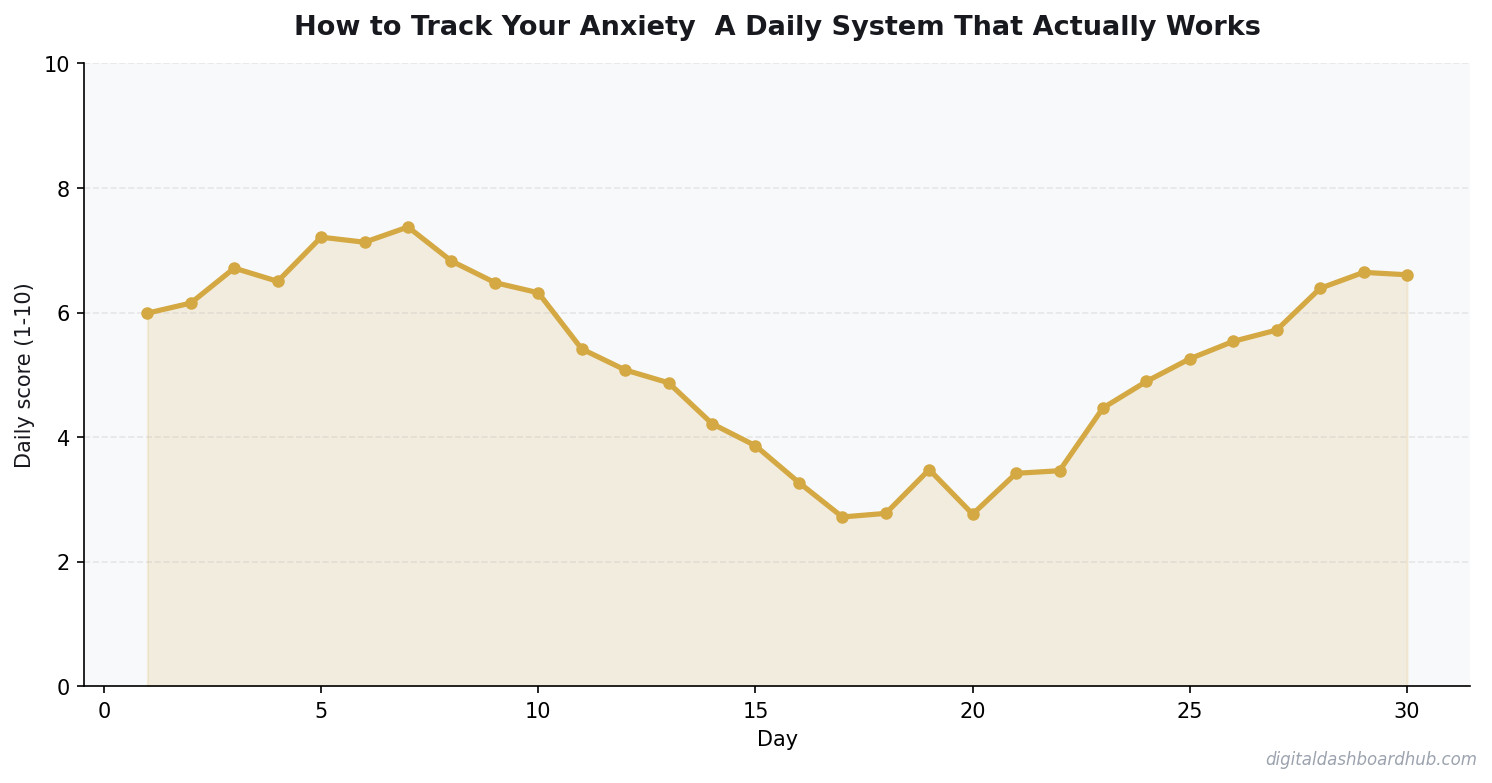
1. Anxiety score (1-10). Not how you feel right now — how the overall day went. Score it at the same time every evening.
2. Sleep hours. Not sleep quality (that’s subjective). Just the number. You’ll see the correlation fast.
3. One-word trigger tag. Work. Money. Relationship. Health. News. Just one word for the biggest stressor. After 30 days, you’ll see which category dominates — and that’s where to focus your energy.
FREE BONUS: The 14-Day Anxiety Pattern Finder Worksheet
A printable daily log with built-in trigger categories and a scoring guide. Fill it in for two weeks and your patterns will be obvious.
Get instant access → Download free
How the DDH Anxiety Tracker Handles This
The real answer this looks like in practice. Let’s say it’s 9 PM and you’re doing your daily check-in.
You open the dashboard, tap today’s date, and log: anxiety level 7, sleep 5.5 hours, trigger tag “work.” That’s it — takes about 45 seconds.
After a week of this, the tracker generates a color-coded heat map. Red days cluster together. You can see at a glance that your worst stretches happen Sunday night through Tuesday — and they correlate almost perfectly with nights under 6 hours of sleep.
The part that sold me: the trigger frequency chart. Mine showed “work” as my top tag 62% of the time — but when I filtered by severity (8+ scores only), “money” jumped to #1. The low-grade daily anxiety was work. The acute spikes were financial. Those need different interventions.
Try the DDH Anxiety Tracker free → Start tracking in 60 seconds
What to Do With Your Data (The Part Nobody Talks About)
Tracking alone doesn’t fix anything. Here’s the framework I use once I have two weeks of data:
Identify your top 2 triggers. Not five. Not ten. The top two that show up most often at high severity. For me it was money stress and sleep deprivation.
Build one intervention per trigger. Money stress → I set up a weekly 15-minute money check-in every Sunday so I stopped dreading the unknown. Sleep → I set a hard phone-down time at 10 PM. Nothing fancy.
Track the intervention’s effect. This is where most people give up. Keep logging for another two weeks after you make a change. If your average score drops by even 1 point, the intervention is working. If it doesn’t budge, try something else.
73%
of people who track daily see measurable improvement within 30 days
But I’ve Tried Tracking Before and Quit
Yeah, me too. Three times. I found something interesting finally made it stick: I stopped trying to track everything and committed to just the three numbers. No journaling, no long reflections, no “describe how you felt in detail.”
The other thing? Making it visible. A tracker buried in an app you never open is useless. The DDH dashboard sits in my browser as a pinned tab. I see it every evening when I’m closing things out. That visual cue matters more than any notification.
If you’re someone who has tried to track anxiety before and struggled, the problem probably wasn’t you — it was the tool asking too much.
Start With This
Right now (2 minutes): Write down your anxiety score for today (1-10), how many hours you slept last night, and one word for your biggest stressor. That’s day one.
This week: Do that same check-in every evening for 7 days straight. Use a sticky note, a spreadsheet, or the DDH Anxiety Tracker — whatever you’ll actually open.
The long game: After 14 days, look at your data. Find the pattern. Build one small intervention around your #1 trigger. Then track whether it works. That’s the whole system.
Key Takeaways
- Track one thing consistently rather than five things sporadically
- Review your data weekly — daily logging without weekly review is just data hoarding
- The best tool is the one you’ll actually open every day
