You’re Not “Lazy” — Your Brain Just Works Differently
Enter your own numbers in the interactive tool below and get a real-time read. The dashboard version adds saved scenarios, history, and full feature access.
You’ve spent your entire adult life building invisible systems to keep yourself functional — color-coded calendars, 47 alarms on your phone, a notes app that looks like a conspiracy theory board. And you’re still late, still forgetting appointments, still wondering why everything feels harder for you than everyone else.
In This Article
- You’re Not “Lazy” — Your Brain Just Works Differently
- The Numbers Are Damning: How Medicine Failed Women with ADHD
- ADHD Symptoms in Women That Nobody Talks About
- Why Standard ADHD Screeners Miss Women
- How to Track ADHD Symptoms That Actually Get You Diagnosed
- How the DDH ADHD Symptom Tracker Handles This
- What to Do With Your Tracking Data
- ADHD Tracking Apps vs. Dedicated Dashboards
- The Hormone Connection Most Doctors Ignore
- What Happens After Diagnosis
I learned nobody told you: ADHD in women looks nothing like the hyperactive boy bouncing off walls in a classroom. It looks like you — high-functioning on the outside, drowning on the inside. And because the diagnostic criteria were literally built around 6-year-old boys in the 1970s, millions of women are walking around undiagnosed, blaming themselves for a neurological difference they didn’t choose.
I’m going to walk you through the specific symptoms to track, why traditional screening fails women, and how to build a data trail that actually gets you the help you need.
The Numbers Are Damning: How Medicine Failed Women with ADHD
According to a 2023 study published in the Journal of Clinical Psychology, women receive an ADHD diagnosis an average of 11.8 years later than men. That’s over a decade of misdiagnosis, self-blame, and coping mechanisms that eventually collapse under enough stress.
📊 The first 14 days are the hardest. After that, tracking becomes automatic — like checking the weather.
The CDC reports that boys are diagnosed with ADHD at roughly 2.5 times the rate of girls — not because boys have it more often, but because their symptoms are disruptive in classrooms while girls’ symptoms are internal. A boy who can’t sit still gets referred. A girl who daydreams and loses things gets called “spacey” or “not living up to her potential.”
The real kicker: women with undiagnosed ADHD are 3 times more likely to develop anxiety and depression than neurotypical women. They’re not anxious because something is wrong with their emotions — they’re anxious because their brain literally processes information differently and nobody ever told them.
ADHD Symptoms in Women That Nobody Talks About
Forget the stereotype. Here are the symptoms that actually show up in adult women — the ones that get dismissed as personality quirks or anxiety:
Emotional dysregulation. You cry at commercials. You get disproportionately angry over small things. You feel rejection so deeply it physically hurts. This isn’t being “too sensitive” — it’s called Rejection Sensitive Dysphoria (RSD), and it’s one of the most common ADHD symptoms in women.
The mental load collapse. You can manage everything perfectly for weeks, and then one extra task gets added and the entire system falls apart. This boom-bust cycle is textbook ADHD executive function failure, not a character flaw.
Time blindness. You genuinely cannot feel time passing. An hour feels like 10 minutes when you’re focused, and 10 minutes feels like an hour when you’re bored. You’re not “bad at time management” — your brain literally processes temporal information differently.
Decision paralysis. You stand in front of your closet for 20 minutes unable to pick an outfit. You keep 47 browser tabs open because closing one feels like losing information forever. This is working memory overload, not indecisiveness.
Why Standard ADHD Screeners Miss Women
Most ADHD screening tools — including the widely-used ASRS — weight heavily toward hyperactive-impulsive symptoms. They ask about fidgeting, interrupting people, and difficulty waiting in line. These are predominantly male-presenting symptoms.
What they don’t ask about:
This is why self-tracking is so powerful. A screener gives a snapshot. Tracking gives a pattern. And patterns are what get you diagnosed.
How to Track ADHD Symptoms That Actually Get You Diagnosed
Here’s the system I recommend, built from talking to dozens of women who successfully navigated the diagnostic process:
Step 1: Track daily for at least 30 days. Doctors want patterns, not single bad days. You need a minimum of 30 data points to show that your symptoms are consistent, not situational.
Step 2: Rate these 5 categories daily (1-10 scale):
- Focus/attention (could you sustain attention on tasks you didn’t choose?)
- Emotional regulation (did small things trigger big reactions?)
- Task initiation (how hard was it to START things?)
- Working memory (did you forget what you were doing mid-task?)
- Time perception (were you late? Did time slip away?)
Step 3: Note your menstrual cycle phase. ADHD symptoms in women fluctuate dramatically with hormones. Many women report that symptoms worsen significantly during the luteal phase (the week before your period) when estrogen drops. This hormonal connection is one of the most under-studied aspects of women’s ADHD.
Step 4: Track sleep, caffeine, and stress alongside symptoms. A doctor will want to rule out other explanations. If you can show that your focus problems persist even when you’re well-rested and not stressed, that’s powerful evidence.
FREE BONUS: The Women’s ADHD Symptom Tracking Checklist
30-day tracking template with all 5 categories pre-built, plus hormonal cycle overlay. Print it or use it digitally.
Get instant access → DOWNLOAD FREE
How the DDH ADHD Symptom Tracker Handles This
The pattern was clear this actually looks like in practice with a dedicated tracking dashboard.
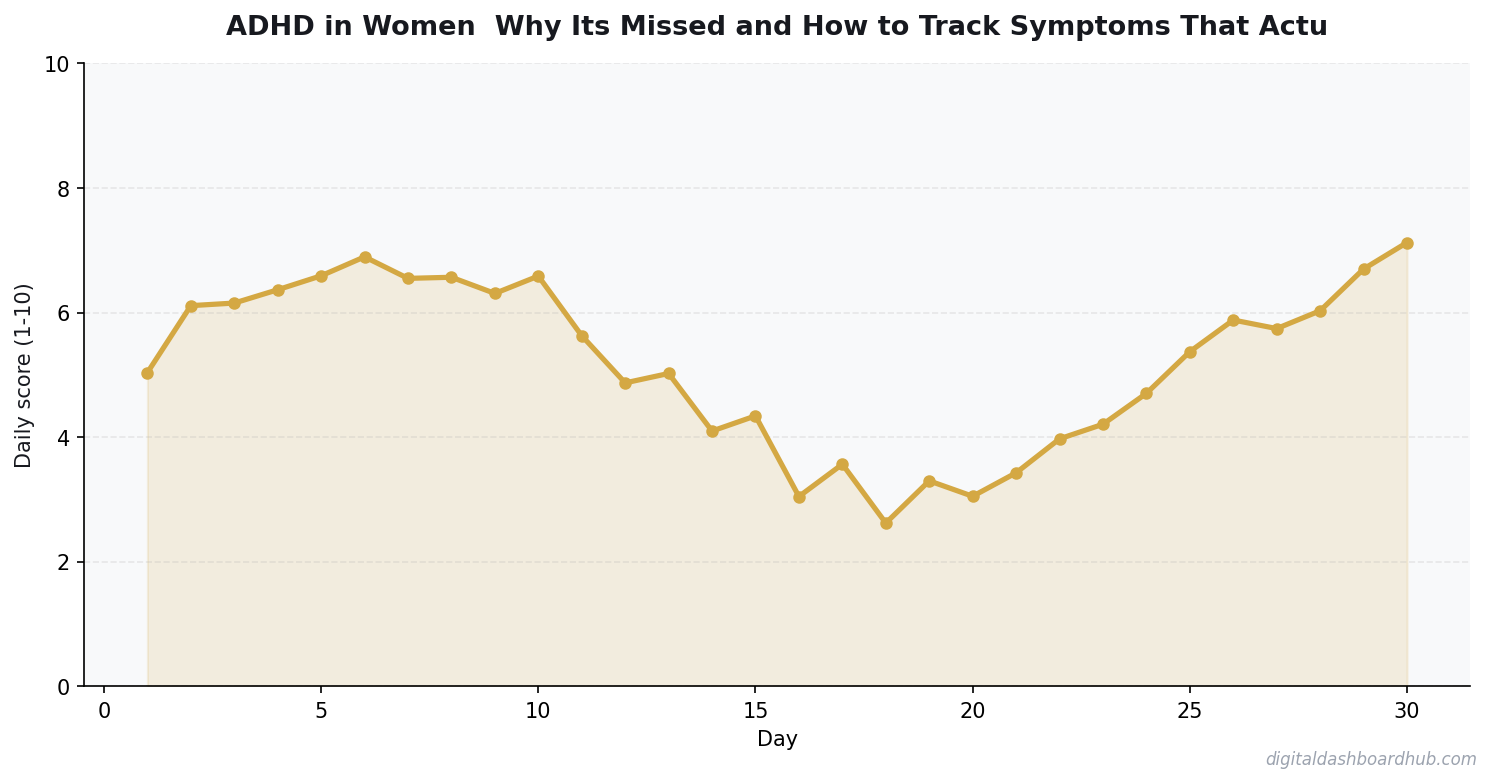
Let’s say you’ve been tracking for three weeks. You open the DDH ADHD Symptom Tracker and immediately see a color-coded heat map of your symptom severity across all five categories. Red clusters jump out at you — and they’re all in the same phase of your cycle.
The pattern view overlays your symptom data with your cycle, sleep, and caffeine intake on a single timeline. You can see at a glance that your worst focus days correlate with your luteal phase and poor sleep — but your emotional dysregulation spikes even on well-rested days, which tells you (and your doctor) that it’s not just sleep deprivation.
The export feature generates a clean summary you can hand directly to a clinician: average scores by category, worst days flagged, cycle correlation data, and a trend line showing consistency over time. One woman told me her psychiatrist said it was “the most useful patient data she’d ever received.”
The part that sold me: the pattern recognition that shows symptom clusters across weeks, not just individual bad days. That’s the difference between “I think I might have ADHD” and “Here’s 30 days of data showing consistent executive function deficits that worsen with hormonal fluctuations.”
→ Try the DDH ADHD Symptom Tracker free: app.digitaldashboardhub.com/signup
What to Do With Your Tracking Data
Once you have 30+ days of data, here’s how to use it:
Finding the right clinician matters more than the data itself. Look for a provider who specifically lists adult ADHD in women as a specialty. A general psychiatrist who last studied ADHD in medical school 20 years ago may still be operating on outdated criteria. The CHADD provider directory (chadd.org) is a good starting point.
Lead with patterns, not labels. Don’t walk in and say “I think I have ADHD.” Say “I’ve been tracking five areas of cognitive function for 30 days and I’m seeing consistent patterns I’d like your help interpreting.” This positions you as a collaborator, not a self-diagnoser, and most clinicians respond much better to it.
Bring your data in a clean format. A structured tracker export beats a handwritten journal every time. Clinicians have 15-minute appointment slots — make your data easy to read.
ADHD Tracking Apps vs. Dedicated Dashboards
You have options for tracking. Here’s an honest comparison:
Most generic health apps treat ADHD as an afterthought — they’ll let you rate your “mood” but they don’t distinguish between emotional dysregulation, focus issues, and working memory failures. Those distinctions matter for diagnosis.
The Hormone Connection Most Doctors Ignore
This is the part that makes me genuinely angry. Estrogen is a key modulator of dopamine — the exact neurotransmitter that’s dysregulated in ADHD. When estrogen drops (during your period, postpartum, and in perimenopause), ADHD symptoms can intensify dramatically.
This means millions of women experience ADHD symptom flares that perfectly correlate with their menstrual cycle, and their doctors chalk it up to PMS. A 2021 study in Frontiers in Neuroscience confirmed that estrogen fluctuations directly affect dopamine receptor sensitivity, which explains why many women with ADHD report that their medication “stops working” at certain points in their cycle.
If you’re tracking symptoms and you’re also tracking your cycle through a period tracker, overlay the two. The correlation might be the most convincing evidence you bring to your appointment.
What Happens After Diagnosis
Getting diagnosed isn’t the end — it’s the beginning of actually understanding yourself. What actually happened was most women report in the first year after diagnosis:
Month 1-3: The grief phase. You’ll mourn the years you spent thinking something was wrong with you. This is normal and valid. Many women describe a mix of relief (“I’m not broken”) and anger (“Why didn’t anyone catch this sooner?”).
Month 3-6: The experimentation phase. Whether you pursue medication, behavioral strategies, or both, this period is about figuring out what works for YOUR brain. Building systems that work with your ADHD rather than against it is the entire game.
Month 6-12: The integration phase. Your coping mechanisms get upgraded. You stop white-knuckling through life and start working with your brain’s actual wiring. The tracking data you collected pre-diagnosis becomes your baseline for measuring what’s actually helping.
21 days
average time to form a tracking habit that sticks
Put This Into Action
1. Start today (2 minutes): Rate your focus, emotional regulation, task initiation, working memory, and time perception right now on a 1-10 scale. Write it on a sticky note. You just started tracking.
2. This week: Set a daily 9 PM alarm to rate those five categories. Use a notes app, a spreadsheet, or the DDH ADHD Tracker. Consistency matters more than the tool.
3. The long game: After 30 days, review your data. Look for patterns by day of week, time of month, and sleep quality. If the patterns are consistent, book an appointment with a provider who specializes in adult ADHD in women — and bring your data.
Still here? You’re serious about this.
Join 400+ women who downloaded the ADHD Symptom Tracking Checklist this month. It takes 2 minutes per day and most women say the patterns become obvious within 2 weeks.
Get your free copy → DOWNLOAD FREE
Keep reading (related guides):
255+ interactive tools for your money, time, and health.
Full features for 14 days · Secure payment · Stop anytime
Common Mistakes That Sabotage ADHD Systems
I’ve made every one of these. Sharing them so you don’t waste the same months I did.
Trying to track everything. More data points don’t equal better results. Track the 2-3 things that actually move the needle for your specific situation. For me, that’s task completion rate, sleep quality, and med
Key Takeaways
- Track one thing consistently rather than five things sporadically
- Review your data weekly — daily logging without weekly review is just data hoarding
- The best tool is the one you’ll actually open every day
ication timing. Everything else is noise.
$0
To Get Started
Full access during your trial period
While You’re Here
- ADHD and Money: Why Your Brain Makes Budgeting Feel Impossible
- Why People with ADHD Start Everything and Finish Nothing (And 7 Systems That Help)
- ADHD Daily Routine Planner: Build Structure That Works With Your Brain
- PCOS Symptom Tracking: How Monitoring Your Body Helps You Take Back Control

Andy Gaber is the founder of Digital Dashboard Hub, a suite of 255+ interactive financial, productivity, and wellness tools. He built DDH after getting frustrated with financial apps that gave outputs without context. Follow along for tool tutorials, revenue analytics breakdowns, and honest takes on personal finance.