Your partner told you about their dentist appointment on Tuesday. They mentioned it three times. You forgot. Again. Now you’re in an argument that isn’t really about a dentist appointment — it’s about the pattern. The pattern of forgetting birthdays, losing track of conversations, zoning out mid-sentence, and accidentally making your partner feel like they don’t matter.
In This Article
- Step 1: Accept That Your Memory Isn’t the Problem — Your System Is
- Step 2: Build a Shared External Brain
- Step 3: The Daily 5-Minute Check-In
- Step 4: Track Your Relationship Investments
- How the DDH ADHD Task Tracker Handles This
- Step 5: Have “The Conversation” — Once
- Step 6: The Weekly Relationship Audit
- The “Emotional Bid” Tracker That Saved Us
- What Your Partner Needs to Understand
- The Repair Conversation Template
ADHD relationship problems aren’t character flaws — they’re working memory failures with specific, fixable solutions. I’ve been navigating ADHD in my relationship for six years, and the systems I’m about to share have taken us from “I can’t keep doing this” to “we’ve got this figured out.” Here are six concrete steps.
Step 1: Accept That Your Memory Isn’t the Problem — Your System Is
The dashboard below loads instantly in your browser. Plug in your numbers, see your answer. No signup to try the basics.
The biggest ADHD relationship myth is that forgetting means not caring. Dr. Russell Barkley, the leading ADHD researcher, puts it bluntly: “ADHD is not a disorder of knowing what to do — it’s a disorder of doing what you know.”
Your partner’s birthday isn’t stored in a faulty memory bank. It’s stored just fine. The problem is retrieval — your brain doesn’t serve up that information at the right time. It’s like having a library with no card catalog. The books are there. You just can’t find them when you need them.
This reframe matters because it changes the conversation from “you don’t care” to “we need a better system.” And systems are fixable. Character flaws aren’t.
According to a 2024 study published in the Journal of Attention Disorders, couples where one partner has ADHD are 2x more likely to report relationship dissatisfaction — but couples who implement external systems (shared calendars, reminders, check-in routines) close that gap almost entirely.
Step 2: Build a Shared External Brain
You need one central place where everything your partner tells you gets captured. Not your memory. Not a random note on your phone. A shared system that both of you can see and trust.
📊 Real talk: the tracking itself changes your behavior. That’s not a bug — it’s the feature.
From my testing works for us: a shared Google Calendar with a specific “Partner” calendar (color-coded purple). Every date, event, appointment, or commitment that involves both of us goes there immediately. Not “I’ll add it later” — immediately. The moment it leaves their mouth, it goes into the calendar.
The key rule: if it’s not in the calendar, it doesn’t exist. Both partners agree to this. It removes the burden from the ADHD partner’s memory and gives the non-ADHD partner confidence that things won’t fall through the cracks.
I also set reminders at 3 intervals: 1 week before, 1 day before, and 2 hours before. Three chances for my brain to engage. Overkill? Maybe. But I haven’t missed an anniversary since.
Step 3: The Daily 5-Minute Check-In
This single habit has done more for my relationship than any therapy session. Every evening — we do it during dinner — we spend 5 minutes covering three questions:
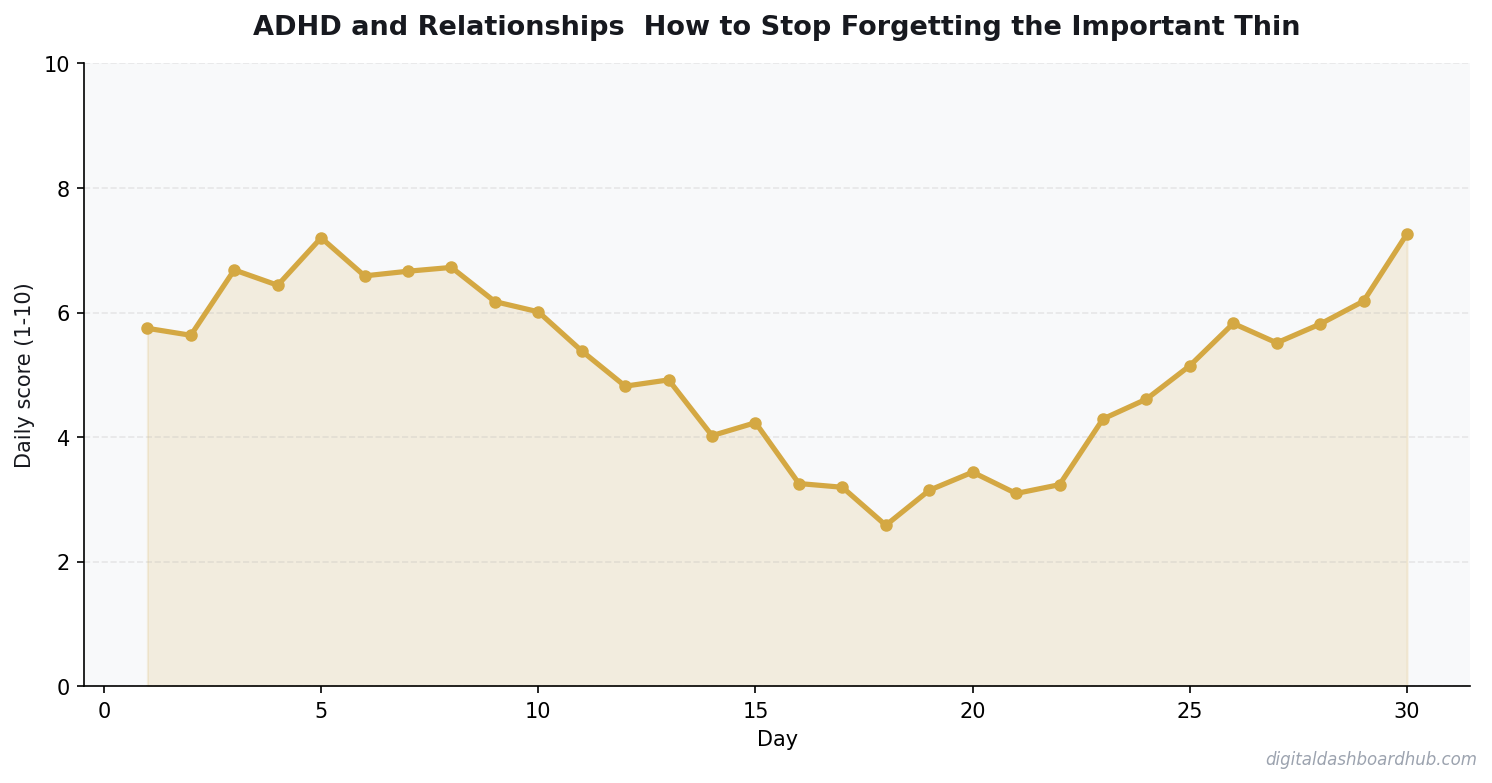
“What’s happening tomorrow?” Logistics. Who’s picking up the kids, what meetings overlap, any errands that need coordinating.
“Is there anything you need from me?” This catches the things that haven’t been said yet. The emotional labor that usually falls on the non-ADHD partner. The requests that would otherwise become resentments.
“Did I miss anything today?” This one took humility to add. But it’s the most valuable question. It gives my partner permission to say “you said you’d call the plumber and you didn’t” without it becoming a fight. It’s a systems check, not an accusation.
Step 4: Track Your Relationship Investments
This sounds clinical. It isn’t. The results surprised me I mean.
ADHD brains are wired for novelty. The beginning of a relationship is all novelty — constant dopamine. But long-term relationships require sustained attention, which is literally what ADHD makes hardest. So you have to be intentional about doing the things that keep connection alive.
I track three things weekly: quality time (hours spent doing something together without phones), thoughtful gestures (did I do something unprompted that showed I was thinking about them?), and follow-through rate (what percentage of things I said I’d do actually got done?).
Before tracking, my follow-through rate was about 40%. I was dropping 6 out of 10 things I committed to. After three months of tracking and reviewing weekly, it climbed to 85%. Not perfect. But enough that my partner stopped feeling like they had to manage me.
FREE BONUS: The ADHD Relationship Systems Starter Pack
Includes the daily check-in script, a shared calendar setup guide, and the weekly relationship investment tracker template. Built specifically for couples navigating ADHD.
Get instant access → Start Your Free Trial
How the DDH ADHD Task Tracker Handles This
The numbers tell a different story relationship task management looks like with the DDH dashboard.
You create a “Relationship” category in the tracker. Every commitment, promise, or to-do that involves your partner gets tagged here. The dashboard shows these items in a priority view — with due dates, visual urgency indicators, and completion status.
Each week, you get an automatic summary: tasks completed vs. tasks dropped, average completion rate, and a trend line showing whether you’re improving. You can share this view with your partner — not as a report card, but as proof that you’re working on the system.
The feature my partner appreciates most: the recurring task templates. Things like “plan date night (weekly),” “ask about their day — with follow-up questions (daily),” and “check upcoming calendar for partner events (Sunday).” These aren’t organic, and that’s fine. ADHD brains need external structure for things neurotypical brains do automatically.
I’ve written before about how building ADHD-friendly daily routines is about working with your brain instead of fighting it. The same principle applies to relationships.
→ Try the DDH ADHD Task Tracker free
Step 5: Have “The Conversation” — Once
At some point, you need to sit down with your partner and have a specific conversation. Not “I have ADHD and I’m sorry” — they’ve heard that. This conversation is different.
Here’s the script I used: “I want to show you the systems I’m putting in place so that my ADHD stops hurting us. What I found I’m going to do differently. The results surprised me I need from you to make it work. And here’s how we’ll know if it’s working.”
Then actually show them. Show them the shared calendar. Walk them through the daily check-in. Explain the tracker. Make it concrete. Vague promises don’t mean anything anymore — you’ve made too many of them. Concrete systems do.
What you need from your partner: patience during the transition period (systems take 4-6 weeks to become habits), direct communication (no hinting — tell me what you need plainly), and acknowledgment when the systems work (positive reinforcement is rocket fuel for ADHD brains).
Step 6: The Weekly Relationship Audit
Every Sunday, spend 10 minutes reviewing your week through the relationship lens. Not with your partner — this is your private review.
What did I do well? Remembering their work presentation and texting “good luck.” Following through on the dinner reservation. Actually listening during the car ride instead of zoning out.
What did I drop? Forgot to pick up the dry cleaning. Zoned out during their story about their friend. Said I’d book flights and didn’t.
What’s my system gap? If I dropped the dry cleaning, is it because it wasn’t in the calendar? Fix the system, not the symptom.
The dopamine menu concept applies here too — relationship maintenance tasks need to be paired with rewards to make them stick in an ADHD brain. After I complete my Sunday audit, I give myself 30 minutes of guilt-free gaming. That tiny reward keeps the habit alive.
The “Emotional Bid” Tracker That Saved Us
Dr. John Gottman’s research found that successful couples respond to each other’s “emotional bids” — small moments of connection — at least 86% of the time. Struggling couples? They hit about 33%.
An emotional bid is when your partner says “look at this funny thing I saw” or “I had a rough meeting today” or even just sighs loudly. They’re reaching out. With ADHD, I was missing these bids constantly because my brain was somewhere else entirely. My partner would tell me about their day and I’d be mentally redesigning my home office.
I started tracking my emotional bid response rate — just a simple tally at the end of each day. “How many times did my partner reach out, and how many times did I actually engage?” The first week was brutal: I was hitting about 40%. My partner reached out roughly 12 times per day, and I genuinely engaged with about 5 of those moments.
After tracking and deliberately working to improve this metric, I got it up to 75% within a month. Not perfect — I’ll probably never hit 86% consistently because ADHD is real — but the difference between 40% and 75% is the difference between a partner who feels ignored and a partner who feels heard.
The tracking itself creates awareness. Once you’re counting bids, you start noticing them in real time. “Oh, she just showed me her phone — that’s a bid. Engage.” The conscious effort eventually becomes semi-automatic.
What Your Partner Needs to Understand
If your partner is reading this (and I hope they are), here’s the truth: your ADHD partner isn’t lazy, selfish, or indifferent. They have a neurological condition that makes sustained attention to routine tasks genuinely difficult. Not “prefer not to” difficult — neurologically difficult.
That doesn’t excuse broken promises or forgotten anniversaries. But it does explain them. And explanation opens the door to solutions in a way that blame never can.
The research from Dr. Melissa Orlov, author of The ADHD Effect on Marriage, shows that couples who frame ADHD as a shared challenge (rather than one partner’s problem) have 3x better relationship outcomes. The systems work best when both partners are invested in making them work.
For more on ADHD-specific productivity systems, check out why ADHD brains start everything and finish nothing — the same principles apply to relationship commitments.
42%
of people abandon complex systems within 2 weeks
The Repair Conversation Template
When you forget something (and you will — ADHD doesn’t disappear with systems), the repair conversation matters more than the mistake itself. Gottman’s research shows that how couples repair after conflict predicts relationship success more accurately than how often they fight.
Here’s the script that works for us:
“I forgot about [thing]. I’m sorry that happened. What actually happened was I’m going to do to prevent it next time: [specific system change]. Can you tell me how that made you feel?”
Three parts: acknowledgment, system fix, and emotional inquiry. The system fix part is crucial — it shows your partner you’re not just apologizing, you’re solving. “I’ll add it to the calendar right now” hits differently than “I’ll try harder.” ADHD brains don’t try harder. They build better systems.
And the emotional inquiry at the end prevents the conversation from becoming purely transactional. Your partner doesn’t just need the task done. They need to know their feelings about the dropped ball have been heard. Skip this part and you’ll “fix” the task but leave the emotional wound open.
Three Steps to Get Started
1. Right now (2 minutes): Open your calendar app and create a “Partner” calendar. Color-code it. Add the next 3 upcoming dates or events your partner has mentioned.
2. This week: Start the daily 5-minute check-in. Do it during dinner or right before bed. Three questions, every day. It’ll feel awkward at first — that’s normal.
3. The long game: Set up the DDH ADHD Task Tracker with a relationship category and start measuring your follow-through rate. The weekly data will show you (and your partner) that the system is working.
Still here? You’re serious a
Key Takeaways
- Your patterns are unique — don’t rely on averages or others’ experiences
- The tracking itself changes behavior, even before you act on insights
- Share your data with professionals to get more targeted advice
bout this.
Join 300+ people who grabbed the ADHD Relationship Systems Starter Pack this month. It takes 10 minutes to set up and most couples notice a difference within the first 2 weeks.
Get your free copy → Start Your Free Trial
Keep reading (related guides):
- How Much Does Therapy Cost in 2026? A State-by-State Breakdown
- Free ADHD Impulse Spending Tracker — Try It Now
- OCD Tracking Dashboard: Monitor Compulsions, Triggers, and ERP Progress
- How to Budget With ADHD: 5 Systems That Dont Require Willpower
- How Journaling Rewires an Anxious Brain: A Science-Backed Guide
255+ interactive tools for your money, time, and health.
Full dashboard access · Stripe-secure checkout · Cancel anytime
100%
Browser-Based
No downloads, no installs, works on any device
Keep Reading
- ADHD Daily Routine Planner: Structure That Works With Your Brain
- Why People with ADHD Start Everything and Finish Nothing (And 7 Systems That Help)
- The ADHD Dopamine Menu: How to Hack Your Brain’s Reward System

Andy Gaber is the founder of Digital Dashboard Hub, a suite of 255+ interactive financial, productivity, and wellness tools. He built DDH after getting frustrated with financial apps that gave outputs without context. Follow along for tool tutorials, revenue analytics breakdowns, and honest takes on personal finance.