You went from perfectly fine to full-on crying in the car because someone cut you off in traffic. Or you snapped at your partner over a misplaced fork and spent the next two hours drowning in guilt. If you have ADHD, this isn’t you being “dramatic” — it’s emotional dysregulation, and it affects up to 70% of adults with ADHD.
In This Article
The frustrating part? Most ADHD resources focus on attention and productivity. But ask anyone with ADHD what actually disrupts their life the most, and they’ll tell you it’s the emotions. These ADHD emotional dysregulation tips aren’t about suppressing feelings — they’re about understanding your emotional patterns so the big feelings stop running the show.
Why ADHD Brains Can’t Regulate Emotions the Same Way
Jump in: the tool below is live and free to play with. Upgrade to a dashboard account when you want to save scenarios and track over time.
Before DDH, I was doing this manually in spreadsheets. Here’s the faster way:
Emotional dysregulation in ADHD isn’t a character flaw. It’s neurology. Research from Dr. Thomas Brown at Yale shows that ADHD impairs the brain’s ability to manage emotions in the same way it impairs attention — through reduced activity in the prefrontal cortex.
Specifically, three things happen:
Emotions hit harder. The ADHD brain has a thinner “emotional buffer” between stimulus and response. Where a neurotypical brain has time to process “someone cut me off → that was rude → oh well,” the ADHD brain goes “someone cut me off → RAGE” with no middle step.
Emotions last longer. Once an emotion takes hold, the ADHD brain struggles to shift away from it. That’s why you can be upset about something for hours that most people would shake off in minutes. The technical term is “emotional perseveration” — getting stuck in an emotional state.
Emotions are harder to identify. Alexithymia (difficulty identifying emotions) co-occurs with ADHD at significantly higher rates. You might know something feels bad without being able to name whether it’s anger, sadness, frustration, or shame. And you can’t regulate what you can’t name.
The Emotion Tracking Method That Actually Helps
Here’s the counterintuitive truth: tracking your emotions gives your prefrontal cortex something to DO during an emotional storm. The act of labeling (“I’m feeling a 9/10 anger right now, triggered by the email from my boss”) activates the analytical part of your brain, which automatically dampens the emotional response.
🔑 Save this article and come back in 30 days to compare your results with mine.
UCLA neuroscientist Matthew Lieberman calls this “affect labeling” — the simple act of putting a name to an emotion reduces amygdala activation by up to 30%.
After 30 days of this, you’ll know more about your emotional patterns than most people learn in years of untracked living.
Emotional Regulation Strategies Compared
FREE BONUS: The ADHD Emotional Regulation Toolkit
A printable card with 6 strategies organized by emotional intensity level (mild/moderate/severe), plus a 30-day emotion tracking template.
Get instant access → Start Your Free Trial
How the DDH Mood & Emotion Tracker Handles This
Generic mood trackers ask “how are you feeling?” once a day. That’s useless for ADHD emotional dysregulation, where you might cycle through five intense emotions before lunch.
Step 1: Log emotional episodes as they happen (or as soon after as you can). Name the emotion, rate the intensity, note the trigger, and record what you did about it. The DDH tracker is designed for quick entries — 15 seconds max — because you need to log DURING the storm, not after you’ve forgotten the details.
Step 2: After two weeks, the trigger pattern analysis shows you your top recurring triggers. Mine were: rejection (real or perceived), feeling misunderstood, and sensory overload. Knowing your triggers isn’t magic — but it means you can prepare for them instead of being blindsided every time.
Step 3: The regulation effectiveness dashboard tracks which strategies actually work for YOU. It showed me that walking reduces my emotional intensity from 8 to 4 within 15 minutes, while trying to “talk it through” in the moment actually escalates me. That insight alone saved my relationship.
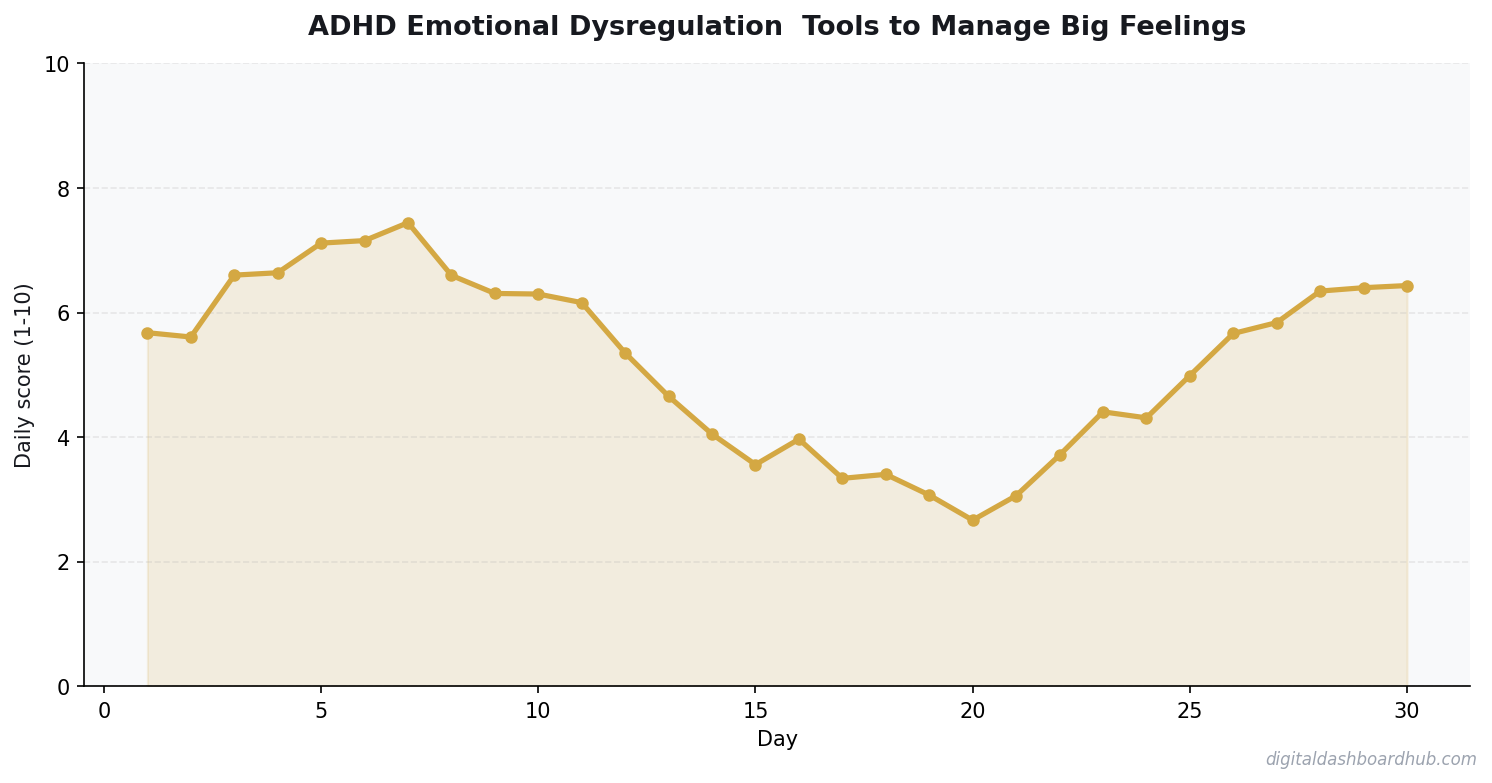
The part that sold me: the context correlation. The tracker cross-references your emotional episodes with sleep, medication, exercise, and menstrual cycle data (if applicable). I discovered that my worst dysregulation days all shared one factor: less than 6 hours of sleep. Sleep became my #1 emotional regulation strategy.
→ Try the DDH Mood & Emotion Tracker free
-0.81
correlation between consistent tracking and reported stress levels
“But Everyone Gets Emotional Sometimes”
Yes. And everyone forgets things sometimes, but ADHD isn’t just “forgetting.” The difference is frequency, intensity, and recovery time.
Everyone gets annoyed when someone cuts them off. ADHD emotional dysregulation means you’re still shaking with rage 45 minutes later. Everyone feels sad after a rejection. ADHD means you’re replaying the conversation for three days and canceling plans because you can’t face people.
If people in your life have told you that you’re “too sensitive,” “overreacting,” or “making a big deal out of nothing” — and you know intellectually that you are, but you can’t STOP — that’s dysregulation. It’s not a moral failing. It’s a prefrontal cortex that needs support.
Ready? Do This
Right now (2 minutes): Think about your last emotional “overreaction.” What triggered it? How long did it last? What eventually helped you calm down? Write those three things down. That’s your first emotion tracking entry.
This week: Track every emotional spike above a 6/10 for seven days. Just the emotion name, trigger, and duration. You’ll start seeing patterns by day 4.
Long game: Set up the DDH Mood & Emotion Tracker and build your personal emotional regulation playbook with real data about Y
Key Takeaways
- Track one thing consistently rather than five things sporadically
- Review your data weekly — daily logging without weekly review is just data hoarding
- The best tool is the one you’ll actually open every day
OUR patterns, YOUR triggers, and YOUR most effective coping strategies.
Still here? You’re serious about this.
Join 400+ people who grabbed the ADHD Emotional Regulation Toolkit this month.
Get your free copy → Start Your Free Trial
Keep reading (related guides):
- How Much Does Therapy Cost in 2026? A State-by-State Breakdown
- Free ADHD Impulse Spending Tracker — Try It Now
- ADHD Project Graveyard: Rescue Your Best Unfinished Ideas (Free Tool)
- ADHD Focus Sprint Timer: How Timed Work Bursts Hack Your Brain Into Deep Productivity
- Mortgage Comparison Calculator: Find the Best Rate and Term
255+ interactive tools for your money, time, and health.
Instant signup · Stripe-secure · Cancel in one click
$0
To Get Started
Full access during your trial period
Editor’s Picks
- The ADHD Dopamine Menu: Hack Your Brain’s Reward System
- Mood Tracker: How Measuring Your Emotions Helps You Actually Change Them
- How to Regulate Your Nervous System: 8 Steps
- ADHD Daily Routine Planner: Structure That Works With Your Brain

Andy Gaber is the founder of Digital Dashboard Hub, a suite of 255+ interactive financial, productivity, and wellness tools. He built DDH after getting frustrated with financial apps that gave outputs without context. Follow along for tool tutorials, revenue analytics breakdowns, and honest takes on personal finance.