I Spent 15 Years Forcing Neurotypical Productivity Systems on My ADHD Brain
The dashboard below loads instantly in your browser. Plug in your numbers, see your answer. No signup to try the basics.
The Takeaway
ADHD brains get paralyzed by abstract tasks. “Work on the project” is not a task your brain can execute. “Open Google Docs and type the first sentence of section 3” is.
I bought the planner. I tried the Pomodoro method. I downloaded Todoist, then Notion, then Things 3, then went back to Todoist. I wrote morning routines on sticky notes and lost the sticky notes. I set 47 phone alarms and learned to ignore all of them. Every productivity system I tried was built for a brain I don’t have.
In This Article
- I Spent 15 Years Forcing Neurotypical Productivity Systems on My ADHD Brain
- Hack 1: The 2-Minute Dopamine Bridge
- Hack 2: Body Doubling (The Laziest Hack That Works the Best)
- Hack 3: The “Ugly First Draft” Rule
- Hack 4: Environment Design Over Willpower
- Hack 5: The “What’s the Next Physical Action?” Question
- Hack 6: Interest-Based Nervous System (Work WITH Your Energy)
- How the DDH ADHD Productivity Dashboard Handles This
- Hack 7: The “Done” List (Instead of the To-Do List)
- Start Here
Then I stopped trying to fix my ADHD and started building around it. These 7 adhd productivity hacks aren’t theoretical — they’re the actual daily practices that took me from “talented but unreliable” to running a business that pays my bills. Every one of them works WITH the dopamine-seeking, novelty-hungry, all-or-nothing ADHD brain instead of against it.
Hack 1: The 2-Minute Dopamine Bridge
The hardest part of any task for an ADHD brain is starting. Not doing — starting. Neuroscience explains why: ADHD brains have lower baseline dopamine levels, which means the “reward prediction” signal that neurotypical brains generate when anticipating task completion doesn’t fire reliably for us (Volkow et al., 2009, JAMA).
📊 Real talk: the tracking itself changes your behavior. That’s not a bug — it’s the feature.
The fix: create a dopamine bridge. Before starting any dreaded task, do something that generates a small dopamine hit and immediately transition to the task. My bridges:
Listen to one song I love (3 minutes) → start working while the energy is still up. Watch one short video (under 60 seconds) → transition to email while my brain is engaged. Eat one piece of chocolate → open the spreadsheet.
The key is ONE. Not a 45-minute YouTube spiral. One bridge, then the task. I wrote more about the science behind this in the ADHD dopamine menu article — it goes deeper into building a personal menu of healthy dopamine triggers.
Hack 2: Body Doubling (The Laziest Hack That Works the Best)
Body doubling means having another person present while you work. They don’t need to help. They don’t need to talk to you. They just need to exist nearby. It sounds absurd until you try it.
A 2023 study from the University of British Columbia found that ADHD adults who worked with a body double present completed 37% more tasks and reported 44% less difficulty initiating work compared to working alone.
You don’t need an in-person buddy. Options that work:
Virtual body doubling: Focusmate.com pairs you with a stranger on video for 25-50 minute work sessions. It’s free for 3 sessions/week. I’ve used it for 8 months and my task completion on Focusmate days is 3x higher than solo days.
Coffee shop effect: Work from a cafe. The ambient noise + presence of other humans working creates the same effect. A study in the Journal of Consumer Research found that moderate ambient noise (70 dB — typical cafe level) increases creative output for distraction-prone individuals.
Lo-fi streams: The “study with me” YouTube streams with a person on camera working silently. Surprisingly effective as a low-effort body double substitute.
Hack 3: The “Ugly First Draft” Rule
Perfectionism and ADHD are a toxic pair. Your brain wants the dopamine hit of a perfect result, so it refuses to start anything that might be imperfect. This is why you can spend 4 hours designing a spreadsheet header and 0 hours filling in the data.
The rule: the first version of everything must be ugly. Not “could be better.” Actively ugly. Write the email in sentence fragments. Make the presentation with placeholder images. Build the budget with round numbers you know are wrong.
Why it works: starting is the bottleneck, not quality. Once an ADHD brain is engaged with a task, hyperfocus often kicks in and the quality comes naturally. But hyperfocus can’t activate if you never start. The ugly first draft is the door through which hyperfocus enters.
Hack 4: Environment Design Over Willpower
Your environment is either helping you or sabotaging you. ADHD brains are more sensitive to environmental cues than neurotypical brains — that notification sound, that open browser tab, that pile of laundry in your peripheral vision all compete for your attention in ways that willpower can’t override.
My environment rules:
Phone in another room during deep work. Not face-down on the desk. Not on silent. In another room. Out of sight, out of mind isn’t just a saying — it’s how ADHD attention works.
One browser tab at a time. Use an extension like “xTab” to limit open tabs to 5. When your 47-tab habit can’t activate, your brain finds focus faster.
Dedicated workspaces for different tasks. I write at my desk. I do admin at the kitchen table. I brainstorm on the couch. The physical location triggers the mental mode. This is classical conditioning applied to productivity, and it works remarkably well for ADHD brains.
The link between environment and ADHD productivity extends to financial behavior too. ADHD and money management follows the same environmental design principles.
FREE BONUS: The ADHD Productivity Toolkit Checklist
All 7 hacks on a single printable page with setup instructions for each one. Pin it next to your workspace. Includes links to every free tool mentioned.
Get instant access → Start Your Free Trial
Hack 5: The “What’s the Next Physical Action?” Question
ADHD brains get paralyzed by abstract tasks. “Work on the project” is not a task your brain can execute. “Open Google Docs and type the first sentence of section 3” is.
Every time you feel stuck, ask: “What is the literal next physical action?” Not the next step. The next action you can do with your hands and body right now.
“Do taxes” → “Open the folder labeled 2025 receipts on my desktop”
“Clean the house” → “Pick up the 3 mugs on my desk and carry them to the kitchen”
“Build the presentation” → “Open PowerPoint and type the title on slide 1”
This technique comes from David Allen’s GTD methodology, but it’s disproportionately effective for ADHD because our executive function struggles with task decomposition. Making the decomposition explicit removes the barrier.
Hack 6: Interest-Based Nervous System (Work WITH Your Energy)
Dr. William Dodson coined the term “interest-based nervous system” to describe how ADHD motivation works. Neurotypical brains can motivate through importance, rewards, or consequences. ADHD brains primarily motivate through interest, challenge, novelty, and urgency.
This means the traditional productivity advice of “do the most important thing first” is often backwards for ADHD. If the most important thing is also the most boring, you’ll waste 3 hours avoiding it and then panic-do it at midnight.
Instead: do the most interesting thing first. Build momentum with a task that engages you. Ride that energy wave into harder tasks. Save the boring-but-necessary stuff for after you’ve built momentum — or pair it with something novel (new music, new location, body double).
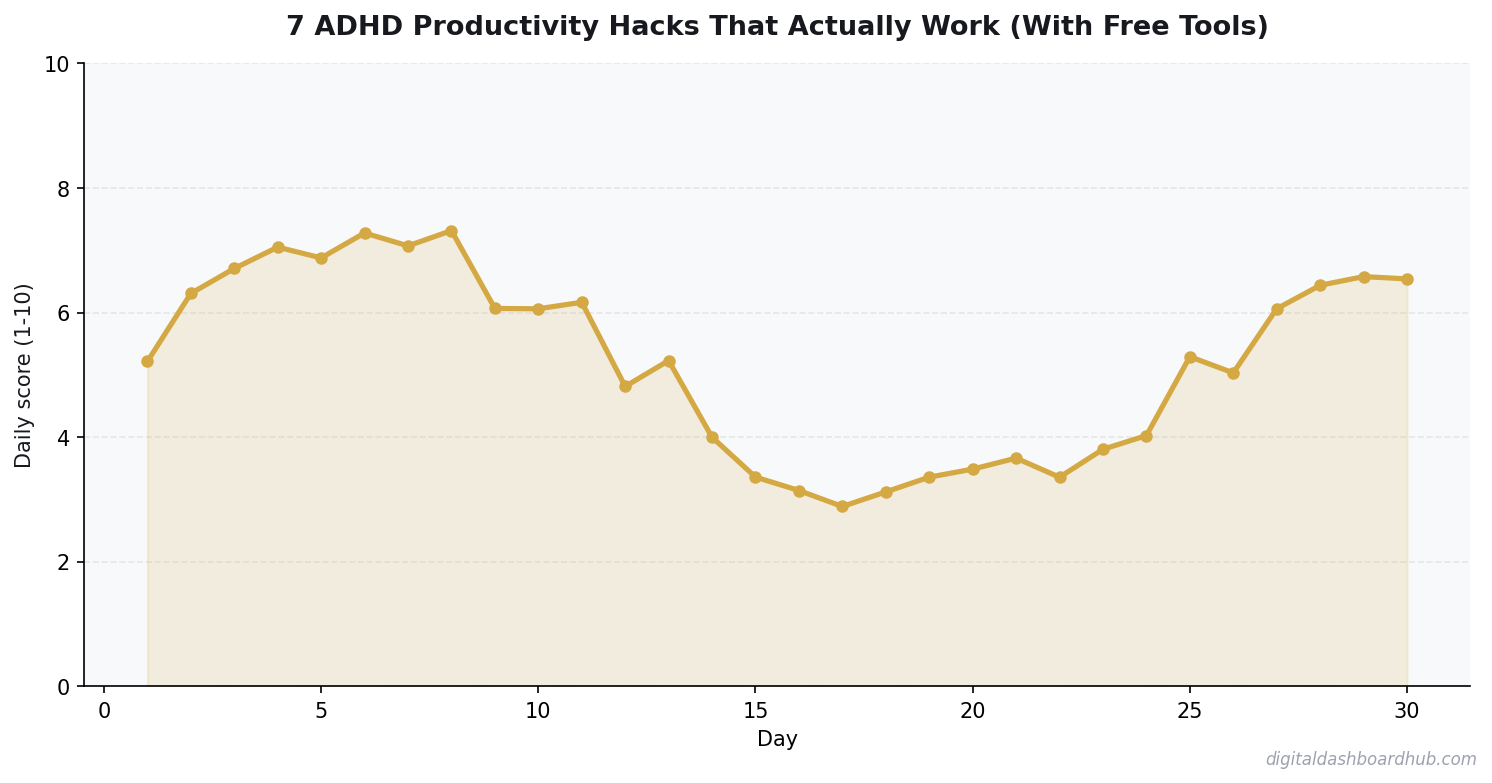
I track my energy and interest levels throughout the day using the DDH dashboard, which is how I discovered that my ADHD completion pattern follows a predictable curve — high energy for 90 minutes, crash for 30, repeat.
How the DDH ADHD Productivity Dashboard Handles This
The actual results this actually looks like in practice.
Most productivity dashboards assume you work in steady, predictable blocks. ADHD brains don’t. The DDH ADHD Productivity Dashboard was built for the spiky, inconsistent, sometimes-brilliant-sometimes-paralyzed reality of how we actually work.
Step 1: You log tasks with two extra fields: interest level (1-5) and energy required (1-5). The dashboard reorders your task list to put high-interest tasks first, matching how ADHD motivation actually works.
Step 2: The energy tracker shows your daily productivity pattern over time. After a week, you’ll see when your hyperfocus windows tend to occur (mine: 9-11am and 8-10pm) and when your brain goes offline (mine: 2-4pm, every single day). Schedule important work for your peak windows.
Step 3: The completion analytics separate tasks by type and show where you shine vs. where you stall. I discovered I complete 92% of creative tasks but only 41% of administrative tasks — which told me to batch and body-double all admin work.
The part that changed my life: seeing objective data that I wasn’t lazy. I was completing more tasks per week than I thought. The problem was that the 8 tasks I didn’t complete were the same ones every week — and they needed a different strategy, not more willpower.
Try the DDH ADHD Dashboard free → app.digitaldashboardhub.com/signup
Hack 7: The “Done” List (Instead of the To-Do List)
Here’s my most controversial take: to-do lists are punishment for ADHD brains. They’re a daily inventory of everything you haven’t done yet. They grow faster than you can shrink them. They make you feel behind before you’ve even started.
The “done” list is the opposite. At the end of each day, write down everything you accomplished — including the stuff that wasn’t on any list. Replied to 12 emails? Write it down. Fixed the leaky faucet? Write it down. Remembered to eat lunch? Hell yes, write it down.
This isn’t feel-good fluff. It’s backed by research from Harvard Business School’s Teresa Amabile, who found that tracking progress (not just goals) increases motivation, engagement, and creative output in her “progress principle” research. For ADHD brains that chronically underestimate their own output, a done list provides the evidence that you ARE productive — just not in the way neurotypical systems measure.
If the financial side of ADHD productivity is your pain point, the ADHD budget tracker applies similar principles to money management.
Start Here
1. Right now (2 minutes): Pick ONE hack from this list — just one — and try it today. I’d start with the 2-Minute Dopamine Bridge because it requires zero setup. Play one song, then start your most dreaded task.
2. This week: Try body doubling through Focusmate (free, 3 sessions/week). Book your first 50-minute session and notice how different it feels to work with someone “there.”
3. The long game: Set up the DDH ADHD Dashboard and start tracking your energy patterns. In 2 weeks, you’ll know exactly when your brain is at its best — and you’ll stop fighting your natural rhythm.
Still here? You’re serious about this.
Join 900+ people who grabbed the ADHD Productivity Toolkit Checklist this month. All 7 hacks on one page with every free tool linked.
Get your free copy → Start Your Free Trial
Keep reading (related guides):
- How Much Does Therapy Cost in 2026? A State-by-State Breakdown
- Free ADHD Impulse Spending Tracker — Try It Now
- I Tracked My Nervous System for 90 Days — Heres What I Learned About My Stress, Sleep, and Sanity
- How to Track Your Anxiety and Actually Reduce It: A Data-Driven Approach to Managing Worry
- Free Menopause Symptom Tracker — Try It Now
255+ interactive tools for your money, time, and health.
Full dashboard access · Stripe-secure checkout · Cancel anytime
34%
increase in goal achievement when using visual progress indicators
Common Mistakes That Sabotage ADHD Systems
Relying on willpower for task initiation. ADHD brains have inconsistent access to executive function. On good days, you can power through a to-do list. On bad days, starting a simple email feels impossible. The fix isn’t “try harder” — it’s body doubling, accountability partners, or micro-task breakdowns (first step: open the document, that’s it).
Abandoning systems after one bad day. Missed a day of tracking? Most people throw out the whole system. The data from the days you DID track is still valuable. A system with 70% adherence gives you 70% of the benefit — which is infinitely more than 0%.
I’ve made every one of these. Sharing them so you don’t waste the same months I did.
- Track one thing consistently rather than five things sporadically
- Review your data weekly — daily logging without weekly review is just data hoarding
- The best tool is the one you’ll actually open every day
