
Six Trade Businesses, Six Different Revenue Profiles. Pick Wrong and You’re Capped at $80K. Pick Right and $300K Is Realistic.
Enter your own numbers in the interactive tool below and get a real-time read. The dashboard version adds saved scenarios, history, and full feature access.
About this article: I’m Andy, founder of Digital Dashboard Hub. I built DDH’s 255 free interactive tools to solve the specific financial, productivity, and wellness tracking gaps I kept seeing — starting with the problem this article covers. The free tool below is available without signup and works instantly. Try it and see your numbers in real time.
Before DDH, I was doing this manually in spreadsheets. Here’s the faster way:
Bottom Line
In This Article
- Six Trade Businesses, Six Different Revenue Profiles. Pick Wrong and You’re Capped at $80K. Pick Right and $300K Is Realistic.
- 6 Trades Compared: The Full Picture
- Electrician: Best Overall for Scaling
- HVAC: Highest Revenue Ceiling
- Roofing: Highest Solo Revenue, Weather Dependent
- Plumbing: Highest Emergency Revenue
- Welding: Specialized Skill, Harder to Scale
- Concrete: High Revenue, High Capital
- The Decision Matrix
Run the numbers with your own data.
Every trade business requires physical skill and hard work. But the financial outcomes are wildly different. An electrician and a concrete contractor both work with their hands, but one has a clear path to $300,000+ as a business owner while the other faces equipment costs that eat margins alive. The startup investment, revenue ceiling, and scaling math vary so much across trades that choosing the right one is the most important financial decision you’ll make.
Why This Matters
Most people overestimate short-term results and underestimate long-term compounding.
This calculator compares electrician, plumber, HVAC, roofing, welding, and concrete businesses across every metric that matters — because the “best” trade depends on your budget, your market, and whether you want to work solo forever or build a company.
6 Trades Compared: The Full Picture
Electrician: Best Overall for Scaling
Electrical work has the lowest equipment costs, highest demand, and cleanest scaling path of any trade. A licensed electrician with a van and basic tools can start with $5,000-$10,000. Service calls bill at $85-$150/hour. Panel upgrades run $2,000-$4,000. EV charger installations (growing fast in 2026) bill $1,500-$3,000.
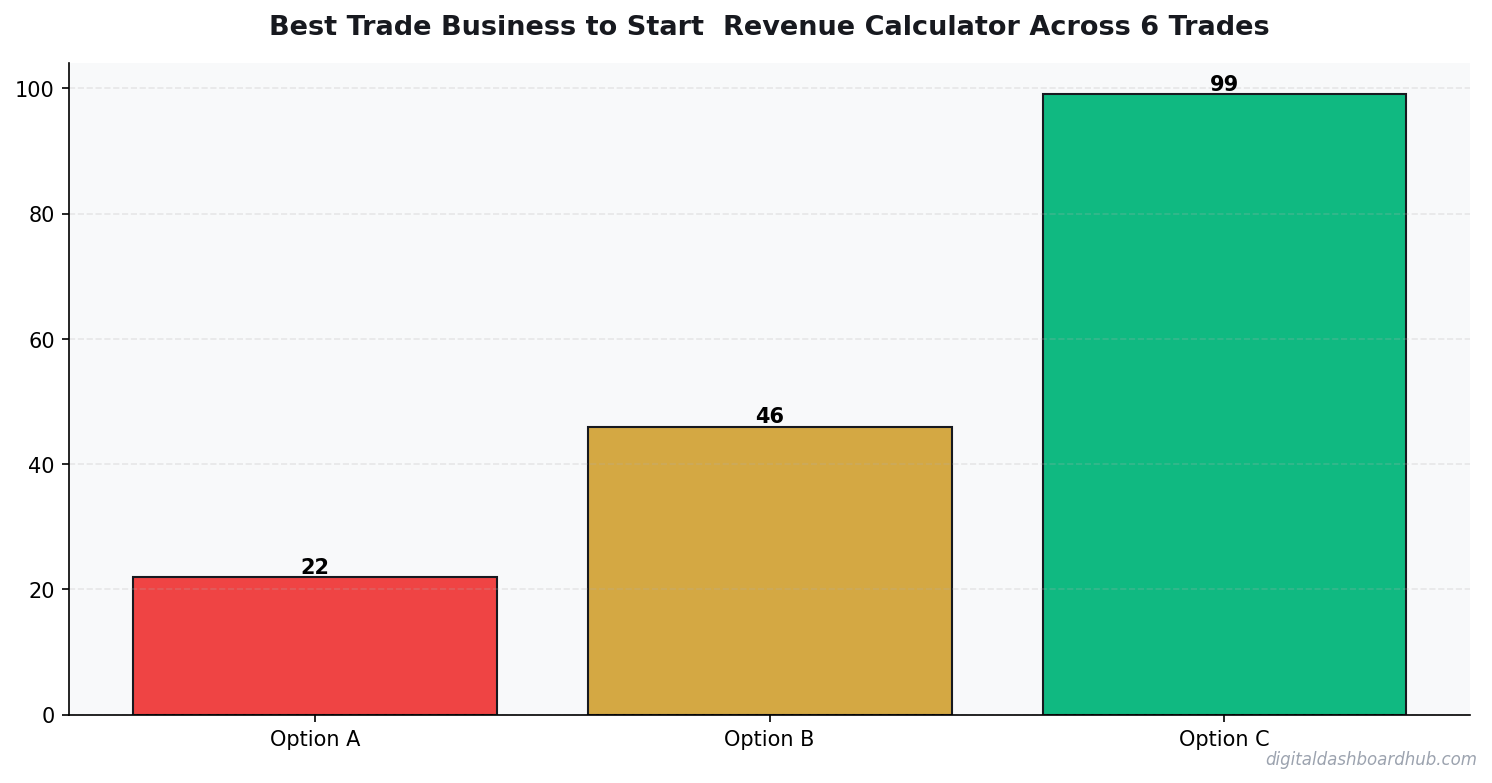
The scaling math is clean because electrical work requires minimal equipment per crew — a van, hand tools, a meter, and wire. Adding a crew costs $40,000-$50,000/year in wages plus $500/month for a van. Each crew generates $200,000-$350,000 in annual revenue. At 25-30% margins, each additional crew adds $50,000-$90,000 in owner profit.
The licensing barrier is your competitive moat. Electrical licensing requires 4-5 years of apprenticeship plus exams. That keeps supply limited and rates high. In markets with strong licensing enforcement, competition stays manageable.
HVAC: Highest Revenue Ceiling
HVAC has the highest revenue ceiling of any trade business, driven by two things: expensive equipment (a residential AC replacement runs $5,000-$12,000) and recurring service contracts. A single HVAC company with 1,000 service contract customers at $200/year has $200,000 in guaranteed annual revenue before any installation or repair work.
Startup costs are higher than electrical or plumbing — $10,000-$30,000 for specialized tools, refrigerant handling equipment, and EPA certification. But the service contract model creates predictable recurring revenue that no other trade matches.
An HVAC company with 5 trucks can gross $1.5-$2.5 million annually. At 20-25% net margins, the owner clears $300,000-$500,000. The best HVAC companies are worth 1-2x annual revenue when sold, making this the best trade for building equity.
Roofing: Highest Solo Revenue, Weather Dependent
Roofing offers the highest solo contractor income because job sizes are large. A residential roof replacement runs $8,000-$20,000. A solo roofer with a helper crew (subcontracted labor) can complete 2-3 roofs per week in season, grossing $20,000-$50,000/week.
The catch: seasonality. In northern climates, roofing season is April through November. Four months of minimal work means you need to earn 12 months of income in 8 months. The calculator models this seasonal adjustment to show true annual revenue.
Startup costs are moderate — $15,000-$40,000 for a dump trailer, safety equipment, nail guns, and initial material for your first few jobs. Insurance is expensive ($5,000-$15,000/year) because roofing has the highest injury rate in the trades.
Compare all 6 trades with your numbers: The Trade Business Revenue Calculator lets you input your region, startup budget, and growth timeline. It projects solo income and business owner income for each trade. Start your free trial and find the trade that fits your financial goals.
Plumbing: Highest Emergency Revenue
Plumbing’s unique advantage is emergency pricing. A burst pipe at 2 AM? That’s a $300-$500 service call before any work begins. Emergency plumbing rates run $150-$250/hour, and the calls are steady year-round. No seasonal dip.
The revenue profile mirrors electrical closely: low startup costs, clean scaling, strong licensing moat. Where plumbing edges ahead is in urgency — electrical problems can wait until Monday; a flooded basement cannot. That urgency translates to higher willingness to pay and lower price sensitivity.
Welding: Specialized Skill, Harder to Scale
Welding pays well as a solo operator — mobile welders charge $75-$150/hour for structural, pipe, or specialty welding. Underwater welders earn $50,000-$80,000 for short-season work. But scaling a welding business is harder because each job requires your specific skill. Training a welder to your quality standard takes 6-12 months of supervision.
The best welding businesses combine fabrication (custom metalwork, gates, railings) with field welding (structural repairs, pipe work). A shop with 3-4 welders can gross $500,000-$800,000 annually. Net margins are lower than electrical or plumbing (15-22%) because of material costs and equipment depreciation.
Concrete: High Revenue, High Capital
Concrete work has the highest startup costs in the trades. A concrete pump costs $30,000-$100,000. A finishing crew needs forms, vibrators, power trowels, and a truck. Even a basic flatwork operation needs $20,000-$40,000 to start.
But the revenue per job is substantial. A residential driveway runs $4,000-$8,000. A commercial slab $15,000-$50,000. The work is physically brutal and weather-dependent, but profitable concrete contractors with good reputations stay booked solid because the barrier to entry keeps competition lower than other trades.
100%
Browser-Based
No downloads, no installs, works on any device
The Decision Matrix
Lowest startup cost: Electrician or plumber ($5,000-$15,000)
Fastest to solo income: Roofing (large job sizes) or plumbing (emergency demand)
Highest business owner income: HVAC ($300K-$500K+) or roofing ($250K-$600K)
Best recurring revenue: HVAC (service contracts) and plumbing (maintenance plans)
Most recession-proof: Plumbing and electrical (people fix broken things regardless of economy)
Your Next Move
- Run the calculator: Start your free trial and compare all 6 trades with the Revenue Calculator. Input your region and startup budget to see realistic projections.
- Talk to owners: Before committing to a 4-year apprenticeship, shadow a business owner in your top 2 trades. See the reality of the daily work, not just the income numbers.
- Plan the business, not just the skill: Every trade pays a decent living as an employee. The wealth is in owning the business. Start thinking about your first hire and first truck from day one.
Tradespeople and aspiring business owners have used this calculator to choose their path. Try it free and see which trade business delivers the best return for your time and investment.
Keep reading (related guides):
- Auto Mechanic Revenue: What Owners Make vs. What Youd Expect (2026)
- Boutique Revenue Calculator
- Product Idea Scoring Matrix: Rate Your Next Idea Before You Waste 3 Months Building It
- Brewery Profit Margins: What Owners Actually Take Home (2026)
- Mortgage Comparison Calculator: Find the Best Rate and Term
Picking the Right Trade Business for Your Situation
Highest-earning isn’t the same as best-fit. Here is how to choose based on your capital, timeline, and tolerance for physical work.
If you have under $15K in startup capital
Look at handyman, lawn care, pressure washing, and painting. These require basic tools and a truck, can start with a single residential client, and can ramp to $60K-$120K solo without employees. Margin is thinner per job but startup risk is near zero.
If you have $25K-$60K in capital
Electrical, plumbing, HVAC service businesses fit this range. You’ll need a licensed lead (yourself or a master), a service vehicle, insurance, and working capital for 90 days of expenses. Annual revenue ceiling: $200K-$450K as a one-truck operation, $800K+ with two trucks.
If you have $75K+ and want to scale
Roofing, concrete, and general contracting reward bigger capital. Average ticket size is $8K-$40K, so one job can float your monthly overhead. Margin is 18-28%, but cash flow is lumpy — plan for 3-4 months of reserves.
If you hate sales
Specialize in B2B subcontract work for GCs, property managers, or insurance restoration companies. You give up 15-25% of ticket price in exchange for near-zero marketing costs and steady lead flow. Lower ceiling, higher floor.
If you love sales and systems
Residential service businesses with a recurring maintenance model (HVAC tune-ups, plumbing inspections, pest control) compound. Each maintenance agreement is a future service call. Companies with 500+ maintenance agreements routinely sell for 3-5x EBITDA.
Quick FAQ: Choosing a Trade Business
Do I need a license to start?
Depends on the trade. Landscaping, pressure washing, handyman, and cleaning usually require only a business license ($50-$300). Electrical, plumbing, HVAC, and roofing require trade-specific licenses ($300-$2,000 plus exam prep time). Skip licensed trades if you’re not ready for the coursework.
How long until I can quit my day job?
Most successful trade businesses reach $8K-$12K monthly gross within 6-12 months of part-time operation. If you can live on $5K-$7K monthly, that’s your quit-the-job threshold. Going full-time too early (before $10K monthly gross) is the single biggest cause of trade business failure.
What’s the biggest hidden expense?
Insurance. General liability plus commercial auto plus workers’ comp can easily hit $8K-$15K per year once you have employees. Factor this before you quote jobs — many new trade owners underprice because they forgot to load insurance into their hourly cost.
Should I niche down or be a generalist?
Niche down. A roofer who only does insurance restoration, or a plumber who only does commercial backflow, earns 30-70% more than a generalist doing everything for everyone. Premium pricing follows specialization.
Is franchising worth it in 2026?
Sometimes. Established franchises in trades (some HVAC, restoration, cleaning) give you marketing, training, and systems for $25K-$80K upfront plus 5-9% ongoing royalty. Worth it if you need the systems. Not worth it if you already know the trade — royalties eat 15-30% of your lifetime profit.
Pressure-Testing Your Trade Business Pick
Before you commit $30K-$80K of startup capital to a trade business, stress-test your choice with these six questions. Any “no” is a signal to reconsider or get more information.
1. Can I name five specific customers I could sell to in my first month?
Not “there’s a market” — name five real households or businesses you could call tomorrow. If you can’t, your customer acquisition is theoretical, and theoretical doesn’t pay bills.
2. Do I have 6-12 months of personal living expenses saved?
Trade businesses rarely produce owner income in the first 6 months. Without a runway, you’ll make desperate pricing decisions, take bad jobs, and damage the business before it gets a chance to mature.
3. Can I tolerate the physical demands long-term?
Roofing, HVAC install, landscaping, concrete — these trades use your body hard. If you can’t honestly see yourself doing this work at 55, plan for a transition to ownership and management within 10-15 years, and factor that into your business model choice.
4. Am I choosing based on what I like or what pays?
Best is both. But if you hate sales and pick a trade that requires constant customer interaction (residential service), you’ll burn out. If you hate being alone and pick solo work (handyman), same problem. Temperament-business fit matters as much as margin.
5. Have I talked to 5+ current operators?
Industry research from articles is useful. Talking to 5 people currently running the business you’re considering is essential. Every trade has unspoken realities that only come out in conversation, and skipping this step leads to avoidable mistakes.
6. Do I have a fallback if year one doesn’t work?
Most trade businesses take 18-30 months to stabilize. Having a fallback — savings, a spouse’s income, a part-time skill to fall back on — removes the pressure that kills early-stage businesses. The businesses that survive aren’t always the best ideas; they’re the ones with the longest runway.
255+ interactive tools for your money, time, and health.
Full features for 14 days · Secure payment · Stop anytime
Keep Reading

Andy Gaber is the founder of Digital Dashboard Hub, a suite of 255+ interactive financial, productivity, and wellness tools. He built DDH after getting frustrated with financial apps that gave outputs without context. Follow along for tool tutorials, revenue analytics breakdowns, and honest takes on personal finance.