Use the free Boat Repair Revenue Calculator below — plug in your real numbers and get instant results. No signup required for the lite version.
Try the Boat Repair Revenue Calculator
Boat Repair Revenue Calculator
Enter your numbers below — results update instantly
Want the full Boat Repair dashboard with expense tracking, break-even analysis, and growth projections?
Why This Matters
Running numbers in your head is how bad financial decisions happen. A quick calculation with real data beats a gut feeling every single time. I built this tool because I was tired of spreadsheet gymnastics just to answer basic questions about my finances.
The calculator above handles the basics. But if you need trend tracking, scenario comparison, and exportable reports — the full version inside Digital Dashboard Hub does all of that and more.
What You Get in the Full Dashboard
| Approach | Startup Cost | Time Investment | Revenue Potential | Best For |
|---|---|---|---|---|
| Solo operator | Low ($1K-$10K) | Full time | $60K-$200K/yr | Maximum margins, full control |
| Small team (2-5) | Medium ($10K-$50K) | Management + some fieldwork | $200K-$800K/yr | Scaling without losing control |
| DDH Revenue Tracker | Free trial | 5 min setup | N/A (profit tool) | Know your real numbers in real time |
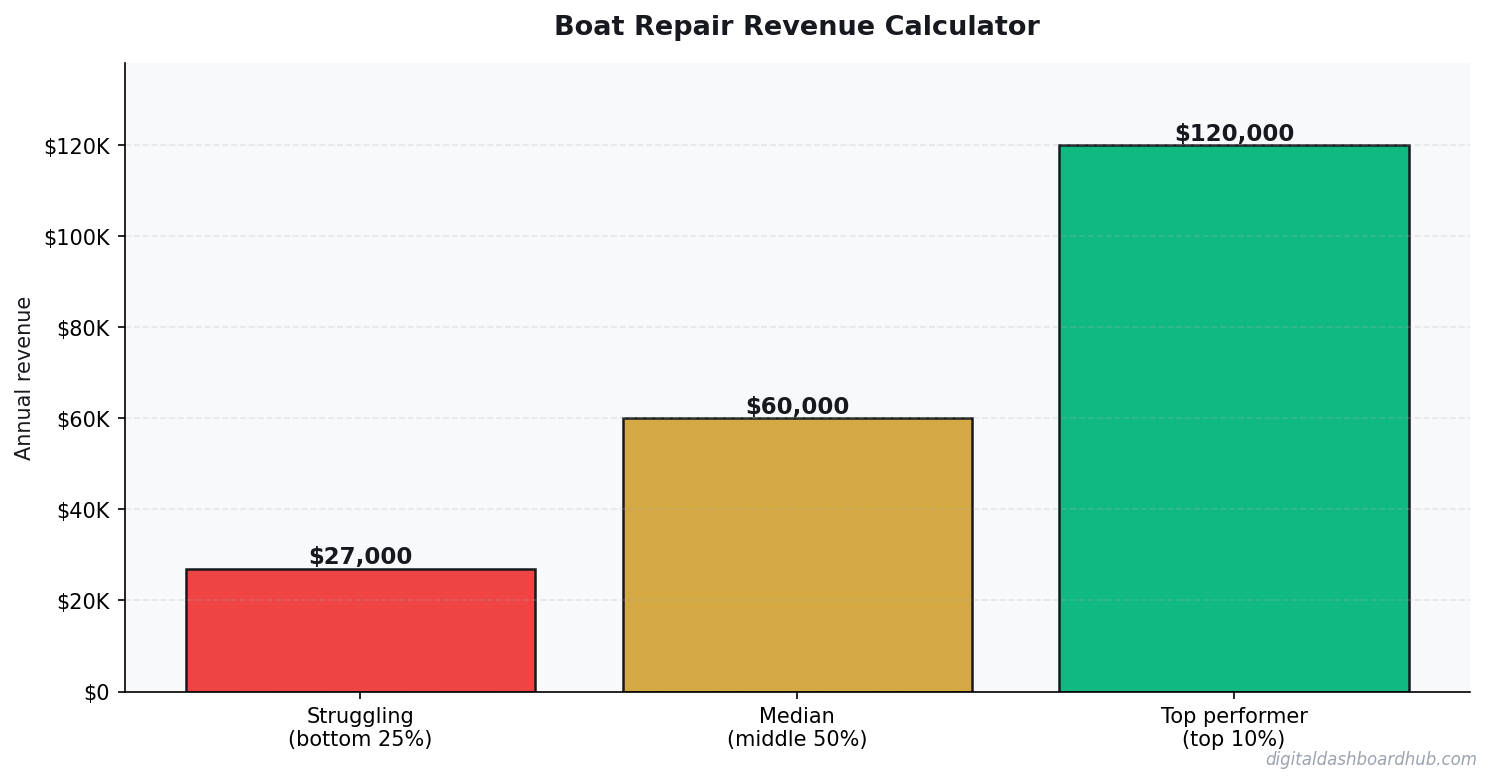
The full Boat Repair Revenue Calculator inside DDH includes features the lite version above can’t offer:
- Historical tracking — see your numbers change over weeks and months
- Visual charts — bar graphs, trend lines, and breakdowns that make patterns obvious
- Scenario modeling — “what if I change X?” comparisons side by side
- PDF reports — export professional reports for partners, lenders, or your own records
- — one subscription covers every calculator and tracker in the library
How to Use This Tool
Step 1: Enter your actual numbers in the fields above. Don’t guess — pull from your bank statements or business records for the most accurate results.
Step 2: Read the output cards. They update instantly as you type. Play with different scenarios to see how small changes affect your bottom line.
Step 3: If you want to save your results, track changes over time, or run more advanced projections — start a free 14-day trial of the full dashboard. No credit card required.
Your Next Move
You’ve already done the hardest part — you looked at your numbers instead of avoiding them. Here’s what to do with that momentum:
- Right now (30 seconds): Bookmark this page so you can rerun the calculation next month
- This week: Pull your real numbers from your accounts and run them through the calculator above
- Long game: Try the full DDH dashboard — 261 tools, 14 days free, cancel anytime
There’s More
- Stress Management Isn’t Just Bubble Baths: A Data-Driven Approach to Actually Reducing Stress
- Rent vs. Buy Calculator 2026: The True Cost of Each Option (Real Numbers)
- Calorie Deficit Calculator: How to Lose Weight Without Obsessing Over Every Bite
What Boat Repair Shop Revenue Actually Looks Like
A 2-tech marine repair operation in the coastal Southeast does roughly $480,000-$560,000 in gross annual revenue during a normal year. That’s running 3-4 jobs per week at an average of $2,800-$3,500 per job over a 40-week effective working season (marine repair drops sharply in the off-season unless you’re in a year-round boat market like Florida).
Parts markup runs 35-45% on common components — impellers, thermostats, belts, raw water pumps, zincs. Labor is typically billed at $95-$145/hour depending on market and specialization. A 3-person shop billing 65% of available hours at $120/hour average generates $148,000 in labor revenue alone.
The shops that struggle are the ones billing their most skilled tech’s time at the same rate as routine maintenance work. Tiered labor pricing — $95/hour for basic service, $140/hour for engine diagnostics and complex repair — is standard in automotive and should be standard in marine.
The 3 Factors That Drive Boat Repair Revenue
1. Seasonal capacity planning. Pre-season launch prep (April-May) is the single most concentrated high-demand window. A shop that can handle 20% more jobs during peak season — even by bringing in a temporary helper or outsourcing fiberglass and canvas work — captures revenue that competitors on a wait list are turning away.
2. Recurring service contracts. Offering annual engine service contracts at $650-$950/boat for winterization, spring commissioning, and mid-season check removes the chase-the-customer cycle. 40 contracted boats at $800/contract = $32,000 in committed annual revenue before a single walk-in job.
3. Storage revenue as a margin booster. Marine shops with any outdoor or indoor space should consider winter storage contracts. At $1,500-$2,800/boat for a 5-month indoor storage season, even 20 stored boats adds $30,000-$56,000 in near-pure-margin revenue. You already have the yard, the forklifts, and the insurance. Storage turns dead season into income.
What Most People Get Wrong About Boat Repair Economics
They look at gross revenue and miss the seasonal cash flow reality. A $520,000 gross shop earns most of that revenue in a 6-month window. The other 6 months cover fixed costs (rent, insurance, loan payments on equipment) with dramatically reduced incoming cash. Shops that don’t plan for the lean season with reserves built during peak season run into real cash flow problems in December and January.
The second misconception: that specialization limits the customer base. A shop known specifically for outboard engine work, or Volvo Penta expertise, or high-performance boat systems actually commands higher hourly rates and attracts more repeat customers than a generalist shop. Boaters with specialized boats want specialists. Developing a niche and marketing it specifically is almost always better than trying to be everything to everyone.
Common Mistakes That Kill Boat Repair Margin
Not charging for parts delays. When a job is paused waiting for a part on backorder, the boat is taking up bay space and the mechanic’s scheduling is disrupted. Smart shops charge a storage fee for boats sitting longer than 72 hours waiting on owner decisions or part arrivals — typically $25-$50/day. It creates the right incentive for owners to respond to update calls promptly, and it fairly compensates the shop for real overhead.
Underpricing diagnostic labor. Many boat repair shops don’t charge separately for the 2-3 hours it takes to diagnose a complex electrical or engine problem, because customers push back on paying to “just figure out what’s wrong.” But those hours are the most skilled, highest-value work the shop does. A thorough diagnostic at $130-$150/hour builds trust, ensures the right repair is performed, and prevents comebacks. Shops that charge appropriately for diagnostics are simultaneously more profitable and have fewer warranty disputes.
Taking on every job regardless of specialty. A marine shop that works on everything from outboards to inboards to diesels to generator sets spreads expertise thin and makes parts stocking impossible. The most profitable shops specialize — outboard-only, or specific engine brands, or high-performance — and charge a premium for it. Referral relationships with other shops for work outside your specialty keeps customers happy and maintains goodwill with competitors.
The Boat Repair Business at Scale
A single 2-bay shop with 3 technicians is a solid lifestyle business with good owner income. Scaling beyond that requires either adding physical space (another location or expansion) or moving into adjacent revenue streams: dealer arrangement with an engine brand, parts retail (online and counter), or marine detailing alongside repair.
Each expansion path has different capital requirements and operational complexity. Adding an engine dealership brings manufacturer support, parts pricing advantages, and certified technician training — but also inventory requirements, floor plan financing, and sales responsibilities. Marine detailing adds a separate crew that doesn’t require specialist certification but needs its own scheduling and customer acquisition. Parts retail, even just online, can run effectively in the background once established.
The calculator lets you model where the highest marginal return comes from given your specific shop’s current numbers — whether that’s adding a tech to increase job throughput, adding storage to monetize existing yard space, or raising your labor rate to reflect specialized expertise in your market.
Keep reading (related guides):
14-day trial · Stripe checkout · Cancel anytime

Andy Gaber is the founder of Digital Dashboard Hub, a suite of 255+ interactive financial, productivity, and wellness tools. He built DDH after getting frustrated with financial apps that gave outputs without context. Follow along for tool tutorials, revenue analytics breakdowns, and honest takes on personal finance.