Tuesday’s migraine made no sense. You slept eight hours, drank enough water, skipped the wine, ate regular meals, and still ended up in a dark room with an ice pack pressed against your skull, wondering what you did wrong this time.
If you experience migraines, you’ve had this exact thought: “I did everything right and it still happened.” It’s demoralizing, confusing, and — here’s the part that matters — almost certainly not the full picture.
Migraines feel random because the human brain is terrible at identifying patterns across multiple variables over long time periods. You might intuitively connect a migraine to the glass of red wine you had the night before, but completely miss the barometric pressure drop that preceded it by twelve hours, or the fact that you ate aged cheese at lunch, or that your period is due in two days, or that you slept thirty minutes later than usual and disrupted your circadian rhythm.
No one can track all of those variables in their head. But a systematic tracking approach can reveal patterns that feel invisible — and give you (and your doctor) actionable data instead of frustrated guesses.
Why Migraines Feel Unpredictable (But Usually Aren’t)
Before you scroll: the calculator below is running in your browser right now. For the full feature set — saved scenarios, history, exports — open the dashboard.
Neurologists have identified a concept called “migraine threshold” — essentially, your brain has a tolerance level for accumulated triggers. One trigger alone might not push you over the threshold. But stack two or three together, and you’re down for the count.
This is why the same trigger doesn’t always produce the same result. A glass of wine on a well-rested, low-stress Saturday might be perfectly fine. That same glass on a Tuesday after poor sleep, high stress, and a weather change becomes the straw that breaks the camel’s neurological back.
The threshold model explains the apparent randomness: it’s not one thing causing your migraines. It’s the combination of things on any given day, stacked against your current baseline vulnerability. And the only way to see those combinations clearly is to track everything consistently.
The Seven Trigger Categories Worth Tracking
Research has identified hundreds of potential migraine triggers, but they generally cluster into seven major categories. Tracking across all seven gives you the most complete picture.
1. Sleep Patterns
Sleep is arguably the single most influential migraine variable, and it works in both directions. Too little sleep triggers migraines. Too much sleep triggers migraines. Irregular sleep timing triggers migraines. Your brain craves consistency.
Track these daily:
- Bedtime and wake time
- Total hours slept
- Sleep quality (subjective 1-5 scale)
- Any disruptions (woke during the night, insomnia, snoring/apnea)
- Weekend vs. weekday timing differences
The weekend migraine phenomenon — getting a headache on Saturday morning when you should be relaxing — is often caused by sleeping 1-2 hours later than your weekday schedule. Your brain interprets the schedule change as disruption, even though you got more total sleep.
2. Food and Drink
Common dietary triggers include aged cheeses, processed meats (nitrates), chocolate, alcohol (especially red wine and beer), artificial sweeteners (aspartame), MSG, citrus fruits, and caffeine — both consuming it and withdrawing from it.
But here’s the critical nuance: food triggers are highly individual. The foods on every “migraine trigger list” aren’t universal. Chocolate might be a significant trigger for you and completely irrelevant for someone else. The only way to know your personal triggers is to track what you eat and correlate it with migraine occurrence over time.
Track daily:
- Meals and major snacks (timing and content)
- Caffeine intake (amount and timing)
- Alcohol consumption (type and amount)
- Water intake
- Any skipped meals (irregular eating is a trigger itself)
3. Weather and Environment
Barometric pressure changes are one of the most well-documented migraine triggers, and one of the most frustrating because you can’t control the weather. But you can anticipate it.
Track:
- Notable weather changes (storms approaching, temperature swings)
- Barometric pressure (many weather apps now show this)
- Bright light or glare exposure
- Strong odors (perfume, cleaning products, exhaust)
- Screen time duration
- Altitude changes (driving through mountains, flying)
4. Hormonal Cycles
For people who menstruate, hormonal fluctuations are the single most common migraine trigger. Estrogen drops — particularly in the 2-3 days before menstruation begins — can trigger severe migraines that are often more treatment-resistant than non-hormonal episodes.
Track:
- Menstrual cycle day
- Period start and end dates
- PMS symptoms
- Ovulation timing (roughly mid-cycle)
- Any hormonal medications or changes (birth control, HRT)
The PCOS Management Tracker includes hormonal symptom tracking that can also serve as a foundation for migraine-hormone correlation, especially for those managing multiple hormonal conditions simultaneously.
5. Stress and Emotional State
Stress itself triggers migraines — but here’s the counterintuitive part: the migraine often hits after the stress resolves, not during it. The “let-down” migraine is extremely common. You power through a stressful work week, and Saturday morning the migraine arrives like an uninvited guest celebrating the weekend.
Track daily:
- Overall stress level (1-10 scale)
- Major stressors (work deadline, conflict, financial worry)
- Emotional events (argument, crying, intense excitement)
- Whether the day was a “let-down” day after sustained stress
6. Physical Factors
Your body’s physical state on any given day affects your threshold significantly.
Track:
- Exercise (type, intensity, duration)
- Neck and shoulder tension
- Posture issues (long periods at a desk)
- Dehydration signs
- Skipped meals or fasting
- Travel (especially long drives or flights)
- Physical exertion (lifting, sports, yard work)
7. Medication and Supplements
Both the medications you take and the ones you stop taking can influence migraines.
Track:
- All medications taken (prescription and OTC)
- Migraine-specific medications (triptans, ergotamines, CGRP inhibitors)
- Time between onset and medication
- Whether medication was effective
- Caffeine as a treatment (some people use caffeine to abort early migraines)
- Supplements (magnesium, riboflavin, CoQ10, feverfew)
Medication overuse headache — or rebound headache — is a real concern. If you’re using acute migraine medications more than 10-15 days per month, the medications themselves may be perpetuating the cycle. Tracking frequency makes this pattern visible.
What Your Migraine Diary Should Actually Record Per Episode
| Tracking Method | Setup | Data Quality | Doctor-Shareable? | Best For |
|---|---|---|---|---|
| Paper journal | Immediate | Inconsistent | Sometimes | Low-tech preference |
| Generic health app | 5 min | Medium | Export only | Basic logging |
| DDH Symptom Tracker | 5 min | High (structured fields) | Yes — generates patterns | Chronic conditions, complex symptom tracking |
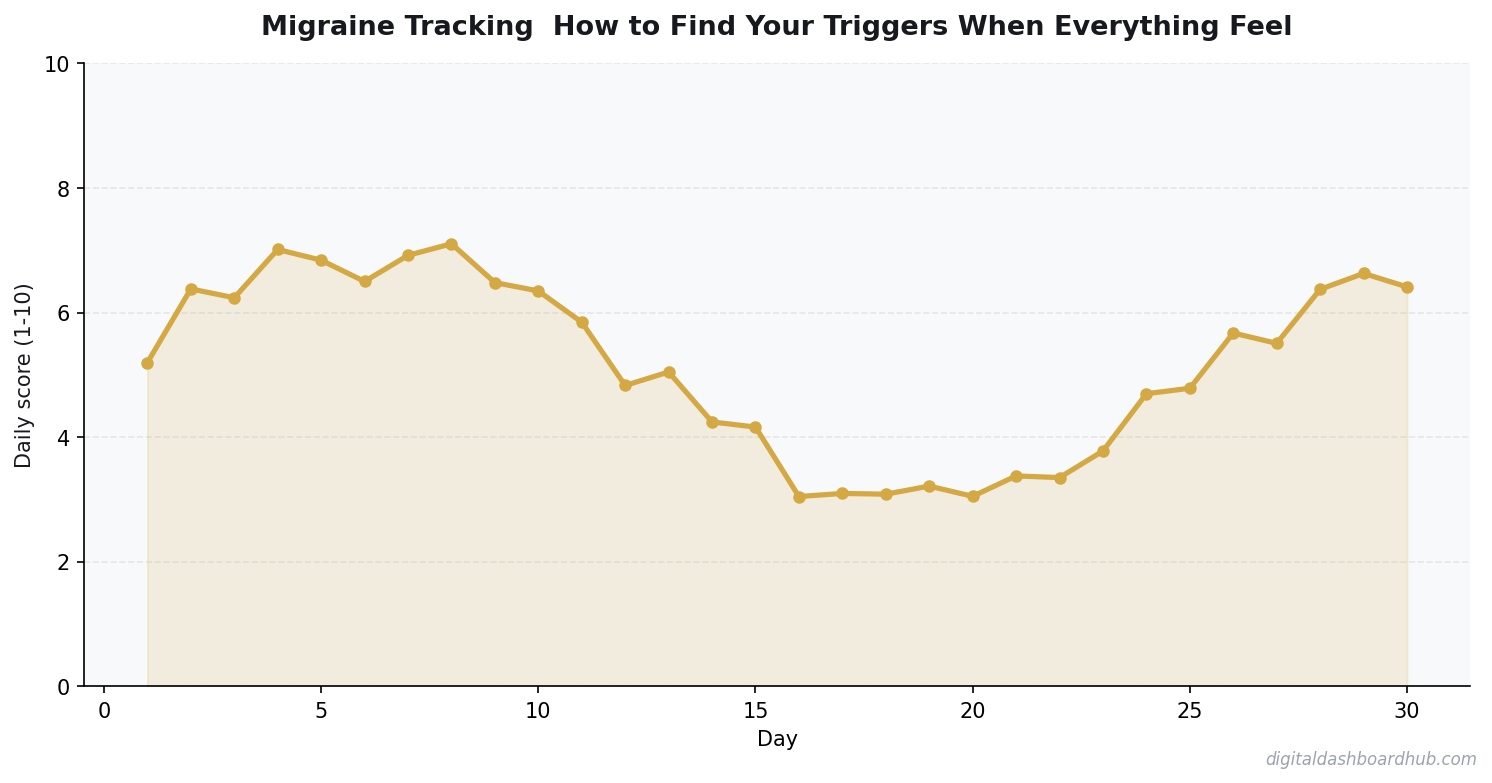
When a migraine hits, record these details as soon as you’re able:
Timing:
– Date and day of week
– Time symptoms started
– Duration of the entire episode
– Time of worst intensity
Characteristics:
– Pain location (one side, both sides, behind the eye, base of skull)
– Pain type (throbbing, pressing, stabbing, pulsating)
– Intensity (1-10 scale)
– Aura symptoms (visual disturbances, tingling, speech difficulty)
– Associated symptoms (nausea, vomiting, light sensitivity, sound sensitivity)
Context (the 24-48 hours before onset):
– Sleep the night before
– Food and drink consumed
– Stress events
– Weather changes
– Physical activity
– Hormonal cycle position
– Any unusual exposures (smells, lights, travel)
Treatment and Recovery:
– What you took and when
– Did it work? How long until relief?
– Total time from onset to functional
– Lingering symptoms the next day (postdrome/”migraine hangover”)
A comprehensive Stress Management Spreadsheet can track the daily stress metrics that feed into your migraine analysis, while a Meditation Practice Tracker helps you measure whether mindfulness interventions are actually reducing migraine frequency over time.
How Systematic Tracking Reveals Hidden Patterns
After 30-60 days of consistent tracking, patterns start emerging that were invisible before:
Timing patterns: “My migraines almost always start between 2-4 PM.” This might indicate blood sugar drops, afternoon caffeine withdrawal, or accumulated screen time.
Stacking patterns: “I get migraines when poor sleep AND weather change happen together, but never from either alone.” This is the threshold model in action.
Hormonal patterns: “Migraines cluster on days 26-28 of my cycle, every cycle.” This gives your doctor specific information for preventive treatment timing.
Food patterns: “Migraines follow aged cheese — but only when I also had wine within 24 hours.” Combination triggers are impossible to spot without tracking.
Recovery patterns: “Triptans work if I take them within 30 minutes of onset but are useless after 2 hours.” This timing data is crucial for effective treatment.
The CBT Worksheet Tracker can complement your migraine diary by helping you identify thought patterns and stress responses that contribute to your overall trigger load — because the cognitive-behavioral connection to chronic pain conditions is well-documented.
What to Bring to Your Neurologist
Doctors see hundreds of patients. The ones who get the best care bring data. Walking into your neurologist appointment with 60 days of tracked migraine data transforms the conversation from “I get bad headaches sometimes” to a productive, data-driven discussion.
Prepare a summary that includes:
- Frequency: Total migraine days per month (average)
- Pattern: Most common day of week, time of day, cycle day
- Top identified triggers: Based on your correlation data
- Treatment efficacy: Which medications work, how fast, at what dosage
- Disability impact: Days of missed work, reduced function days
- Trend line: Is frequency increasing, decreasing, or stable?
This data directly influences treatment decisions. A neurologist might prescribe preventive medication if you’re experiencing more than 4 migraine days per month, or recommend hormonal management if your data clearly shows menstrual migraine patterns, or suggest behavioral modifications if stress-weather stacking is your primary trigger combination.
Starting Your Tracking Practice
The biggest obstacle to effective migraine tracking isn’t complexity — it’s consistency. A perfect tracking system used for one week is less valuable than a simple one maintained for three months.
Start with the essentials:
- Daily baseline: Sleep, stress, meals, water, cycle day (takes 60 seconds)
- Episode details: When a migraine occurs, record timing, intensity, and the 24-hour context
- Treatment log: What you took, when, and whether it helped
Do this for 30 days minimum before trying to draw conclusions. The human brain wants to find patterns after three data points — resist the urge. Give the data time to accumulate.
After 60-90 days, review your logs with fresh eyes. Look for the combinations, not the single triggers. The pattern that changes your life might be something you never would have guessed.
The Anxiety Management Spreadsheet tracks many of the same daily wellness metrics — mood, sleep, stress, physical symptoms — and can serve as a parallel tracking tool if anxiety and migraines co-occur for you, which research suggests they often do.
Get our free 30-Day Migraine Trigger Tracker — a printable daily log designed specifically for migraine sufferers. Track sleep, food, stress, weather, hormones, and episode details in under two minutes per day. [Download it here and start finding your patterns.]
Keep reading (related guides):
- How Much Does Therapy Cost in 2026? A State-by-State Breakdown
- Free ADHD Impulse Spending Tracker — Try It Now
- I Tracked My ADHD Life for 30 Days — Heres What the Data Showed
- ADHD Freelancer Dashboard: Run Your Business Without Dropping Every Ball
- Debt Snowball vs Avalanche Calculator: Which Method Saves You More Money
255+ interactive tools for your money, time, and health.
14-day trial · Stripe checkout · Cancel anytime
Keep Reading
- I Tested 9 Expense Tracker Apps for 3 Months — Here’s What Actually Worked
- How to Regulate Your Nervous System: 8 Steps to Move From Chronic Stress to Calm
- I Tracked My Nervous System for 90 Days — Here’s What I Learned About My Stress, Sleep, and Sanity

Andy Gaber is the founder of Digital Dashboard Hub, a suite of 255+ interactive financial, productivity, and wellness tools. He built DDH after getting frustrated with financial apps that gave outputs without context. Follow along for tool tutorials, revenue analytics breakdowns, and honest takes on personal finance.