
Three Trades, Three Very Different Businesses
Enter your own numbers in the interactive tool below and get a real-time read. The dashboard version adds saved scenarios, history, and full feature access.
I grew up around trade guys. My uncle was a roofer, my neighbor ran an HVAC company, and my best friend’s dad was a master electrician with his own shop. All three drove nice trucks. All three complained about different things. And all three had wildly different bank accounts — though none of them would admit it.
If you’re trying to decide which trade business to start (or scale), revenue potential matters. But it’s not the only thing that matters. Seasonality, margins, scaling difficulty, and physical toll all vary dramatically between roofing, HVAC, and electrical. Let’s compare them with real numbers.
Revenue Comparison: The Top-Line Numbers
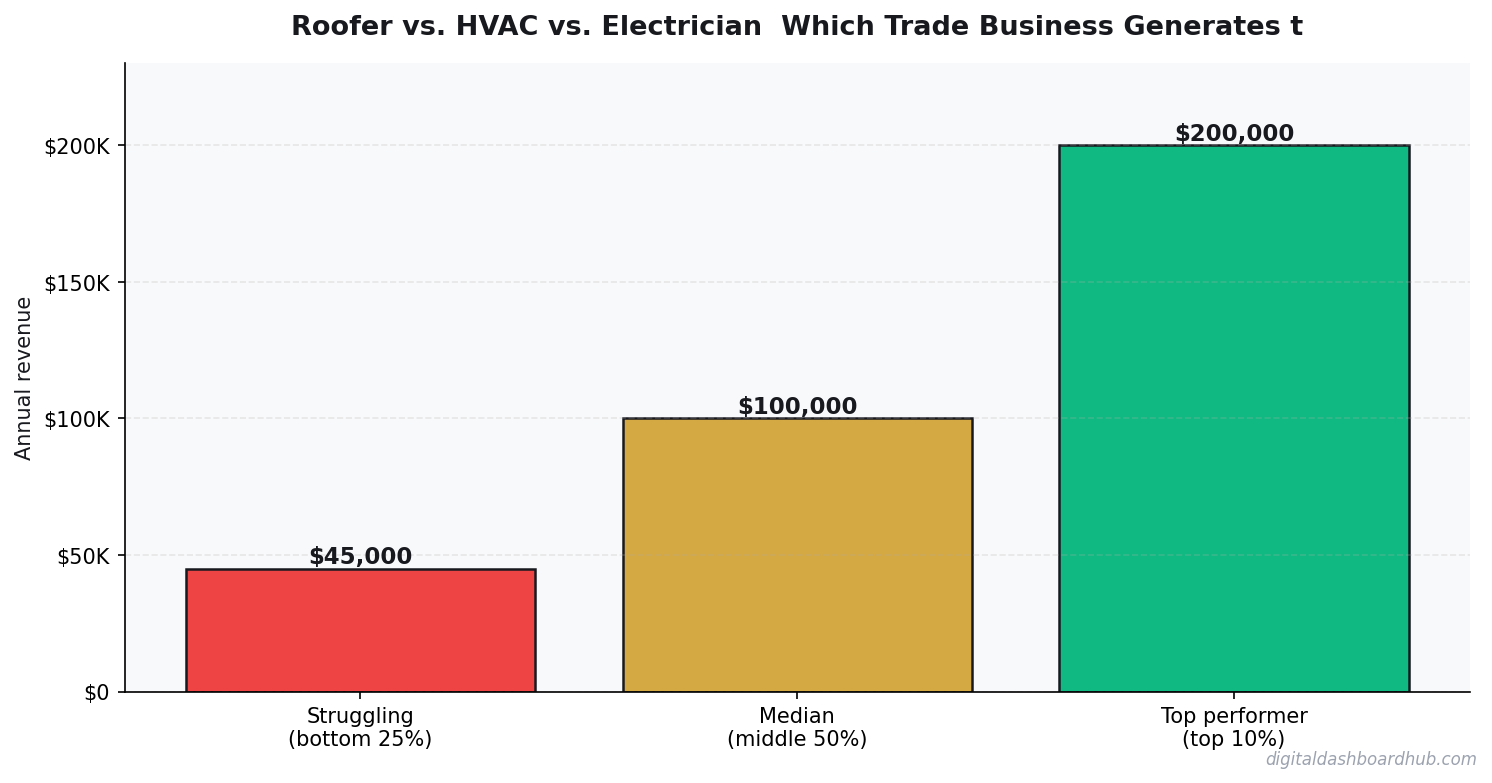
Let’s start with what most people care about — how much money comes in the door.
Roofing generates the highest top-line revenue, but HVAC and electrical often produce better margins. The reason is simple: roofing has high material costs (shingles, underlayment, flashing) that eat into gross profit, while HVAC and electrical are more labor-heavy with lower material percentages.
Roofing: High Revenue, High Risk, High Seasonality
Roofing is the sprinter of the trades. When it’s good, it’s very good. A single residential reroof generates $8,000-$15,000 in revenue. A commercial job can be $50,000-$500,000. Storm season in hail-prone states can turn a $600K company into a $2M company in a single quarter.
But the downsides are significant. Roofing is brutally seasonal in northern climates — you might do 70% of your annual revenue between April and October. The work is physically dangerous (roofing has one of the highest injury rates of any occupation). And the labor market is incredibly tight because not many people want to carry bundles of shingles up a ladder in July heat.
Insurance restoration (storm damage work) is where the real money is, but it’s feast-or-famine. I know roofers in Texas who made $400K personally in 2023 (major hail year) and $120K in 2024 (mild weather). That kind of volatility makes financial planning nearly impossible without a solid tracking system.
HVAC: The Recurring Revenue King
HVAC is the trade business I’d start if I wanted predictable, flexible income. Here’s why: maintenance agreements. A residential HVAC company with 500 maintenance agreements at $200/year has $100,000 in guaranteed recurring revenue before a single service call or install happens.
The install side is lumpy — a full system replacement runs $6,000-$15,000, and you might do 5-15 per month depending on your market size. But the service and maintenance side provides a steady baseline. Smart HVAC operators build their business on maintenance agreements and treat installs as the bonus.
The downside? Startup costs are higher than roofing or electrical. You need specialized equipment, EPA certifications for refrigerant handling, and typically a commercial vehicle with a proper inventory setup. And HVAC has its own seasonality issue — heating season and cooling season are busy, but spring and fall can be slow.
Electrical: Highest Margins, Hardest to Scale
Electrical work has the best margins of the three trades because the material cost percentage is the lowest. Wire, outlets, panels, and fixtures are relatively cheap compared to the labor expertise required to install them safely and to code. A master electrician billing $120/hour with $15/hour in materials is running a 87% gross margin on that service call.
The challenge with electrical is scaling. Every jurisdiction requires a licensed master electrician on staff (or as the owner) to pull permits. You can’t just hire anyone off the street — you need licensed journeymen, and there’s a nationwide shortage. The apprenticeship pipeline takes 4-5 years, which means if you need electricians today, you’re competing for a very small pool of qualified workers.
Electrical also has smaller average job sizes than roofing or HVAC. A panel upgrade is $2,000-$4,000. A service call might be $150-$500. You need a higher volume of jobs to hit the same revenue as a roofer doing $12,000 reroofs. That means more trucks, more scheduling complexity, and more customer interactions per dollar of revenue.
How the DDH Revenue Projection Calculator Handles This
Comparing trade businesses on paper is one thing. Modeling your specific situation — your market, your crew size, your seasonal patterns — requires a calculator that accounts for all the variables.
The Business Revenue Calculator inside Digital Dashboard Hub lets you plug in your average job size, jobs per week, seasonal adjustment factors, material costs, and labor costs to project monthly and annual revenue for any trade business. You can run all three trades side-by-side and compare net owner income after all expenses.
The seasonality modeling is what sets it apart. You can assign a percentage factor to each month (January might be 40% of peak capacity for a roofer, 90% for an HVAC company doing heating work), and the projection adjusts accordingly. No more guessing whether your slow season can cover payroll.
The Scaling Comparison: Who Grows Faster?
This is where the businesses really diverge. Scaling a roofing company is relatively straightforward — hire another crew, buy another trailer of tools, find another crew leader. The work is project-based and doesn’t require the same licensing density as electrical.
HVAC companies sell for the highest multiples because of recurring revenue. A buyer sees 500 maintenance agreements and knows there’s a baseline of predictable income. Roofing companies sell for lower multiples because the revenue is project-based and heavily dependent on the owner’s relationships and sales ability.
Physical Toll and Longevity
I’d be dishonest if I didn’t address this. Roofing is physically punishing. The average career span for a hands-on roofer is 15-20 years before knees, backs, and shoulders force a transition to management or retirement. HVAC is moderately physical — crawl spaces and attics take a toll, but it’s less repetitive strain than roofing. Electrical is the least physically demanding of the three, though it carries the highest risk of acute injury (electrocution).
If you’re 25 and starting a trade business, all three are viable. If you’re 40, electrical or HVAC will give you more career runway as an active technician. If you’re planning to be an owner-operator who moves to management quickly, roofing’s physical demands are less relevant — you’ll be selling and managing, not carrying shingles.
Mid-Article Bonus: The “Which Trade Should I Start?” Decision Framework
Start a roofing company if: You’re in a storm-prone market, you’re comfortable with sales and marketing, you want the highest potential top-line revenue, and you can handle income volatility.
Start an HVAC company if: You want recurring revenue, you’re thinking long-term (building a business to sell), you have access to capital for startup costs, and you value predictability over peak earning potential.
Start an electrical company if: You’re already a licensed electrician, you want the highest margins, you’re okay with slower scaling, and you prefer technical work over sales-heavy business models.
There’s no wrong answer. But there is a wrong answer for you, and the only way to figure that out is to run the numbers for your specific market and situation.
Do This First
Step 1: Pick the trade that matches your skills and market. If you’re not sure, drive around your area and count the trucks. The trade with the most trucks has the most demand — and the most competition. The trade with the fewest trucks might be an underserved opportunity.
Step 2: Calculate your year-one revenue projection using real local data. Call 5 companies in your area and ask what they charge for common jobs. That gives you average job size. Estimate jobs per week based on your crew size. Multiply. That’s your top line.
Step 3: Start a free trial of Digital Dashboard Hub and use the Business Revenue Calculator to model all three trades side-by-side with your local market data. See which one produces the owner income you’re targeting after expenses, taxes, and seasonal adjustments. Let the math make the decision.
Keep reading (related guides):
Which Trade Fits You Best
Choose based on what you’re optimizing for — ceiling, stability, or startup simplicity. Each of these three trades wins a different criterion.
Roofing: highest ceiling, lumpiest cash flow
Average ticket $8K-$25K. A good residential roofer runs 35-60 jobs per crew per year, grossing $250K-$650K. Margin 18-28%. But cash flow is feast-or-famine — weather, insurance claims, and seasonality make it the most volatile of the three.
HVAC: best recurring revenue
Service contracts are HVAC’s superpower. 200 maintenance agreements at $250/year each = $50K of recurring revenue before you sell a single install. Average ticket $3K-$9K on installs, $300-$800 on service. Steadier than roofing, lower ceiling.
Electrical: highest hourly, lowest ticket
Electricians typically bill $120-$200 per hour on service calls, but average ticket is smaller ($400-$2,500) than HVAC or roofing. Solid $90K-$140K ceiling as solo, $300K+ with employees. Easiest of the three to run as a legitimate solo operator.
Which one has the best startup economics
Electrical wins for startup simplicity. Truck, tools, and license: $25K-$40K. HVAC needs more specialized equipment and certifications ($45K-$75K). Roofing needs insurance, ladders, dumpsters, and a crew ($35K-$60K) plus weather tolerance.
Combined strategies
Many trade owners run cross-trade referral partnerships — the roofer refers ice-dam electrical work, the HVAC tech refers roof replacements after noticing damage. Formalized referral programs can add $30K-$80K in annual revenue with zero marketing spend.
Quick FAQ: Comparing Trades
Which trade has the lowest barrier to entry?
Electrical, arguably — license path is clearer, equipment costs are lower, and the work is less weather-dependent than roofing or HVAC. But any of the three can be entered solo with $25K-$60K of capital and 1-2 years of licensing prep.
Which trade has the best work-life balance?
HVAC, especially if you build a service-contract-heavy model. Scheduled maintenance calls beat emergency service. Electrical is close second. Roofing is worst — weather-driven, physically demanding, and tends to peak during the worst weather months.
Which trade ages best?
Electrical. Electricians can work productively into their late 60s with relatively low physical demands. HVAC mid-to-late 50s. Roofing hard caps around 50-55 for most active roofers — the body simply can’t sustain another decade of the work.
Which trade has the best acquisition economics?
HVAC. Established HVAC businesses with maintenance contracts sell for 3-5x EBITDA. Roofers sell for 2-3x. Electricians vary widely depending on commercial vs residential mix. If you’re building to sell, HVAC has the clearest exit path.
Can I run multiple trades under one brand?
Yes, and many do. “Home Services” franchises combine electrical, HVAC, and plumbing under one roof. Works great for customer cross-sell. Harder operationally because each trade has its own licensing, insurance, and specialist labor pool — usually requires $500K+ revenue before it’s worth doing.
255+ interactive tools for your money, time, and health.
Full features for 14 days · Secure payment · Stop anytime
Keep Reading
- Side Hustle Income Tax Tracker (Free Tool)
- Freelancer Tax Guide 2026: What to Track All Year So April Doesn’t Destroy You
- How Sinking Funds Saved Me From Financial Emergencies

Andy Gaber is the founder of Digital Dashboard Hub, a suite of 255+ interactive financial, productivity, and wellness tools. He built DDH after getting frustrated with financial apps that gave outputs without context. Follow along for tool tutorials, revenue analytics breakdowns, and honest takes on personal finance.