
business-models-three-completely-different-revenue-stories”>Three Business Models, Three Completely Different Revenue Stories
Jump in: the tool below is live and free to play with. Upgrade to a dashboard account when you want to save scenarios and track over time.
Before DDH, I was doing this manually in spreadsheets. Here’s the faster way:
A salon owner grossing $350,000/year might take home less than a suite renter grossing $120,000. A booth renter making $80,000 might have more financial freedom than either. The beauty industry has three distinct business models, and most pros choose based on vibes instead of math.
I’ve spent the last two months interviewing salon owners, booth renters, and suite operators in three different cities to build a real revenue comparison. Not theoretical numbers from a business textbook — actual revenue, actual expenses, actual take-home pay from people doing the work right now in 2026.
The results surprised me, and they’ll probably surprise you too.
The Three Models, Defined
Salon owner: You own the business. You rent or own the physical space, hire stylists (as employees or contractors), handle marketing, manage inventory, and take a percentage of revenue from every chair. You’re a business operator who may also do hair. Revenue ceiling: highest. Headache ceiling: also highest.
Booth renter: You rent a station inside someone else’s salon. You pay a fixed weekly or monthly fee ($150-$500/week depending on location) and keep everything you earn above that. You’re responsible for your own clients, supplies, and taxes. You’re essentially a solo business operating inside someone else’s space.
Suite renter: You rent a private suite (like Sola Salons, My Salon Suite, or Phenix Salon Suites) and run your own mini-salon. Monthly rent runs $250-$700/week depending on market. You have full control over your space, pricing, and brand. It’s a middle ground between booth renting and owning — private space, no employees, lower overhead than full salon ownership.
The Revenue Comparison: Real Numbers
Here’s the side-by-side based on averages from the pros I interviewed, cross-referenced with industry data from the Professional Beauty Association:
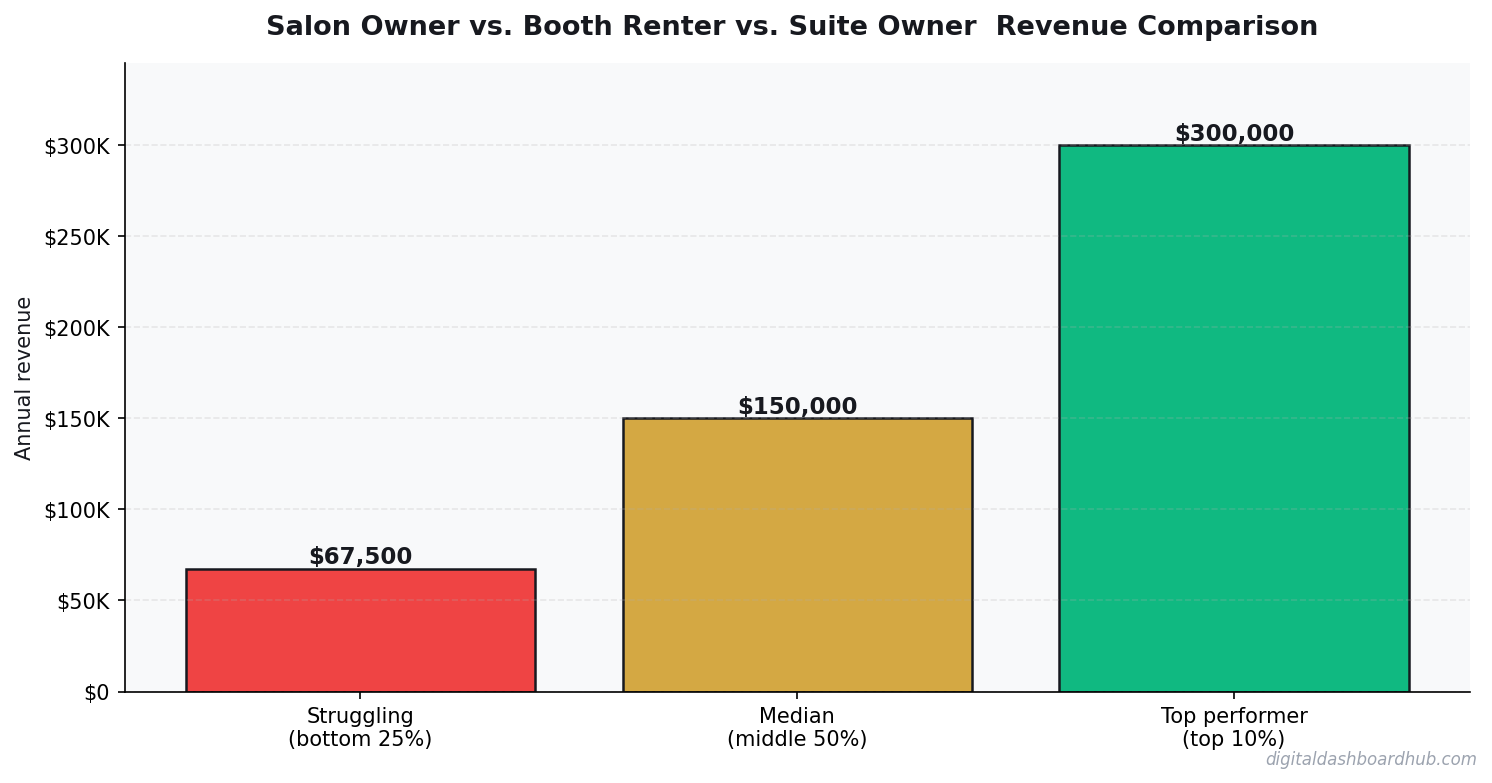
Read that last row carefully. The salon owner grossing $350,000 has a lower effective hourly rate than the suite renter grossing $120,000. Because the owner works 50-60 hour weeks managing staff, handling emergencies, and running the business — not just doing hair.
The Salon Owner: High Revenue, High Headache
Salon ownership looks glamorous from the outside. $350,000 in annual revenue sounds impressive until you trace where that money actually goes. In our example, $140,000 — 40% of gross revenue — goes straight to paying other stylists. Another $48,000 goes to rent. By the time you pay for product, insurance, marketing, and utilities, you’re keeping 27 cents of every dollar.
The owner I interviewed in Nashville put it bluntly: “I make about $64,000 a year and work 55 hours a week. My best booth renter works 35 hours and takes home $45,000. She has no employees to manage, no lease to worry about, and she sleeps better than I do.”
So why own a salon? Scalability. A booth renter’s income is capped by their personal hours. A salon owner can add chairs, add stylists, and grow revenue without personally doing more hair. The ceiling on ownership is $200K+ in take-home for a well-run multi-location operation. But getting there takes 5-10 years of 55-hour weeks, significant capital risk, and management skills that have nothing to do with cutting hair.
The Booth Renter: Freedom With a Low Ceiling
Booth renting is the simplest model. You pay your weekly rent ($250-$500 in most mid-size markets), do hair, and keep the rest. No employees, no lease negotiations, no business insurance beyond personal liability. The overhead is low, the freedom is high, and the startup cost is essentially one month’s rent plus your tools.
The limitation is the ceiling. You can only earn what you can personally produce, and there are only so many hours in a week. A booth renter seeing 25 clients/week at an average ticket of $65 grosses $84,500/year. After rent and supplies, take-home is around $39,000-$45,000. To earn more, you either raise prices (which requires building demand) or work more hours (which leads to burnout).
The sweet spot for booth renters is a high-demand specialization — color correction, extensions, textured hair — that supports premium pricing. A booth renter doing color corrections at $200+ per service can earn $70,000-$90,000 working the same hours as a general stylist earning $40,000.
The Suite Renter: The 2026 Sweet Spot
Suite renting has exploded in the past five years, and the numbers explain why. You get the autonomy and branding control of ownership without the overhead of a full salon. You set your own prices, choose your own products, decorate your own space, and answer to nobody — but your rent is fixed and manageable.
The suite renter I interviewed in Denver pays $1,800/month for a private suite at a Sola Salons location. She sees 30 clients/week at an average ticket of $75, grossing about $117,000/year. After rent ($21,600), supplies ($11,000), insurance ($1,500), marketing ($3,000), and other expenses, she takes home roughly $52,000 — working 38 hours/week.
Her effective hourly rate is about $26/hour. Compare that to the salon owner at $22/hour who works 55 hours and carries a lease, employee headaches, and six figures of business risk. The suite renter sleeps better.
How the DDH Revenue Calculator Handles This
The beauty industry has unique financial dynamics — tips, product sales, seasonal fluctuations, and the critical relationship between average ticket price and client volume. The DDH Business Revenue Calculator lets beauty pros model all three business structures with their actual numbers.
You input your average ticket, weekly client count, rent, supply costs, and other overhead, and the calculator shows you take-home pay for each model side by side. It also includes a “what-if” slider for price increases — so you can see that raising your average ticket by $10 adds $13,000/year in gross revenue before you actually change your prices.
The feature suite renters love most is the break-even client count. It tells you the minimum number of clients per week you need to cover all expenses and pay yourself a target salary. For most suite renters, the break-even is 12-16 clients/week. Everything above that is profit. That number is powerful because it tells you exactly when you can stop worrying and start thriving.
Mid-Article Bonus: The Retail Product Play
One revenue stream that separates high-earning beauty pros from average ones is retail product sales. Stylists who actively sell products to their clients add 15-25% to their gross revenue. On an $85,000 gross, that’s $12,750-$21,250 in additional revenue with 40-50% margins.
Suite renters have the biggest advantage here because they control their product selection and keep 100% of the profit. Booth renters often can’t sell retail (it’s the salon owner’s product). Salon owners sell retail but split the margin with stylists in commission models.
If you’re a suite renter not selling retail, you’re leaving $5,000-$10,000/year on the table. It’s the closest thing to passive income a beauty pro can get — the client is already in your chair, already trusts your recommendation, and already needs the product.
Which Model Fits Which Career Stage
This is the framework I recommend based on the data and interviews:
Years 0-3 (building skills and clientele): Booth renting. Low risk, low overhead, maximum flexibility to build your book of business. Focus entirely on getting good and getting busy. Don’t worry about branding or business ownership yet.
Years 3-7 (established with a full book): Suite renting. You’ve got the clients, the skills, and the reputation. Now you need the space and brand to match. Suite renting lets you raise prices (private experience justifies premium pricing), control your environment, and earn more per hour without adding stress.
Years 7+ (ready to scale beyond personal production): Salon ownership. But only if you want to be a business operator, not just a stylist. Ownership is a career change from “doing hair” to “running a business that does hair.” Some stylists love that transition. Others hate it and go back to suite renting within two years.
The Numbers Most Beauty Pros Get Wrong
The biggest financial mistake I see beauty pros make is ignoring self-employment tax. As a booth renter or suite renter, you’re self-employed. That means you owe 15.3% in self-employment tax (Social Security + Medicare) on top of your income tax. A booth renter earning $60,000 net doesn’t take home $60,000 — they take home roughly $42,000 after SE tax and income tax.
The second mistake is not accounting for product cost accurately. Many stylists estimate product cost at 5-8% of revenue. The actual number is usually 10-14% when you include backbar products (shampoo, conditioner, processing treatments used on every client but never billed separately). That 5% difference on $100,000 in revenue is $5,000 in underestimated expenses.
The third mistake is pricing based on the market instead of on costs. If your expenses require $65/hour to hit your income target, charging $55 because “that’s what everyone else charges” means you’ll never get there. Run your numbers first, then set your prices based on what you need to earn, not what the salon down the street charges.
The Quick-Start Version
Step 1: Calculate your current effective hourly rate. Take your last month’s take-home pay, divide by hours worked (including administrative time, not just client hours). That’s your real wage. If it’s under $25, you’re in the wrong model or the wrong pricing structure.
Step 2: Get actual rent quotes for suite spaces in your area (Sola Salons, Phenix, or local equivalents). Knowing the real number replaces the fear of “I can’t afford it” with a concrete break-even calculation.
Step 3: Run your numbers through the DDH Revenue Calculator to compare all three models with your actual client count, ticket price, and expenses — and find the model that pays you what you’re worth.
You Might Also Like
- Side Hustle Income & Tax Tracker (Free Tool)
- Freelancer Finance Dashboard
- The Side Hustle Tax Trap: Track Every Dollar
Keep reading (related guides):
- Rent vs. Buy Calculator 2026: The True Cost of Each Option (Real Numbers)
- True Cost of Your Mortgage Calculator: Its More Than the Payment
- The True Cost of a Mortgage vs. The True Cost of Renting: A 30-Year Analysis
- I Compared Rent vs. Mortgage in All 50 States. The Results Surprised Me.
- Small Business Finance Basics: The Only 5 Numbers You Need to Track Weekly
255+ interactive tools for your money, time, and health.
Instant signup · Stripe-secure · Cancel in one click

Andy Gaber is the founder of Digital Dashboard Hub, a suite of 255+ interactive financial, productivity, and wellness tools. He built DDH after getting frustrated with financial apps that gave outputs without context. Follow along for tool tutorials, revenue analytics breakdowns, and honest takes on personal finance.