You’re Managing 4 Platforms, Creating 60 Posts a Month, and Charging $1,500 — That’s Probably Too Low
Scroll down — the interactive tool runs live with your inputs. Full version lives inside Digital Dashboard Hub. Two-click trial, Stripe-secure.
What to Remember
In This Article
- You’re Managing 4 Platforms, Creating 60 Posts a Month, and Charging $1,500 — That’s Probably Too Low
- 2026 Social Media Manager Rates by Service Type
- Three Pricing Models (and Which One Pays Best)
- In-House vs. Freelance vs. Agency: Income Comparison
- How to Raise Your Rates Without Losing Clients
- The Platform Premium
- Your Action Plan
The #1 fear: “If I raise my rates, they’ll leave.” Reality: good clients expect rate increases. Here’s the playbook:
Social media management is one of those fields where the gap between undercharging and right-charging is $30K–$50K per year. The problem isn’t that clients won’t pay more. It’s that most social media managers have no framework for pricing, so they grab a number from a Facebook group and hope for the best.
Real Talk
The difference between people who hit their targets and those who don’t? They measure weekly, not yearly.
I pulled 2025-2026 rate data from freelancer surveys, agency rate cards, and job boards to give you actual benchmarks. Then I built a calculator so you can price your services based on what you deliver, not what feels safe.
2026 Social Media Manager Rates by Service Type
If you’re doing multi-platform management with content creation for under $2,000/month, you’re leaving serious money on the table. A single platform with 12 posts and community management alone is worth $1,000–$2,000.
Three Pricing Models (and Which One Pays Best)
Hourly: $25–$75/hour
Entry-level social media managers charge $25–$35/hour. Mid-level: $40–$55. Senior/specialist: $60–$100+. The problem with hourly is the same as any service business — you’re capped by hours, and as you get faster (which you should), you earn less per client.
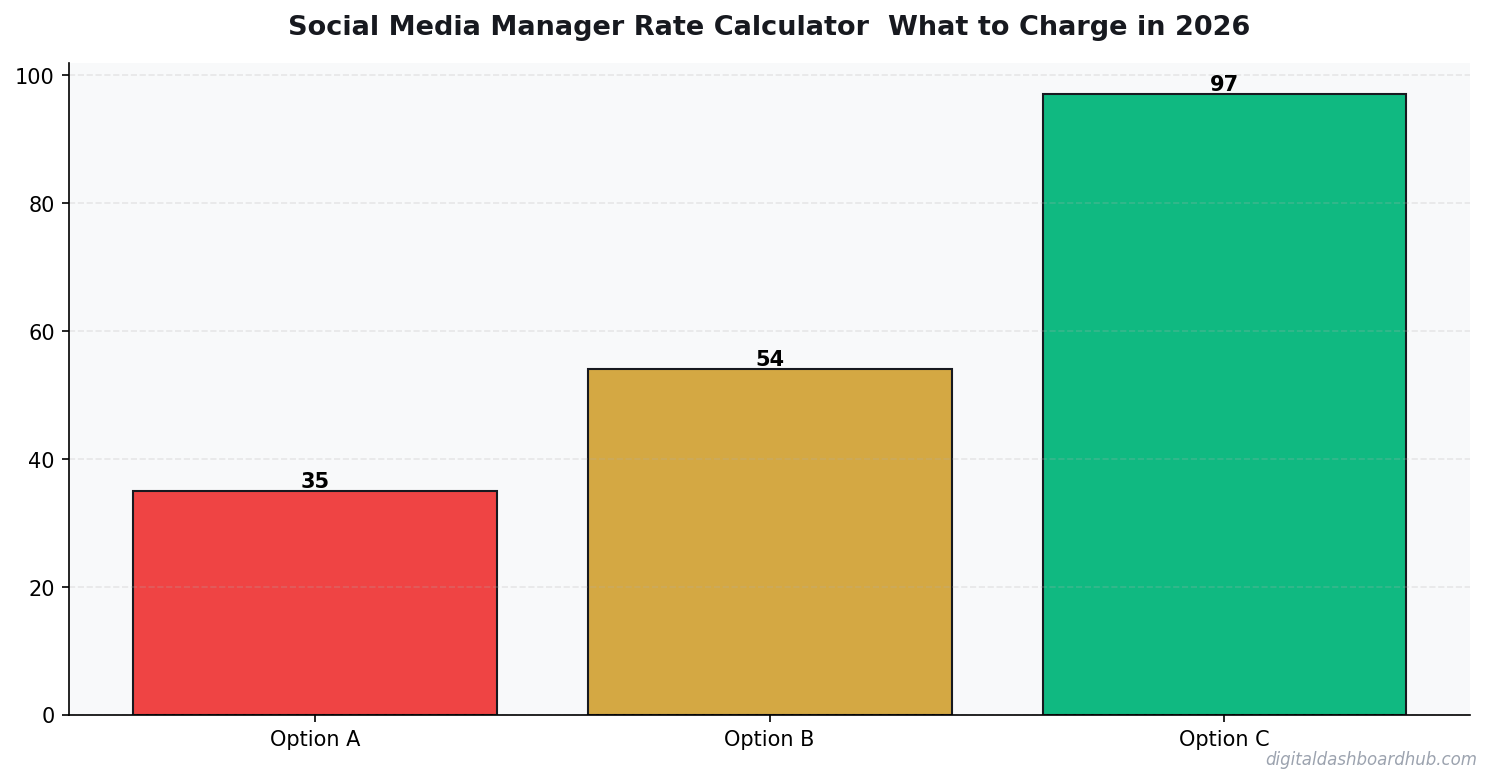
Hourly only makes sense for consulting calls, one-off projects, or when you genuinely can’t estimate scope.
Monthly Retainer: $1,000–$8,000/client
This is where most successful social media managers land. You define a package (X posts, Y platforms, Z hours of engagement), charge a flat monthly rate, and scope-creep becomes manageable because the deliverables are clear.
The sweet spot for a solo manager: 4–6 retainer clients at $2,000–$3,500 each = $8,000–$21,000/month. More than 6 clients and quality drops. Fewer than 4 and you’re vulnerable to a single cancellation.
Performance-Based: Base + Percentage of Results
Some managers charge a lower base ($1,000–$2,000) plus a percentage of ad spend (10–20%) or a bonus for hitting KPIs (follower growth, engagement rate, lead generation). This works well when you’re confident in your skills and the client has real revenue tied to social media.
Risk: if the client’s product sucks or their sales team drops the ball, your bonus evaporates despite great social media performance.
What should YOU charge? The social media manager rate calculator factors in your experience, platforms, service scope, and market to recommend a specific rate range.
In-House vs. Freelance vs. Agency: Income Comparison
How to Raise Your Rates Without Losing Clients
The #1 fear: “If I raise my rates, they’ll leave.” Reality: good clients expect rate increases. Here’s the playbook:
- Give 60 days’ notice. “Starting [date], my monthly rate will increase to $X. This reflects the expanded scope and results we’ve achieved together.”
- Tie it to results. Show them the metrics: follower growth, engagement increase, leads generated. When clients see ROI, price becomes secondary.
- Offer a loyalty lock. “I’m raising rates for new clients to $4,000/month. As an existing client, I’m offering you $3,500 if you commit to 6 months.” Everyone loves feeling like they got a deal.
- Be prepared to lose 1 client. If you have 5 clients at $2,000 and raise to $2,800, losing 1 client still nets you more ($11,200 vs. $10,000). And you freed up time to land a new client at the higher rate.
I put together a rate increase email template and client ROI report template. Get both free with your trial.
The Platform Premium
Not all platforms require the same effort or command the same rates:
- TikTok/Reels: Highest rate premium (video production is time-intensive). Charge 30–50% more.
- LinkedIn: B2B clients pay more because LinkedIn leads are worth more. Premium pricing territory.
- Pinterest: Lower effort per pin but requires SEO knowledge. Good for passive management retainers.
- Instagram: The baseline. Most clients start here. Standard rates apply.
- X/Twitter: High-maintenance (real-time engagement expected). Charge accordingly or avoid.
3 Brands
One Platform
Finance, Creator, and Wellness tools
Your Action Plan
- Calculate your current effective rate. Open the rate calculator, input your current clients and hours, and find out what you’re really making per hour. If it’s under $50, you have room to raise.
- Package your services. Stop custom-quoting every client. Build 3 packages (Basic, Growth, Premium) with clear deliverables and pricing. Packages communicate professionalism and make buying easier.
- Raise one rate this week. Pick your most underpriced client. Send the notice. The longer you wait, the more money you lose.
Over 2,000 freelancers use our calculators to price their services and track their income. Start your free trial and stop guessing what to charge.
A Real Rate Calculation: Social Media Manager in the Midwest
Here’s how I’d actually think through pricing if I were a social media manager in Indianapolis setting rates for 2026. Assume 3 retainer clients. Each client gets 3 posts/week across Instagram and LinkedIn, plus 1 monthly strategy call and a monthly performance report.
Time per client: 8 hours/week for content creation, 2 hours scheduling/analytics, 1 hour communication = 11 hours/week, 44 hours/month. At a $50/hour blended rate, that’s $2,200/month per client. Three clients = $6,600/month. But your effective hourly rate on a $2,200 retainer at 44 hours is exactly $50 — which feels fine until you account for non-billable time.
Add 30% for admin, pitching, invoicing, and professional development: your real time investment is 57 hours/month per client. Now your effective rate is $38.60/hour. That’s a solo SMM making good money but not great money. To hit $75/hour effective, that same retainer needs to be $4,275/month — or you need to cut the time investment in half through better systems.
The Two Levers That Move Your Rate the Most
Specialization premium. A social media manager who works with “anyone” bills $35–$55/hour. A social media manager who works exclusively with orthodontists, or SaaS startups, or e-commerce brands doing $2M+/year bills $75–$120/hour. Same skills, same hours, completely different positioning. Niching down is the single highest-ROI move in this business.
Results documentation. Every client win you can quantify — follower growth rate, engagement rate improvement, leads generated, revenue attributed — makes your next rate increase defensible. “I grew a client’s Instagram from 2,400 to 18,000 followers in 8 months with a 4.2% engagement rate” closes deals. “I manage social media” doesn’t. Start building your case file now, even if it means asking current clients for access to their analytics.
What to Charge for Ad Management (People Always Get This Wrong)
If you run paid ads, don’t bury it in your retainer. Charge a separate ad management fee — typically 15–20% of ad spend with a $500/month minimum. A client spending $2,000/month on ads should pay you $400 at minimum, not have it absorbed into a flat retainer you priced before you knew ads were part of the scope. Scope creep on ad management is where SMM businesses quietly lose $500–$1,000/month in unrealized revenue.
Keep reading (related guides):
- Mortgage Comparison Calculator: Find the Best Rate and Term
- How to Calculate Your Freelance Rate (So You Stop Undercharging)
- Free ADHD Freelancer Ops Tool: Finally a System That Works With Your Brain
- ADHD Freelancer Dashboard: Run Your Business Without Dropping Every Ball
- Debt Snowball vs Avalanche Calculator: Which Method Saves You More Money
What to Include in Every Social Media Management Quote
Your quote is both a sales document and a scope contract. Including these elements protects your margin and closes the deal faster.
1. Fixed monthly deliverables, itemized
Not “manage Instagram” — specify “20 feed posts, 15 Stories, 3 Reels, 1 strategy call per month, community management under 2 hours daily.” Every undefined deliverable becomes scope creep. Every defined one justifies your price.
2. Platforms explicitly named
Instagram and TikTok are 60% more work than LinkedIn and Twitter. Quote each platform separately, even if you bundle for a package rate. This gives you clean line items to upsell from if they want to add a channel later.
3. Response times and working hours
“I respond within 24 business hours, Monday-Friday” prevents weekend DMs from your client at 11pm. Put your working hours in writing. Clients respect what’s documented and ignore what isn’t.
4. Content approval process and deadlines
“You approve all content 48 hours before post date. Content not approved by then moves to the next cycle.” Without this, a client who takes a week to approve a batch can destroy your content calendar and your margin.
5. Outcome metrics, not vanity metrics
Report monthly on follower growth, engagement rate, traffic to site, and leads generated — not impressions or reach. Clients renew based on outcomes they can tie to business results, not platform metrics that don’t turn into revenue.
Quick FAQ: Social Media Rate Calculator
How do I set my hourly rate?
Target annual income ÷ 1,200 billable hours. Want $100K? That’s $83/hour. Want $150K? $125/hour. Most social media managers undercharge because they calculate based on 2,000 “available” hours — but only 1,100-1,300 of those are actually billable after admin, sales, and time off.
What if a client says my rate is too high?
Fine — they’re not your client. Price signals quality in services. Dropping your rate to match a budget-constrained lead usually means 6 months of unhappy work followed by a bad referral. Keep your rate, propose a lower-scope option, or pass.
How do I raise rates on existing clients?
Give 60-day notice in writing. Tie the increase to results delivered, not just time elapsed. Offer a one-tier-down option at the current rate. Most clients accept 10-18% annual increases without friction if you’ve been delivering.
Should I offer discounts?
Rarely. Multi-month prepayment (3-6 months): 5-8% discount is reasonable. Non-profits or passion projects: personal decision but don’t make it your business model. Blanket “first-month free” or 50%-off deals attract price-sensitive clients you won’t want long-term.
How should I price one-off consulting?
Hourly: $150-$350 depending on experience. Strategy session packages: $500-$2,500 for defined deliverables (content audit, strategy doc, competitor analysis). Don’t mix hourly consulting with monthly retainers in your pricing — they communicate different things.
255+ interactive tools for your money, time, and health.
14 days free · No charge today · 2-click cancel
Keep Reading
- Freelancer Finance Dashboard: Track Income, Taxes, and Cash Flow
- The Side Hustle Tax Trap: Track Every Dollar
- Freelancer Tax Guide 2026
Common Questions About Social Media Manager Rate Calculator: What to Charge in 2026
How long does it take to see results?
Most people see meaningful progress within 30-90 days when they apply these strategies consistently. The key is tracking your numbers from day one so you have a baseline to measure against.
What’s the biggest mistake people make?
Trying to do everything at once. Pick one or two strategies from this guide, implement them fully, then layer in additional tactics. Spreading yourself thin is the fastest way to see no results from any of it.
Do I need special tools or software?
Not necessarily to start — but the right tools eliminate hours of manual work. Our free calculators and trackers at Digital Dashboard Hub are a good starting point before you invest in paid software.

Andy Gaber is the founder of Digital Dashboard Hub, a suite of 255+ interactive financial, productivity, and wellness tools. He built DDH after getting frustrated with financial apps that gave outputs without context. Follow along for tool tutorials, revenue analytics breakdowns, and honest takes on personal finance.