Use the free Candle Soap Revenue Calculator below — plug in your real numbers and get instant results. No signup required for the lite version.
Try the Candle Soap Revenue Calculator
The dashboard below loads instantly in your browser. Plug in your numbers, see your answer. No signup to try the basics.
Candle Soap Revenue Calculator
Enter your numbers below — results update instantly
Want the full Candle Soap dashboard with expense tracking, break-even analysis, and growth projections?
Why This Matters
Running numbers in your head is how bad financial decisions happen. A quick calculation with real data beats a gut feeling every single time. I built this tool because I was tired of spreadsheet gymnastics just to answer basic questions about my finances.
The calculator above handles the basics. But if you need trend tracking, scenario comparison, and exportable reports — the full version inside Digital Dashboard Hub does all of that and more.
What You Get in the Full Dashboard
| Approach | Startup Cost | Time Investment | Revenue Potential | Best For |
|---|---|---|---|---|
| Solo operator | Low ($1K-$10K) | Full time | $60K-$200K/yr | Maximum margins, full control |
| Small team (2-5) | Medium ($10K-$50K) | Management + some fieldwork | $200K-$800K/yr | Scaling without losing control |
| DDH Revenue Tracker | Free trial | 5 min setup | N/A (profit tool) | Know your real numbers in real time |
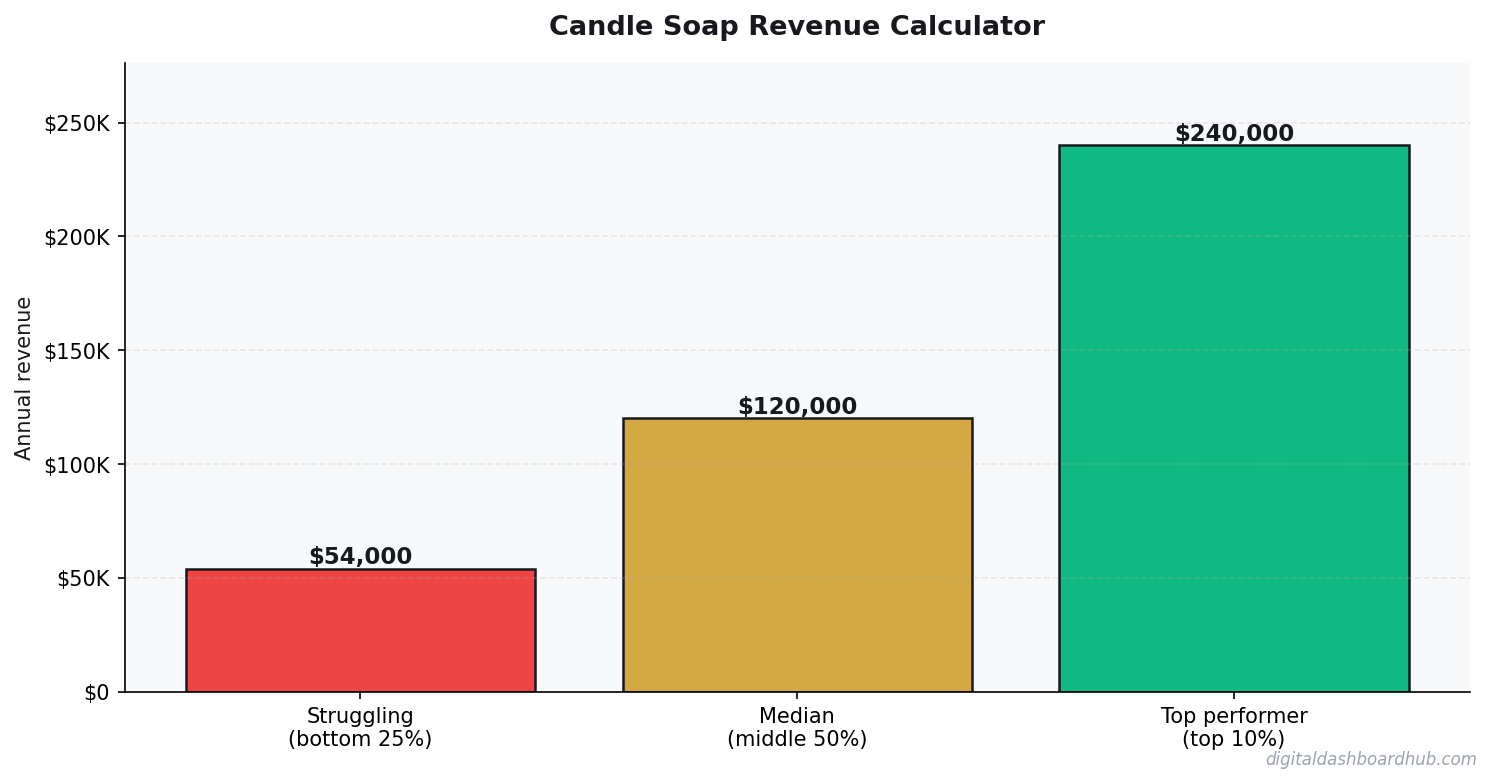
The full Candle Soap Revenue Calculator inside DDH includes features the lite version above can’t offer:
- Historical tracking — see your numbers change over weeks and months
- Visual charts — bar graphs, trend lines, and breakdowns that make patterns obvious
- Scenario modeling — “what if I change X?” comparisons side by side
- PDF reports — export professional reports for partners, lenders, or your own records
- — one subscription covers every calculator and tracker in the library
How to Use This Tool
Step 1: Enter your actual numbers in the fields above. Don’t guess — pull from your bank statements or business records for the most accurate results.
Step 2: Read the output cards. They update instantly as you type. Play with different scenarios to see how small changes affect your bottom line.
Step 3: If you want to save your results, track changes over time, or run more advanced projections — start a free 14-day trial of the full dashboard. No credit card required.
Your Next Move
You’ve already done the hardest part — you looked at your numbers instead of avoiding them. Here’s what to do with that momentum:
- Right now (30 seconds): Bookmark this page so you can rerun the calculation next month
- This week: Pull your real numbers from your accounts and run them through the calculator above
- Long game: Try the full DDH dashboard — 261 tools, 14 days free, cancel anytime
Keep Reading
- How to Track Variable Expenses When Your Budget Never Looks the Same Twice
- Workout Progress Tracker: The Method That Finally Kept Me Consistent
- How to Regulate Your Nervous System: 8 Steps to Move From Chronic Stress to Calm
Common Questions About Candle Soap Revenue Calculator
How long does it take to see results?
Most people see meaningful progress within 30-90 days when they apply these strategies consistently. The key is tracking your numbers from day one so you have a baseline to measure against.
What’s the biggest mistake people make?
Trying to do everything at once. Pick one or two strategies from this guide, implement them fully, then layer in additional tactics. Spreading yourself thin is the fastest way to see no results from any of it.
Do I need special tools or software?
Not necessarily to start — but the right tools eliminate hours of manual work. Our free calculators and trackers at Digital Dashboard Hub are a good starting point before you invest in paid software.
A Real-Numbers Look at Candle and Soap Revenue
Let’s run the actual math on a candle business doing $4,000/month in revenue — a reasonable year-two target for a serious part-time maker.
Average candle price: $22. Units sold: 182/month. Material cost per candle (wax, fragrance, wick, vessel, label): $6.20. Total materials: $1,128.40. Packaging and shipping supplies: $220. Merchant fees at 8%: $320. Total COGS: $1,668. Gross margin: $2,332 — a 58.3% margin before your labor.
If making 182 candles takes 34 hours total, you netted $68.59/hour. That’s actually solid — but only if you’re efficient. A beginner spending 60+ hours brings effective hourly rate to $38.87.
The 3 Factors That Move Candle and Soap Revenue Most
1. Wholesale vs. retail ratio. Selling wholesale to boutiques at 50% of retail feels like a margin hit — but a single boutique account placing $600 orders quarterly is worth $2,400/year with zero marketing effort. 70% retail, 30% wholesale is a healthy balance at the $3,000-5,000/month level.
2. Seasonal demand planning. Candle and soap businesses spike hard in Q4. If you’re not building inventory in August and September, you’ll run out of bestsellers during your highest-margin window. One missed holiday season of stockouts can cost 25-35% of annual revenue.
3. Product line discipline. The temptation to create 40 scents is real. The math favors 8-12 core SKUs done well. More SKUs mean more raw material minimums, more labeling complexity, and more inventory risk. Focus on what sells.
Why Candle and Soap Margins Look Great Until You Do the Real Math
The math on handmade candles and soap looks promising at first glance: pour $8 in materials, sell for $28, keep $20. But that $20 doesn’t account for the time spent sourcing, pouring, curing, labeling, photographing, listing, and shipping. At minimum wage, a candle that takes 45 minutes of total labor has a real cost of $15.75 in time alone. Add materials, and you’re making $4.25 on a $28 product.
The math improves dramatically at scale with batching. Pouring 50 candles in one session instead of 5 cuts per-unit labor time by 60–70%. Same principle applies to soap curing batches. Makers who treat production like a small manufacturing operation — dedicated production days, optimized workstations, standardized recipes — run much better margins than those who fill orders one at a time.
The products with the best economics aren’t always the most popular. A $45 “premium” candle with unique fragrance blending and a custom vessel might have the same materials cost as a $28 standard candle but triple the margin. Specialty positioning consistently outperforms volume pricing in the handmade goods space.
Where Candle and Soap Businesses Actually Make Money
Wholesale and corporate gifting are often more profitable than retail despite lower per-unit prices. A corporate holiday gift order of 500 candles at $12 each (with $4 in materials and $2 in labor) generates $3,000 in profit from one order. Compare that to selling those same candles retail at $28 each but spending 200+ hours on fulfillment, customer service, and marketing over a full quarter.
Subscription boxes and repeat buyer programs are the other lever. A candle of the month club at $22/month with a $6 product cost and $2 shipping net runs at 64% margin. More importantly, you can plan production, forecast revenue, and batch efficiently. Subscriptions also have much lower customer acquisition cost per dollar of revenue than one-time retail sales.
Makers who cross $100K gross consistently have diversified into at least two channels. Relying solely on Etsy or local markets creates revenue fragility. The most resilient businesses I’ve seen combine an owned e-commerce store (higher margins), wholesale accounts (reliable volume), and one seasonal channel (holiday markets or craft fairs for brand awareness and cash injection).
SaaS Metrics That Predict Revenue 90 Days Out
Most SaaS founders track lagging indicators — revenue, churn, MRR growth — and react after the damage is done. These three leading indicators give you a 60–90 day warning window:
Trial activation rate. The percentage of trials that complete your core onboarding action (not just sign up — actually use the product) predicts paid conversion rate almost perfectly. If activation drops 5 points, expect paid conversions to drop 2–3 points 30 days later. Fix activation before you spend more on acquisition.
Feature adoption breadth. Customers using 3+ features churn at roughly half the rate of customers using 1 feature. If new signups aren’t adopting secondary features within the first 14 days, your onboarding is creating single-feature customers who are one bad experience away from canceling.
Support ticket volume per customer. A rising ticket rate signals product confusion, which precedes churn by 4–6 weeks. Track it per cohort — if a specific month’s cohort is generating more tickets, something in that period’s onboarding or feature release broke the experience.
Keep reading (related guides):
- Auto Mechanic Revenue: What Owners Make vs. What Youd Expect (2026)
- Boutique Revenue Calculator
- Home Seller Net Proceeds Calculator: What Youll Actually Walk Away With
- A/B Test Results Analyzer: Know If Your Winner Is Real or Just Random Noise
- Small Business Finance Basics: The Only 5 Numbers You Need to Track Weekly
Full dashboard access · Stripe-secure checkout · Cancel anytime

Andy Gaber is the founder of Digital Dashboard Hub, a suite of 255+ interactive financial, productivity, and wellness tools. He built DDH after getting frustrated with financial apps that gave outputs without context. Follow along for tool tutorials, revenue analytics breakdowns, and honest takes on personal finance.