
If you’re paid every two weeks, you already know the struggle: payday comes and goes, and suddenly you’re three days from the next check wondering how your bank account got so thin. The frustration isn’t that you’re bad with money—it’s that biweekly pay creates a budgeting challenge that monthly budgeting advice just doesn’t solve.
Here’s the thing nobody tells you: a biweekly paycheck budget requires a completely different strategy than monthly budgeting. You’re not working with 12 paychecks a year or 24 monthly cycles. You’re actually managing 26 paychecks, which throws everything off. Bills don’t care that you get paid every two weeks. Rent still comes due on the same day every month. Groceries still need to be bought the same way.
But here’s the good news: once you understand how to structure a budget for biweekly pay, you’ll never stress about money between paychecks again. You’ll actually have a clear system, predictable cash flow, and—best part—those bonus paycheck months will feel like winning the lottery.
Let me walk you through exactly how to do this.
Why Biweekly Budgeting Is Different
Before we get to the approach, let’s understand the problem. If you’re using a traditional monthly budget, you’re probably tracking spending by calendar month. But your paychecks don’t align with calendar months at all.
Here’s the math: With 52 weeks in a year and paychecks every 2 weeks, you get 26 paychecks annually. If you divided your annual income by 12 months, you’d be assuming 24 paychecks a year. That’s why your monthly budget never quite works.
Worse, some months you get three paychecks. This happens twice a year.
The truth is, traditional monthly budgeting doesn’t account for the rhythm of biweekly pay. You need a system that tracks two paychecks at a time.
Think about it this way: if you earn $2,500 per paycheck after taxes, your monthly take-home isn’t $5,000. It’s actually $5,416 when you annualize it ($2,500 × 26 ÷ 12). That $416 difference per month is real money—nearly $5,000 a year—that gets lost in the cracks of a monthly budget. A biweekly system captures every dollar.
Biweekly vs. Monthly Budgeting: A Side-by-Side Comparison
Monthly budgeters estimate their income as two paychecks per month and build a single spending plan around that number. It feels clean, but it ignores the two months each year where a third paycheck shows up. Those “extra” paychecks often get absorbed into lifestyle spending instead of going toward debt or savings.
Biweekly budgeters, on the other hand, build a spending plan around each individual paycheck. Every pay period has its own mini-budget: its own bills, its own savings allocation, and its own discretionary spending cap. Nothing falls through the cracks because you’re planning at the cadence your employer actually pays you.
Here’s a concrete example. Say your rent is $1,800 and it’s due on the 1st. With monthly budgeting, you just allocate $1,800 from “this month’s income.” But with biweekly pay, you need to know: which paycheck covers rent? If you’re paid on the 3rd and the 17th, you need $1,800 available from a paycheck that hasn’t landed yet. That mismatch causes overdrafts, late fees, and panic. A biweekly system solves this by assigning rent to the correct pay period and pre-positioning cash.
The Biweekly Paycheck Calendar: Know Exactly Which Bills Hit Which Check
A Before/After: What Biweekly Budgeting Actually Changes
Here’s a typical scenario. $1,650 paycheck lands on the 1st. Rent is $900, due the 5th. Groceries run $350/month. Car payment is $280, due the 15th. That leaves $120 for everything else for the rest of the month — and the second paycheck on the 15th has to cover utilities, insurance, gas, and any unexpected cost before the cycle resets.
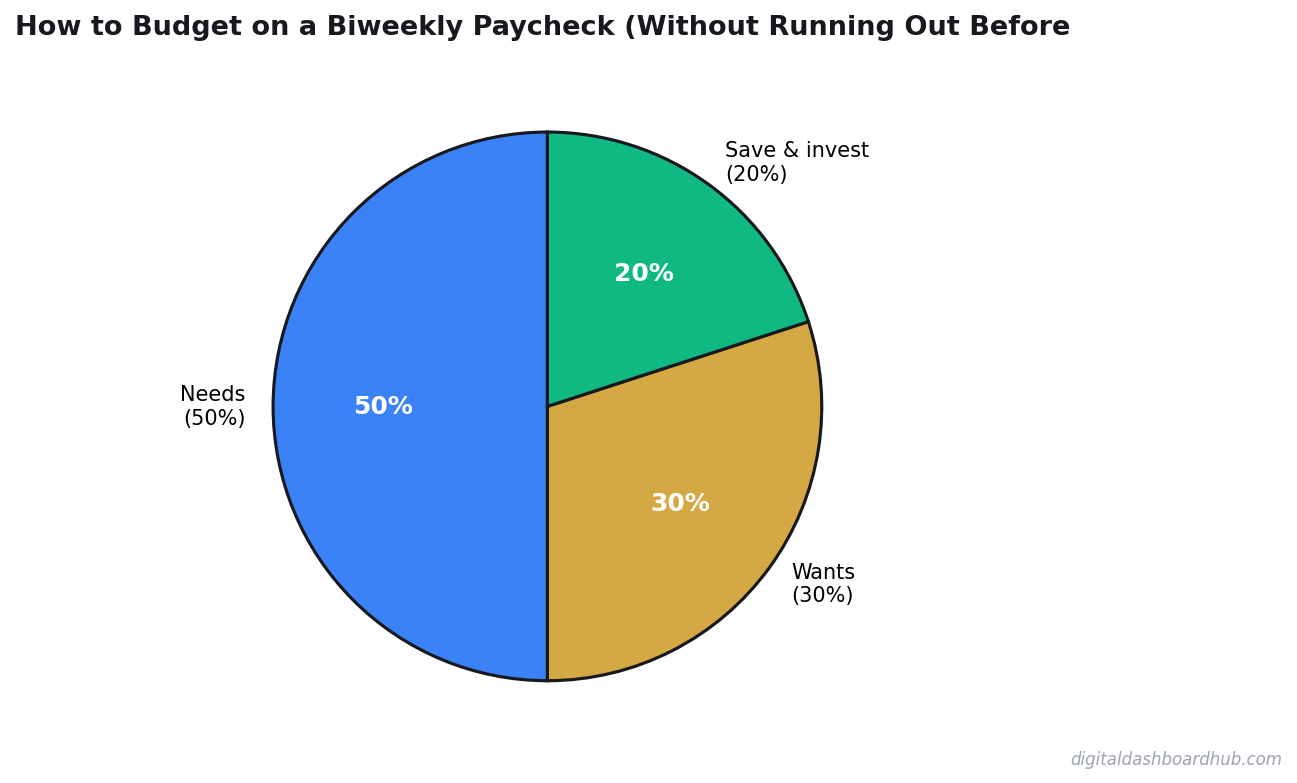
The problem isn’t the math. The problem is that the math lives in your head, not on paper. When the second paycheck lands, it feels like income, but $430 in committed expenses is already waiting for it. That “fresh” $1,650 is actually $1,220 in spending money before you’ve bought a single thing this week.
Biweekly budgeting fixes this by assigning every dollar of every check before it lands. Check 1 covers rent and groceries. Check 2 covers car, utilities, gas, and a set savings transfer. Whatever’s left in each check is discretionary — and you know exactly how much that is before you spend a single dollar.
The Two-Paycheck Month Problem
There’s a quirk in biweekly pay that catches people off guard: twice a year, you get three paychecks in a month. Most months have 2 checks. But with a biweekly schedule, 2 months per year have 3.
People who budget monthly treat the third check like a windfall and spend it on wants. People who budget strategically earmark it in advance — emergency fund top-up, debt payoff, sinking fund contribution. Knowing which months will have 3 checks and planning for them in advance is one of the highest-ROI budgeting moves you can make.
Common Biweekly Budget Mistakes
The biggest one: treating variable expenses as annual averages divided by 26. Car insurance might be $1,200/year, so people budget $46.15 per paycheck. But if the premium comes out quarterly as a lump sum, that $46 never actually leaves the account — until the $300 charge hits and suddenly the budget is in crisis. Track variable expenses by when they actually hit, not when they theoretically average out.
Second biggest: no buffer. A biweekly budget with no cushion means any deviation cascades into the next category. Keep at least $150-$200 as a standing buffer in your checking account that you treat as zero. Call it your “budget floor.”
Third: not adjusting for irregular income months. Overtime, bonuses, tax refunds — these should go directly into predetermined categories (debt, savings, sinking funds) before they hit the checking account and disappear into general spending. Decide before you see the money where it goes.
Building the Budget in Practice: A Simple Framework
Step 1: list every recurring expense with its due date and whether it hits check 1 or check 2. Expenses in the first two weeks of the month (rent, certain utilities, first-of-month subscriptions) go to check 1. Everything else to check 2.
Step 2: Subtract committed expenses from each check. What remains is your discretionary budget for that pay period — groceries, dining, entertainment, personal spending. If the math doesn’t work, something has to change: income, expenses, or both. The budget makes that visible.
Step 3: automate savings on payday. Even $50 moved to a savings account the moment each check lands is $1,300/year in automatic savings, before you’ve had a chance to spend it. The most important budgeting principle is that decisions made before you have the money are more effective than decisions made after.
When Your Budget Doesn’t Balance: What to Do
Most biweekly budget templates assume the math works out. Often it doesn’t — especially on the first attempt. If your committed expenses plus a reasonable discretionary allowance exceed your take-home pay, you have an income problem, an expense problem, or both. The budget didn’t create the problem; it made it visible. That’s valuable.
The triage order: first, look for expenses that are optional contracts (subscriptions, gym memberships, streaming services). These can be cancelled immediately and show up fast. Second, look for expenses with flexibility (grocery budget, dining, entertainment). Third, recurring fixed costs — these require more work to reduce (renegotiating bills, refinancing, moving) but have higher impact when addressed. Finally, income: a side income of $300-$400/month changes a tight biweekly budget significantly, and often faster than expense cuts of equivalent size.
The biweekly budget is a feedback mechanism, not a constraint. When it shows your current spending pattern doesn’t work at your income level, that’s the information you needed — and now you can act on it.
The biweekly budget only works if you actually use it. Build it once, automate what you can (savings transfers, bill pay), and review it weekly for 90 days. After 90 days of consistent use, most people find the check-in takes under 5 minutes because the structure is already doing the work. The first 90 days are where habits form and where most budgets either stick or don’t — commit to the full 90 before evaluating whether it’s working.
Keep reading (related guides):
- Free Sinking Fund Calculator — Try It Now
- Free Menopause Symptom Tracker — Try It Now
- Nervous System Regulation Tracker: The Visual Dashboard That Helps You Understand Your Bodys Stress Signals
- I Owed $47,000 in Taxes and Had $11,000 in the Bank: How I Rebuilt My Freelance Finances From the Ground Up
- Etsy Seller Revenue Calculator: Project Your Monthly Shop Income
255+ interactive tools for your money, time, and health.
14 days free · No charge today · 2-click cancel

Andy Gaber is the founder of Digital Dashboard Hub, a suite of 255+ interactive financial, productivity, and wellness tools. He built DDH after getting frustrated with financial apps that gave outputs without context. Follow along for tool tutorials, revenue analytics breakdowns, and honest takes on personal finance.