The Experiment I Almost Did Not Start
Ninety days ago, if you had told me I would be writing about tracking my nervous system, I would have smiled politely and changed the subject. I was the person who rolled my eyes at wellness dashboards, who thought “nervous system regulation” was just therapy-speak for “calm down,” and who believed that stress was just part of being a functional adult with a demanding career. You power through it. That is what adults do.
Then I hit a wall. Not a dramatic, cinematic collapse — just a slow, grinding deterioration. I was sleeping seven hours but waking up exhausted. My digestion was a mess for no apparent reason. I would snap at my partner over nothing and then feel terrible about it. I could not focus for more than twenty minutes without reaching for my phone. My jaw ached every morning from clenching it all night. And underneath all of it was this constant, low-grade buzz of anxiety that I could not trace to any specific source.
My therapist suggested I start tracking my nervous system states. She explained the basics of polyvagal theory — how the autonomic nervous system cycles between three states (safe and social, fight-or-flight, and shutdown) — and recommended I use a tracking tool to log my states, symptoms, and what I was doing to regulate throughout the day. I was skeptical, but I was also miserable enough to try anything. So I committed to 90 days with a nervous system regulation tracker. Here is what happened.
Week One: The Humbling Realization That I Had No Self-Awareness
The first thing I learned was that I had almost zero ability to identify my own nervous system state in real time. The tracker asked me to check in three times a day and note whether I felt ventral (safe, grounded, connected), sympathetic (activated, anxious, restless), or dorsal (shut down, numb, collapsed). On the first day, I checked “ventral” for all three because I thought I felt fine.
Then I read the descriptions more carefully. Ventral vagal means genuinely at ease — you are present, your breathing is deep and regular, you feel connected to the people around you, and your body is relaxed. I went back and honestly reassessed my day. By that standard, I had not been in ventral at all. I was in low-grade sympathetic activation from the moment I checked my email at 6:45 AM until I collapsed into dorsal shutdown on the couch around 8 PM.
That first week was humbling. Day after day, the tracker showed the same pattern: wake up already slightly activated, ramp into full sympathetic mode by mid-morning, stay there through a marathon of meetings and deadlines, and crash into numbness every evening. I was spending essentially zero time in a regulated, ventral state. No wonder I felt terrible.
The other revelation from week one was how many physical symptoms I had been ignoring. When the tracker prompted me to log physical signals, I started noticing things I had completely normalized: my shoulders were up by my ears by 10 AM, I was holding my breath during focused work, my stomach was tight and uncomfortable after lunch, and my hands were cold even in a warm room. These were not random discomforts — they were my nervous system telling me exactly what state I was in. I had just spent years not listening. Learning to actually measure my stress rather than just vaguely sensing it was a game changer.
Month One: The Sleep Connection That Changed My Mornings
| Approach | Startup Cost | Time Investment | Revenue Potential | Best For |
|---|---|---|---|---|
| Solo operator | Low ($1K-$10K) | Full time | $60K-$200K/yr | Maximum margins, full control |
| Small team (2-5) | Medium ($10K-$50K) | Management + some fieldwork | $200K-$800K/yr | Scaling without losing control |
| DDH Revenue Tracker | Free trial | 5 min setup | N/A (profit tool) | Know your real numbers in real time |
By the end of the first month, I had enough data for the tracker to show me some meaningful patterns. The biggest one was the connection between my evening state and the next morning’s baseline.
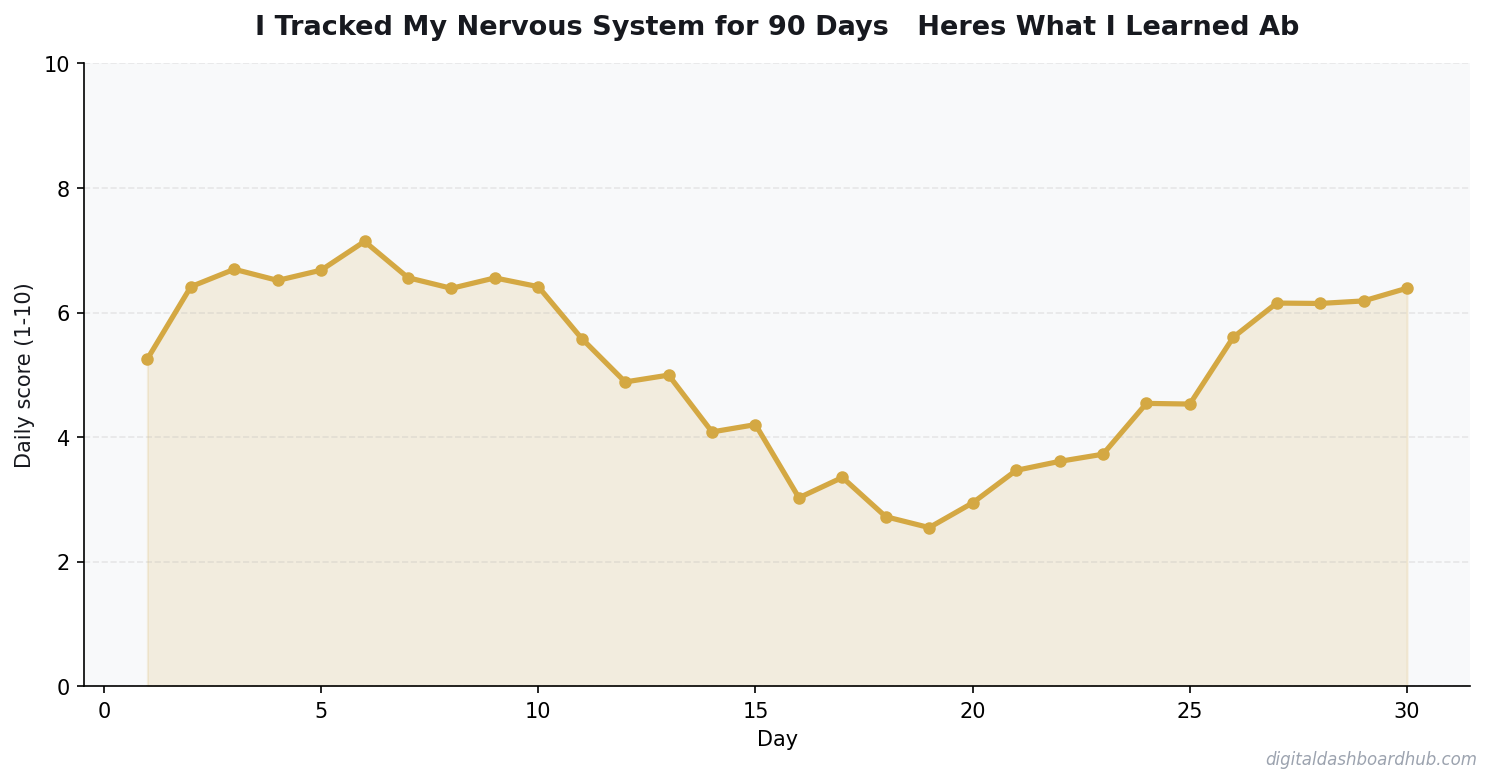
On nights when I spent the last two hours before bed in dorsal shutdown — scrolling my phone mindlessly, watching TV I was not really paying attention to, eating snacks I was not hungry for — I woke up the next morning already sympathetically activated. My resting heart rate was higher, my first check-in showed agitation and restlessness, and the entire day tended to be more dysregulated.
But on the few nights when I accidentally did something that brought me into ventral before bed — a real conversation with my partner, a walk around the block, twenty minutes of reading a physical book — the next morning was measurably different. Lower baseline activation, calmer first check-in, and a noticeable increase in my ability to handle the normal stressors of the day without spiraling.
This was not subtle. The pattern showed up clearly on the tracker’s trend view within three weeks. It was the same kind of pattern-recognition power that makes mood tracking so effective — you see connections that are completely invisible when you are living inside the experience without data to reference.
I started what I called a “ventral wind-down” routine: phone in another room by 8 PM, fifteen minutes of gentle stretching, and then whatever felt genuinely enjoyable and connecting rather than numbing. The shift in my morning state was noticeable within days. My sleep tracker confirmed it too — my sleep quality scores jumped by about 15 percent within two weeks of consistent evening regulation.
Month One, Part Two: Identifying My Biggest Triggers
The tracker also helped me identify my top three sympathetic triggers with uncomfortable clarity. Number one was back-to-back video calls with no transition time. The data showed my activation spiking during the second consecutive call and not coming back down until I had at least thirty minutes of unstructured time. Number two was checking email first thing in the morning — every time I started the day in my inbox, my first check-in was sympathetic. Number three was skipping lunch or eating at my desk while working. The combination of low blood sugar and sustained cognitive demand pushed me into high sympathetic every single time.
None of these insights were shocking in retrospect, but without the data, I had never connected these specific behaviors to these specific nervous system consequences with enough clarity to actually change anything. The tracker made the connection undeniable.
Month Two: Finding What Actually Regulates My Specific Nervous System
This was the month everything started to shift. I had been trying various regulation techniques — breathwork, meditation apps, cold showers, journaling, exercise — and logging each one along with my state before and after. The results were surprising.
The regulation techniques I expected to work the best (long meditation sessions, intense exercise) actually produced mixed results. Meditation was helpful when I was mildly activated but made things worse when I was highly sympathetic — sitting still with my thoughts racing just amplified the agitation. Intense exercise brought me down from high sympathetic effectively but often pushed me past regulation into dorsal shutdown afterward, especially if I was already depleted.
The techniques that consistently worked for my nervous system were more mundane: five minutes of slow, extended exhale breathing (not a 45-minute meditation); walking outside without headphones for fifteen to twenty minutes; brief social interaction that involved genuine laughter or connection; and humming or singing along with music (which activates the vagus nerve through vocal cord vibration, apparently). Each of these reliably shifted my state from sympathetic toward ventral within minutes, and the tracker’s correlation data confirmed it over dozens of instances.
The personalization aspect was crucial. I had spent years trying techniques because they worked for other people, not because data showed they worked for me. The tracker eliminated the guesswork and gave me a shortlist of proven regulation tools for my specific nervous system. If you have ever struggled with building a meditation practice, understanding your nervous system state first might be the missing piece.
Month Two, Part Two: The Anxiety Pattern I Never Would Have Found Without Data
Around week seven, the tracker surfaced a pattern that genuinely shocked me. Every Sunday evening, my sympathetic activation spiked — not mildly, but to the same levels I experienced during my most stressful workdays. This happened regardless of whether I had a pleasant weekend, regardless of what the coming week looked like, regardless of everything I thought might be causing it.
When I looked at the data more carefully, the Sunday spike had been there from week one. It was so consistent that it was clearly not situation-dependent — it was a conditioned nervous system response. My body had learned, over years of stressful Monday mornings, to begin activating the night before. I was experiencing anticipatory stress that had nothing to do with my current reality and everything to do with a pattern my nervous system had encoded years ago.
Identifying this pattern was the first step to breaking it. I started deliberately front-loading regulation on Sunday evenings — the walks, the breathing, the social connection — and within three weeks, the Sunday spike had decreased by roughly half. It did not disappear entirely (deeply encoded patterns take time), but knowing it was a conditioned response rather than a reaction to actual danger made it far less distressing. I could notice the activation, label it, regulate through it, and move on.
Month Three: The Baseline Shift
By the beginning of month three, something fundamental had changed. Not in a dramatic, overnight transformation way — in a measurable, data-backed way. My daily average time in ventral state had increased from roughly 15 percent in week one to nearly 45 percent. My sympathetic activation peaks were less intense and shorter in duration. My dorsal shutdown episodes — those evening crashes into numbness — had decreased from daily occurrences to roughly twice per week.
The physical symptoms tracked alongside these changes. My jaw clenching had decreased significantly (my dentist confirmed this at a routine appointment, unprompted). My digestion had normalized. My sleep quality scores were consistently in a range I had not seen in years. And the low-grade anxiety — that constant background hum that had been my companion for so long I barely noticed it anymore — had quieted to something I only experienced situationally rather than constantly.
The numbers told the story clearly, but the subjective experience was even more striking. I felt like a different person — not because I had eliminated stress from my life, but because I had developed the capacity to move through stress without getting stuck in it. The activation would come, I would notice it (the tracking habit had made me hyper-aware of my internal state), I would deploy a regulation technique that I knew worked for me, and I would return to baseline. The whole cycle that used to take hours or even days now took fifteen to thirty minutes.
What 90 Days of Nervous System Tracking Taught Me
Looking back at three months of data, several core lessons stand out. First, self-awareness is not something you have or do not have — it is a skill you develop through consistent practice and feedback. The tracker was my feedback mechanism, and my self-awareness improved dramatically simply from the habit of checking in multiple times per day.
Second, regulation is not one-size-fits-all. The techniques that work for you might not work for me, and the only way to know is to test and track. Anecdotal evidence and influencer recommendations are not enough — your nervous system is unique and deserves personalized data.
Third, patterns that feel emotional or psychological are often physiological. My Sunday anxiety was not a mindset problem — it was a conditioned nervous system response. My inability to focus was not a discipline problem — it was a dysregulation problem. My evening numbness was not laziness — it was dorsal shutdown from sustained sympathetic overdrive. Reframing these experiences through a nervous system lens was more therapeutically valuable than years of trying to think my way out of them. The same data-driven philosophy behind depression mood tracking applies here — measurement creates understanding, and understanding creates the possibility of change.
Fourth, and most importantly, change is not instantaneous but it is measurable. If I had tried to assess my progress based on how I felt on any given day, I would have concluded the experiment was failing during weeks when I happened to have a bad stretch. But the trend lines told a completely different story — a story of steady, undeniable improvement that was invisible at the daily level but obvious at the monthly level.
Would I Recommend Tracking Your Nervous System?
Without hesitation, yes. But I would add a caveat: commit to at least 30 days before you assess whether it is working. The first two weeks feel awkward and forced. The data is sparse and patterns are not yet visible. It is easy to dismiss the whole thing as navel-gazing wellness nonsense (trust me, I had that thought multiple times in week one).
But somewhere around week three or four, when the trend lines start forming and the correlations start appearing, something shifts. You stop tracking because you committed to an experiment and start tracking because the data is genuinely useful and occasionally revelatory. By month two, it becomes as natural as checking the weather — a quick glance at your internal state that takes seconds and informs how you approach the rest of your day.
I went into this experiment as a skeptic and came out as someone who checks his nervous system dashboard the way he used to check his stock portfolio — regularly, with genuine interest, and with a clear sense of what the numbers mean and what to do about them. If you are dealing with chronic stress that bubble baths cannot fix, tracking your nervous system might be exactly the approach you have been missing.
The version of me from 90 days ago would not recognize the version writing this. Not because of some miraculous transformation, but because of something more valuable: understanding. I understand my body’s signals now. I understand my triggers. I understand which tools actually work for me. And I have the data to prove all of it.
Start Your Own Nervous System Tracking Journey
You might also find this helpful: IVF Cycle Tracking: How to Stay Organized Through the Most Overwhelming Process of Your Life.
Keep reading (related guides):
- Free ADHD Impulse Spending Tracker — Try It Now
- ADHD Impulse Spending Tracker: The Free Visual Dashboard Built for Your Brain
- Nervous System Regulation Tracker: The Visual Dashboard That Helps You Understand Your Bodys Stress Signals
- ADHD Daily Routine Planner: How to Build Structure That Works With Your Brain (Not Against It)
- Sinking Fund Savings Goal Planner: The Free Visual Dashboard That Kills Surprise Expenses
255+ interactive tools for your money, time, and health.
14 days free · No charge today · 2-click cancel

Andy Gaber is the founder of Digital Dashboard Hub, a suite of 255+ interactive financial, productivity, and wellness tools. He built DDH after getting frustrated with financial apps that gave outputs without context. Follow along for tool tutorials, revenue analytics breakdowns, and honest takes on personal finance.