Your partner just showed you the positive test. After the initial rush of emotions, a quieter thought creeps in: “How much is this actually going to cost?” You Google it, find a number like “$15,000 for the first year,” and have no idea whether that’s accurate for YOUR situation, YOUR city, YOUR insurance plan. Generic averages don’t help when you’re trying to build a real budget for a real baby.
In This Article
I pulled data from hospital billing databases, insurance cost analyses, and parent surveys to build a year-by-year baby cost calculator that breaks down exactly where the money goes — from the delivery room through age five. Turns out the numbers actually look like when you stop rounding.
Year Zero: The Delivery and Setup Costs
Jump in: the tool below is live and free to play with. Upgrade to a dashboard account when you want to save scenarios and track over time.
Before the baby even comes home, you’re looking at two major cost buckets:
Hospital delivery: The average vaginal delivery in the US costs $14,768 before insurance (FAIR Health, 2025). C-sections average $22,646. After insurance, your out-of-pocket typically runs $2,500-$5,000 depending on your plan’s deductible and coinsurance. If you have an HSA or FSA, this is exactly what it’s for.
Nursery and gear setup: The minimalist approach (crib, car seat, stroller, basic clothing, diapers) runs about $1,500-$2,500. The “Pinterest nursery” approach can hit $5,000-$8,000. The smart play is somewhere in between — buy the car seat and crib new (safety matters), get everything else secondhand or from registries.
The biggest single line item: childcare. Full-time daycare averages $1,230/month nationally. In high-cost metros (Boston, DC, SF), it’s $2,000-$2,500/month. This single expense accounts for 45-55% of all baby-related costs in the first five years.
The First Year Breakdown (Where $16,800 Actually Goes)
Year one is the most expensive and the most variable. Here’s the average breakdown:
Childcare: $8,400-$14,760/year. This assumes full-time care starting around month 3 (when most parental leave ends). A nanny is 30-50% more expensive than a daycare center. A nanny share splits costs but limits flexibility. Family care is free but rarely full-time.
Diapers and wipes: $900-$1,200/year. Newborns go through 8-12 diapers per day. By month 6 it drops to 6-8. At an average of $0.28 per diaper, you’re spending $70-$100/month. Cloth diapers cost $300-$500 upfront and save roughly $600/year, but they add 3-4 loads of laundry per week.
Formula (if not breastfeeding): $1,200-$2,400/year. Standard formula runs $100-$150/month. Specialty formulas for allergies or sensitivities can hit $200-$400/month. This is one of those costs that’s either $0 (breastfeeding) or $1,200+ (formula) — there’s very little middle ground.
Pediatrician visits: $400-$800/year after insurance. The AAP recommends 7 well-child visits in the first year. Copays of $25-$50 per visit add up. Sick visits (plan for 3-5) add more. And then there’s the inevitable ER visit for a fever that turns out to be nothing — $250-$500 out of pocket.
How the DDH Baby Cost Calculator Handles This
I built this calculator because every other baby cost tool I found online gave a single lump-sum number with zero customization. “Having a baby costs $15,000 in the first year.” Cool, but I live in Austin, my partner plans to breastfeed, we’re doing a nanny share, and my insurance has a $3,000 deductible. Generic numbers are useless for specific plans.
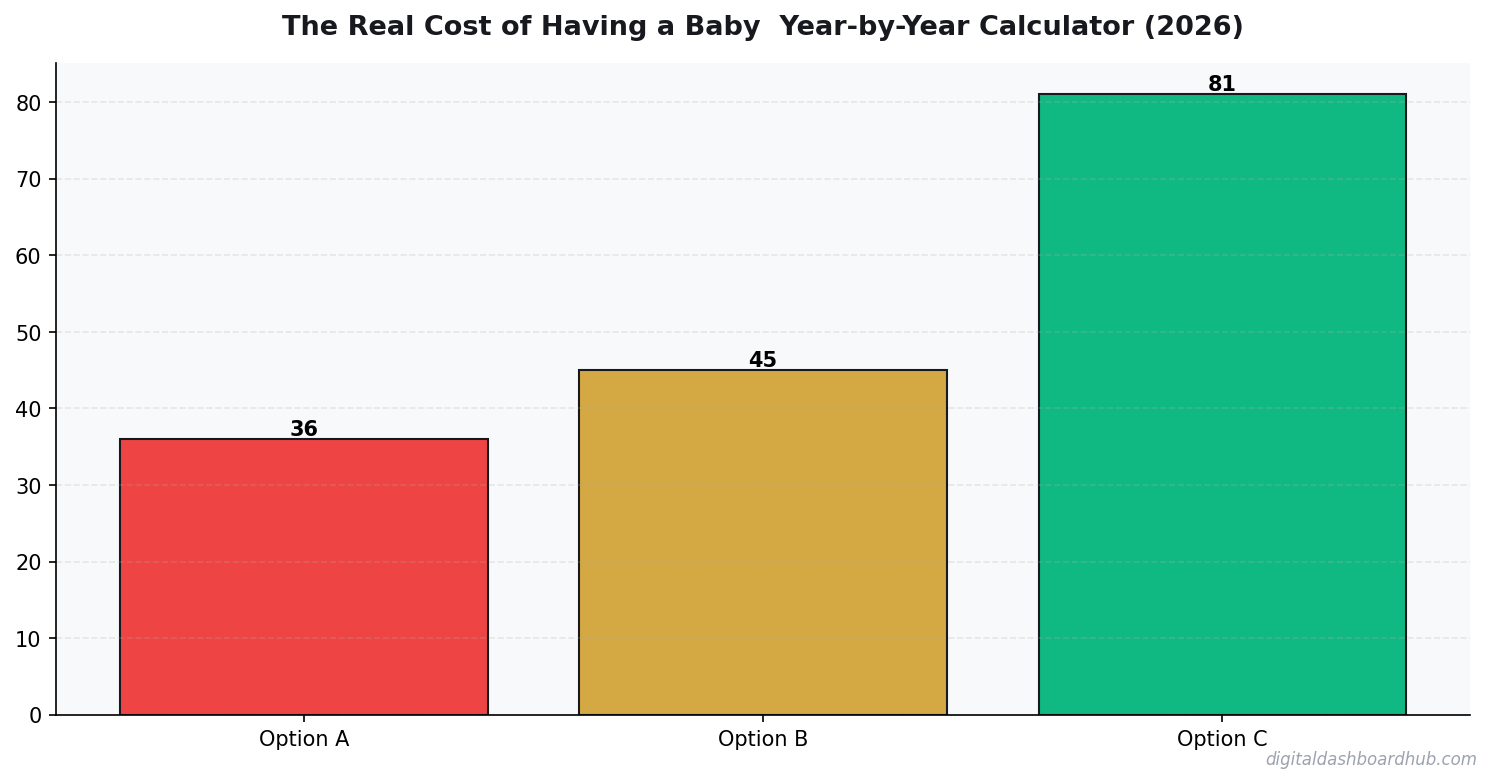
The DDH Baby Cost Calculator lets you select your specific situation for each category: your delivery type (vaginal/C-section), insurance deductible, childcare plan (daycare/nanny/nanny share/family), feeding method, and city cost-of-living. It then generates a month-by-month cost projection for the first year and a year-by-year view through age 5.
When my friend Sarah ran her numbers, the calculator showed her that switching from a private nanny ($2,200/month) to a nanny share ($1,300/month) would save her $10,800 in the first year alone. That one adjustment funded her entire emergency buffer for unexpected baby costs. The tool paid for itself in one use.
Try the DDH Baby Cost Calculator free — get your personalized month-by-month projection in 5 minutes.
FREE BONUS: The Baby Budget Planner Spreadsheet
Month-by-month budget template for baby’s first year with pre-filled category estimates. Customize the numbers to match your situation.
Get instant access → Sign up free
The Costs That Sneak Up on New Parents
Income loss during leave. The US has no federal paid family leave. If your employer doesn’t offer paid leave, 6-12 weeks of unpaid time off for one parent costs $6,000-$18,000 in lost wages. Even with paid leave, many plans only cover 60-80% of salary. Budget the gap.
The “just this once” spending pattern. Sleep-deprived parents make impulse purchases. That $40 sleep sack. The $80 noise machine. The $120 baby monitor upgrade because the first one’s app was glitchy. I’ve talked to dozens of new parents, and the average “impulse baby gear” spending in the first year is $800-$1,500 — money that wasn’t in any budget.
Increased utilities. More laundry (3-4 extra loads/week), higher heating/cooling (baby rooms need consistent temperature), more hot water usage. Expect your utility bills to jump $50-$80/month. Small individually, but that’s $600-$960 per year nobody warns you about.
Smart Strategies to Cut Baby Costs by 30%
Buy nothing groups. Facebook Buy Nothing groups are goldmines for baby gear. Babies outgrow everything in 2-3 months. Other parents are desperate to get rid of barely-used items. I’ve seen Uppababy strollers ($900 retail) posted for free pickup.
Registry strategy. Create registries at 3 stores. Add the expensive essentials (car seat, crib, stroller) plus consumables (diapers, wipes in multiple sizes). Most registries offer a 15% completion discount on anything not purchased by your shower date. Time your registry strategically.
Use a sinking fund approach. Instead of one “baby fund,” create separate funds for predictable expenses: delivery copay, gear/setup, and 3-month childcare reserve. This prevents the gear splurge from eating into your childcare budget.
Stop Reading, Start Doing
Right now (5 minutes): Call your insurance company (or check your plan docs online) and find three numbers: your deductible, your coinsurance rate, and your out-of-pocket maximum. These three numbers determine your delivery cost — the single biggest day-one expense.
This week: Run your numbers through the DDH Baby Cost Calculator. Plug in your actual insurance, childcare plans, and city. The personalized number will replace that vague anxiety with a concrete savings target.
The long play:<
/strong> Set up a sinking fund system with 3 buckets (delivery, gear, childcare reserve) and automate monthly transfers. Even $300/month for 9 months gives you $2,700 in buffer before the baby arrives. $0 To Get Started Full access during your trial period Keep reading (related guides): 255+ interactive tools for your money, time, and health. Full dashboard access · Stripe-secure checkout · Cancel anytime Most people notice meaningful patterns within 2 to 4 weeks of consistent tracking. The first week is almost always noisy — you’re still learning what to record, when to record it, and how honest to be with yourself. By week two, baselines emerge. By week four, you can start testing changes against data instead of guessing. Don’t judge the system in the first seven days. Give it a full month before deciding whether the system is worth keeping or whether the approach needs a rethink. Start with one metric that is both objective and daily. Objective means a number, not a feeling. Daily means once every 24 hours, not “whenever I remember.” Two metrics is fine; three is too many to sustain for someone new. You can always add more once the habit is locked in. The goal of the first month is consistency, not coverage. It’s better to track one thing perfectly for thirty days than six things sloppily for five, and the data will be far more useful. Miss one day, no problem — tracking is a long game and single-day gaps don’t break the trend. Miss two days in a row, and your brain starts negotiating you out of the system entirely. The rule most people use: never miss twice. Log something — even a single data point — on the second day, then resume the full routine the next morning. Streaks matter less than quick recovery after a miss, and nobody maintains an unbroken record forever. The goal is resilience, not perfection. No. A notebook, a spreadsheet, or a free tool all work. The paid-app question should come after 4 weeks of consistent tracking, not before. If you’re going to quit inside the first two weeks, you’ll quit a free tool and a paid one at roughly the same rate. Prove the habit first, then decide whether a paid tool removes enough friction to be worth the subscription. Don’t use “finding the perfect app” as a way to avoid starting the system this week. Two rules. First, log at the same time each day — morning before coffee, or evening before bed — so you control the biggest variable. Second, write down the conditions, not just the number. A reading without the time, posture, and recent activity is almost useless. A check-in without the context of sleep or stress is just noise. Structure your log so the conditions travel with the measurement. Data without context is decoration, not signal, and won’t help you make better choices. Weekly for noticing; monthly for deciding. A weekly review is a five-minute scan for surprises: what changed, what stayed the same, what correlates with what. A monthly review is longer and ends with a decision — keep the system, change one variable, or scrap the experiment and try a different approach. Don’t try to decide anything meaningful from a single week of data. And don’t wait a full quarter to look back, either — trends go stale fast when you’re not watching. Andy Gaber is the founder of Digital Dashboard Hub, a suite of 255+ interactive financial, productivity, and wellness tools. He built DDH after getting frustrated with financial apps that gave outputs without context. Follow along for tool tutorials, revenue analytics breakdowns, and honest takes on personal finance.
Explore More
Common Questions About Cost Having Baby Calculator Year
How long before I see results?
What should I track first?
What if I miss a day?
Do I need a paid app to do this?
How do I know the data is accurate?
When should I review the data?
