You’ve Googled “how to deal with anxiety” so many times that Google probably thinks you’re writing a thesis. Deep breathing, journaling, therapy, exercise, supplements — you’ve tried some combination of all of it. Some days are better. Most aren’t. And the worst part is not knowing why some days are better.
In This Article
Anxiety self-management isn’t about eliminating anxiety (good luck with that). It’s about understanding your specific anxiety well enough to predict bad days, avoid unnecessary triggers, and stack the deck in your favor. That takes data, not just coping strategies.
Why “Just Breathe” Isn’t a Strategy
Scroll down — the interactive tool runs live with your inputs. Full version lives inside Digital Dashboard Hub. Two-click trial, Stripe-secure.
Breathing exercises work in the moment. So does going for a walk, splashing cold water on your face, or holding an ice cube. These are acute interventions — useful for getting through a panic spike, useless for reducing how often those spikes happen.
The analogy I keep coming back to: treating anxiety with only coping techniques is like treating a house fire by getting really good at running out of the building. Helpful in the moment, but wouldn’t you rather stop the fires from starting?
To reduce frequency and intensity, you need to understand your trigger patterns. Not the obvious ones (of course a job interview makes you anxious). The subtle ones: sleep quality, caffeine timing, social media exposure, blood sugar crashes, specific days of the week. These patterns are invisible without tracking.
What a Self-Management System Actually Looks Like
Forget complicated journals. A working anxiety self-management system has three components:
🔑 Real talk: the tracking itself changes your behavior. That’s not a bug — it’s the feature.
Daily check-in (90 seconds): Rate your anxiety 1-10, note your top trigger, log sleep hours. That’s it. No essays.
Weekly review (5 minutes): Look at your 7 data points. Which days were worst? What did they have in common? What was different about good days?
Monthly adjustment (10 minutes): Identify your top 2 trigger patterns and test one intervention. Then track whether it works.
Important note: This isn’t a replacement for therapy or medication if you need them. It’s a complement. Several therapists I’ve spoken to say they wish their clients tracked between sessions because session recall is notoriously unreliable.
My First 30 Days of Tracking
I started tracking in January. After testing my data revealed that my memory couldn’t:
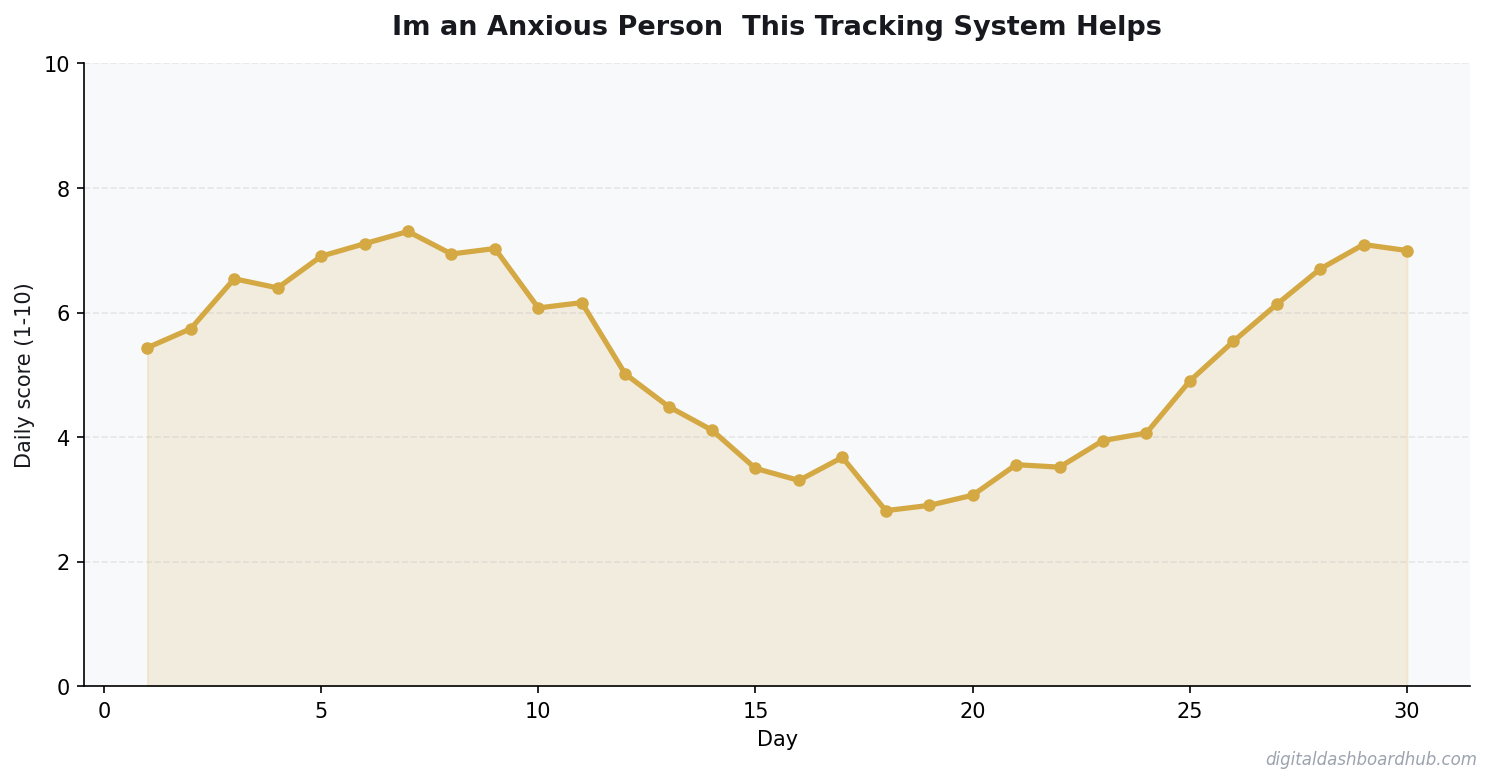
Caffeine after 2 PM was a trigger. Not caffeine in general — just afternoon caffeine. My worst anxiety scores clustered on days where I had coffee after lunch. I switched to decaf after 1 PM and my average evening anxiety score dropped by 1.4 points within a week.
Sunday nights were consistently the worst. No surprise there — anticipatory anxiety about Monday. But seeing it as a predictable pattern let me build a Sunday evening routine (light exercise, prep Monday’s tasks, no news) that reduced Sunday scores by about 30%.
Exercise was more powerful than I expected. Days with 20+ minutes of movement averaged 2.3 points lower than sedentary days. Not “exercise might help” — 2.3 points on a 10-point scale. That’s a measurable, significant difference. Nervous system regulation through movement is one of the most evidence-backed approaches and my data confirmed it personally.
FREE BONUS: The Anxiety Trigger Discovery Worksheet
A 14-day printable tracker with pre-loaded trigger categories and a built-in analysis template. Fill it out, flip to the analysis page, and your top triggers show themselves.
Get instant access → Download free
How the DDH Anxiety Tracker Handles This
Let me walk you through a typical day with the system.
It’s 9 PM. You open the dashboard, tap today’s date. Three fields: anxiety score (you pick 6), sleep last night (6.5 hours), trigger tag (you pick “work” from the dropdown). Done in 40 seconds.
After two weeks, the dashboard generates a heat map. Your week is color-coded — green days (scores 1-3), yellow (4-6), red (7-10). You immediately see that red days cluster on Monday-Tuesday and correlate with sub-6-hour sleep the night before.
The part that sold me: the intervention tracker. When you make a change (like cutting afternoon caffeine), you mark the start date. The dashboard automatically compares your average scores before and after that date. No math, no spreadsheet formulas — just a clear before/after comparison that tells you if your change is working.
Try the DDH Anxiety Tracker free → Start your 14-day discovery
34%
increase in goal achievement when using visual progress indicators
But I Don’t Want to Focus on My Anxiety More
This is the most common objection, and it’s valid. Won’t tracking anxiety make you more anxious?
In my experience — and supported by research from the University of Rochester — structured tracking reduces anxiety about anxiety. The ambiguity is often worse than the reality. When you can see that your average is a 4.7, not “terrible all the time,” it provides perspective your anxious brain can’t generate on its own.
The key word is “structured.” Ruminating about your anxiety all day makes it worse. Spending 90 seconds logging a score and moving on gives your brain a container for that information. It says “I’ve recorded this, I can let it go now.” Journaling works on the same principle — externalizing anxiety onto paper (or a dashboard) reduces its grip.
What to Do Now
Right now (2 minutes): Score your anxiety right now, 1-10. Write down what you think your #1 trigger is. Now you have a hypothesis to test over the next two weeks.
This week: Do the 90-second check-in every evening for 7 days. Paper, phone notes, or the DDH Anxiety Tracker — pick whatever you’ll actually do.
The long game: After 14 days, look at your data. Find one pattern. Make one small change. Track for another 14 days. That cycle — observe, adjust, measure — is the entire self-management system. It’s not complicated. It’s consistent.
Still h
Key Takeaways
- Track one thing consistently rather than five things sporadically
- Review your data weekly — daily logging without weekly review is just data hoarding
- The best tool is the one you’ll actually open every day
ere? You’re ready to understand your anxiety instead of just surviving it.
Join 400+ people who started the Anxiety Trigger Discovery process this month. Most identify their top trigger within 10 days.
Get your free worksheet → Start discovering
Keep reading (related guides):
- How Much Does Therapy Cost in 2026? A State-by-State Breakdown
- Free ADHD Impulse Spending Tracker — Try It Now
- Why Traditional Budgets Fail ADHD Brains — And the Visual Tracker That Actually Works
- Nervous System Regulation Tracker: The Visual Dashboard That Helps You Understand Your Bodys Stress Signals
- How Journaling Rewires an Anxious Brain: A Science-Backed Guide
255+ interactive tools for your money, time, and health.
14 days free · No charge today · 2-click cancel
3 Brands
One Platform
Finance, Creator, and Wellness tools
People Also Read
- How to Track Your Anxiety and Actually Reduce It
- How to Regulate Your Nervous System: 8 Steps to Calm
- How Journaling Rewires an Anxious Brain
- Depression Mood Tracker: How Tracking Mental Health Data Helps
Common Questions About Anxiety Self Management Tracking
How long before I see results?
Most people notice meaningful patterns within 2 to 4 weeks of consistent tracking. The first week is almost always noisy — you’re still learning what to record, when to record it, and how honest to be with yourself. By week two, baselines emerge. By week four, you can start testing changes against data instead of guessing. Don’t judge the system in the first seven days. Give it a full month before deciding whether the system is worth keeping or whether the approach needs a rethink.
What should I track first?
Start with one metric that is both objective and daily. Objective means a number, not a feeling. Daily means once every 24 hours, not “whenever I remember.” Two metrics is fine; three is too many to sustain for someone new. You can always add more once the habit is locked in. The goal of the first month is consistency, not coverage. It’s better to track one thing perfectly for thirty days than six things sloppily for five, and the data will be far more useful.
What if I miss a day?
Miss one day, no problem — tracking is a long game and single-day gaps don’t break the trend. Miss two days in a row, and your brain starts negotiating you out of the system entirely. The rule most people use: never miss twice. Log something — even a single data point — on the second day, then resume the full routine the next morning. Streaks matter less than quick recovery after a miss, and nobody maintains an unbroken record forever. The goal is resilience, not perfection.
Do I need a paid app to do this?
No. A notebook, a spreadsheet, or a free tool all work. The paid-app question should come after 4 weeks of consistent tracking, not before. If you’re going to quit inside the first two weeks, you’ll quit a free tool and a paid one at roughly the same rate. Prove the habit first, then decide whether a paid tool removes enough friction to be worth the subscription. Don’t use “finding the perfect app” as a way to avoid starting the system this week.
How do I know the data is accurate?
Two rules. First, log at the same time each day — morning before coffee, or evening before bed — so you control the biggest variable. Second, write down the conditions, not just the number. A reading without the time, posture, and recent activity is almost useless. A check-in without the context of sleep or stress is just noise. Structure your log so the conditions travel with the measurement. Data without context is decoration, not signal, and won’t help you make better choices.
When should I review the data?
Weekly for noticing; monthly for deciding. A weekly review is a five-minute scan for surprises: what changed, what stayed the same, what correlates with what. A monthly review is longer and ends with a decision — keep the system, change one variable, or scrap the experiment and try a different approach. Don’t try to decide anything meaningful from a single week of data. And don’t wait a full quarter to look back, either — trends go stale fast when you’re not watching.
Is it worth tracking if my data is imperfect?
Yes. Imperfect data beats no data every time, as long as you know where the imperfections are. A log with a few missing days and honest notes about what went wrong is more useful than a complete but fabricated record. The goal isn’t a museum-quality dataset — it’s enough signal to make better decisions next month than you made last month. Perfect is the enemy of done, especially in week one when the habit itself is fragile.

Andy Gaber is the founder of Digital Dashboard Hub, a suite of 255+ interactive financial, productivity, and wellness tools. He built DDH after getting frustrated with financial apps that gave outputs without context. Follow along for tool tutorials, revenue analytics breakdowns, and honest takes on personal finance.