Six months ago, I loaded five habits into a tracker and committed to doing all of them daily. Reading 20 pages, meditating 10 minutes, exercising 30 minutes, journaling, and drinking 80oz of water. Full send. The self-improvement dream team.
In This Article
The Setup: How I Tracked Everything
Enter your own numbers in the interactive tool below and get a real-time read. The dashboard version adds saved scenarios, history, and full feature access.
Running a SaaS business means I track these numbers obsessively. Here’s what the data actually shows:
I used a visual habit dashboard that showed daily completion as colored cells — green for done, red for missed, yellow for partial. No apps with notifications I’d learn to ignore. No journal that would end up in a drawer. Just a visual board I saw every morning when I opened my laptop.
The psychology behind this matters: research shows that tracking a habit makes you 42% more likely to follow through. But not all tracking is equal. The key is visibility — if you have to open an app, navigate to a screen, and tap through menus, tracking itself becomes a habit you need to build. Bad design.
The 6-Month Scorecard: Raw Numbers
The pattern is crystal clear: month 3 is the graveyard. Every single habit dipped in month 3. The novelty was gone, the results weren’t dramatic yet, and life got busy. The habits that survived all had one thing in common — I modified them to be easier, not harder.
💡 Most people overcomplicate this. Start with ONE metric and expand from there.
Why Reading and Water Tracking Died
Reading 20 pages sounds easy. It’s not. It requires 30-45 minutes of focused attention in a world where your phone offers infinite dopamine for zero effort. By month 4, I was “reading” with my phone face-up next to the book, checking it every 3 pages. The habit wasn’t building — it was becoming a source of guilt.
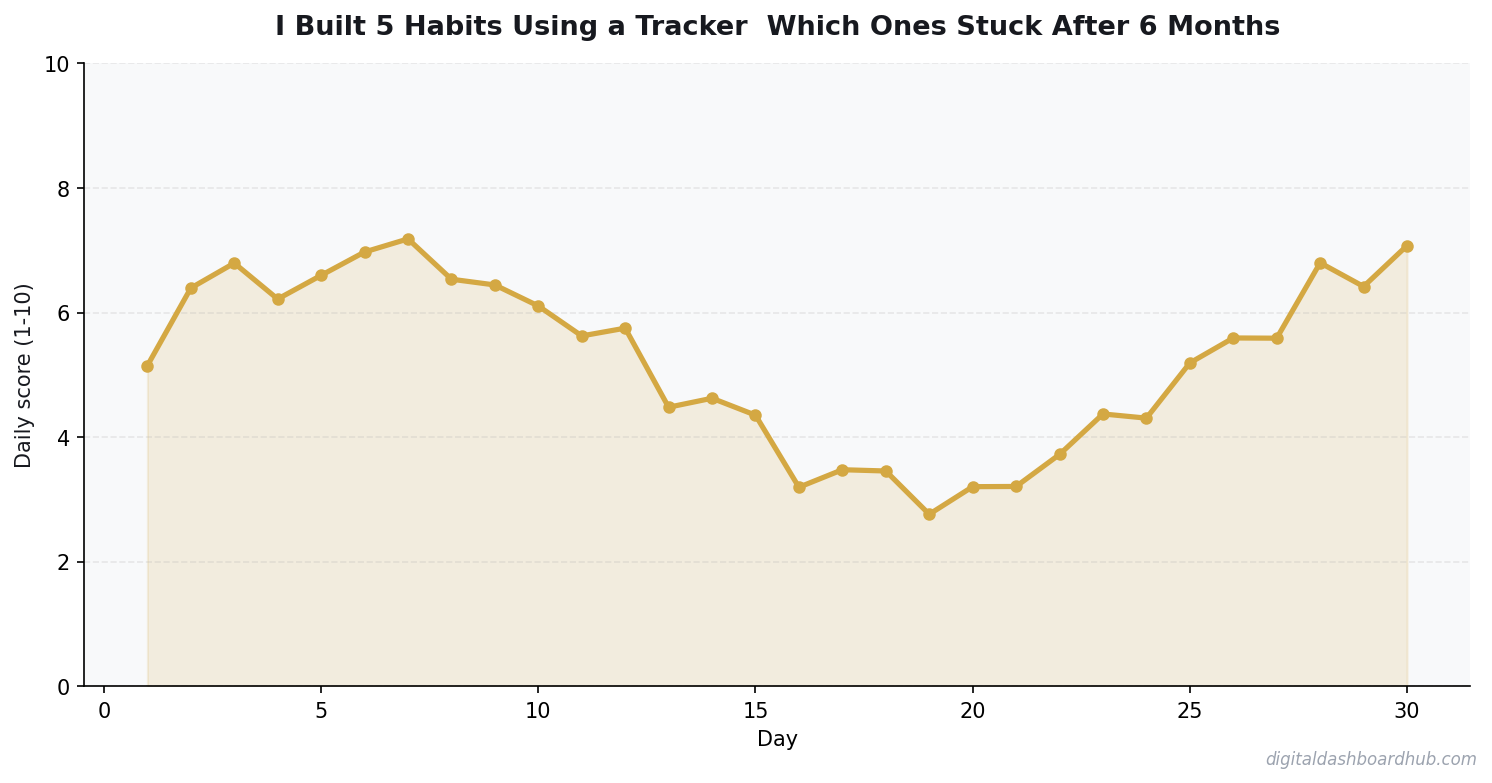
Water tracking died for a different reason: the tracking itself was too annoying. Logging every glass of water throughout the day required a level of micro-awareness I just couldn’t sustain. It’s not that hydration doesn’t matter — it’s that manually tracking fluid intake 8-10 times daily is a terrible habit design.
The lesson: if the tracking mechanism is harder than the habit, the tracking dies first, and the habit dies second.
Why Exercise, Meditation, and Journaling Survived
These three habits shared traits that the dead habits lacked:
Clear start and end. Exercise has a defined time block. Meditation has a timer. Journaling has a page. “Read 20 pages” felt indefinite because I’d lose count and check my progress repeatedly. Immediate reward. Post-exercise endorphins. Post-meditation calm. Post-journaling clarity. Water tracking gave me… needing to pee more? Not exactly motivating. Flexibility built in. I gave myself permission to do a 20-minute walk instead of a 30-minute gym session. A 5-minute meditation instead of 10. The complete guide to habits that stick calls this “minimum viable effort” — and it’s the single most important concept for long-term habit survival.
How the DDH Habit Tracker Handles This
The tracker I used was a DDH interactive dashboard, and the design choices are what made the difference compared to apps I’d tried before.
Step 1: I set up 5 habits with daily targets. Each habit gets a row, each day gets a column. One click to mark complete. The entire daily check-in takes under 30 seconds.
Step 2: The visual streak display shows consecutive days completed. Missing a day breaks the streak, and seeing that broken chain is surprisingly motivating to keep going. My longest meditation streak was 34 days — breaking it genuinely bothered me enough to restart immediately.
Step 3: The monthly completion percentage updates in real-time. When I saw reading drop below 50% in month 3, the data gave me permission to drop it intentionally instead of carrying the guilt. Data-informed quitting is underrated — it’s how you protect the habits that matter.
The part that sold me: the monthly trend comparison. Seeing exercise hold steady at 73-87% while reading cratered from 77% to 27% made the decision obvious. Double down on what’s working, cut what isn’t. Same principle we use in mood tracking — the data tells you what to keep.
Try the DDH Habit Tracker free — start with just 2-3 habits and track for 30 days.
34%
increase in goal achievement when using visual progress indicators
The Rules I’d Give My Past Self
Start with 3 habits maximum, not 5. Every habit you add reduces your success rate on all the others. Research suggests willpower is a shared resource — and it’s heavily influenced by sleep quality.
Build in a “minimum viable” version from day one. Don’t wait until month 3 to modify. Set your target as the floor, not the ceiling. “Exercise 15 min” with an average of 30 is better than “Exercise 30 min” that you skip entirely on hard days.
Track weekly completion rates, not daily streaks. Streaks create an all-or-nothing mentality. Missing one day shouldn’t feel like failure. 5/7 days (71%) is an excellent habit. Streaks make it feel like 0% because the chain broke.
What to Do Now
Right now (2 min): Pick the 2 habits you most want to build. Write down the minimum viable version of each — what’s the absolute smallest version you’d still count as “done”?
This week: Track those 2 habits daily for 7 days using whatever sy
Key Takeaways
- Start with the simplest possible system and add complexity only when needed
- Data shows you what’s working — stop guessing and start measuring
- Consistency beats intensity: 3 minutes daily beats 30 minutes weekly
stem is most visible to you. Paper on your desk, a browser tab, a whiteboard. The medium matters less than the visibility.
Long game: Set up DDH habit tracking and commit to 90 days. That’s when the real patterns emerge and you’ll know which habits have legs.
Keep reading (related guides):
- How Much Does Therapy Cost in 2026? A State-by-State Breakdown
- Free ADHD Impulse Spending Tracker — Try It Now
- ADHD and Side Hustles: Best Business Ideas for the ADHD Brain
- Why People with ADHD Start Everything and Finish Nothing (And 7 Systems That Actually Help)
- How Journaling Rewires an Anxious Brain: A Science-Backed Guide
255+ interactive tools for your money, time, and health.
Full features for 14 days · Secure payment · Stop anytime
Explore More
- The Science of Habit Tracking: Why Writing It Down Works
- The Complete Guide to Building Habits That Actually Stick
- Mood Tracker: How Measuring Emotions Helps You Change Them

Andy Gaber is the founder of Digital Dashboard Hub, a suite of 255+ interactive financial, productivity, and wellness tools. He built DDH after getting frustrated with financial apps that gave outputs without context. Follow along for tool tutorials, revenue analytics breakdowns, and honest takes on personal finance.