The Car Wash Industry Is Having a Moment
About this article: I’m Andy, founder of Digital Dashboard Hub. I built DDH’s 255 free interactive tools to solve the specific financial, productivity, and wellness tracking gaps I kept seeing — starting with the problem this article covers. The free tool below is available without signup and works instantly. Try it and see your numbers in real time.
Bottom Line
In This Article
- The Car Wash Industry Is Having a Moment
- The Four Models at a Glance
- Self-Service Bay: The Semi-Passive Play
- Express Tunnel: The Subscription Revenue Machine
- Full-Service: The Margin Squeeze
- Mobile Detailing: Low Entry, High Hustle
- How the DDH Car Wash Revenue Calculator Handles This
- The Location Factor: Where You Build Matters More Than What You Build
- Mid-Article Bonus: The Membership Math for Express Tunnels
- The Practical Takeaway
The smart operators target a 60/40 split: 60% of revenue from memberships, 40% from single washes. That gives you a stable base with upside from walk-in volume on sunny weekends.
Car washes are a $15 billion industry in the US, and they’re growing at 5.5% annually. Private equity firms have been acquiring car wash chains at aggressive multiples. Subscription models (unlimited washes for $30-$50/month) have transformed express washes into recurring revenue machines. And mobile detailing has exploded thanks to Instagram marketing and low startup costs.
Worth Noting
These calculations account for inflation, taxes, and real-world variables most free tools ignore.
But “car wash” isn’t one business model — it’s at least four fundamentally different businesses that happen to involve cleaning cars. The revenue potential, startup costs, labor requirements, and scalability of each model are so different that picking the wrong one for your situation can mean the difference between $80K/year and $800K/year.
Let’s break down all four.
The Four Models at a Glance
Self-Service Bay: The Semi-Passive Play
Self-service car washes are the vending machine of the car wash world. Customers pull into a bay, insert coins or credit cards, and wash their own car using the equipment you provide — pressure washer, foam brush, rinse, wax, vacuum. Your main job is maintenance, not customer service.
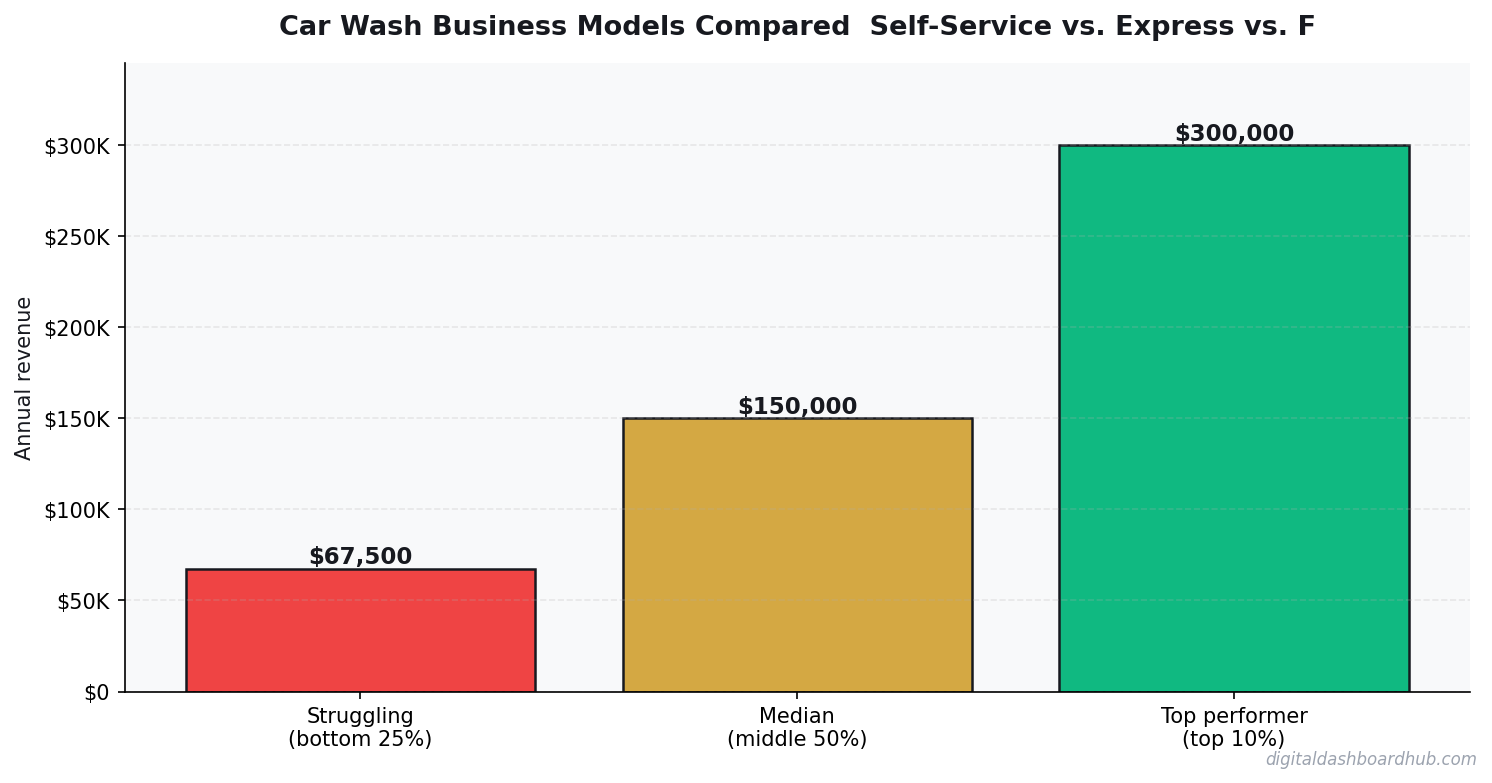
A typical self-service wash has 4-6 bays and 4-8 vacuum stations. Revenue per bay averages $50-$100 per day in a decent location, which puts a 5-bay wash at $250-$500/day or $91K-$182K per year. Add vacuum revenue ($30-$60/day for 6 stations) and vending machines ($10-$20/day), and a solid self-service location generates $120K-$250K annually.
The beauty is the labor model. You need 1-2 part-time employees for cleaning, maintenance, and coin collection. No washers, no detailers, no tip-outs. Operating expenses are primarily water, electricity, chemicals, and equipment maintenance. Net margins of 35-55% are common for well-maintained locations.
The downside: growth is purely location-dependent, the experience isn’t premium enough to command high prices, and credit card payment systems need constant upkeep. Also, self-service volumes are declining as younger consumers prefer the convenience of express washes. This is a model that works but has limited upside.
Express Tunnel: The Subscription Revenue Machine
This is where the big money is, and where private equity is pouring capital. An express tunnel wash processes 100-300+ cars per day through a conveyor system in 3-5 minutes per car. At $12-$20 per wash (or $30-$50/month unlimited membership), a single location can generate $500K-$2M+ in annual revenue.
The subscription model changed everything. When Mister Car Wash and similar chains introduced unlimited monthly plans, they created a recurring revenue business with 60-70% gross margins on membership revenue. A location with 2,000 active members at $40/month generates $960K/year in predictable, weather-resistant income. Even when it rains and per-wash revenue drops, membership revenue stays constant.
The catch: startup costs are enormous. A new express tunnel build-out runs $3M-$6M including land, equipment, and construction. Even converting an existing car wash to express format costs $1M-$3M. Financing is available, but you’re looking at $25K-$50K/month in debt service before you wash a single car.
Breakeven for an express tunnel typically takes 3-5 years. But once you’re past breakeven, the economics are outstanding — mature locations with strong membership bases can net $300K-$800K/year for the owner. That’s why PE firms are paying 8-12x EBITDA for established express wash chains.
Full-Service: The Margin Squeeze
Full-service car washes offer everything: exterior wash, interior cleaning, vacuuming, window cleaning, and sometimes detailing add-ons. The customer drops off the car, sits in a waiting room, and picks up a clean vehicle 20-45 minutes later.
Revenue per car is the highest of any model — $25-$75 per wash depending on the service package, plus $100-$300 for detail add-ons. A busy full-service wash doing 80-120 cars per day can generate $600K-$800K annually. With detailing services, that can push above $1M.
But here’s the problem: labor. Full-service washes need 8-20 employees per shift. Washers, vacuumers, window cleaners, detailers, cashiers, a manager. At $14-$18/hour per employee, labor costs eat 40-50% of revenue. Add in facility costs, water, chemicals, and insurance, and net margins drop to 15-30%.
Full-service is the hardest model to operate profitably because you’re essentially running a labor-intensive service business with razor-thin margins. The operators who succeed are obsessive about efficiency — they’ve timed every step, cross-trained every employee, and optimized the workflow down to the second. The operators who fail are the ones who thought “car wash” was a simple business.
Mobile Detailing: Low Entry, High Hustle
Mobile detailing is the bootstrapper’s car wash business. You show up at the customer’s location with your equipment, supplies, and a water source (or waterless wash products), and you detail their car wherever it’s parked — at their home, office, or gym parking lot.
Startup costs are absurdly low compared to fixed-location models. A professional mobile setup — pressure washer, generator, water tank, vacuum, supplies, and a wrapped trailer or van — runs $5,000-$30,000. You can start with even less if you begin with waterless wash and interior-only detailing.
Revenue per job is high: $150-$300 for a full detail, $50-$80 for an express exterior detail, $200-$500+ for paint correction or ceramic coating. A solo detailer doing 3-4 full details per day at $200 average generates $600-$800/day or $150K-$200K/year working 5 days/week.
Margins are the best in the business — 50-70% — because you have almost no overhead. No rent, no property taxes, no utility bills. Your main expenses are supplies (maybe $15-$25 per detail), fuel, and equipment maintenance.
The limitation is obvious: it doesn’t scale beyond your personal capacity unless you hire detailers and buy more rigs. At that point you’re managing people, vehicles, and quality control — which is a fundamentally different business than detailing cars. Most mobile detailers who try to scale past 2-3 employees struggle with quality consistency and employee turnover.
How the DDH Car Wash Revenue Calculator Handles This
Choosing between these four models requires modeling your specific situation — your available capital, your market’s demographics, your willingness to manage employees, and your income goals. A spreadsheet can do this, but it’s tedious and error-prone.
The Business Revenue Calculator inside Digital Dashboard Hub lets you model any car wash format by inputting your key variables: cars per day, average ticket, membership revenue, labor costs, rent, equipment costs, and seasonal adjustments. It projects monthly and annual revenue, shows your break-even month, and calculates owner income after all expenses.
Run all four models with your local market data and see which one hits your target income at a startup cost you can actually fund. That’s a decision based on math, not emotion.
The Location Factor: Where You Build Matters More Than What You Build
For fixed-location models, location is the single biggest determinant of success. A mediocre car wash in a great location will outperform a great car wash in a mediocre location every time. The metrics that matter:
Traffic count: Minimum 25,000 vehicles per day passing your location for an express tunnel. 15,000+ for self-service or full-service. If you can’t hit these thresholds, the math doesn’t work.
Visibility: The car wash needs to be visible from the road at driving speed. If customers have to know it’s there to find it, you’ll spend a fortune on advertising that a better location wouldn’t require.
Ingress/egress: Can customers easily enter and exit your lot? If the turn is awkward, the entrance is hard to see, or the exit puts them in a difficult traffic merge, you’ll lose 20-30% of potential customers.
Competition radius: How many washes are within a 3-mile radius? In suburban areas, you want no more than 2-3 direct competitors within 3 miles. In urban areas, the density threshold is higher because there’s more overall demand.
Mid-Article Bonus: The Membership Math for Express Tunnels
If you’re serious about the express tunnel model, the membership economics deserve a deep look. Here’s how the math works for a typical suburban location:
Your goal is 2,000 active members. At $40/month, that’s $80,000/month in membership revenue. Members wash an average of 4-5 times per month. Your variable cost per wash (water, chemicals, equipment wear) is about $2.50. So 2,000 members × 4.5 washes × $2.50 = $22,500/month in variable costs against $80,000 in revenue. That’s a 72% gross margin on membership revenue.
Compare that to single-wash customers: $15 per wash × 150 customers/day × 30 days = $67,500/month in single-wash revenue. Variable cost is still $2.50 per wash, so $11,250. That’s an 83% margin, but the revenue is weather-dependent and unpredictable. One rainy week can kill 30-40% of your single-wash volume.
The smart operators target a 60/40 split: 60% of revenue from memberships, 40% from single washes. That gives you a stable base with upside from walk-in volume on sunny weekends.
255+
Interactive Tools
The Practical Takeaway
Step 1: Be honest about your startup capital. If you have $20K, mobile detailing is your path. If you have $300K-$500K, self-service or full-service are realistic. If you have $2M+ or access to financing, express tunnel is the highest-ceiling model.
Step 2: Research your local market. Drive around and count competitors within a 5-mile radius. Visit each one and note their volume, pricing, and service quality. The best opportunities are markets with high demand and outdated competition.
Keep reading (related guides):
- Auto Mechanic Revenue: What Owners Make vs. What Youd Expect (2026)
- Boutique Revenue Calculator
- YouTube Revenue Growth Simulator: Model Your Channels Income Over 12 Months
- Spray Tan Revenue Calculator: Appointments, Pricing, and Take-Home Pay
- A/B Testing Your Etsy Listings: How to Know Whats Actually Working
255+ interactive tools for your money, time, and health.
Full features for 14 days · Secure payment · Stop anytime
Keep Reading
- How Sinking Funds Saved Me From Financial Emergencies
- Side Hustle Income Tax Tracker (Free Tool)
- Rent vs Buy Calculator 2026

Andy Gaber is the founder of Digital Dashboard Hub, a suite of 255+ interactive financial, productivity, and wellness tools. He built DDH after getting frustrated with financial apps that gave outputs without context. Follow along for tool tutorials, revenue analytics breakdowns, and honest takes on personal finance.