I told myself I was “just tired” for about eight months straight. Work was fine. Relationships were fine. Everything was fine — except I was sleeping 11 hours a night, canceling plans constantly, and couldn’t remember the last time I felt genuinely excited about anything.
In This Article
- The Problem With “How Are You Feeling?”
- What Mental Health Tracking Actually Looks Like
- The Three Stages of Mental Health Awareness Through Data
- Tracking Methods Compared
- How the DDH Mood Tracker Handles This
- “But I Don’t Want to Focus on Negative Feelings”
- When Your Data Says “Get Help”
- Your Next Move
- Related Deep Reads
The Problem With “How Are You Feeling?”
Scroll down — the interactive tool runs live with your inputs. Full version lives inside Digital Dashboard Hub. Two-click trial, Stripe-secure.
After testing dozens of approaches with DDH users, I’ve found what consistently works. Let me share the real picture:
We’re terrible at self-assessment. Psychological research consistently shows that people overestimate their wellbeing when asked in the moment. A 2022 study from the University of Michigan found that people rate their mental health 25-40% higher in conversation than in anonymous self-reports.
That gap is the denial zone. It’s where “I’m fine” lives. And it’s almost impossible to close that gap without external data — something that holds a mirror up and says, “Actually, you rated yourself a 2 out of 10 for the last twelve days straight.”
This isn’t about pathologizing normal emotions. Bad days happen. Bad weeks happen. But when you track consistently, you can tell the difference between a rough patch and a pattern that needs attention.
What Mental Health Tracking Actually Looks Like
Forget the apps that ask you to pick from 17 different emotion categories with cartoon faces. Effective mental health tracking is simpler and more honest than that.
💰 The first 14 days are the hardest. After that, tracking becomes automatic — like checking the weather.
What actually works works:
Total daily investment: under 60 seconds. That’s it. The power isn’t in any single entry — it’s in the trend line across 30, 60, 90 days.
The Three Stages of Mental Health Awareness Through Data
Stage 1: The Reality Check (Week 1-2). This is where most denial breaks. You start logging and realize your “occasional bad day” is actually 9 out of 14 days below a 4. The data doesn’t lie, and it doesn’t protect your ego.
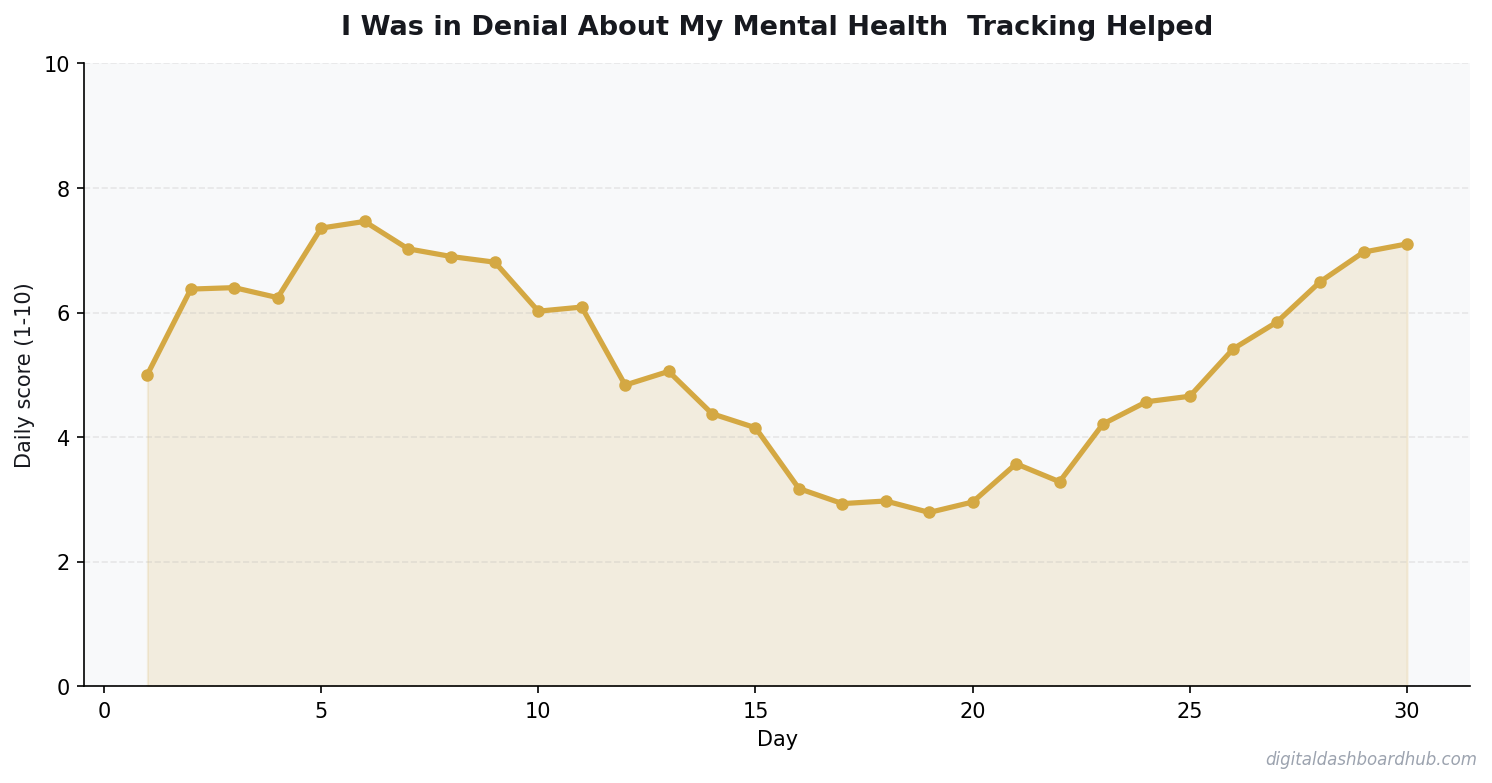
Stage 2: Pattern Recognition (Month 1-2). You start seeing the triggers. Maybe your mood tanks every Sunday night (anticipatory anxiety about work). Maybe your best days all share one thing: you went outside for 20+ minutes. These patterns are invisible without tracking.
Stage 3: Informed Action (Month 3+). Now you have enough data to actually do something targeted. Not “I should probably exercise more” but “my mood scores are 2.3 points higher on days I walk for 30 minutes, and my anxiety drops from 7 to 4 when I journal before bed.”
Tracking Methods Compared
FREE BONUS: The 30-Day Mental Health Baseline Template
The exact tracking sheet I used to break through my own denial. Covers mood, energy, anxiety, sleep, and social connection with auto-scoring.
Get instant access → Start Your Free Trial
How the DDH Mood Tracker Handles This
Let me walk you through what this looks like in practice.
Step 1: Each night, you spend 30 seconds rating mood, energy, anxiety, and sleep. Quick numerical scores with an optional one-line note. No friction, no lengthy questionnaires.
Step 2: After two weeks, the dashboard shows your trend lines with automatic rolling averages. You can see at a glance whether you’re trending up or down — no guesswork, no selective memory.
Step 3: The correlation engine highlights connections between your inputs. It might surface: “Days with 7+ hours of sleep correlate with mood scores 2.8 points higher.” Or “Your anxiety spikes on days you skip exercise.” These aren’t generic tips — they’re YOUR patterns from YOUR data.
The part that sold me: the weekly snapshot email. Every Monday, you get your 7-day average across all metrics. Seeing “average mood: 3.1” in your inbox is the kind of wake-up call that breaks through denial faster than any self-help book.
→ Try the DDH Mood Tracker free
“But I Don’t Want to Focus on Negative Feelings”
I hear this one a lot, so let me address it directly. Tracking your mental health doesn’t mean dwelling on negativity. It means measuring reality so you can improve it.
Would you tell someone with high blood pressure to stop checking it because “focusing on the number makes it worse”? Of course not. Mental health data works the same way. You measure it to manage it. And the good days get tracked too — they’re just as important for understanding what works.
Research from the University of Rochester found that people who practice regular emotional self-monitoring show a 23% improvement in emotional regulation within 8 weeks. The tracking itself is therapeutic.
2.6x
average underestimate of time needed for tasks (without tracking)
When Your Data Says “Get Help”
Tracking isn’t a replacement for professional support. But it’s an incredibly powerful tool for knowing when to seek it. If your 30-day mood average is consistently below 4, if your anxiety scores are above 7 more days than not, if you see a sustained downward trend over three weeks — those are clear signals.
And when you do reach out to a therapist, your tracking data gives them a head start. Instead of spending three sessions establishing a baseline, you walk in with one.
Your Next Move
Right now (2 minutes): Rate your mood right now, 1-10. Be honest. Write it down somewhere — your phone notes, a sticky note, anywhere. That’s your first data point.
This week: Set a nightly alarm for 9 PM. Rate mood, energy, anxiety, and sleep every night for 7 days. Even a notes app works. Don’t overthink it.
Long game: Start using the DDH Mood Tracker to build your 90-day mental health profile. The trend lines will tell you things about you
Key Takeaways
- Your patterns are unique — don’t rely on averages or others’ experiences
- The tracking itself changes behavior, even before you act on insights
- Share your data with professionals to get more targeted advice
rself you’ve been avoiding — and that’s exactly why they matter.
Still here? You’re serious about this.
Join 350+ people who grabbed the 30-Day Mental Health Baseline Template this month.
Get your free copy → Start Your Free Trial
Keep reading (related guides):
- How Much Does Therapy Cost in 2026? A State-by-State Breakdown
- Free ADHD Impulse Spending Tracker — Try It Now
- Gut Health Tracker: Connect What You Eat to How You Feel (Free Tool)
- The Science of Habit Tracking: Why Writing It Down Makes You 42% More Likely to Succeed
- Auto Mechanic Revenue: What Owners Make vs. What Youd Expect (2026)
255+ interactive tools for your money, time, and health.
14 days free · No charge today · 2-click cancel
$0
To Get Started
Full access during your trial period
Related Deep Reads
- Mood Tracker: How Measuring Your Emotions Helps You Actually Change Them
- Depression Mood Tracker: How Tracking Your Mental Health Data Helps You Heal
- How to Track Your Anxiety and Actually Reduce It
- Stress Management: A Data-Driven Approach That Works

Andy Gaber is the founder of Digital Dashboard Hub, a suite of 255+ interactive financial, productivity, and wellness tools. He built DDH after getting frustrated with financial apps that gave outputs without context. Follow along for tool tutorials, revenue analytics breakdowns, and honest takes on personal finance.