When you’re living with chronic pain, those 15 minutes in the doctor’s office can feel like trying to describe the ocean with a single cup of water. You walk in hoping they’ll understand the relentless ache that wakes you at 3 AM, the sharp flare-up that hits when you attempt groceries, the way some days feel manageable while others leave you unable to get out of bed. But the clinical clock is ticking. You might mention “pain level: 6 out of 10,” and then it’s time to move on.
This is where pain tracking becomes more than just data—it becomes validation. It becomes your voice when you don’t have time to fully speak.
At Track & Thrive Wellness, we know that chronic pain isn’t just a medical condition to be managed—it’s a lived experience that profoundly affects your daily life. And we’ve learned through our community that the people who improve their pain management outcomes aren’t the ones waiting passively for answers. They’re the ones documenting their truth, finding their own patterns, and walking into their next appointment armed with evidence.
Why Chronic Pain Tracking Matters More Than You Think
Scroll down — the interactive tool runs live with your inputs. Full version lives inside Digital Dashboard Hub. Two-click trial, Stripe-secure.
Chronic pain operates on a timeline that doesn’t fit neatly into quarterly doctor visits. Your pain has patterns—cycles, triggers, and connections that shift subtly across weeks and months. But those patterns are invisible if you’re not tracking them, and they’re nearly impossible for you to remember clearly when memory gets clouded by fatigue and flare-ups.
Here’s what research consistently shows: patients who track their pain get better outcomes. They experience improved treatment adherence, better communication with healthcare providers, and—perhaps most importantly—a greater sense of agency and control in their own care.
When you track your pain, several meaningful things happen:
You gain self-awareness. Instead of a vague sense that “things are getting worse” or “my medication isn’t working,” you have specific data points. You can say, “I’ve noticed that my pain increases by 2-3 points on days when I don’t sleep well” or “Ibuprofen alone doesn’t help, but ibuprofen plus heat therapy significantly reduces symptoms.”
You build a narrative. Chronic pain can feel random and chaotic. Tracking helps you discover that it’s actually following a script—one that you can learn to read and, to some degree, influence.
You become an advocate for yourself. When you walk into your doctor’s office with a spreadsheet showing pain levels over eight weeks, correlated with specific activities and medications, you’re no longer asking them to believe your experience. You’re showing them.
You reduce medical gaslighting. Far too many people with chronic pain hear “it’s all in your head” or face skepticism about their symptoms. Documentation is your protection. It’s hard to dismiss data.
What to Track: Building Your Chronic Pain Profile
The key to meaningful pain tracking is intentional measurement. You’re not tracking for the sake of tracking; you’re collecting data strategically to reveal patterns.
Here’s what to include in your pain journal:
Pain Intensity and Location
Track on a scale of 0-10, but be honest about what each number means to you. Does a “4” mean you can work but are uncomfortable? Does a “7” mean you need to lie down? Note the specific location(s) of pain. You might have multiple pain points, and they might behave differently in response to treatments.
Triggers and Activities
What were you doing in the hours before the pain flared? Did you spend time at a computer? Go for a walk? Sit for an extended period? Were you emotionally stressed? Identifying patterns takes time, but they emerge. Some people discover their pain worsens after specific activities with a 6-8 hour delay. Others notice immediate correlation.
Medication Effectiveness
When you take medication, note:
- The specific medication(s) and dosage
- The time you took it
- Pain level before and after (check back at 30 minutes, 1 hour, 2 hours, 4 hours)
- Any side effects you experienced
This reveals which medications actually work for you—not just which ones you’ve been prescribed.
Sleep Quality
Track both quantity and quality. Many people with chronic pain find that poor sleep amplifies pain signals the next day, creating a vicious cycle. Note: bedtime, wake-up time, how many times you woke, and your sleep quality (poor/fair/good). You might discover that 7 hours of quality sleep results in significantly better pain management than 9 hours of interrupted sleep.
Weather and Barometric Pressure
This isn’t just folklore. Many people with chronic pain have genuine physiological responses to weather changes. If you track this consistently, you might find correlations worth discussing with your healthcare provider.
Food and Nutrition
Certain foods can increase inflammation or pain sensitivity for some people. Do you notice worse pain on days when you eat processed foods? Better pain on days when you prioritize vegetables? This takes weeks to identify, but patterns do emerge.
Stress and Emotional State
Chronic pain and mental health are deeply interconnected. Stress doesn’t “cause” your pain, but it absolutely can amplify it. Track your stress level and mood daily. You might discover that on high-stress days, your pain threshold drops significantly.
Weather and Environmental Factors
Temperature, humidity, seasonal changes—note them all. Some pain conditions genuinely respond to these factors.
How Tracking Reveals Hidden Patterns
| Tracking Method | Setup | Data Quality | Doctor-Shareable? | Best For |
|---|---|---|---|---|
| Paper journal | Immediate | Inconsistent | Sometimes | Low-tech preference |
| Generic health app | 5 min | Medium | Export only | Basic logging |
| DDH Symptom Tracker | 5 min | High (structured fields) | Yes — generates patterns | Chronic conditions, complex symptom tracking |
This is where data transforms from information into insight.
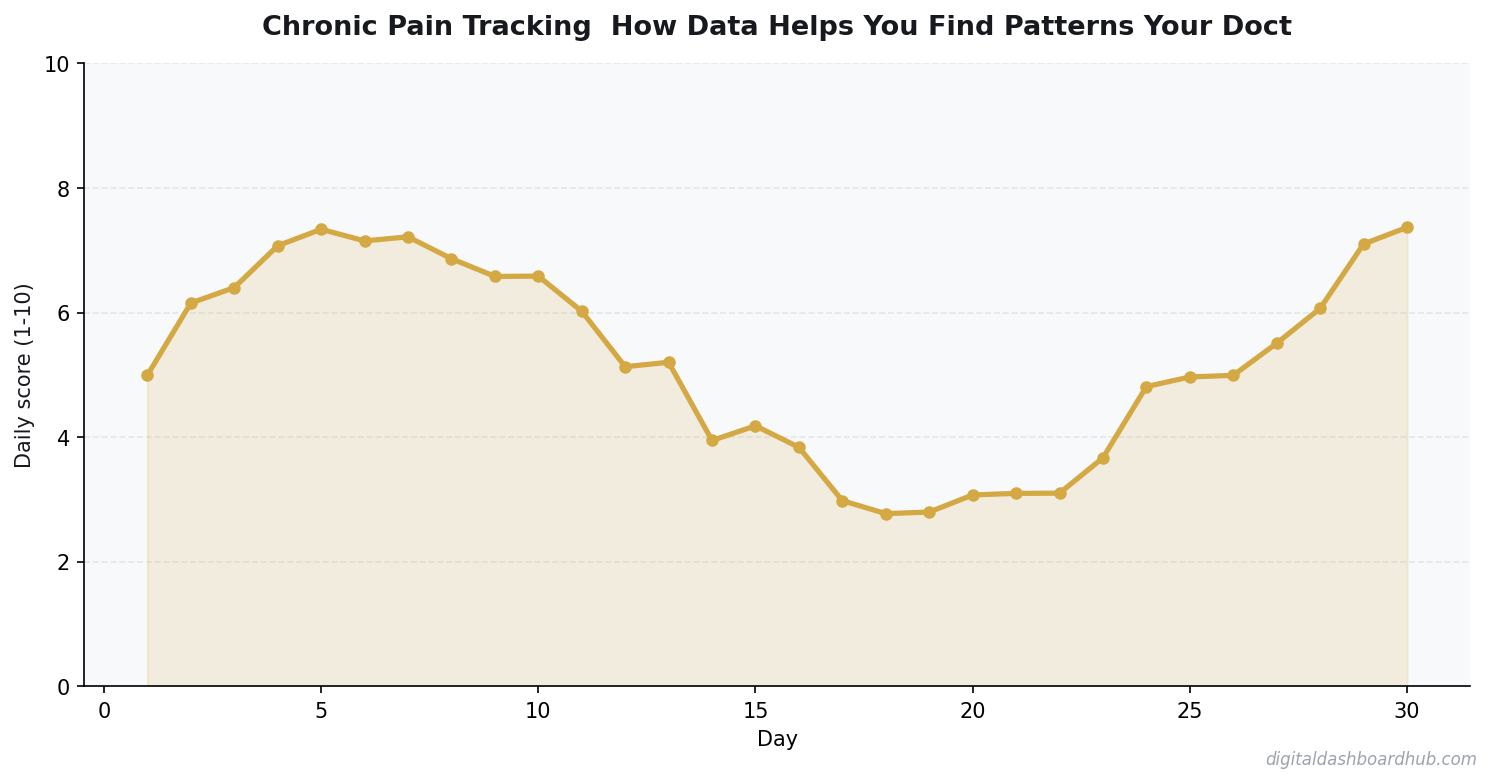
After two weeks of tracking, you might notice nothing. After four weeks, patterns begin to whisper. After eight weeks, patterns are shouting.
You might discover:
- Your pain increases every single day between 2-4 PM, suggesting you need to adjust your medication timing
- You have excellent pain days on Thursdays and Fridays, but terrible pain on Mondays—pointing toward stress and work pressure
- Rainy days consistently worsen your pain by 2-3 points
- Your pain medication is less effective than you thought; you’re actually still at moderate pain levels 4 hours after taking it
- The “low-carb diet” everyone recommended actually increased your pain, while increased water intake helped more than you expected
These are the patterns your doctor can’t see in a 15-minute visit. These are the insights that shouldn’t require guesswork or intuition—they require evidence.
Preparing for Doctor Appointments With Your Data
Your pain data transforms your medical appointments from vague conversations into strategic consultations.
Before your appointment:
-
Create a summary. Don’t bring 8 weeks of raw data. Calculate averages, identify trends, and highlight anomalies. “My average pain level is 5.2, but I experience flare-ups up to 8 on 3-4 days per week” is much more useful than 56 individual data points.
-
Identify specific patterns. Come prepared with observations: “I notice my pain increases 12 hours after intense exercise,” or “My medication is effective for approximately 4 hours, after which pain returns to baseline.”
-
Ask targeted questions. Instead of “What do I do about my pain?”, ask “Given that my pain is worse on high-stress days, would it be worth adjusting my stress management approach, or should we explore different medications?” You’re collaborating, not complaining.
-
Bring your visual data. A line graph of pain levels over 8 weeks communicates instantly what paragraphs of description cannot.
Many patients report that bringing organized pain tracking data to appointments shifts the entire dynamic. Doctors take you more seriously. They’re more likely to believe your experience. And they’re more equipped to actually help you because you’ve given them a complete picture.
The Emotional Side of Chronic Pain: Validation and Self-Advocacy
Here’s something that’s rarely discussed in pain management guides: the emotional impact of tracking your own pain.
For many people, tracking is the first time they validate their own experience. You’ve been living with this pain, and maybe people around you—or even healthcare providers—have minimized it. “It’s not that bad.” “Have you tried yoga?” “Maybe it’s stress.”
When you track your pain, you’re saying: My experience is real enough to document. It matters enough to measure.
This act of tracking is, itself, a form of self-advocacy. You’re gathering evidence for your own defense. You’re taking your pain seriously, which means you can face a world that might not.
Additionally, tracking creates distance and perspective. Instead of being completely immersed in pain (“I hurt, therefore my entire existence is pain”), tracking allows you to observe your pain as data. Some days are a “7.” Some days are a “3.” The variability you discover through tracking is actually hopeful—it means your pain isn’t a fixed, unchangeable constant. There are factors you can influence.
For many people, this shift from “my pain is my life” to “my pain is something I can track, understand, and partially influence” is genuinely meaningful.
Tools to Get You Started
You don’t need anything fancy. A simple spreadsheet works beautifully. That said, having a structured template designed specifically for chronic pain tracking removes decision fatigue and helps you stay consistent.
If you’re looking for a pre-built chronic pain tracking spreadsheet with automated calculations and visual charts, the TTW Stress Management Spreadsheet provides an excellent foundation for tracking multiple stressors and their impact on your wellbeing—stress being one of the primary pain amplifiers.
For those managing pain in the context of hormonal cycles, our Menstrual Cycle Tracker helps track how your pain fluctuates throughout your cycle, which is particularly valuable if you have conditions like endometriosis or PCOS.
If you’re also managing the emotional and mental health components of chronic pain—which is essential—our CBT Worksheet Tracker supports cognitive behavioral approaches to pain management, helping you document thoughts, beliefs, and emotional patterns that influence your pain experience.
And if meditation, breathing exercises, or other mindfulness practices are part of your pain management toolkit, our Meditation Practice Spreadsheet tracks consistency and perceived benefits, helping you quantify something often considered purely subjective.
The Long-Term Benefits of Pain Documentation
Three months into pain tracking, something remarkable often happens: you start to own your narrative.
Instead of feeling like something that’s happening to you, your pain becomes something you’re actively managing. The data helps you understand your body better than any single healthcare provider could, because you live in your body 24/7 and they see you once every few months.
Over time, tracking also reveals what actually works. Medication A might look good on paper, but your data shows it’s less effective than you thought. Medication B, which you dismissed, might actually provide better sustained relief. That $80 physical therapy session you debated? The data shows it reduced your pain for 3-4 days afterward. That’s real value.
You also become a better advocate for yourself with healthcare providers. You stop asking permission to manage your own care and start demonstrating that you’re managing it. You move from “Please help me” to “Here’s what I’ve discovered about my pain. Let’s work together based on this evidence.”
This empowerment matters. Chronic pain often steals agency and control. Tracking helps you reclaim both.
Free Chronic Pain Tracking Starter Kit
Getting started with pain tracking can feel overwhelming if you’re already dealing with chronic pain and fatigue. We want to remove that barrier.
We’ve created a free Chronic Pain Tracking Starter Kit that includes:
- A pre-built pain tracking template
- Guidelines for what to measure and why
- Instructions for calculating meaningful averages and identifying patterns
- A sample doctor’s appointment summary sheet
- Tips for staying consistent without burning out
Simply enter your email above, and we’ll send you the complete starter kit. No charge. No upsells. Just tools designed by and for people navigating chronic pain.
Moving Forward: Your Pain, Your Data, Your Advocacy
Chronic pain is complex. It doesn’t always respond to standard treatments. It often requires personalization, patience, and persistence. But it doesn’t require blind guesswork.
You deserve healthcare providers who take your experience seriously. You deserve treatment approaches tailored to your individual body and circumstances. And you deserve to understand your own pain well enough to advocate for what you need.
That journey begins with tracking.
It begins with documenting your truth until it becomes undeniable—to yourself, to your doctors, and to anyone who questions whether your pain is as real and significant as you know it to be.
Start this week. Choose three things to track. Use paper or spreadsheet, whatever feels sustainable. Notice what emerges over the next two weeks, and then notice what shifts when you have four weeks of data.
Your patterns are waiting to be discovered. And discovering them might be the first step toward actually managing your chronic pain.
Disclaimer
This article is for informational purposes only and is not a substitute for professional medical advice, diagnosis, or treatment. Chronic pain is a complex medical condition that requires individualized care from qualified healthcare providers. Pain tracking is a supplementary tool to support communication with your healthcare team, not a replacement for medical treatment. Always consult with your doctor or healthcare provider before making any changes to your pain management approach, including changes to medications, physical activity, or other treatments. Track & Thrive Wellness does not provide medical advice, and the strategies discussed here should be used as part of a comprehensive care plan developed with your healthcare provider.
Keep reading (related guides):
- How Much Does Therapy Cost in 2026? A State-by-State Breakdown
- Free ADHD Impulse Spending Tracker — Try It Now
- How to Finish Projects When You Have ADHD: A Step-by-Step System
- Best ADHD Planners in 2026: Digital vs Paper vs Hybrid
- Rent vs. Buy Calculator 2026: The True Cost of Each Option (Real Numbers)
255+ interactive tools for your money, time, and health.
14 days free · No charge today · 2-click cancel
Keep Reading
- I Tested 9 Expense Tracker Apps for 3 Months — Here’s What Actually Worked
- How to Regulate Your Nervous System: 8 Steps to Move From Chronic Stress to Calm
- I Tracked My Nervous System for 90 Days — Here’s What I Learned About My Stress, Sleep, and Sanity

Andy Gaber is the founder of Digital Dashboard Hub, a suite of 255+ interactive financial, productivity, and wellness tools. He built DDH after getting frustrated with financial apps that gave outputs without context. Follow along for tool tutorials, revenue analytics breakdowns, and honest takes on personal finance.