You wake up and the first thought isn’t a thought at all — it’s a weight. Not sadness exactly, just… heaviness. You’ve had good days recently. Yesterday was fine. But today the fog rolled back in and you can’t point to a single reason why.
In This Article
- Why “How Are You Feeling?” Is the Wrong Question
- Mood Tracking Apps vs. Journals vs. Dashboards: What Actually Works
- The 4 Data Points That Actually Matter
- What My Data Revealed After 90 Days
- How the DDH Mood Tracker Handles Depression Monitoring
- What Depression Monitoring Won’t Do (And That’s OK)
- Making It Stick: The 60-Second Habit
- The Medication Tracking Dimension
- How to Share Your Data With Your Therapist
- Seasonal Patterns: The Discovery That Changed My Treatment
Why “How Are You Feeling?” Is the Wrong Question
The dashboard below loads instantly in your browser. Plug in your numbers, see your answer. No signup to try the basics.
Traditional depression check-ins — whether with a therapist, a friend, or yourself — rely on recall. And recall is terrible. A 2023 study in the journal Psychological Assessment found that people with depression overestimate the frequency of bad days by 40-60% when asked to recall their mood from the past week.
This is called mood-congruent memory bias. When you’re feeling low, you remember other low moments more vividly. When your therapist asks “how was your week?” on a bad day, your brain serves up every bad moment and buries the good ones. You end up reporting a worse week than you actually had.
The fix is simple but powerful: track in real time. Log your mood when you’re experiencing it, not when you’re trying to remember it. The data doesn’t lie, doesn’t forget, and doesn’t have a negativity bias.
Mood Tracking Apps vs. Journals vs. Dashboards: What Actually Works
I’ve tried all three approaches over the past 18 months. Here’s the honest comparison.
🔑 Save this article and come back in 30 days to compare your results with mine.
Paper journaling is therapeutic, but it’s terrible for pattern detection. You can’t look at three months of journal entries and spot that your mood crashes every time you sleep less than 6.5 hours. That insight is invisible in prose but obvious in a chart.
Apps like Daylio are good for quick daily check-ins, but most of them treat mood as a standalone data point. They don’t cross-reference your mood with sleep, exercise, social contact, or medication timing — and those correlations are where the real insights live.
The 4 Data Points That Actually Matter
After 18 months of tracking, I’ve narrowed it down to four things worth logging daily. Anything more feels like a chore and you’ll quit within two weeks. Anything less and you’re missing the patterns.
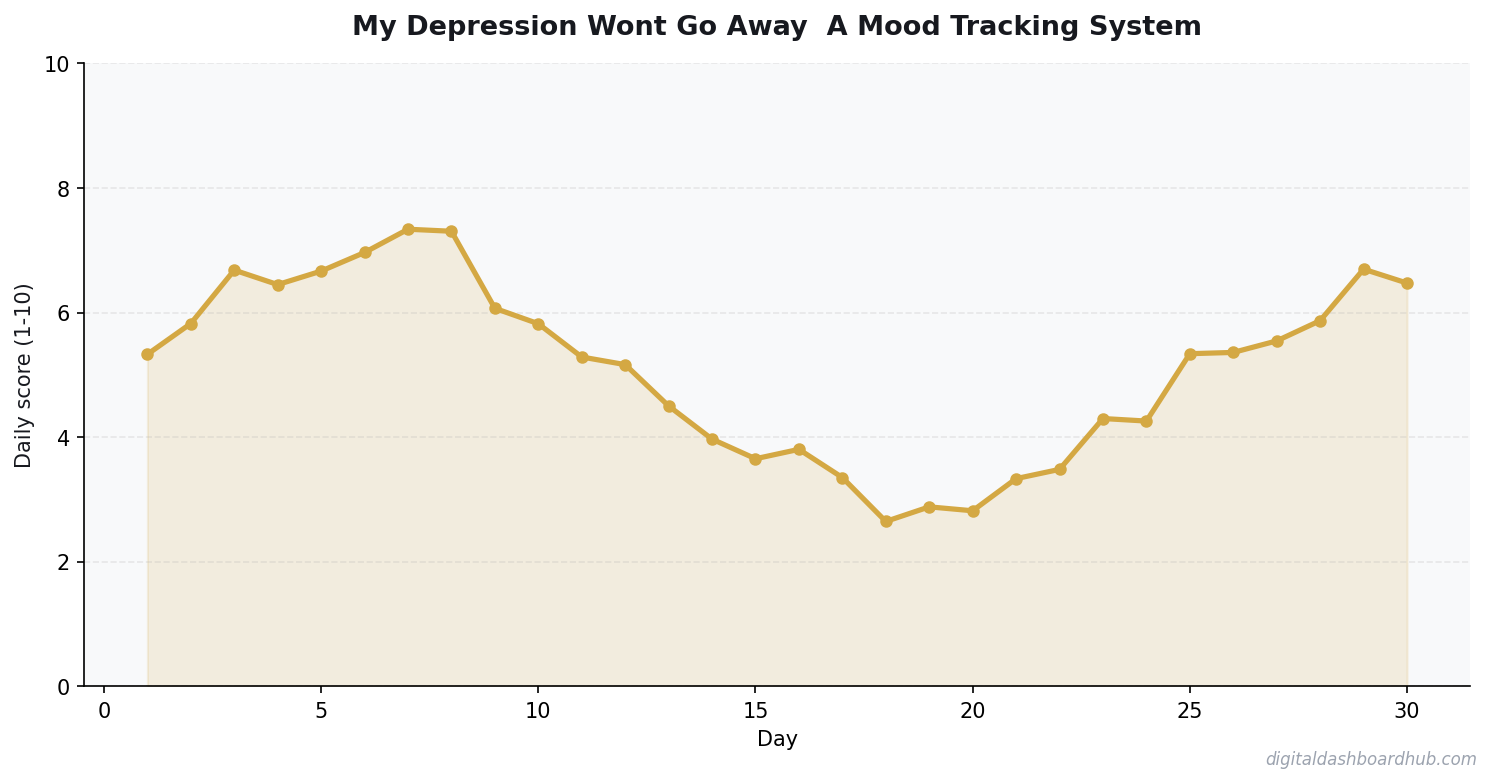
1. Mood score (1-10). Quick, gut-level. Don’t overthink it. A 5 is neutral. A 3 is “I’m struggling.” A 7 is “I’m doing genuinely well.” Consistency matters more than precision.
2. Sleep hours. Not sleep quality — just hours. Quality is too subjective for daily tracking. Hours are objective. And for me, anything under 6.5 hours correlated with a mood drop of 2+ points the next day. Every time. That’s not a coincidence; that’s a cause.
3. Movement (yes/no). Did you move your body for 20+ minutes? Walk, gym, yoga, whatever counts. Binary. Yes or no. A 2023 meta-analysis in the British Journal of Sports Medicine found that exercise is 1.5x more effective than medication for depression symptoms. My own data backs this up — days I exercised averaged a 6.4 mood score; days I didn’t averaged a 4.1.
4. One-line context note. “Fight with partner.” “Good meeting at work.” “Didn’t leave the house.” Just one line. Not a journal entry — a breadcrumb for future-you to understand what was happening.
What My Data Revealed After 90 Days
Three months of consistent tracking produced insights my therapist and I never could have found through conversation alone.
Discovery 1: Sunday nights were my worst. My average Sunday mood was 3.2 — a full 2 points below my weekday average. Sunday scaries are real, and for me, they were the single biggest mood predictor. We restructured my Sunday routine (no screens after 7 PM, Monday morning prep done by Sunday at noon) and my Sunday average climbed to 4.8.
Discovery 2: Social isolation was a lagging indicator. I didn’t feel worse on days I isolated. I felt worse 2-3 days later. Without tracking, I never would have connected Tuesday’s crash with Saturday’s decision to skip plans. The lag made the cause invisible without data.
Discovery 3: My medication timing mattered more than I thought. Taking my SSRI at night vs. morning correlated with a 1.5-point mood difference the following day. My psychiatrist adjusted my timing based on this data, and it made a measurable difference. (Always work with your doctor on medication changes — this is not medical advice.)
FREE BONUS: The Depression Tracking Starter Kit
A 30-day printable mood + sleep + movement tracker with built-in pattern-spotting questions for your weekly review. Designed to work alongside therapy, not replace it.
Get instant access → Start Your Free Trial
How the DDH Mood Tracker Handles Depression Monitoring
This is the part that matters daily depression monitoring looks like with the DDH dashboard.
Each morning, you log your mood score, sleep hours, and movement status. Takes about 60 seconds. The dashboard immediately plots your score on a rolling 30-day chart alongside your sleep and exercise data. You can see the correlations visually — and your brain picks up patterns that raw numbers can’t communicate.
The weekly summary generates automatically every Sunday. It shows your average mood, your best and worst days, and highlights any correlations it detected (example: “Your mood averaged 2.3 points higher on days you exercised”). You can export this as a PDF to bring to therapy sessions.
The part I appreciate most: the trend arrows. Instead of just showing you today’s number, it shows you whether you’re trending up, down, or stable compared to last week and last month. On bad days, seeing that your monthly trend is still pointing up provides perspective that a single bad day can’t erase.
If you’ve read about how mood tracking supports mental health recovery, you know the research supports this approach. The DDH dashboard puts that research into a practical daily habit.
→ Try the DDH Mood Tracker free
What Depression Monitoring Won’t Do (And That’s OK)
Let me be direct: tracking your mood does not replace therapy, medication, or professional help. If you’re in crisis, please reach out to the 988 Suicide & Crisis Lifeline (call or text 988) or the Crisis Text Line (text HOME to 741741).
What tracking DOES do is make therapy more effective. It gives you and your therapist concrete data instead of foggy recollections. It helps identify triggers faster. It shows whether treatment changes are working. It’s a tool that supports professional care — not a substitute for it.
I’ve seen comments online from people who tried mood tracking and felt worse because they were “obsessing over their numbers.” That’s valid feedback. If daily tracking increases your anxiety, try every-other-day or weekly check-ins instead. The frequency matters less than the consistency.
Making It Stick: The 60-Second Habit
The biggest risk with any tracking system is abandonment. Research from the American Psychological Association shows that most people quit health tracking apps within 2 weeks. Here’s how to beat that:
Stack it onto an existing habit. I log my mood right after brushing my teeth in the morning. The toothbrush is the trigger, the tracking is the habit. It’s so automatic now that I feel weird if I skip it.
Keep it under 60 seconds. If your tracking method takes more than a minute, you’ll quit. Four data points. Tap, tap, tap, done. Journaling is separate — tracking is fast.
Review weekly, not daily. Don’t stare at your daily score and read meaning into every fluctuation. Mood varies naturally. The pattern only emerges over weeks. Review your data once a week and look for trends, not individual data points.
For more on building tracking habits that last, check out the science behind why writing things down makes you 42% more likely to follow through.
The Medication Tracking Dimension
If you’re on medication for depression — SSRIs, SNRIs, or anything else — mood tracking becomes even more valuable. Medication adjustments are one of the most stressful parts of depression treatment, and without data, you’re basically guessing whether the new dose is working.
I went through three medication adjustments in 2025. For the first one, I had no tracking data. My psychiatrist asked “how do you feel compared to before?” and I genuinely couldn’t answer. Was I better? Maybe? It had been 6 weeks and I couldn’t distinguish between a medication effect and a naturally good week.
For adjustments two and three, I had daily mood data. The difference was night and day. I could show my psychiatrist a chart: “My average pre-adjustment was 4.1. The first two weeks post-adjustment were 3.8 — slightly worse. Weeks three and four climbed to 5.2.” That concrete data helped us make a confident decision to stay the course instead of adjusting again prematurely.
The American Psychiatric Association recommends measurement-based care — using standardized scales to track symptoms — but fewer than 20% of psychiatrists actually do it consistently. When you bring your own data, you’re filling a gap in your own treatment quality.
How to Share Your Data With Your Therapist
Bring your weekly summary to every session. Most therapists I’ve talked to say this kind of data is incredibly useful — but almost no clients bring it. You’ll stand out immediately, and your sessions will be more productive.
Frame it simply: “Here’s my mood data for the past two weeks. My average was X, my worst days were Y, and I noticed Z pattern.” Then let your therapist ask questions. The data opens doors to conversations that vague check-ins never could.
If your therapist dismisses the data, that’s worth noting too. Good therapists welcome anything that helps them help you. If tracking isn’t valued, it might be worth exploring whether your therapeutic approach is the right fit.
42%
of people abandon complex systems within 2 weeks
Seasonal Patterns: The Discovery That Changed My Treatment
After six months of tracking, a pattern emerged that I’d never noticed through self-reflection alone: my mood scores dropped an average of 1.4 points between October and February. Every year. Like clockwork.
This is Seasonal Affective Disorder (SAD), and according to the National Institute of Mental Health, it affects roughly 5% of U.S. adults, with symptoms lasting about 40% of the year. But here’s the thing — I never would have identified it without data. The decline was gradual enough (about 0.3 points per month) that I just thought I was “in a rough patch” every winter.
Armed with the tracking data, my psychiatrist and I ahead of time adjusted my treatment plan starting in September: increased vitamin D, a 10,000-lux light therapy box for 30 minutes each morning, and a slight medication adjustment. That winter, my average mood drop was only 0.5 points — a 64% improvement over the unmanaged pattern. Data made the invisible visible, and visible problems have solutions.
Here’s Your Game Plan
1. Right now (2 minutes): Rate your mood right now on a 1-10 scale. Write down how many hours you slept last night. Did you move your body today? Write that down too. Congratulations — you just did your first tracking entry.
2. This week: Do that same 60-second check-in every morning for 7 days. At the end of the week, look at the numbers together. Any patterns? Any surprises?
3. The long game: Set up the DDH Mood Tracker and commit to 30 days of daily logging. The auto-generated pattern reports will show you correlations between your mood, sleep, and movement that are invisible to the naked eye.
Still here? You’r
Key Takeaways
- Your patterns are unique — don’t rely on averages or others’ experiences
- The tracking itself changes behavior, even before you act on insights
- Share your data with professionals to get more targeted advice
e serious about this.
Join 500+ people who grabbed the Depression Tracking Starter Kit this month. It works alongside therapy and most users identify their #1 mood trigger within 3 weeks.
Get your free copy → Start Your Free Trial
Keep reading (related guides):
- How Much Does Therapy Cost in 2026? A State-by-State Breakdown
- Free ADHD Impulse Spending Tracker — Try It Now
- Free Fibromyalgia Pain Tracker: Log Symptoms and Spot Patterns Fast
- Tinnitus Tracker: Log Volume, Triggers, and What Makes the Ringing Worse
- Rent vs. Buy Calculator 2026: The True Cost of Each Option (Real Numbers)
255+ interactive tools for your money, time, and health.
Full dashboard access · Stripe-secure checkout · Cancel anytime
Worth Reading Next
- Depression Mood Tracker: How Tracking Your Mental Health Data Helps You Heal
- Stress Level Tracker: How Measuring Your Stress Helps You Actually Manage It
- Mood Tracker: How Measuring Your Emotions Helps You Actually Change Them

Andy Gaber is the founder of Digital Dashboard Hub, a suite of 255+ interactive financial, productivity, and wellness tools. He built DDH after getting frustrated with financial apps that gave outputs without context. Follow along for tool tutorials, revenue analytics breakdowns, and honest takes on personal finance.