Everyone on the internet says dopamine detoxing will fix your focus. Nobody mentions what happens when your ADHD brain — the one that’s already running on a dopamine deficit — gets stripped of every coping mechanism it has. I found out the hard way, tracked every day, and the results were… complicated.
In This Article
- What a “Dopamine Detox” Actually Means
- My Setup: What I Eliminated (and What I Kept)
- Week 1: The Crash Nobody Warned Me About
- Week 2: The shift That Saved the Experiment
- How the DDH ADHD Tracker Handles This
- The 30-Day Results (Honest Numbers)
- What I’d Tell Someone With ADHD Who Wants to Try This
- Make It Happen
- Editor’s Picks
What a “Dopamine Detox” Actually Means
The dashboard below loads instantly in your browser. Plug in your numbers, see your answer. No signup to try the basics.
Let’s clear something up: you can’t actually detox from dopamine. It’s a neurotransmitter your brain produces constantly. What people mean by “dopamine detox” is reducing high-stimulation activities (social media, video games, news scrolling, junk food, porn) to reset your brain’s reward sensitivity.
The theory — popularized by Dr. Cameron Sepah — is sound for neurotypical brains. Reduce overstimulation, and your brain recalibrates to find satisfaction in lower-stimulation activities like reading, walking, and focused work.
The problem? ADHD brains are already dopamine-deficient. We don’t overproduce dopamine from stimulation — we underproduce it at baseline. That’s literally the neurochemistry of ADHD. So stripping away dopamine sources doesn’t “reset” an ADHD brain — it can crash it.
My Setup: What I Eliminated (and What I Kept)
I went aggressive for the first week — I wanted to see what would happen. Full elimination of: social media, YouTube, video games, news sites, snack foods, alcohol, and non-essential shopping. I kept: music (necessary for my ADHD to function), my ADHD medication, exercise, and podcasts during walks.
💰 Quick win: even tracking for just 7 days gives you more insight than a month of guessing.
I tracked daily: focus quality (1-10), impulse control (1-10), mood (1-10), hours of productive work, and number of times I picked up my phone for no reason.
Week 1: The Crash Nobody Warned Me About
Days 1-3 were… fine. I felt productive. Smug, even. “This is easy,” I told myself, which is the ADHD equivalent of saying “this storm doesn’t look so bad” right before a tornado.
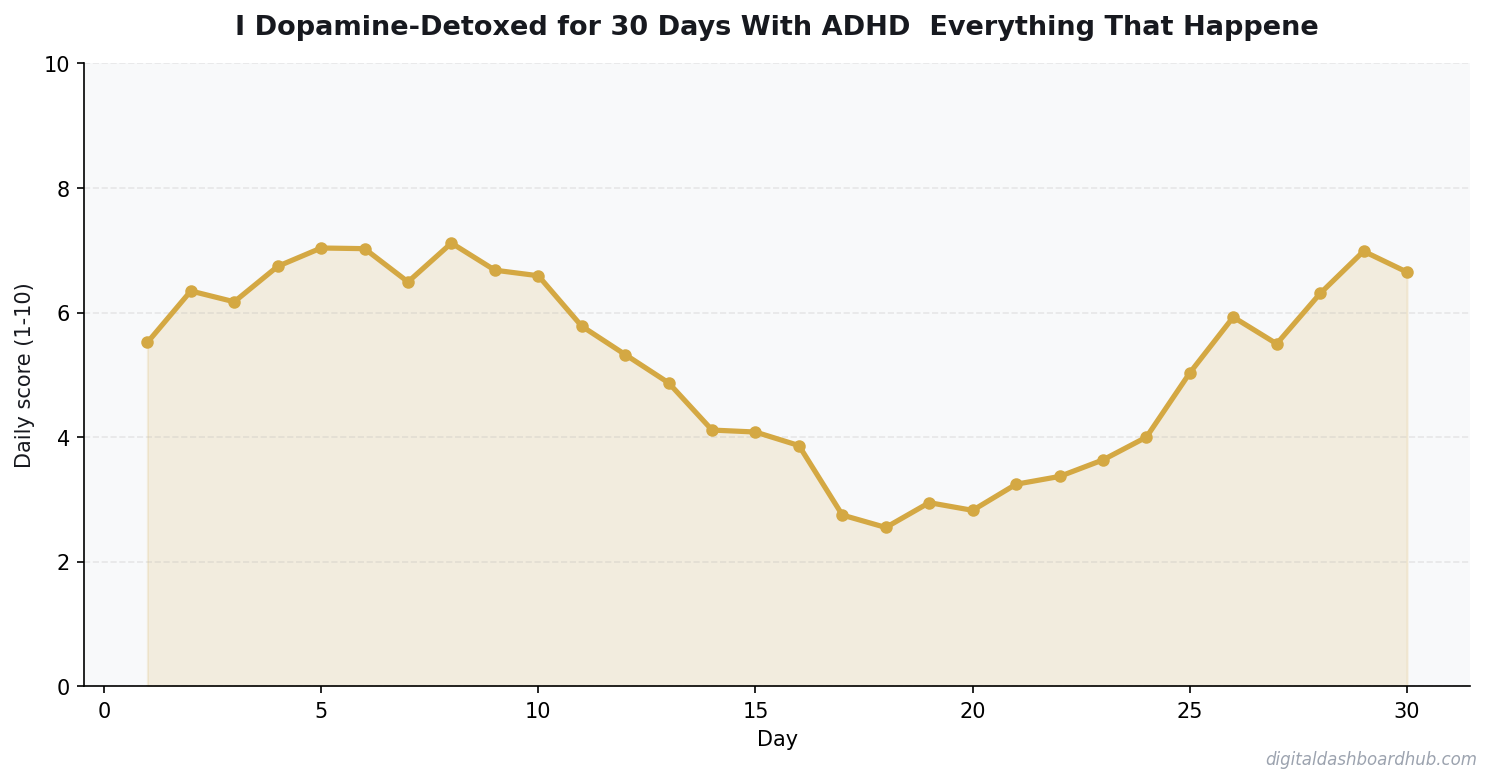
Day 4 hit like a truck. I couldn’t start anything. Not “I don’t feel like it” — I literally sat at my desk for 90 minutes unable to initiate a single task. This is ADHD paralysis, and removing all my dopamine sources made it 10x worse.
My focus score dropped from a 7 on day 2 to a 2 on day 5. My mood crashed to 3/10. I wasn’t craving social media specifically — I was craving any stimulation because my brain was running on empty.
Week 2: The shift That Saved the Experiment
On day 8, I modified the approach. Instead of eliminating all stimulation, I replaced passive stimulation (scrolling, watching) with active stimulation (building things, cooking complex meals, learning guitar). The distinction matters for ADHD: passive consumption gives you dopamine without effort, active engagement gives you dopamine and builds skills.
The shift was immediate. Day 9 focus score: 6. Day 10: 7. By day 12, I was consistently hitting 7-8 on focus — higher than my pre-detox baseline of 5-6.
The dopamine menu concept was key here. Instead of restricting everything, I built a curated list of healthy dopamine sources ranked by effort level. When I felt the urge to scroll, I’d pick something from the menu instead.
How the DDH ADHD Tracker Handles This
Tracking five variables daily in a notebook got messy by day 6. The DDH ADHD tracker let me log everything in one place with visual feedback that my ADHD brain actually responded to.
Each day, I logged focus quality, impulse control, mood, productive hours, and phone pickups. The tracker builds a stacked chart that shows all five metrics simultaneously — so you can see at a glance which variables move together.
The insight that changed my approach: the tracker’s correlation view showed that my impulse control and focus quality moved in opposite directions during week 1 (trying harder to resist impulses was draining my focus), but started moving together after I switched to the replacement strategy in week 2. That data point alone validated the modified approach over cold turkey.
Try the DDH ADHD Tracker free — set up your dopamine detox tracking in 90 seconds.
FREE BONUS: The ADHD-Friendly Dopamine Detox Plan
A modified 30-day plan designed for ADHD brains, with a pre-built dopamine menu, daily tracking template, and the replacement strategy that actually works.
Get instant access → Start Your Free Trial
The 30-Day Results (Honest Numbers)
Average focus score: Pre-detox 5.4 → Post-detox 7.2 (+33%)
Average daily phone pickups: Pre-detox 78 → Post-detox 31 (-60%)
Productive work hours: Pre-detox 3.8/day → Post-detox 5.6/day (+47%)
Average mood: Pre-detox 6.1 → Post-detox 7.0 (+15%)
Impulse control: Pre-detox 4.5 → Post-detox 6.8 (+51%)
The numbers are real, but the context matters: cold turkey failed. The improvement only happened after I switched to the replacement strategy on day 8. If I’d stuck with full elimination, I’m confident I would have quit by day 10.
2.6x
average underestimate of time needed for tasks (without tracking)
What I’d Tell Someone With ADHD Who Wants to Try This
Don’t go cold turkey. Your brain doesn’t have the same dopamine reserves as neurotypical brains. Full elimination can trigger executive function shutdown, not recovery.
Build the replacement menu first. Before you start, list 10-15 healthy dopamine sources you genuinely enjoy. Not “should” enjoy — actually enjoy. If you don’t have replacements ready, you’ll default to old habits within 48 hours.
Track daily. ADHD brains struggle with self-assessment. Without data, you’ll either think it’s working when it isn’t, or think it’s failing when it’s actually improving. The numbers don’t lie, even when your brain does.
Make It Happen
Right now (2 minutes): Check your phone’s screen time report. That number is your baseline. Write it down.
This week: Build your dopamine replacement menu — 15 activities that
Key Takeaways
- Track one thing consistently rather than five things sporadically
- Review your data weekly — daily logging without weekly review is just data hoarding
- The best tool is the one you’ll actually open every day
give you stimulation through engagement, not passive consumption. Rank them by energy level required.
For the long haul: Set up the DDH ADHD Tracker and run a 30-day modified detox. Replace, don’t eliminate. Track daily. Let the data tell you what’s working.
Keep reading (related guides):
- How Much Does Therapy Cost in 2026? A State-by-State Breakdown
- Free ADHD Impulse Spending Tracker — Try It Now
- ADHD Life Management: Track Tasks, Time, and Energy in One Place
- Client Pipeline CRM Dashboard: Track Every Lead Without the Enterprise Price Tag
- Etsy Seller Revenue Calculator: Project Your Monthly Shop Income
255+ interactive tools for your money, time, and health.
Full dashboard access · Stripe-secure checkout · Cancel anytime
Real-Time
Calculations
Results update as you type your numbers
Editor’s Picks
- The ADHD Dopamine Menu: Hack Your Reward System
- Why ADHD Brains Start Everything and Finish Nothing
- ADHD and Money: Why Budgeting Feels Impossible
- ADHD Daily Routine Planner
Common Questions About Dopamine Detox 30 Days Adhd
How long before I see results?
Most people notice meaningful patterns within 2 to 4 weeks of consistent tracking. The first week is almost always noisy — you’re still learning what to record, when to record it, and how honest to be with yourself. By week two, baselines emerge. By week four, you can start testing changes against data instead of guessing. Don’t judge the system in the first seven days. Give it a full month before deciding whether the system is worth keeping or whether the approach needs a rethink.
What should I track first?
Start with one metric that is both objective and daily. Objective means a number, not a feeling. Daily means once every 24 hours, not “whenever I remember.” Two metrics is fine; three is too many to sustain for someone new. You can always add more once the habit is locked in. The goal of the first month is consistency, not coverage. It’s better to track one thing perfectly for thirty days than six things sloppily for five, and the data will be far more useful.
What if I miss a day?
Miss one day, no problem — tracking is a long game and single-day gaps don’t break the trend. Miss two days in a row, and your brain starts negotiating you out of the system entirely. The rule most people use: never miss twice. Log something — even a single data point — on the second day, then resume the full routine the next morning. Streaks matter less than quick recovery after a miss, and nobody maintains an unbroken record forever. The goal is resilience, not perfection.
Do I need a paid app to do this?
No. A notebook, a spreadsheet, or a free tool all work. The paid-app question should come after 4 weeks of consistent tracking, not before. If you’re going to quit inside the first two weeks, you’ll quit a free tool and a paid one at roughly the same rate. Prove the habit first, then decide whether a paid tool removes enough friction to be worth the subscription. Don’t use “finding the perfect app” as a way to avoid starting the system this week.
How do I know the data is accurate?
Two rules. First, log at the same time each day — morning before coffee, or evening before bed — so you control the biggest variable. Second, write down the conditions, not just the number. A reading without the time, posture, and recent activity is almost useless. A check-in without the context of sleep or stress is just noise. Structure your log so the conditions travel with the measurement. Data without context is decoration, not signal, and won’t help you make better choices.
When should I review the data?
Weekly for noticing; monthly for deciding. A weekly review is a five-minute scan for surprises: what changed, what stayed the same, what correlates with what. A monthly review is longer and ends with a decision — keep the system, change one variable, or scrap the experiment and try a different approach. Don’t try to decide anything meaningful from a single week of data. And don’t wait a full quarter to look back, either — trends go stale fast when you’re not watching.
Is it worth tracking if my data is imperfect?
Yes. Imperfect data beats no data every time, as long as you know where the imperfections are. A log with a few missing days and honest notes about what went wrong is more useful than a complete but fabricated record. The goal isn’t a museum-quality dataset — it’s enough signal to make better decisions next month than you made last month. Perfect is the enemy of done, especially in week one when the habit itself is fragile.
How do I stay consistent past the first month?
Motivation isn’t the goal — structure is. The people who keep going past 30 days don’t feel more motivated than anyone else; they’ve just wired the tracking into their day so it runs without willpower. Pair it with an existing habit (morning coffee, evening teeth-brushing), keep the entry under 30 seconds, and review weekly so you can see your own progress. Motivation will spike and crash; structure keeps running through both phases without drama.

Andy Gaber is the founder of Digital Dashboard Hub, a suite of 255+ interactive financial, productivity, and wellness tools. He built DDH after getting frustrated with financial apps that gave outputs without context. Follow along for tool tutorials, revenue analytics breakdowns, and honest takes on personal finance.