You’ve started and abandoned more habits than you can count. The gym membership in January, the meditation app in March, the morning routine that lasted exactly four days. It’s not a willpower problem — it’s a brain wiring problem. And the fix is surprisingly simple.
In This Article
- What Actually Happens in Your Brain When You Track a Habit
- Why Most Habit Trackers Fail (The Neuroscience Explanation)
- The 66-Day Myth (And What the Research Actually Says)
- How the DDH Habit Tracker Handles This
- The Compound Effect: Why Small Habits Create Huge Results
- Your Action Plan
Habit tracking — the act of recording whether you did or didn’t do a behavior — physically changes your brain’s neural pathways. This isn’t motivational fluff. The neuroscience of habit tracking and brain rewiring shows that the simple act of logging creates measurable changes in dopamine response, neural pathway strength, and prefrontal cortex activation.
What Actually Happens in Your Brain When You Track a Habit
Before you scroll: the calculator below is running in your browser right now. For the full feature set — saved scenarios, history, exports — open the dashboard.
I launched Digital Dashboard Hub because the tools I found online were either too generic or too complicated. Here’s the honest breakdown:
Your brain runs on a reward prediction system. Neuroscientist Wolfram Schultz’s research at Cambridge showed that dopamine neurons fire not just when you receive a reward, but when you ANTICIPATE one. This is the key to understanding why tracking works.
When you check off a habit on a tracker, three things happen neurologically:
1. Dopamine release on completion. The checkmark itself becomes a micro-reward. Your ventral tegmental area (VTA) releases dopamine — the same chemical that fires when you eat something delicious or get a like on social media. Over time, the act of completion becomes self-reinforcing.
2. Visual streak anxiety. Once you have a 7-day streak, your brain creates anticipatory anxiety about breaking it. This isn’t unhealthy — it’s your anterior cingulate cortex (the error-detection center) flagging a potential loss. Loss aversion is 2x more powerful than gain motivation, so streaks work.
3. Neural pathway strengthening. Every time you repeat a behavior and log it, the neural pathway for that behavior gets wrapped in more myelin (the insulating sheath around nerve fibers). Research published in Nature Neuroscience found that consistent repetition increases myelin thickness by up to 20%, making the behavior faster and more automatic.
Why Most Habit Trackers Fail (The Neuroscience Explanation)
If tracking is so effective, why do most people abandon their habit trackers within three weeks? Because most trackers work against your brain’s wiring, not with it.
🔑 Quick win: even tracking for just 7 days gives you more insight than a month of guessing.
The best habit tracker is one that gives your brain a small dopamine hit for every entry, creates visual stakes through streaks, and keeps friction under 10 seconds.
The 66-Day Myth (And What the Research Actually Says)
You’ve probably heard it takes 21 days to form a habit. Or 66 days. Both numbers are misleading. The original University College London study by Phillippa Lally found that habit formation ranged from 18 to 254 days, with a median of 66 days.
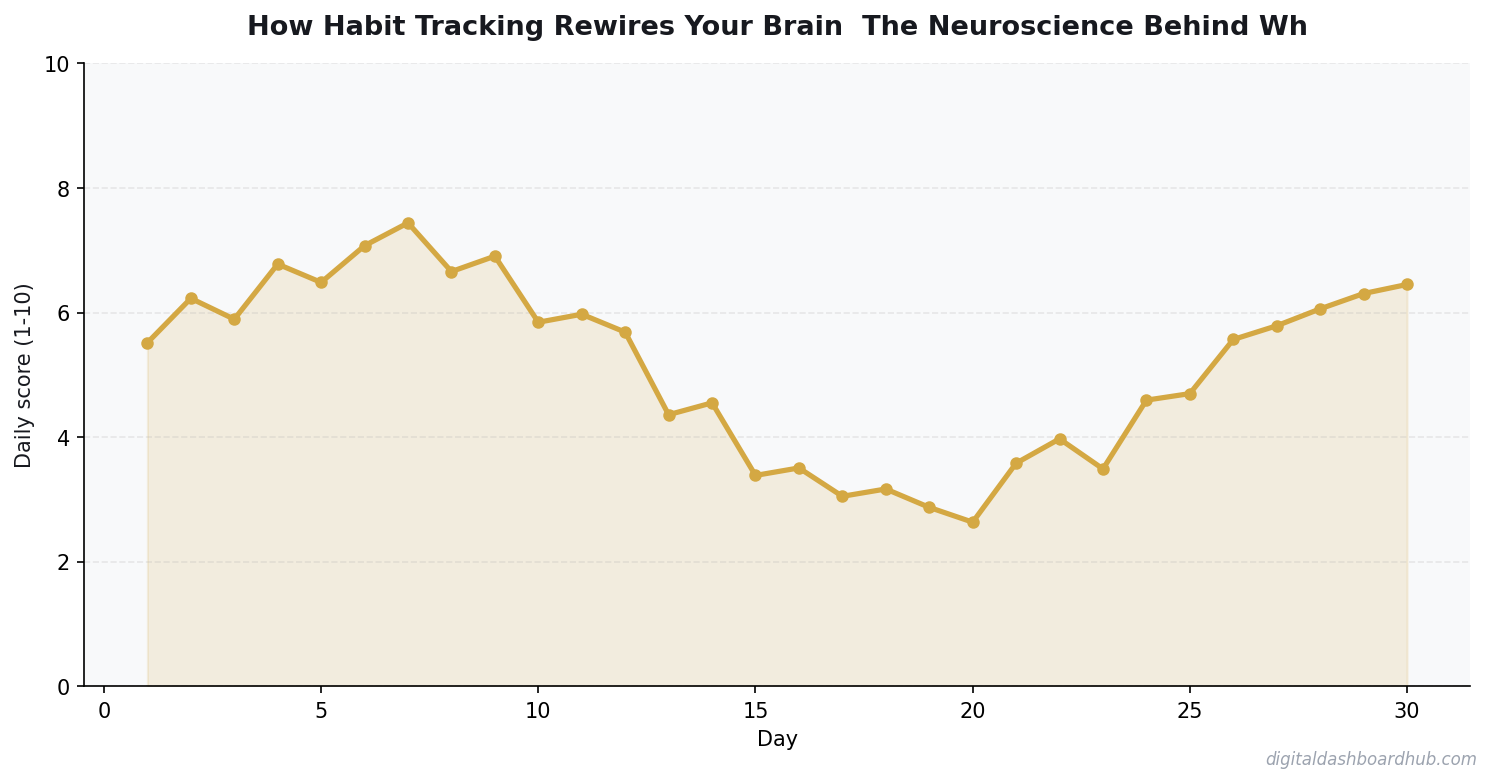
What determines where you fall on that spectrum? Three factors: complexity of the behavior (drinking water = easy, going to the gym = hard), consistency of context (same time/place every day = faster), and — here’s the tracking connection — whether the behavior is consciously monitored.
Lally’s research showed that participants who tracked their habits formed them 42% faster than those who simply tried to remember. That’s the difference between autopilot in 38 days vs. 66 days.
FREE BONUS: The Brain-Based Habit Tracking Template
A 30-day tracker designed around neuroscience principles — optimal habit count, dopamine-friendly logging, and streak psychology built in.
Get instant access → Start Your Free Trial
How the DDH Habit Tracker Handles This
Most habit apps treat tracking like a todo list. Check the box, move on. The DDH Habit Tracker is designed around the neuroscience — and the difference matters.
Step 1: You set up 3-5 habits with flexible completion levels. Instead of binary yes/no, you rate completion on a scale. Did 15 minutes of a planned 30-minute workout? That’s a 50% — and it counts. Your brain gets the dopamine hit and the streak continues.
Step 2: The visual streak board uses color intensity to show consistency. Light green for partial completion, deep green for full completion, gray for misses. Your brain’s visual cortex processes this instantly — you can see your patterns in a glance.
Step 3: After 30 days, the correlation dashboard shows you which habits reinforce each other. Maybe when you meditate in the morning, you’re 80% more likely to exercise that evening. That’s not a coincidence — it’s your prefrontal cortex carrying momentum. The tracker surfaces these connections automatically.
The part that sold me: the “habit stacking” suggestions. Based on your completion data, it identifies which habits are natural pairs and recommends linking them. This mirrors James Clear’s habit stacking concept, but with YOUR actual data instead of generic advice.
→ Try the DDH Habit Tracker free
$1,524/yr
average amount lost to forgotten subscriptions without expense tracking
The Compound Effect: Why Small Habits Create Huge Results
Here’s where it gets exciting. A 1% improvement per day compounds to a 37x improvement over a year. That’s not motivational math — it’s actual compounding (1.01^365 = 37.78).
But here’s the catch: you can’t compound what you can’t measure. Without tracking, you have no idea whether you’re improving 1% per day or sliding backwards 0.5%. The tracker is the measurement system that makes compounding visible.
I tracked just three habits for 90 days: 20 minutes of reading, 10 minutes of stretching, and logging my meals. Individually, none of them felt significant. But at day 90, I’d read 12 books, gained measurable flexibility, and lost 8 pounds without dieting — just from paying attention to what I ate.
Your Action Plan
Right now (2 minutes): Pick ONE habit you want to build. Just one. Write it down with a specific trigger (“after I pour my morning coffee, I will…”). That’s your first neural pathway investment.
This week: Track that one habit every day for 7 days. Use anything — a sticky note on your mirror, your phone notes, whatever creates zero friction. Notice how the streak starts to feel like something you don’t want to break.
Long game: Try the DDH Habit Tracker and set up 3-5 habits with the neuroscien
Key Takeaways
- Your patterns are unique — don’t rely on averages or others’ experiences
- The tracking itself changes behavior, even before you act on insights
- Share your data with professionals to get more targeted advice
ce-based tracking system. Let your brain’s reward system do the heavy lifting.
Still here? You’re serious about this.
Join 600+ people who grabbed the Brain-Based Habit Tracking Template this month.
Get your free copy → Start Your Free Trial
Keep reading (related guides):
- How Much Does Therapy Cost in 2026? A State-by-State Breakdown
- Free ADHD Impulse Spending Tracker — Try It Now
- Workout Progress Tracker: The Method That Finally Kept Me Consistent
- Micro-Business Operations Dashboard (CSL): Your All-in-One Command Center for Running a Lean Business
- Small Business Finance Basics: The Only 5 Numbers You Need to Track Weekly
255+ interactive tools for your money, time, and health.
14-day trial · Stripe checkout · Cancel anytime
- The Complete Guide to Building Habits That Actually Stick
- The Science of Habit Tracking: Why Writing It Down Makes You 42% More Likely to Succeed
- The ADHD Dopamine Menu: How to Hack Your Brain’s Reward System

Andy Gaber is the founder of Digital Dashboard Hub, a suite of 255+ interactive financial, productivity, and wellness tools. He built DDH after getting frustrated with financial apps that gave outputs without context. Follow along for tool tutorials, revenue analytics breakdowns, and honest takes on personal finance.