Your car needs new tires. The bill is $800. Your stomach drops, you mentally rearrange your budget, maybe skip a payment or two on something else, and you spend the next six weeks recovering financially from what should have been a completely predictable expense.
Here’s the uncomfortable question: did you not know your tires would eventually wear out? Of course you did. Every car owner knows tires need replacing. The problem wasn’t the expense — it was the lack of preparation for an expense you could have seen coming from a mile away.
This is exactly the gap that sinking funds fill. And once you understand them, you’ll wonder how you ever budgeted without them.
What Is a Sinking Fund (And How Is It Different From an Emergency Fund)?
The dashboard below loads instantly in your browser. Plug in your numbers, see your answer. No signup to try the basics.
A sinking fund is money you set aside gradually for a specific, planned future expense. That’s it. No complicated financial jargon, no fancy strategy — just intentionally saving small amounts over time so that when a known expense arrives, the money is already there.
The critical distinction: an emergency fund is for surprises. A sinking fund is for certainties you haven’t saved for yet.
Your furnace dying during a freak cold snap in April? Emergency fund. Your property taxes being due every December? That’s not an emergency — that’s a sinking fund category you should have been filling all year.
The problem is that most people lump everything into “emergency fund” and then feel perpetually behind because their emergency savings keep getting raided for expenses that were entirely predictable. New tires, holiday gifts, annual insurance premiums, the veterinarian — none of these are emergencies. They’re inevitabilities.
When you separate planned future expenses into dedicated sinking funds, your actual emergency fund stays intact for genuine emergencies. That psychological shift alone is worth the effort.
The Most Common Sinking Fund Categories (And How Much to Save)
Everyone’s categories will be slightly different based on their life situation, but here are the most universally applicable sinking fund categories along with realistic savings targets:
Home and Living
Home Maintenance — The general rule is to save 1-2% of your home’s value annually for maintenance. For a $300,000 home, that’s $250-500/month. This covers the roof that will eventually need replacing, the water heater that won’t last forever, the appliance that will break at the worst possible time.
Property Taxes and Insurance — If these aren’t escrowed into your mortgage payment, you need a sinking fund. Take your annual amount, divide by 12, and save that monthly. A $3,600 annual tax bill means $300/month into this fund.
Furniture and Appliance Replacement — Couches wear out. Dishwashers die. Save $50-100/month and you’ll never have to put a refrigerator on a credit card.
Transportation
Car Maintenance — Oil changes, tires, brakes, inspections. Budget $100-200/month depending on your vehicle’s age. An older car needs a bigger fund.
Car Replacement — Even if you’re not buying new, start saving toward your next vehicle now. $200-400/month over 3-5 years builds a significant down payment or outright purchase fund.
Registration and Insurance — If you pay annually for better rates, divide by 12 and save monthly.
Health and Wellness
Medical Expenses — Even with insurance, copays, prescriptions, dental work, and vision care add up. If your deductible is $2,000, saving $167/month means you can cover it fully within a year.
Dental and Vision — Often not fully covered by insurance. Budget $50-75/month for cleanings, glasses, contacts.
Personal and Family
Holiday Gifts — The average American household spends over $900 on holiday gifts. That’s $75/month saved January through November — painless compared to a December credit card binge.
Birthday Gifts — Count the birthdays you celebrate annually, estimate spending per person, divide by 12.
Vacation — Decide your annual travel budget and divide by 12. A $3,000 vacation fund means $250/month. When trip time comes, you book guilt-free.
Back-to-School — Supplies, clothes, fees. If you have kids, start saving in January for August expenses. $50-100/month adds up.
Financial and Administrative
Annual Subscriptions — Software, streaming services billed annually, professional memberships. List them all, total the annual cost, divide by 12.
Tax Preparation — If you pay for professional tax prep or owe quarterly estimated taxes, this needs its own fund.
Pet Expenses — Vet visits, medications, grooming, boarding. Pets are expensive, and the costs are almost entirely predictable. $75-150/month depending on your pet’s needs.
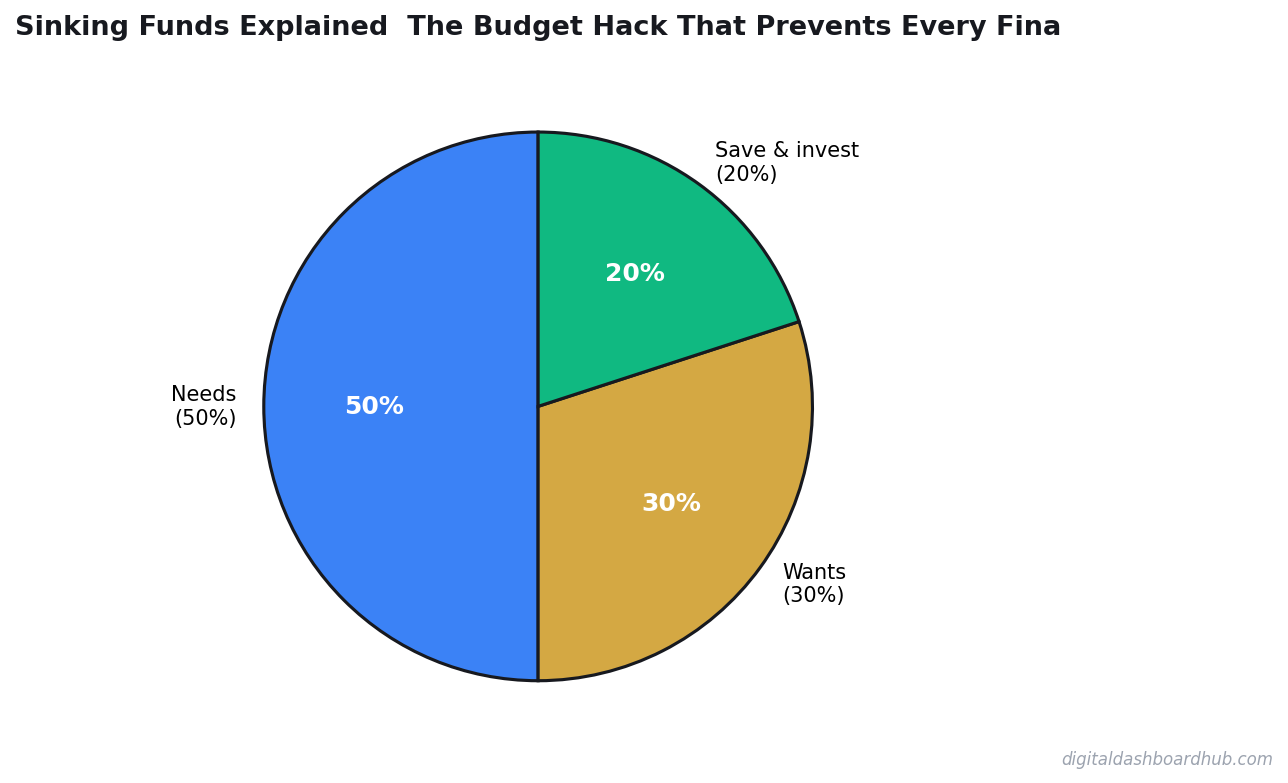
A 50/30/20 Budget Calculator can help you figure out how much of your income should flow toward these savings categories, while an Emergency Fund Calculator helps you right-size your true emergency cushion so your sinking funds can handle the rest.
How to Calculate Your Sinking Fund Amounts
The math is beautifully simple:
Annual expected cost ÷ 12 months = Monthly sinking fund contribution
For less predictable categories, use the high estimate. If car maintenance might cost $1,200-2,400 this year, save based on $2,400 ($200/month). Worst case, you have extra money saved. That’s never a bad outcome.
For irregular expenses, work backwards from the date:
Expected cost ÷ Months until expense = Monthly savings needed
If your car insurance ($1,800) is due in 6 months, you need $300/month. If it’s due in 10 months, you need $180/month. The earlier you start, the less it hurts monthly.
Here’s a starter calculation for a typical household:
| Category | Annual Cost | Monthly Savings |
|---|---|---|
| Car Maintenance | $2,400 | $200 |
| Home Maintenance | $3,000 | $250 |
| Holiday Gifts | $900 | $75 |
| Medical/Dental | $1,500 | $125 |
| Vacation | $2,400 | $200 |
| Pet Expenses | $1,200 | $100 |
| Annual Subscriptions | $600 | $50 |
| Total | $12,000 | $1,000 |
Does $1,000/month sound like a lot? It should — because that’s $12,000 in annual expenses that would otherwise blindside you throughout the year. The money was always going to be spent. Sinking funds just mean it’s spent without stress.
A Financial Health Scorecard can help you assess where you currently stand across all these categories, while a Down Payment Savings Planner applies the same sinking fund logic to your biggest savings goal.
Setting Up Your Sinking Fund System
Option 1: Separate Savings Accounts
Some banks let you create multiple savings accounts with custom names. You literally have an account labeled “Car Fund,” another labeled “Holiday Gifts,” another labeled “Vacation.” Money goes in monthly via automatic transfer. Visually clear, zero chance of accidental spending.
The downside: some banks limit the number of savings accounts, and managing 8-12 accounts can feel unwieldy.
Option 2: One Account + A Tracking Spreadsheet
This is the more practical approach for most people. Keep one savings account for all sinking funds, but use a spreadsheet to track how much of that balance belongs to each category.
Your savings account might show $4,500 total, but your spreadsheet breaks it down: $1,200 car fund, $800 holiday fund, $600 medical fund, $500 vacation fund, $400 home maintenance, and so on. The total is $4,500, but each dollar has a job.
This approach is where a dedicated sinking fund spreadsheet becomes essential. You need something that automatically tracks contributions, shows running balances per category, and tells you at a glance whether each fund is on track.
The Vacation Budget Planner handles the travel-specific sinking fund with cost estimation built in, while a broader budgeting tool like the Net Worth Tracker shows how your growing sinking funds contribute to your overall financial picture.
Option 3: The Hybrid Approach
Use 2-3 savings accounts for your biggest categories (emergency fund, car replacement, vacation) and track everything else in a single account with a spreadsheet. This gives you the psychological separation for major goals while keeping management simple.
Setting Up Automatic Transfers (The “Set It and Forget It” Step)
Sinking funds only work if you actually fund them. And the only way to consistently fund them is to remove yourself from the equation.
Set up automatic transfers from your checking account to your savings account(s) on payday. Not “when I remember.” Not “if there’s money left over.” On payday, automatically, before you have a chance to spend it.
Here’s the optimal setup:
- Paycheck hits checking account (Day 1)
- Automatic transfer to sinking fund savings (Day 1 or Day 2)
- Remaining money is your spending money (Day 2 onward)
This is the “pay yourself first” principle applied to specific future expenses. When the transfer is automatic, your sinking funds grow without willpower, without decisions, without the monthly internal debate of “should I save this or buy that.”
If you get paid biweekly, set up biweekly transfers. The Biweekly Budget Planner is specifically designed for this pay frequency and can help you allocate sinking fund contributions across your pay periods.
The Psychological Magic of Sinking Funds
Beyond the practical financial benefits, sinking funds do something remarkable to your stress levels: they eliminate financial dread.
That low-grade anxiety most people carry about “what if something comes up” — that’s not about actual emergencies. It’s about the dozens of known expenses lurking in the future that feel like emergencies because there’s no plan for them.
When you check your sinking fund tracker and see that your car maintenance fund has $1,400 in it, the check engine light doesn’t trigger a panic attack. It triggers a calm drive to the mechanic. When December arrives and your holiday fund has $825 waiting, gift shopping becomes fun instead of financially traumatic.
This isn’t just about money management. It’s about reclaiming the mental energy currently consumed by financial worry and redirecting it toward things that actually matter.
Start With Three Categories
If the full list feels overwhelming, start with just three sinking funds — the three predictable expenses that have caused you the most stress in the past 12 months. For most people, that’s some combination of car maintenance, holiday spending, and medical expenses.
Fund those three consistently for 3-6 months. Feel the difference when those expenses arrive and the money is just… there. Then add more categories as the habit solidifies.
The goal isn’t perfection on day one. The goal is building a system that makes predictable expenses feel predictable — because they always were. You just didn’t have a plan for them yet.
Download our free Sinking Fund Category Planner — a printable worksheet that walks you through identifying your personal sinking fund categories, calculating monthly amounts, and setting up your first automatic transfers. [Get it here and start building your stress-free savings system today.]
Keep reading (related guides):
- Business Expense Tracker: Categorize and Export for Tax Time
- How Much Money You Need to Retire Early at 40, 45, and 50 (Real Numbers by Age)
- I Almost Opened a Gym. The Revenue Calculator Saved Me $200,000.
- How to Budget With ADHD: 5 Systems That Dont Require Willpower
- Debt Snowball vs Avalanche Calculator: Which Method Saves You More Money
255+ interactive tools for your money, time, and health.
Full dashboard access · Stripe-secure checkout · Cancel anytime
Keep Reading
- I Tested 9 Expense Tracker Apps for 3 Months — Here’s What Actually Worked
- Freelancer Finance Management Dashboard (VVS): Finally, a Money Tool Built for Variable Income
- Airbnb Revenue Calculator: Estimate Your Short-Term Rental Income Before You List

Andy Gaber is the founder of Digital Dashboard Hub, a suite of 255+ interactive financial, productivity, and wellness tools. He built DDH after getting frustrated with financial apps that gave outputs without context. Follow along for tool tutorials, revenue analytics breakdowns, and honest takes on personal finance.