If you’ve ever Googled “how much does a flooring install make?” you already know the answers are all over the place. Some sites say $50K. Others say $500K. The real answer depends entirely on your numbers — and that’s exactly what the free calculator below figures out.
Use the Free Flooring Install Tool
Before you scroll: the calculator below is running in your browser right now. For the full feature set — saved scenarios, history, exports — open the dashboard.
Running a SaaS business means I track these numbers obsessively. Here’s what the data actually shows:
What Flooring Installation Owners Actually Take Home
A 2-3 crew flooring company typically grosses $30K-$60K/month. Material costs run 40-50% of revenue, labor 25-30%. After insurance, truck costs, and waste, net margins land at 15-22%.
Labor hours per square foot determine everything. A crew that installs 300 sq ft/day in hardwood vs. 200 is 50% more profitable on the same job.
Inside the P&L
| Approach | Startup Cost | Time Investment | Revenue Potential | Best For |
|---|---|---|---|---|
| Solo operator | Low ($1K-$10K) | Full time | $60K-$200K/yr | Maximum margins, full control |
| Small team (2-5) | Medium ($10K-$50K) | Management + some fieldwork | $200K-$800K/yr | Scaling without losing control |
| DDH Revenue Tracker | Free trial | 5 min setup | N/A (profit tool) | Know your real numbers in real time |
The biggest line item? Materials (hardwood, tile, lvp) are 40-55% of the job cost — your markup on materials is where margin hides.
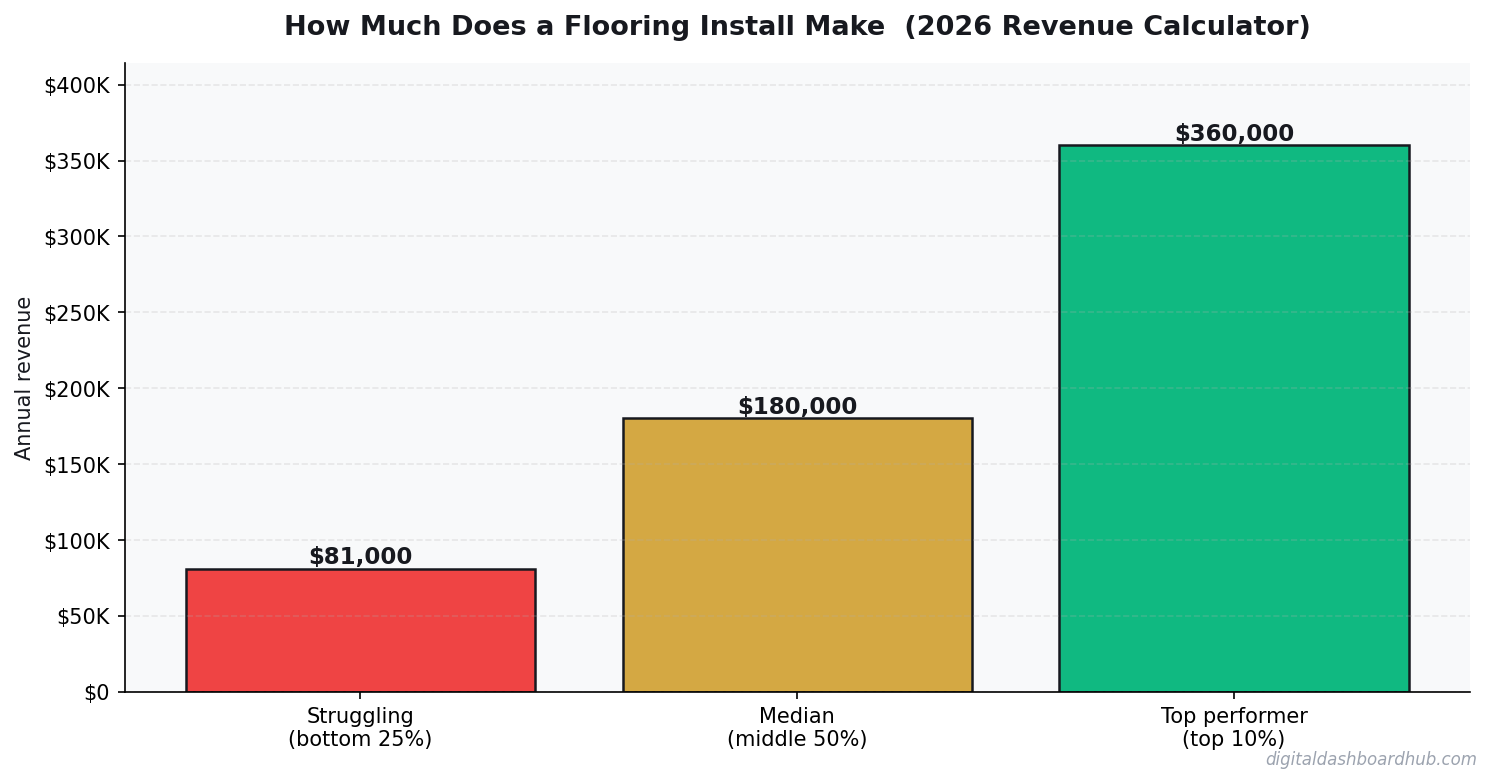
LVP installs are 40% faster than hardwood with comparable revenue per square foot. Shifting your mix toward LVP jobs is the fastest path to better margins.
The Blind Spot in Most Business Plans
Underquoting waste factor. Hardwood jobs need 10-15% waste factor, tile needs 15-20% for cuts. Most installers quote 5-8% and eat the difference.
Spring remodels (March-June) are peak season. Winter is 30-40% slower unless you’re in commercial work.
The Dashboard Behind This Calculator
How to Use This Calculator
Start by entering your actual numbers — not estimates. Pull from your bank statements, your POS system, or your accounting software. The difference between estimated and real inputs is usually the difference between “this looks fine” and “oh, that’s where the money is going.”
Then change one variable at a time. For flooring installation, the lever that usually moves the needle most is lvp installs are 40% faster than hardwood with comparable revenue per square foot. Start there.
If you want to save these projections, track them month-over-month, or model different scenarios side by side, the full dashboard does all of that. Free 14-day trial, no credit card required.
Your Next Move
Related Tools and Articles
- Never Work Again Calculator: The Exact Number by Age
- Why Traditional Budgets Fail ADHD Brains — And the Visual Tracker That Actually Works
- The Side Hustle Tax Trap: How to Track Every Dollar So April Doesn’t Destroy You
Common Questions About How Much Does a Flooring Install Make? (2026 Revenue Calculator)
How long does it take to see results?
Most people see meaningful progress within 30-90 days when they apply these strategies consistently. The key is tracking your numbers from day one so you have a baseline to measure against.
What’s the biggest mistake people make?
Trying to do everything at once. Pick one or two strategies from this guide, implement them fully, then layer in additional tactics. Spreading yourself thin is the fastest way to see no results from any of it.
Do I need special tools or software?
Not necessarily to start — but the right tools eliminate hours of manual work. Our free calculators and trackers at Digital Dashboard Hub are a good starting point before you invest in paid software.
A Flooring Installation Company That Works: The Actual Numbers
Two-crew flooring install operation in Phoenix — 4 installers total, 1 owner/estimator. They run 3 jobs/week averaging $7,500 per job (mix of hardwood, LVP, and tile). That’s $22,500/week in revenue, or $1,080,000 gross annually running 48 productive weeks.
Material costs (flooring, adhesive, underlayment, transitions) at 45% of job cost: $486,000. Labor for 4 installers at $28/hour average, 50 hours/week each: $291,200/year. Truck payments, fuel, insurance, tools, and overhead: ~$75,000/year. Owner net: approximately $228,000. That’s a real number for a well-run two-crew operation in a growing market.
The crews bleeding money are usually underestimating materials and underpricing scope changes. When a job reveals subfloor issues (and they often do), that’s a change order — not an absorbed cost. Installers who don’t charge for unexpected subfloor work erode margin on every job with a surprise underneath it.
The 3 Factors That Move Flooring Revenue Most
1. Job mix — not all flooring is equal. Luxury vinyl plank installs fast, has high homeowner demand, and typically prices at $4-$6/sq ft for installation alone. Hardwood installation is slower, demands more skill, and prices at $6-$10/sq ft. Tile is labor-intensive but commands the highest rates in bathrooms and kitchens. Crews that specialize in premium products — and communicate why — earn 30-40% more per square foot than generalists taking whatever comes in.
2. Average job size. A $3,000 single-room job and a $15,000 whole-house job both take a sales call and a truck on-site. The whole-house job is dramatically more profitable per hour of overhead. The flooring companies growing fastest are specifically targeting contractors, real estate investors, and builders who commission full-house or multi-unit projects — not individual homeowners one room at a time.
3. Materials markup and supplier relationships. Retail flooring markup for contractor purchases typically runs 20-40% below MSRP. Installers who buy at contractor pricing and sell at near-retail are capturing that margin. The ones who “supply and install” at a single price point are almost always earning more than the ones who separate labor and materials — customers don’t comparison-shop the materials markup the same way they shop labor rates.
Common Mistakes Flooring Contractors Make With Pricing
The biggest is not pricing scope changes. A flooring job that starts as “install LVP in living room and hallway” and expands to “also do the master bedroom and fix the subfloor issue we found” is three different jobs — but many contractors treat it as one job and absorb the additional cost to avoid an awkward conversation. Those “awkward” scope change conversations are where the margin lives.
The second mistake: underestimating waste factor. LVP on a simple rectangular room runs 5-8% waste for cuts. A room with angles, irregular walls, or multiple doorways runs 10-15%. Diagonal patterns run 15-20%. Installers who bid based on exact square footage and then absorb the waste are giving material margin away on every complex job.
Third: not tracking profit by job type. If you don’t know whether tile jobs are more profitable than LVP jobs per hour of labor, you can’t make informed decisions about which work to pursue. Track your actual hours and materials cost per job for 3 months and you’ll likely find one or two job types that are significantly more profitable than others — and you can adjust your marketing and bidding to pursue more of those.
When to Add a Second Crew
The revenue ceiling for a single crew is approximately $600,000-$800,000/year, depending on job mix and market rates. A second crew doubles that ceiling but adds fixed costs (additional truck, tools, crew lead wages) and management complexity. The right time to add a second crew is when you have more qualified work than your first crew can complete — not when revenue is uncertain and you’re hoping work will follow the hire.
The transition period is the hardest part. During month 1-3 of a new crew, productivity is lower while they develop rhythm and the crew lead develops judgment. Cash flow is tighter. Operators who plan for a 90-day ramp period with cash reserves in place come out of it fine. Operators who expect instant full productivity often make hasty decisions under pressure.
Keep reading (related guides):
- Auto Mechanic Revenue: What Owners Make vs. What Youd Expect (2026)
- Boutique Revenue Calculator
- Pest Control Revenue Calculator: Recurring Contracts and Seasonal Profit
- Jewelry Business Profit Margins: What Owners Actually Take Home (2026)
- Business Expense Tracker: Categorize and Export for Tax Time
255+ interactive tools for your money, time, and health.
14-day trial · Stripe checkout · Cancel anytime
What Most People Get Wrong
The single biggest mistake is treating revenue as the headline number. Revenue is vanity — margin is sanity, and cash-in-bank is reality. Two operators with identical top-lines routinely end the year $80K apart in take-home, because one priced for volume and the other priced for sustainability. The calculator above forces you to surface that gap before it hits your bank account.
The second mistake is modeling a “best case” and planning around it. The number you should plan around is the 30th-percentile scenario — enough demand to matter, but slower than you hoped. If the business still covers your living expenses there, you have real margin of safety. If it only works in the 80th-percentile case, you are building on sand.
The third mistake is ignoring your time as a cost. If you would otherwise earn $55/hr at a day job and this operation pays you effectively $18/hr for 60-hour weeks, the gap is the real price of running it. Plug your opportunity cost into the calculator and the picture often flips.
How to Pressure-Test Your Numbers
Start with the calculator, then stress-test three levers independently:
- Pricing: What happens to your take-home if you raise prices 10%, but lose 15% of volume? Most operators are surprised to find net income goes up.
- Costs: What happens if your largest input cost rises 20%? This is not hypothetical — it is a typical 12-month swing in most industries.
- Volume: What happens at 70% of your planned volume for 90 days? If that still covers fixed costs, you have a real business. If not, the model is fragile.
Running the calculator three ways takes about ten minutes. The clarity on the other side of those ten minutes is usually the difference between a confident operating plan and guessing for another six months.
Frequently Asked Questions
How accurate is this calculator?
The underlying math uses industry-standard margin and cost ranges sourced from the How Much Does a Flooring Install Make? space. Your actual numbers depend on location, seasonality, and operating style, so treat this as a directional benchmark, not a guarantee. The more precisely you enter your inputs, the tighter the output range becomes.
Can I save my results?
A free Digital Dashboard Hub account saves every scenario you run, lets you compare side-by-side, and unlocks the full dashboard with expense tracking and month-over-month charts. The 14-day trial includes the complete tool library — no credit card required to start.
Who is this tool for?
It’s built for anyone pressure-testing a real decision — existing operators auditing their margins, side-hustlers deciding whether to go full-time, and prospective owners trying to sanity-check a business plan before signing a lease. You do not need any accounting background to use it.
What should I do with the results?
Start by comparing the output against your current (or projected) monthly take-home. If the gap is big, walk back the inputs and identify which lever — pricing, volume, or cost structure — is doing the damage. That is usually where the highest-leverage fix lives.
The Bottom Line
Most operators lose money not because the math is impossible, but because they never actually ran it. Fifteen minutes with the calculator beats three months of guessing. Run your numbers, screenshot the output, and use it as the baseline for every pricing and cost decision over the next quarter.
When you are ready to go deeper, the full Digital Dashboard Hub workspace lets you save scenarios, track actuals month-over-month, and see the trend before problems compound. That is the version that actually compounds the effort — spreadsheets forgotten in a Google Drive folder do not.
Next Steps
- Run the calculator above with your best current estimates.
- Re-run it with a pessimistic scenario (lower volume, higher costs) and a stretch scenario (better pricing, more efficient ops).
- Screenshot all three outputs so you have a baseline to compare against when reality arrives.
- Revisit monthly — the number that matters is the one that changes with your real P&L.
Ready for the full dashboard?
Unlock all 255 tools across business, creator, and health workflows.

Andy Gaber is the founder of Digital Dashboard Hub, a suite of 255+ interactive financial, productivity, and wellness tools. He built DDH after getting frustrated with financial apps that gave outputs without context. Follow along for tool tutorials, revenue analytics breakdowns, and honest takes on personal finance.