Most solopreneurs are flying blind. Not because data doesn’t exist — because they’re not looking at the right data. Most solopreneurs and small business owners are tracking vanity metrics while the numbers that actually predict survival and growth sit in an untouched spreadsheet — or worse, nowhere at all.
That’s exactly why I built a lead magnet conversion tracker. Not another dashboard full of graphs that look impressive but tell you nothing. A tool that answers one question: is what I’m doing working?
The Real Email Marketing Problem Nobody Talks About
Enter your own numbers in the interactive tool below and get a real-time read. The dashboard version adds saved scenarios, history, and full feature access.
Here’s the dirty truth about email marketing: the people who need it most are the least likely to do it. When you’re running a business, creating content, or managing clients, sitting down to analyze data feels like a luxury you can’t afford.
The Cost of Not Tracking
The average solopreneur loses $3,000-$8,000/year in recoverable revenue because they don’t track the right metrics. That’s not a marketing claim — it’s the gap between what people think they earn and what their bank statements show.
For context on how other creators handle their business finances, check out I’m Losing Money to Business Expenses: A Tracker Helped.
The 4 Numbers Every Email Marketing Owner Needs
1. Revenue per hour worked. Not gross revenue — revenue divided by actual hours. Most solopreneurs discover they’re earning $15-25/hour once they account for admin, marketing, and communication time.
2. Client acquisition cost. How much does it cost you to land a new client? Include ad spend, time spent on proposals, networking hours, and content creation. If this number is higher than your first-project profit, you’re losing money to grow.
3. Profit margin by service/product. Not overall margin — per offering. You’ll almost certainly find that 20% of what you sell generates 80% of your profit. Kill or reprice the losers.
4. Cash runway. How many months can you operate with zero new revenue? If the answer is less than 3, that should be your first fix. Related reading: Notion vs DDH Tracker: Productivity Comparison for Creators.
How the DDH Lead Magnet Conversion Tracker Pro Works in Practice
Here’s what tracking email marketing looks like when the tool is built for people who are too busy to track.
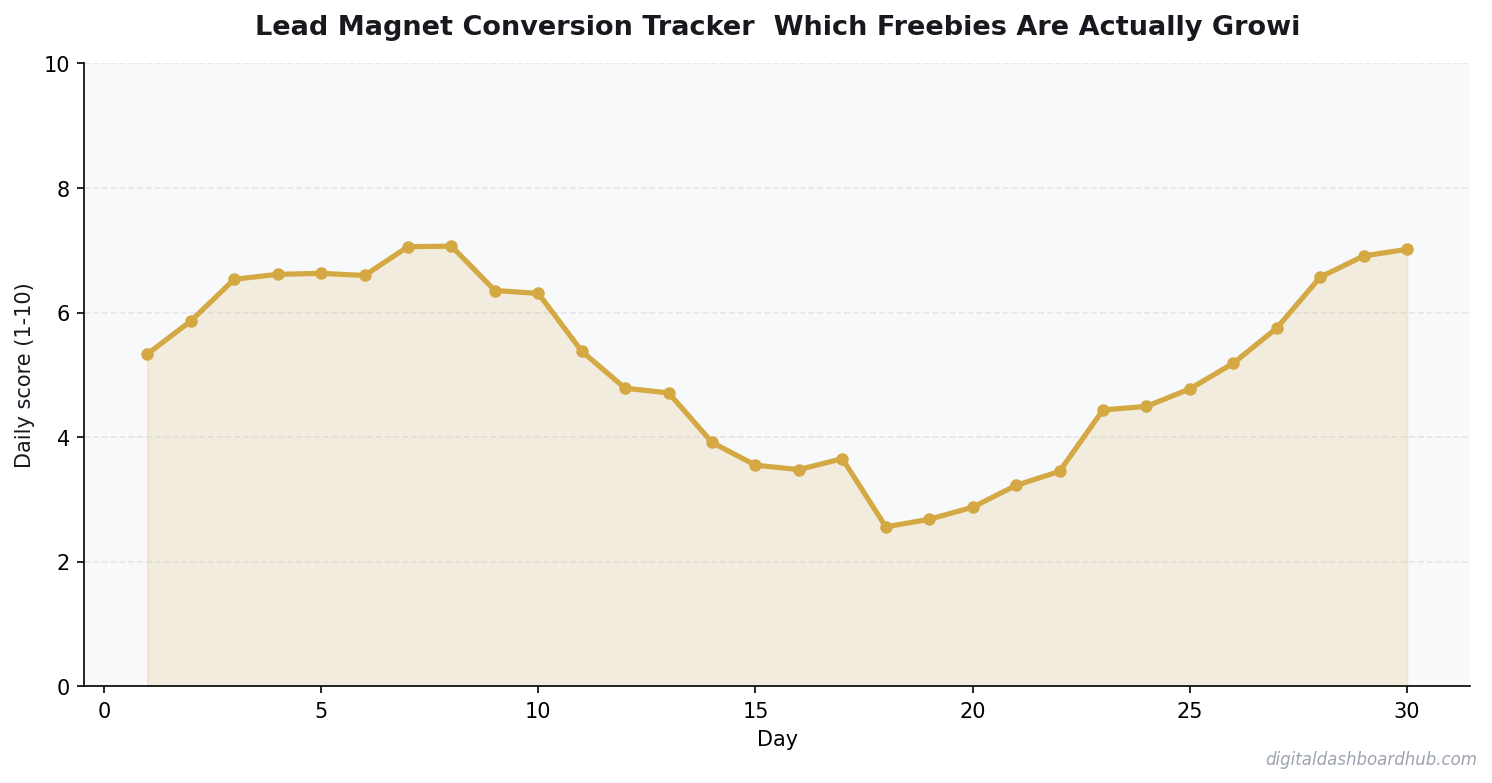
Step 1: Input your key data points. The tool is pre-configured for the metrics that matter for your business type — no custom formula building, no spreadsheet formatting headaches.
Step 2: See your numbers visualized instantly. Color-coded indicators show what’s healthy (green), what needs attention (yellow), and what’s actively costing you money (red). No interpretation needed.
Step 3: Get actionable insights. The tool doesn’t just show you data — it tells you what to do about it. If your conversion rate dropped, it highlights the specific stage where prospects are dropping off.
The feature that justifies the whole tool: the weekly health score. One number, 0-100, that tells you whether your business is trending up or down. Checking one number takes 10 seconds. That’s sustainable even on your busiest week.
If you want to see your numbers: Try the Lead Magnet Conversion Tracker Pro free for 14 days → No credit card. One of 255+ tools built for creators, freelancers, and small business owners.
Email Marketing Tools Compared
| Feature | Spreadsheets | Enterprise Tools | DDH Dashboard |
|---|---|---|---|
| Setup time | 3-10 hours | Days-weeks | 60 seconds |
| Built for solopreneurs | If you build it | No (team-focused) | Yes |
| Cost | Free (your time) | $50-300/mo | Free trial |
| Actionable insights | You interpret | Overload | Built-in |
FREE BONUS: Weekly Business Health Check Template
The exact 5-minute checklist I use every Monday to know if my business is growing or bleeding. One page, printable.
The Freebie That Actually Converts (And Why Most Don’t)
Here’s what the data consistently shows: checklists and templates convert at 2-3x the rate of ebooks and “ultimate guides.” People download guides, feel good about downloading them, and then never open them. Checklists and templates get used immediately — which means the subscriber experiences a win in the first 5 minutes, associates your brand with that win, and opens your next email.
If your lead magnet is an ebook with more than 8 pages, you’re probably converting at 10-20% of what you could. Same topic, same traffic, in a checklist format — 2-4x improvement is common.
How to Read Your Conversion Data
Two numbers matter most: opt-in rate (visitors to subscribers) and email open rate on the first follow-up. Opt-in rate tells you if the offer is compelling. First-follow-up open rate tells you if the subscriber actually wanted what you said you’d deliver.
A high opt-in rate (8%+) with a low first-follow-up open rate (under 40%) means you over-promised. The freebie title was more compelling than the freebie itself. The goal is alignment: the right promise, delivered exactly as expected. Open rates above 55% on the first follow-up mean you nailed it.
The Lead Magnets That Consistently Outperform
Based on split-test data from content creators and online business owners:
- Swipe files and templates: Average 6-12% opt-in rate on warm traffic
- Calculators and quizzes: 8-15% opt-in rate — interactive tools are the highest-converting lead magnets in most niches
- Checklists under 1 page: 4-8% opt-in rate, very high completion rate
- Mini-courses (3-5 emails): Lower opt-in (3-5%) but higher sales conversion on the back end
Match the format to your audience’s urgency. Someone trying to solve a problem today wants a checklist. Someone researching a topic over weeks wants a mini-course. Wrong format for the buyer stage is the most common lead magnet mistake.
The Freebie That Actually Converts (And Why Most Don’t)
Here’s what the data consistently shows: checklists and templates convert at 2-3x the rate of ebooks and “ultimate guides.” People download guides, feel good about downloading them, and then never open them. Checklists and templates get used immediately — which means the subscriber experiences a win in the first 5 minutes, associates your brand with that win, and opens your next email.
If your lead magnet is an ebook with more than 8 pages, you’re probably converting at 10-20% of what you could. Same topic, same traffic, in a checklist format — 2-4x improvement is common.
How to Read Your Conversion Data
Two numbers matter most: opt-in rate (visitors to subscribers) and email open rate on the first follow-up. Opt-in rate tells you if the offer is compelling. First-follow-up open rate tells you if the subscriber actually wanted what you said you’d deliver.
A high opt-in rate (8%+) with a low first-follow-up open rate (under 40%) means you over-promised. The freebie title was more compelling than the freebie itself. The goal is alignment: the right promise, delivered exactly as expected. Open rates above 55% on the first follow-up mean you nailed it.
The Lead Magnets That Consistently Outperform
Based on split-test data from content creators and online business owners:
- Swipe files and templates: Average 6-12% opt-in rate on warm traffic
- Calculators and quizzes: 8-15% opt-in rate — interactive tools are the highest-converting lead magnets in most niches
- Checklists under 1 page: 4-8% opt-in rate, very high completion rate
- Mini-courses (3-5 emails): Lower opt-in (3-5%) but higher sales conversion on the back end
Match the format to your audience’s urgency. Someone trying to solve a problem today wants a checklist. Someone researching a topic over weeks wants a mini-course. Wrong format for the buyer stage is the most common lead magnet mistake.
Keep reading (related guides):
- How Much Does Therapy Cost in 2026? A State-by-State Breakdown
- Free ADHD Impulse Spending Tracker — Try It Now
- ADHD Cleaning Hacks: How to Keep Your Space Tidy Without Overwhelm
- ADHD Rejection Sensitivity: Understanding RSD and 7 Ways to Cope
- Debt Snowball vs Avalanche Calculator: Which Method Saves You More Money
255+ interactive tools for your money, time, and health.
Full features for 14 days · Secure payment · Stop anytime
⚡ Quick Lead Magnet Conversion Pro Score
Track your symptoms in 30 seconds.
Basic score only. Get the full tracker with 255+ tools →
Your Next Move
Right now (2 minutes): Calculate your revenue per hour. Take last month’s revenue and divide by total hours worked (including admin, marketing, client communication — everything). That number will probably surprise you.
This week: Identify your most and least profitable offering. Most businesses have at least one service or product that’s secretly losing money.
The long play: Set up the DDH Lead Magnet Conversion Tracker Pro. 60 seconds to start, 14 days free. Get a weekly health score for your business instead of guessing. There are 255+ tools in the platform — explore the ones that match your business model.
Questions people ask before using this tool
What should I do when the Lead Magnet Conversion shows bad news?
Write down the number, write down the assumption behind the number, and compare both against your last three snapshots. Nine times out of ten the fix is ‘change one thing next week’ not ‘rebuild the funnel.’ Small corrections compound; big rewrites usually waste a month.
How often should I refresh my Lead Magnet Conversion assumptions?
Inputs: weekly. Assumptions (conversion rates, margin, churn): monthly. Strategy-level variables (target market, pricing tier): quarterly. Anything more often and you are reacting to noise; less often and you are flying blind.
Can a Lead Magnet Conversion replace a finance or ops hire?
Not at scale, but it buys you 12-24 months. A solid tool plus 2 hours a week of founder attention covers the work a part-time fractional ops lead would handle. The right time to hire is when the tool stops being the bottleneck — usually around $500K-$1M ARR.
How do small teams actually use a Lead Magnet Conversion day to day?
Weekly, not daily. Most founders set a recurring 20-minute slot on Monday, pull the latest inputs, update the sheet or tool, and look at one output: the trendline vs. last week. Anything more often generates noise; anything less often misses the signal.
When is a Lead Magnet Conversion a waste of time?
When the business has fewer than 20 data points. You need enough history for the math to mean something. Pre-product-market-fit, your effort is better spent on sales calls than calculators. After PMF, tools like this compound hard.
What makes one Lead Magnet Conversion better than another?
The output you actually act on. Tools that dump 40 metrics in a dashboard fail. Tools that surface two or three decisions per week win. Judge any Lead Magnet Conversion by whether it changes what you did next — not by how much data it displays.
Seven mistakes to avoid with this Lead Magnet Conversion tool
- Using the output to build the plan instead of pressure-test it. The tool should challenge your plan, not replace the thinking.
- Celebrating the green line too soon. One good week is not a trend. Require 3 consecutive weeks before calling anything a pattern.
- Tracking the Lead Magnet Conversion in isolation. Metrics only mean something when compared to last week, last month, or a goal; solo numbers are noise.
- Refreshing inputs daily. Daily swings are noise; weekly is the right cadence for most founder-facing metrics.
- Not writing down assumptions. When the number shifts next quarter, you will not remember what changed — logs of the inputs matter more than logs of the output.
- Building a dashboard with 40 metrics. The best operators watch 3-5 and act on one. More tracking is rarely the answer.
- Ignoring cohort differences. An average that blends new and long-term customers hides the real signal. Segment before you decide.
Every growing team hits the ceiling where a spreadsheet and gut feel stop working. A Lead Magnet Conversion tool — used weekly, not obsessed over — is what bridges you from founder-dependent to ops-dependent decisions.
When to use this Lead Magnet Conversion tool (and when to skip it)
This Lead Magnet Conversion earns its weekly slot when: your team is actively iterating on the underlying process, revenue is growing faster than your gut can track, or you are preparing for a board or investor conversation that needs defensible numbers. In those states, a 20-minute Monday review is one of the highest-leverage blocks of your week.
Skip the tool when the business is in firefighting mode — a major customer outage, a co-founder exit, a pivot week. In those windows, operating data is a distraction; focus on the single issue that matters. Also skip it before you have at least 20 data points; anything less is too noisy to draw conclusions from, and pretending otherwise leads to reactive decisions.
The teams that get the most out of a tool like this one set two rules: one person owns the weekly refresh (ownership beats democracy), and the output is reviewed in a 20-minute standing slot (not an ad-hoc ‘when we get to it’). Those two guardrails are what separate ops discipline from theater.
Lead Magnet Conversion quick reference checklist
A quick operator’s checklist for the Lead Magnet Conversion — run it before your weekly review.
- You identified the single biggest lever moving the number — and whether it is under your control.
- You wrote down one decision you are taking based on the output.
- You are reviewing 3-5 metrics, not 40 — the dashboard stays small on purpose.
- You compared this week’s output to the last 3 weeks, not just last week.
- You scheduled a recurring 20-minute review so this does not get skipped next week.
- You updated the inputs within the last 7 days.
What to do next
Once you have walked the checklist, scroll back up and run your real inputs in the interactive Lead Magnet Conversion tool — it takes about 60 seconds. If you want to compare this against the other 254+ calculators, trackers, and planners in the DDH library, the full set lives at app.digitaldashboardhub.com. Free tier covers the core version of every tool; upgrades unlock cross-tool dashboards, scenario saving, and team sharing.
If you are brand new to the DDH toolkit, start with three tools: one that directly serves your primary goal this quarter, one that catches problems before they compound, and one just for fun. That mix prevents the usual fate of productivity tools — great first month, forgotten by month three.
Keep Reading
- I’m Losing Money to Business Expenses: A Tracker Helped
- Notion vs DDH Tracker: Productivity Comparison for Creators
- QuickBooks vs DDH Expense Tracker: Which Fits Your Business?
- Best Freelancer Invoice Apps & Tracker Tools (For People Who Hate Invoicing)
Common Questions About Lead Magnet Conversion Tracker: Which Freebies Are Actually Growing Your List?
How long does it take to see results?
Most people see meaningful progress within 30-90 days when they apply these strategies consistently. The key is tracking your numbers from day one so you have a baseline to measure against.
What’s the biggest mistake people make?
Trying to do everything at once. Pick one or two strategies from this guide, implement them fully, then layer in additional tactics. Spreading yourself thin is the fastest way to see no results from any of it.
Do I need special tools or software?
Not necessarily to start — but the right tools eliminate hours of manual work. Our free calculators and trackers at Digital Dashboard Hub are a good starting point before you invest in paid software.

Andy Gaber is the founder of Digital Dashboard Hub, a suite of 255+ interactive financial, productivity, and wellness tools. He built DDH after getting frustrated with financial apps that gave outputs without context. Follow along for tool tutorials, revenue analytics breakdowns, and honest takes on personal finance.