Your Coworker Didn’t Reply to Your Slack Message and Now You’re Convinced You’re Getting Fired
Before you scroll: the calculator below is running in your browser right now. For the full feature set — saved scenarios, history, exports — open the dashboard.
It’s been 23 minutes. They’re usually fast. They’ve read it — you can see the “read” receipt. But no response. Your brain is already three steps ahead: they’re annoyed with you. They’re talking about you to the manager. They’re building a case to let you go. By minute 40, you’ve mentally drafted your resignation letter and calculated how long your savings will last.
In This Article
- Your Coworker Didn’t Reply to Your Slack Message and Now You’re Convinced You’re Getting Fired
- What RSD Actually Is (And What It Isn’t)
- RSD vs. Social Anxiety vs. General Sensitivity: What’s the Difference?
- Why Your Brain Does This (The Science)
- 7 Coping Strategies That Actually Work for RSD
- How the DDH ADHD Emotional Tracker Handles This
- What to Tell the People Around You
- The Practical Takeaway
- Common Mistakes That Sabotage ADHD Systems
- Frequently Asked Questions
Then they reply: “Sounds good! Was in a meeting.” And the tsunami of dread just… evaporates. Until next time. If this emotional whiplash sounds like your daily life, you’re probably dealing with ADHD rejection sensitivity disorder (RSD) — and you’re definitely not alone. An estimated 99% of adults with ADHD experience RSD to some degree, according to Dr. William Dodson, a psychiatrist who has specialized in ADHD for over 25 years.
What RSD Actually Is (And What It Isn’t)
Rejection Sensitivity Dysphoria isn’t just “being sensitive.” It’s a neurological response unique to ADHD brains where perceived rejection — real or imagined — triggers an emotional pain response that feels disproportionately intense, physical, and overwhelming.
💰 Real talk: the tracking itself changes your behavior. That’s not a bug — it’s the feature.
Key word: perceived. RSD doesn’t require actual rejection. A neutral facial expression from your partner. A friend’s delayed text. A slightly curt email from your boss. Your brain interprets ambiguity as rejection, and the emotional response is immediate, intense, and nearly impossible to talk yourself out of in the moment.
The physical component is what catches people off guard. RSD doesn’t just feel like sadness or embarrassment — it feels like a punch to the chest. A literal sinking sensation. Sudden heat in your face. Some people describe it as a wave of shame so intense it’s nauseating. This isn’t an overreaction. It’s a neurological event happening in a brain with dysregulated emotional processing.
RSD vs. Social Anxiety vs. General Sensitivity: What’s the Difference?
The critical difference: RSD hits like a switch being flipped. One second you’re fine, the next you’re drowning. Social anxiety tends to build gradually. And HSP sensitivity is about overall stimulation, not rejection specifically.
Why Your Brain Does This (The Science)
ADHD brains have differences in the prefrontal cortex — the part that regulates emotional responses. When a neurotypical brain perceives possible rejection, the prefrontal cortex steps in and says: “Hold on, let’s evaluate this rationally. They probably just didn’t see the message.” It dampens the emotional response while you gather more information.
In an ADHD brain, that dampening system is weaker. The emotional response fires first AND hardest. By the time your rational brain catches up, you’ve already experienced 15 minutes of intense emotional pain. You might know rationally that you’re overreacting. That doesn’t stop the feeling. That’s the cruelest part of RSD — awareness doesn’t equal control.
Dr. Dodson explains it this way: “RSD is not a mood that can be managed with mindset tricks. It’s a neurological event that must be either prevented or endured.” That’s why the nervous system regulation approach matters so much — you need strategies that work on a physiological level, not just a cognitive one.
7 Coping Strategies That Actually Work for RSD
I’ve tried everything from CBT worksheets to cold showers to “just don’t think about it.” Here are the seven strategies that made a measurable difference when I tracked my RSD episodes over 90 days:
1. The 90-second rule. Dr. Jill Bolte Taylor’s research shows that the initial neurochemical surge of any emotion lasts about 90 seconds. After that, you’re choosing to continue the emotional response. When RSD hits, set a literal 90-second timer. Your only job during those 90 seconds is to breathe and not act. Don’t send the defensive text. Don’t confront anyone. Just survive the 90 seconds. Most RSD spikes begin to subside after the initial wave passes — IF you don’t feed them with rumination.
2. The “evidence check” journal. After the 90-second wave passes, write down: (a) what happened, (b) what my brain said it meant, and (c) three alternative explanations. “My friend didn’t laugh at my joke” becomes “they might not have heard it / they might be distracted / the joke genuinely wasn’t funny and that’s okay.” This isn’t about dismissing your feelings — it’s about adding context that your panicking brain couldn’t generate in the moment.
3. Pre-loading responses. I keep a list of “RSD first-aid phrases” on my phone: “I’m having an RSD moment. This feeling is real but the interpretation might not be.” “My brain is seeing rejection that probably isn’t there.” “This will pass in 20 minutes.” Reading these during an episode doesn’t eliminate the feeling, but it prevents me from acting on it — which is where the real damage happens.
4. Physical grounding (5-4-3-2-1). Name 5 things you can see, 4 you can touch, 3 you can hear, 2 you can smell, 1 you can taste. This is a standard anxiety technique, but it works especially well for RSD because it forces your brain to process sensory input instead of spiraling through rejection scenarios.
FREE BONUS: The RSD Emergency Kit Card
A wallet-sized printable with the 90-second rule, 5-4-3-2-1 grounding steps, and 6 first-aid phrases for RSD episodes. Keep it on your phone or in your wallet for moments when your brain can’t think straight.
Get instant access → https://app.digitaldashboardhub.com/signup
5. Tracking triggers and patterns. After logging RSD episodes for 60 days, I discovered that 70% of mine happened between 4-8 PM — when my Adderall was wearing off and my brain was tired. Knowing this timing pattern means I can be extra cautious about interpreting social cues during those hours. “Don’t make important social decisions after 4 PM” became a personal rule that prevented dozens of unnecessary conflicts.
6. The “ask, don’t assume” protocol. When I feel rejected, I’ve trained myself to check rather than spiral. “Hey, I noticed you seemed quiet in our last chat — is everything cool between us?” feels vulnerable and scary. But the answer is almost always: “Yeah, totally fine, I was just tired.” One minute of vulnerability prevents hours of imagined catastrophe.
7. Medication adjustment. Some medications help with RSD specifically. Alpha-agonists like guanfacine (Intuniv) have shown efficacy in dampening the emotional intensity of RSD episodes. This isn’t a self-medication suggestion — talk to your prescriber about whether your current ADHD medication addresses emotional regulation or just focus.
How the DDH ADHD Emotional Tracker Handles This
Tracking RSD episodes is the single most powerful tool I’ve found for managing them. When you can see the patterns, you can interrupt them.
Step 1: When an RSD episode hits, you log it: time, trigger, intensity (1-10), physical symptoms, and what you did about it. Takes about 30 seconds — which conveniently falls within your 90-second waiting period anyway.
Step 2: The dashboard maps your episodes by time of day, day of week, and trigger category. Mine showed clear clusters: late afternoon, email/text-related, intensity averaging 7.8. Your pattern will be different — that’s exactly why individual tracking matters.
Step 3: The coping strategy effectiveness tracker shows which of your strategies actually reduce episode duration and intensity. My data showed that the 90-second rule alone reduced average episode duration from 45 minutes to 12 minutes. The evidence check journal reduced intensity from 7.8 to 5.2 on average.
The part that matters most: seeing your progress over time. When you’ve tracked 60 RSD episodes and can see that your average intensity has dropped from 8.1 to 5.4, that’s not a feeling — it’s proof that your strategies are working. For a brain that constantly questions whether it’s “actually getting better,” data is the best reassurance available.
→ Try the DDH ADHD Tracker free: app.digitaldashboardhub.com/signup
What to Tell the People Around You
RSD affects relationships because the people in your life don’t understand why you react so intensely to minor things. Here’s a script that works:
“I have a thing called rejection sensitivity — it’s part of my ADHD. Sometimes my brain interprets neutral things as rejection, and the emotional response is really intense even though I know rationally that it’s probably fine. When I seem to overreact, it’s not drama — it’s a neurological response I’m working on managing. The most helpful thing you can do is be direct with me. If something’s actually wrong, tell me. And if nothing’s wrong, a quick ‘we’re good’ goes a long way.”
Most people respond well to this explanation because it gives them a framework for understanding your reactions AND a simple action they can take. The nervous system tracking approach can also help you explain your patterns to loved ones.
The Practical Takeaway
1. Right now (2 minutes): Think about your last RSD episode. Write down: when it happened, what triggered it, how intense it felt (1-10), and how long it lasted. You just created your first data point. The DDH Stress Level Tracker can help formalize this process.
2. This week: Practice the 90-second rule once. Just once. When you feel the RSD wave hit, set a timer and breathe through it. Don’t text anyone, don’t confront anyone, just survive the 90 seconds. See what happens after the timer goes off.
3. Long game: Start tracking your RSD episodes with the DDH ADHD Emotional Tracker. After 30 days, you’ll have enough data to see your personal patterns — timing, triggers, effective strategies. That data transforms RSD from something that happens TO you into something you can anticipate and manage.
Still here? You’re serious about this.
Join 550+ ADHD adults who grabbed the RSD Emergency Kit Card this month. Keep it on your phone for the next time your brain decides a delayed text means the end of a friendship.
Get your free copy → https://app.digitaldashboardhub.com/signup
Keep reading (related guides):
255+ interactive tools for your money, time, and health.
14-day trial · Stripe checkout · Cancel anytime
Common Mistakes That Sabotage ADHD Systems
I’ve made every one of these. Sharing them so you don’t waste the same months I did.
3 min/day
is all it takes to maintain a meaningful tracking practice
Frequently Asked Questions
What’s the best free tool for managing ADHD tasks?
How do I stop hyperfocusing on the wrong things?
Does medication alone fix ADHD productivity issues?
The Text Message Test That Proved RSD Was Running My Life
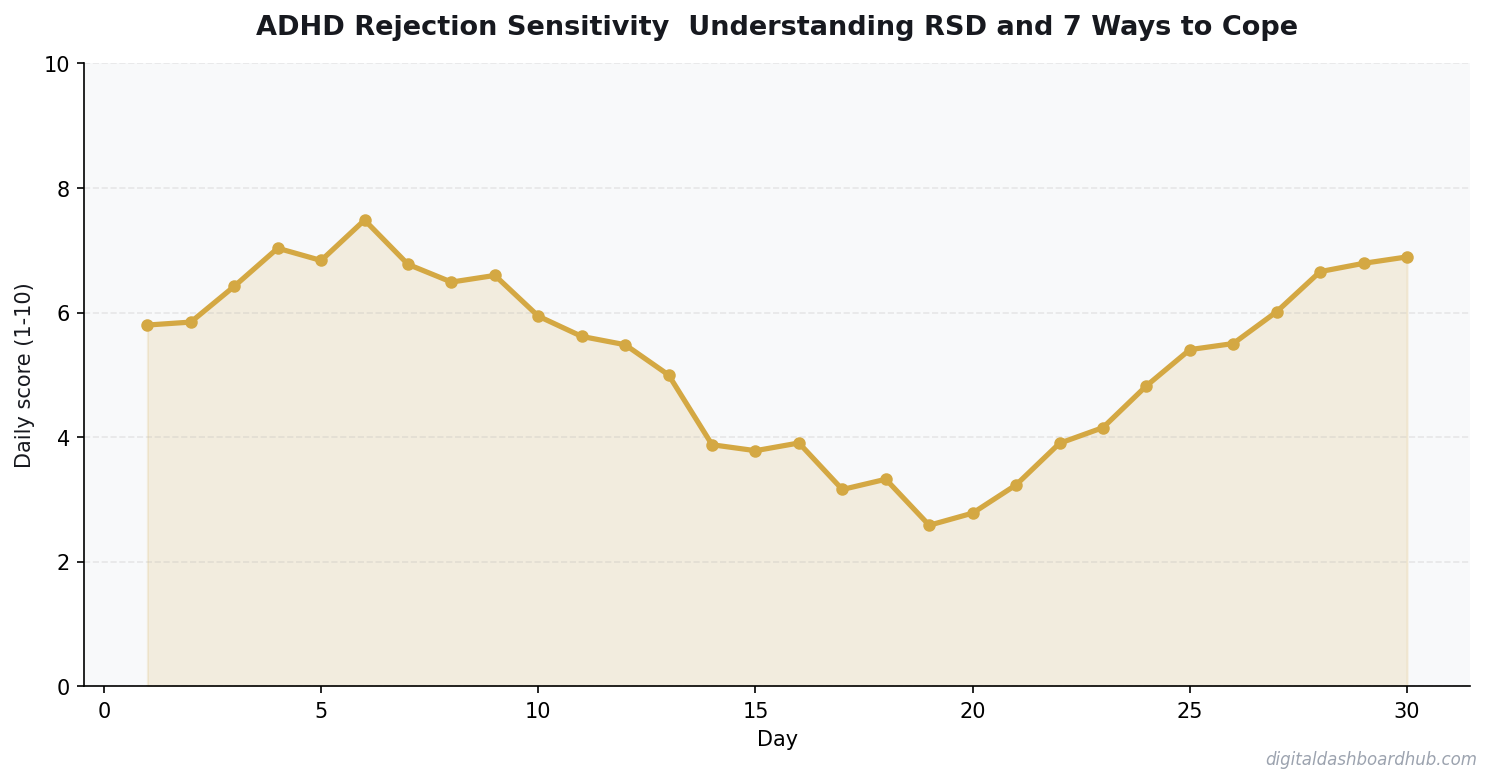
For 30 days, I tracked every time I felt a rejection response and rated the actual severity of the trigger on a 1-10 scale (1 = completely imagined, 10 = genuine rejection). My average trigger severity: 2.3. My average emotional response: 7.8. The gap between those two numbers — 5.5 points — is RSD in a single statistic.
The worst example: a friend responded to my text with “k” instead of her usual paragraph. Trigger severity: 1 (she was probably just busy). My emotional response: 9 (spent 2 hours convinced she was angry at me, drafted and deleted 3 follow-up texts). She called me that evening to chat like nothing
Key Takeaways
- Start with the simplest possible system and add complexity only when needed
- Data shows you what’s working — stop guessing and start measuring
- Consistency beats intensity: 3 minutes daily beats 30 minutes weekly
happened. The rejection was entirely fabricated by my brain.
Seeing this pattern in data — not just feeling it — was the breakthrough. I now check my tracker before reacting to perceived slights. “Is this a real 7, or is this a 2 that feels like a 7?” That pause has prevented dozens of unnecessary confrontations and apology spirals.
3 Brands
One Platform
Finance, Creator, and Wellness tools
Keep Reading
- The ADHD Dopamine Menu
- ADHD Daily Routine Planner
- How to Regulate Your Nervous System
- Why ADHD Brains Start Everything and Finish Nothing

Andy Gaber is the founder of Digital Dashboard Hub, a suite of 255+ interactive financial, productivity, and wellness tools. He built DDH after getting frustrated with financial apps that gave outputs without context. Follow along for tool tutorials, revenue analytics breakdowns, and honest takes on personal finance.