Everyone Said It Would Be Easy Money. Everyone Was Wrong.
The dashboard below loads instantly in your browser. Plug in your numbers, see your answer. No signup to try the basics.
About this article: I’m Andy, founder of Digital Dashboard Hub. I built DDH’s 255 free interactive tools to solve the specific financial, productivity, and wellness tracking gaps I kept seeing — starting with the problem this article covers. The free tool below is available without signup and works instantly. Try it and see your numbers in real time.
The Main Point
In This Article
- Everyone Said It Would Be Easy Money. Everyone Was Wrong.
- The Licensing Gauntlet Nobody Prepares You For
- Month-by-Month Revenue: The Slow Reality
- The True Cost Per Child (It’s Higher Than You Think)
- How the DDH Daycare Revenue Calculator Handles This
- What I Changed in Year Two (And Why It Worked)
- The Financial Milestones Nobody Tells You About
- What I’d Tell Anyone Starting Today
- Your Action Plan
- Related Articles
Budget for 6 months of partial enrollment. Even in areas with childcare shortages, it takes 4-6 months to fill a home daycare. Make sure you can absorb that ramp period financially.
When I started looking into home daycare, the pitch was irresistible. You already have a house. You already love kids. Parents in your area are desperate for childcare. Just get licensed, take on 6 kids, charge $200/week each, and you’re making $62,400/year from home. Simple.
Quick Win
Bookmark this page. Run the numbers with YOUR actual figures before making any decisions.
It wasn’t simple. My first year of running a licensed home daycare brought in $38,700 in revenue — about $24,000 less than my projection. And after expenses, I paid myself about $22,000 for a year of 50-hour weeks. That’s $8.46/hour if you’re keeping score, which I unfortunately was.
Here’s the real story of year one: the licensing surprises, the true cost per child, the month-by-month revenue, and what I’d actually do differently now that I’m in year three and finally making it work.
The Licensing Gauntlet Nobody Prepares You For
I started the licensing process in March expecting to open by May. I opened in August. Five months of inspections, background checks, training requirements, and home modifications that cost me three months of potential revenue plus $4,200 in expenses I hadn’t budgeted.
The shift happened when licensing actually required in my state:
- 40 hours of pre-licensing training (online, but still 40 hours of my time)
- CPR and First Aid certification — $95
- Background check for every household member over 18 — $75 each
- Home inspection requiring: outlet covers on every outlet, cabinet locks on all lower cabinets, a fenced outdoor play area (mine needed repair — $1,800), fire extinguisher in kitchen, carbon monoxide detectors on every level, and a separate handwashing sink accessible to children
- Liability insurance specifically for home daycare — $1,100/year
- That accessible handwashing sink? A plumber charged me $950 to install it
Total licensing and setup costs: $4,200. Not terrible in isolation, but it was $4,200 out before I earned a dollar, and it ate through my already-thin startup budget.
Month-by-Month Revenue: The Slow Reality
I was licensed for 6 children (the maximum for a home daycare in my state without hiring an assistant). What I found was actually happened month by month:
Look at those first few months. It took me until January — five months after opening — to get to 5 children. That’s five months of earning well below my operating costs. Every month with fewer than 4 children, I was losing money after expenses.
The True Cost Per Child (It’s Higher Than You Think)
My annual expenses running a 6-child home daycare:
Food and snacks: $3,600/year ($600/child — I provided breakfast, lunch, and two snacks daily). Supplies and consumables (diapers for younger ones, wipes, cleaning supplies, craft materials, sunscreen): $1,800/year. Insurance: $1,100/year. Continued education (required by licensing — 16 hours/year of training): $200/year. Toys, books, and curriculum materials: $800/year. Increased utilities (running the AC/heat for 10 extra hours daily, extra laundry, extra water): $1,200/year. Home wear and tear (carpet cleaning, paint touch-ups, fence maintenance): $600/year. Background check renewals and licensing fees: $150/year. Total: $9,450/year.
$38,700 in revenue minus $9,450 in expenses = $29,250 in owner income. But remember, I also spent $4,200 on startup costs, so year-one real income was about $25,050. For roughly 2,400 hours of work (50 hours/week × 48 working weeks).
That’s $10.44/hour. Literally less than I could have made working at Target.
How the DDH Daycare Revenue Calculator Handles This
When I was planning, I used a simple formula: kids × rate × weeks = revenue. That’s what everyone uses, and that’s why everyone’s projection is wrong. The DDH Daycare Revenue Calculator accounts for the things that actually eat into your numbers.
It models the enrollment ramp — how many months it takes to reach full capacity. It factors in vacation closures and parent no-show weeks. It calculates true cost per child including food, supplies, and the utility increase. And it shows you the month-by-month cash flow so you can see exactly how much runway you need before the business can support you.
If I’d had a tool that showed me I’d only bring in $1,560 in month one and wouldn’t break even until month four, I would have saved more money before opening. That’s the kind of reality check that prevents the panic I felt in September when I had 3 kids and $2,340 in revenue against $2,200 in expenses (including the cost of food I was providing).
What I Changed in Year Two (And Why It Worked)
Year two revenue: $58,200. That’s a 50% increase. I found something interesting changed.
I raised my rates to $225/week. I was terrified of losing families. I lost zero. Every single parent stayed. I’d been undercharging by $25-30/week compared to other home daycares in my area because I was scared of pricing myself out. Instead, I was pricing myself into poverty.
I started charging for holidays and vacation weeks. Year one, I didn’t charge when I was closed. That cost me roughly $2,400 in lost revenue. Year two, I switched to a flat monthly rate that covers 52 weeks regardless of closures. Two families pushed back; I explained that every daycare center in the area does the same thing. They stayed.
I filled spots faster. Instead of waiting for referrals, I posted on local Facebook groups, registered with my state’s childcare referral system, and put a small sign in my yard. My waitlist went from zero to four families by March of year two. Having a waitlist meant I could replace departing families within days instead of weeks.
I stopped providing diapers. Parents now bring their own diapers and wipes. Saved me roughly $1,200/year in supply costs. Every other home daycare in my area already did this — I was the outlier being “nice” at my own expense.
The Financial Milestones Nobody Tells You About
Here are the breakpoints I’ve identified after three years in this business:
4 children at $200/week = survival. You’re covering expenses and paying yourself minimum wage. This is not a sustainable income, but it keeps the lights on while you fill remaining spots.
6 children at $225/week = solid part-time income. You’re bringing in $58,500/year gross, about $48,000 after expenses. That’s a real income for one person, though not lavish. For a two-income household, this is a strong second income that also eliminates your own childcare costs if you have young kids.
6 children at $275/week + assistant = growth mode. If you hire an assistant (required in most states to exceed 6 children), you can take on 8-12 kids. Revenue can reach $85,000-$114,000/year. But the assistant costs $15-18/hour, so you need at least 8 children before the math works. This is the path to a “real” daycare, and it requires a bigger space and more licensing.
The jump from 6 to 8+ kids is the decision point where home daycare either stays a solid side income or becomes a full-fledged business. Most successful home daycare operators I’ve talked to cap at 6 and keep it manageable, or go all the way to 12 and hire help. The middle ground is expensive.
What I’d Tell Anyone Starting Today
Don’t start until you have at least 3 families committed before you open. Not “interested.” Committed, with deposit paid. Getting from zero to 3 is the hardest part, and doing it before you open means you start month one with enough revenue to cover expenses.
Charge market rate from day one. Look up what daycare centers and other home daycares charge in your area. Price yourself within $10-$20 of the average, not $30-$50 below. You’re not competing on price — you’re competing on small group size, personal attention, and home environment. Those are premium features. Price accordingly.
Build in paid holidays and vacation from the start. It’s 100 times easier to set these expectations in the initial contract than to introduce them later.
Budget for 6 months of partial enrollment. Even in areas with childcare shortages, it takes 4-6 months to fill a home daycare. Make sure you can absorb that ramp period financially.
Your Action Plan
- Run the real numbers. Open the DDH Daycare Revenue Calculator and model your specific situation — your state’s capacity limit, your intended rates, your estimated food and supply costs, and a realistic enrollment ramp.
- Check your state’s licensing requirements today. Search “[your state] home daycare licensing requirements.” The timeline and costs vary wildly. Know what you’re signing up for before you start the process.
- Talk to two home daycare providers in your area. Ask about their rates, their fill time, and the one thing they wish they’d known. Every operator I’ve talked to has a different “I wish someone had told me” story, and each one is worth hearing.
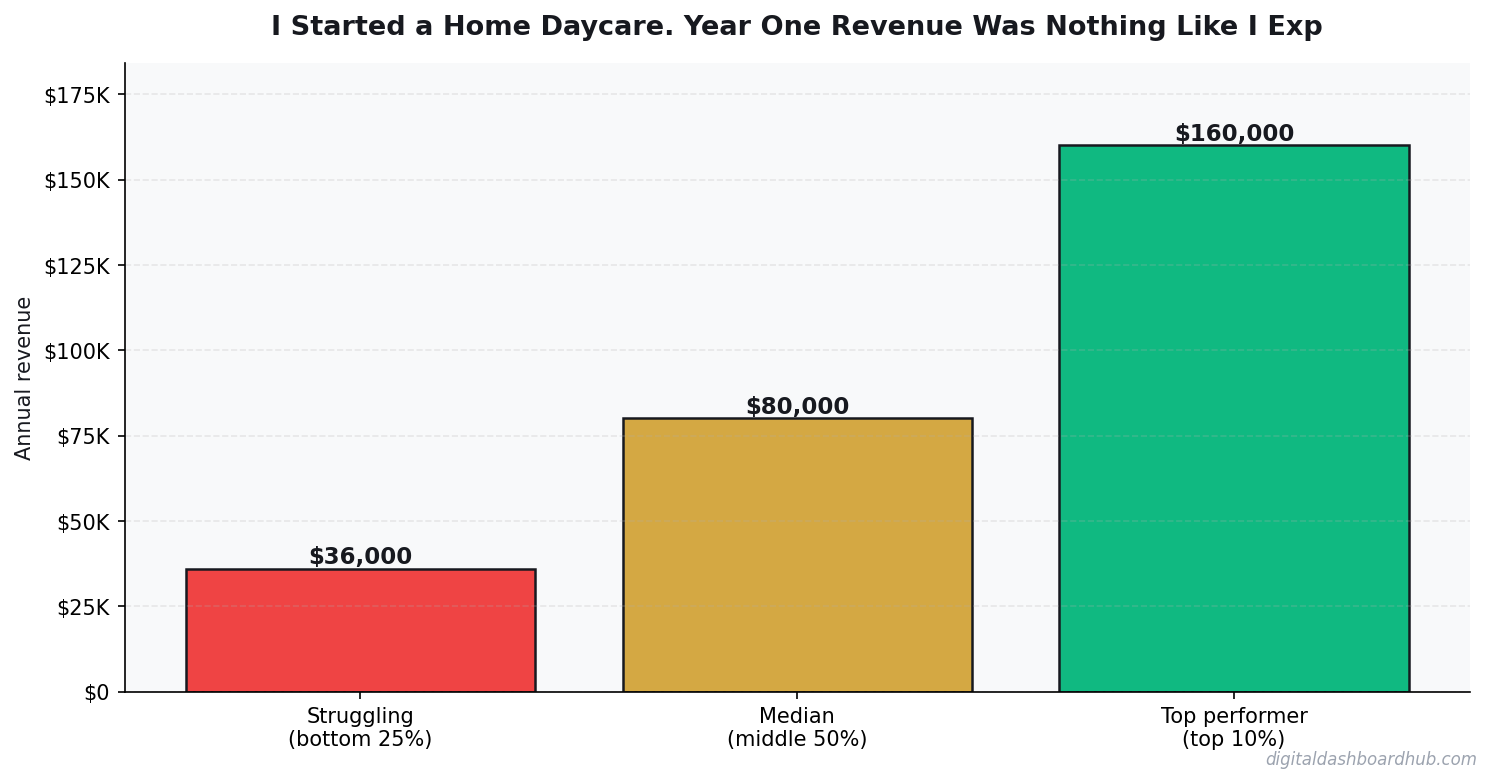
Home daycare can be a genuinely good business. But “good” means $45,000-$60,000/year for full-time work in most markets — not the $80,000+ projections that float around online. Know your real numbers before you commit.
162+
Revenue Calculators
Built for real business decisions
Related Articles
- How Sinking Funds Saved Me From Financial Emergencies
- The Side Hustle Tax Trap: Track Every Dollar
- Freelancer Finance Dashboard: Track Income, Taxes, and Cash Flow in One Visual Hub
Keep reading (related guides):
- Rent vs. Buy Calculator 2026: The True Cost of Each Option (Real Numbers)
- True Cost of Your Mortgage Calculator: Its More Than the Payment
- Homeownership vs. Renting for 30 Years: The Complete Financial Comparison
- Best Mortgage Calculator Apps: 7 Options Tested and Compared
- Amazon FBA Revenue Calculator: What Sellers Actually Make in 2026
255+ interactive tools for your money, time, and health.
Full dashboard access · Stripe-secure checkout · Cancel anytime

Andy Gaber is the founder of Digital Dashboard Hub, a suite of 255+ interactive financial, productivity, and wellness tools. He built DDH after getting frustrated with financial apps that gave outputs without context. Follow along for tool tutorials, revenue analytics breakdowns, and honest takes on personal finance.