The Number That Got Me Into Insurance
Enter your own numbers in the interactive tool below and get a real-time read. The dashboard version adds saved scenarios, history, and full feature access.
A guy at my gym told me he made $140,000 selling life insurance. He drove a leased BMW and wore a suit every day, which at 24 years old I thought meant success. He said the top agents at his agency cleared $300K. He said the licensing exam was easy. He said I’d be a natural.
He was right about one thing: the exam was easy. Everything else was significantly more complicated than he made it sound. But I did make $87,000 my first year — and I’m going to break down exactly where every dollar came from, because when I was starting out, I couldn’t find this information anywhere.
The Commission Structure Nobody Explains Clearly
Insurance compensation is genuinely confusing, and I think it’s confusing on purpose. Here’s how it actually works for a typical captive life insurance agent (which is what most first-year agents are).
When you sell a life insurance policy, you earn a commission based on the first-year premium. For whole life, that’s typically 55-90% of the first-year premium. For term life, it’s lower — usually 40-70%. The percentage depends on your agency contract and your production level.
So if a client pays $2,400/year for a whole life policy and your commission rate is 70%, you earn $1,680 from that single sale. But from my testing the recruiter didn’t mention: that commission is often advanced and then charged back if the policy lapses within the first year. I had three chargebacks my first year totaling $4,200 in clawed-back commissions. That hurt.
Month-by-Month: The Actual Income Curve
This is the part every insurance recruiter glosses over. Your first three months are essentially unpaid training. You’re studying, getting licensed, shadowing senior agents, and building your prospect list. Some agencies pay a small salary during this period ($2,000-$3,000/month). Mine didn’t.
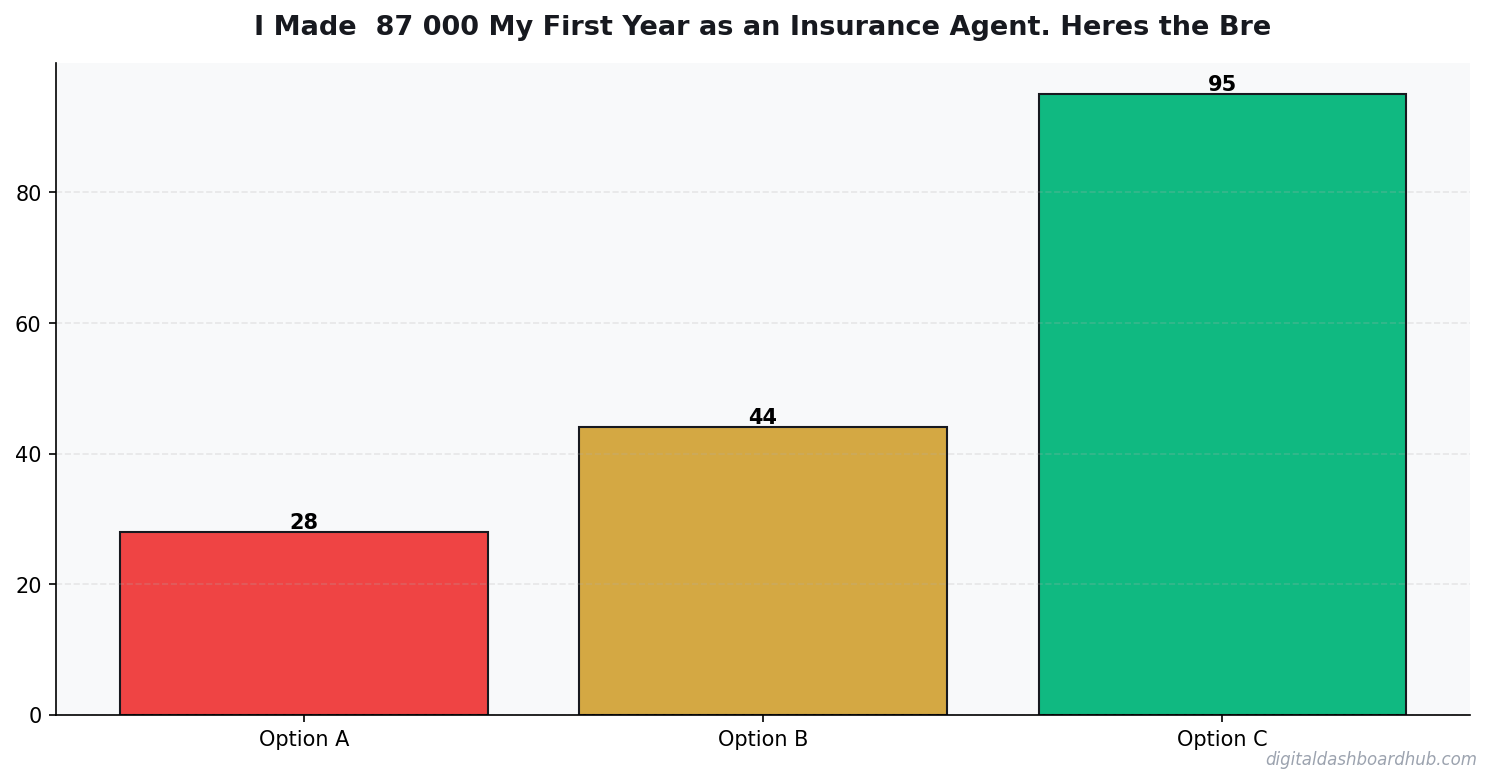
Months 1-3: $3,800 total. I sold five policies in three months, mostly to family and friends. Two were small term policies. I was eating ramen and questioning every life decision. My commission checks were embarrassingly small, and I spent more on gas driving to appointments than I earned from two of those sales.
Months 4-6: $14,200 total. This is when things started clicking. I found a prospecting method that worked for me (LinkedIn outreach to small business owners for group benefits), and I started closing 3-4 policies per month. My confidence was building. I stopped apologizing for the price and started explaining the value.
Months 7-9: $28,500 total. The referral engine kicked in. Three clients from month 4 each referred me to two people. Referred prospects close at nearly double the rate of cold prospects. I also landed my first group benefits account — a 12-person company that generated $4,800 in commission.
Months 10-12: $40,500 total. By now I had a system. I was doing 15 prospecting calls per day, booking 8-10 appointments per week, and closing about 40% of sits. The compounding effect of referrals and renewals started showing up. My best single month was month 11 at $16,200.
Full year total: $87,000 in gross commissions. After chargebacks ($4,200), my net was $82,800. After taxes and expenses, I took home roughly $54,000.
The Prospecting Grind: Real Numbers
If there’s one thing I want first-year agents to understand, it’s this: insurance is a prospecting business that happens to involve selling insurance. The actual sales conversation is maybe 20% of the job. The other 80% is finding people to have that conversation with.
Here are my actual first-year prospecting numbers:
Total calls made: ~3,400. Appointments booked: 312. Appointments that showed up: 247. Presentations completed: 218. Policies sold: 62. That’s a 1.8% call-to-sale ratio. For every policy I sold, I made 55 calls. That’s the reality nobody puts in the recruiting brochure.
The natural market (friends and family) dried up after about 15 sales. After that, every policy came from cold outreach, networking events, or referrals. The agents who quit — and about 70% of first-year agents do quit — almost always quit because they ran out of natural market and couldn’t handle the cold prospecting phase.
How the DDH Income Projection Calculator Handles This
One of my biggest mistakes was not tracking my numbers from day one. I didn’t know my call-to-appointment ratio until month 5. I didn’t know my average commission per sale until month 7. I was flying blind, which meant I couldn’t forecast my income or identify what was actually working.
The Revenue Projection Calculator in Digital Dashboard Hub is built for exactly this kind of variable-income career. You plug in your activity metrics (calls per day, appointment rate, close rate, average commission), and it projects your monthly and annual income with a visual curve. You can model different scenarios — “what if I increase my close rate from 28% to 35%?” — and see the downstream revenue impact immediately.
For commission-based careers, this kind of modeling isn’t optional. It’s the difference between hoping you’ll hit your numbers and engineering your activity to guarantee it.
The Renewal Income Nobody Talks About (Until Year 3)
Here’s the beautiful thing about insurance that kept me going through those brutal first months: renewal commissions. Every policy you sell pays you a small percentage every year it stays in force. Year one, renewals are negligible. Year two, they add up to maybe $300-$500/month. By year three, $1,000-$2,000/month. By year five, $3,000-$5,000/month.
I know agents with 10-year books of business who earn $8,000-$12,000/month in renewals before they make a single new sale. That’s the real wealth in insurance — but you have to survive the first two years to get there.
My renewal income at the end of year one was $127/month. Tiny. But it was growing every month, and I could see the trajectory. By the end of year two, it was $680/month. That’s $8,160/year in passive income, just for keeping my clients happy and their policies in force.
The Expenses They Don’t Mention
Insurance agencies love to say “you’re in business for yourself!” What they mean is: you’re paying for everything yourself. This is what my first year actually cost:
Licensing and continuing education: $1,200. E&O insurance (errors and omissions): $1,800/year. CRM software: $600/year. Gas and car maintenance (those client visits add up): $4,800. Professional clothes (you can’t sell whole life in gym shorts): $1,500. Lead purchase programs: $2,400. Marketing materials: $800. Total first-year expenses: approximately $13,100.
That $87,000 in gross commissions was really $82,800 after chargebacks, then $69,700 after expenses, then roughly $54,000 after taxes. Still a solid first-year income — but a far cry from the $87K headline number.
What I’d Tell Someone Starting Today
The insurance industry is real. The money is real. But the timeline is longer than recruiters suggest, the prospecting is harder than they admit, and the first six months will test your mental health in ways you don’t expect.
If I were starting over, I’d do three things differently. First, I’d track every single metric from day one — calls, appointments, close rate, average premium, chargebacks. You can’t optimize what you don’t measure. Second, I’d focus on a niche immediately instead of selling everything to everyone. The agents making $200K+ almost always specialize: business owners, physicians, teachers, whatever. Third, I’d build a referral system from the very first sale instead of waiting until month 6.
The agents who survive year one and build a real book of business have a career that pays exceptionally well with genuine passive income. The ones who don’t track their numbers, don’t prospect consistently, and don’t ask for referrals wash out before they ever get to enjoy the renewal income.
Mid-Article Bonus: The Commission Tracking System That Saved Me
By month 4, I had commissions coming in from three different carriers, chargebacks hitting at random, and no idea what my actual monthly income was. I built a spreadsheet that tracked every policy, its premium, my commission rate, the expected chargeback window, and the renewal schedule. It took me a full Sunday to set up, but after that, I could forecast my income two months out with 90% accuracy.
That forecasting ability changed everything. I stopped panicking during slow weeks because I could see the pending commissions in the pipeline. I started making decisions based on data instead of fear. And when my agency manager asked why I was outperforming agents with 3 years of experience, the honest answer was: I knew my numbers better than they did.
Your Action Plan
Step 1: If you’re considering insurance sales, calculate your personal survival number — the minimum monthly income you need to cover rent, food, and insurance for 6 months. Have that saved before you start. Don’t rely on first-quarter commissions to pay rent.
Step 2: Build your tracking system before you make your first call. Track calls, appointments, sits, closes, premiums, and commissions from day one. The agents who succeed are the ones who treat this like a data-driven business, not a hope-driven hustle.
Step 3: Start a free trial of Digital Dashboard Hub and use the Income Projection Calculator to model your first-year earnings based on realistic activity numbers. Plug in 15 calls/day, a 9% appointment rate, and a 28% close rate, and see what the math actually produces. Then decide if the grind is worth the payoff.
Keep reading (related guides):
What Separates Top First-Year Agents from the Rest
Most first-year insurance agents wash out in 18 months. The ones who make it past year two usually do four things differently from day one.
1. They track policies sold per week, not commission earned
Commission fluctuates with policy mix and carrier bonuses. Activity is the leading indicator. Top first-years average 6-9 policies per week by month three. If you’re below 4, you have a prospecting problem no amount of training will fix.
2. They build renewal infrastructure from month one
Year-one income is mostly new business commission. Year-two income should be mostly renewals. If you’re not tracking renewal dates, contact cadences, and cross-sell opportunities from your first policy, you’re leaving 40-60% of your future income on the table.
3. They pick a vertical and dominate it
Generalists work 60-hour weeks for $55K. Agents who niche down — doctors, contractors, restaurant owners — clear $120K-$180K because they’re the obvious expert in a small segment. Pick a vertical you have natural access to and go deep.
4. They run their CRM like a system, not a filing cabinet
Top agents log every conversation, every follow-up date, every note. Average agents do this for two weeks and then give up. Consistent CRM discipline is the difference between a $45K rookie year and an $85K rookie year.
The year-one numbers to hit
Target: 200-300 new policies written, 40%+ retention into year two, $70K-$95K gross commissions. If you’re below 150 policies at month twelve, something structural is broken — usually prospecting volume or niche focus.
255+ interactive tools for your money, time, and health.
Full features for 14 days · Secure payment · Stop anytime
Keep Reading
- The Side Hustle Tax Trap: Track Every Dollar
- Freelancer Finance Dashboard: Track Income, Taxes, and Cash Flow in One Visual Hub
- Sinking Fund Savings Goal Planner (Free Tool)

Andy Gaber is the founder of Digital Dashboard Hub, a suite of 255+ interactive financial, productivity, and wellness tools. He built DDH after getting frustrated with financial apps that gave outputs without context. Follow along for tool tutorials, revenue analytics breakdowns, and honest takes on personal finance.