My doctor looked at the 148/92 reading and said the word I’d been dreading: “medication.” But then she said something unexpected — “Let’s try three months of lifestyle changes first, but you need to track every single reading.” Six months later, I was at 122/78 with zero prescriptions.
About this article: I’m Andy, founder of Digital Dashboard Hub. I built DDH’s 255 free interactive tools to solve the specific financial, productivity, and wellness tracking gaps I kept seeing — starting with the problem this article covers. The free tool below is available without signup and works instantly. Try it and see your numbers in real time.
In This Article
This is the full story of how I tracked my blood pressure daily, identified exactly what was spiking it, and made targeted changes that brought my numbers down enough to avoid medication. Not everyone can do this — some people genuinely need meds, and that’s not a failure. But for the ~30% of hypertension cases that respond to lifestyle intervention, tracking is the difference between guessing and knowing.
Where I Started: The Numbers That Scared Me
Jump in: the tool below is live and free to play with. Upgrade to a dashboard account when you want to save scenarios and track over time.
At 38, I didn’t think I was a blood pressure candidate. I exercised occasionally, didn’t smoke, and only drank socially. But my doctor’s office readings told a different story:
January reading: 148/92 (Stage 2 hypertension)
February reading: 142/88 (still Stage 2)
March reading: 145/90 (not improving)
The CDC reports that 47% of American adults have hypertension, defined as systolic blood pressure ≥130 or diastolic ≥80. And most of them don’t know it because high blood pressure has no symptoms until it causes damage.
Why Office Readings Aren’t Enough
Here’s something most people don’t realize about blood pressure: a single reading is almost meaningless. White coat syndrome (elevated readings from doctor’s office anxiety) affects up to 30% of patients. And your BP fluctuates throughout the day based on stress, caffeine, sleep, hydration, and even posture.
💰 The tool matters less than the consistency. Pick something simple and stick with it for 30 days.
My doctor recommended home monitoring twice daily — morning and evening — for a minimum of 7 consecutive days. That’s 14 readings per week instead of 1 reading every 3 months. The American Heart Association backs this approach, noting that home monitoring provides a more accurate picture than office visits alone.
The Changes I Made (Based on My Data)
I didn’t overhaul everything at once. I made one change per week and watched my numbers to see what actually moved the needle.
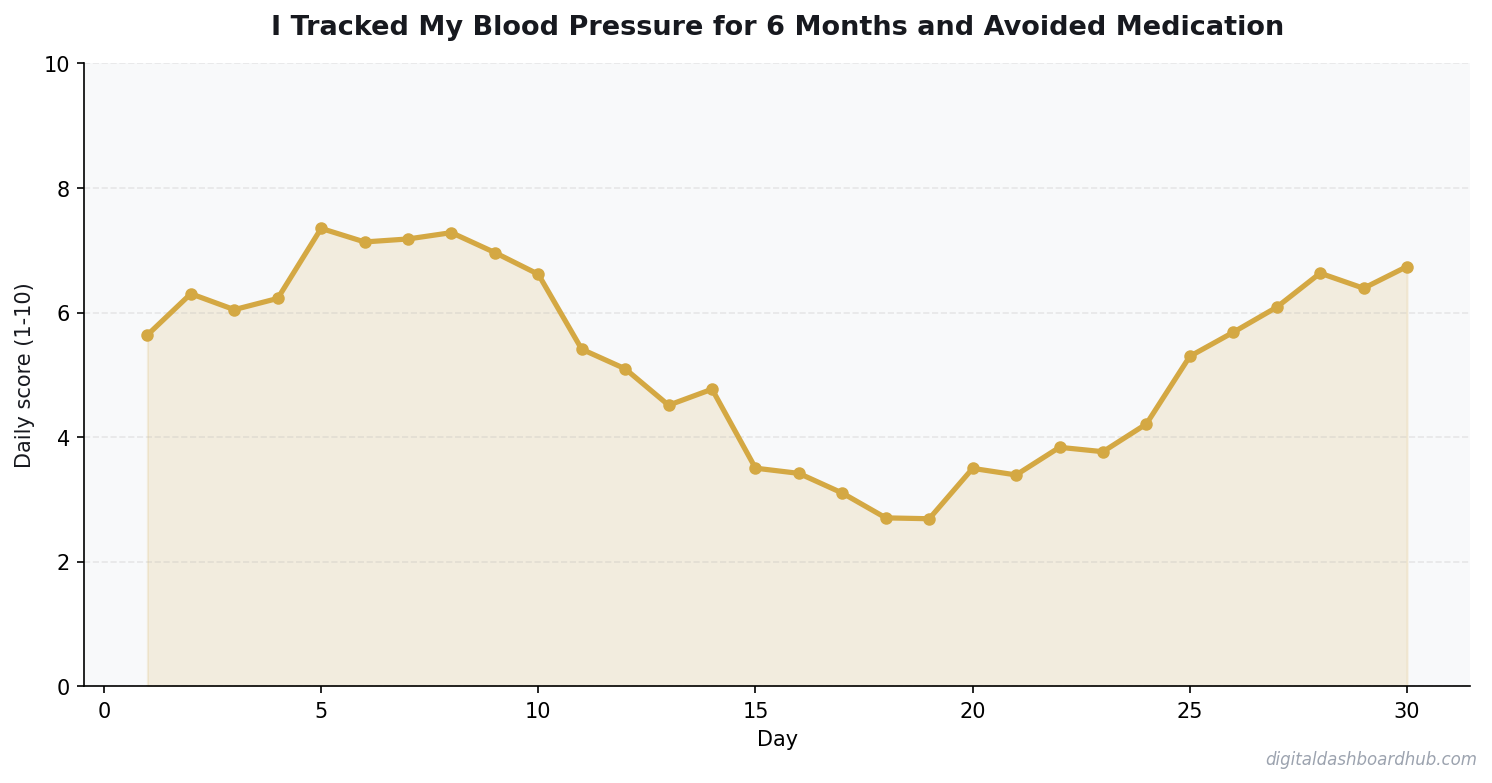
Week 1-2: Sodium tracking. I started reading labels. Turns out my “healthy” lunch (canned soup + whole grain bread) had 1,800mg of sodium — nearly the entire daily recommended limit. I swapped to homemade meals and my average systolic dropped 6 points in two weeks.
Week 3-4: Sleep consistency. My data showed morning readings were 12-15 points higher after nights with less than 6.5 hours of sleep. I set a hard bedtime at 10:30 PM. Morning readings dropped another 5 points on average.
Week 5-8: Walking 30 minutes daily. Not intense exercise — just walking. The data was clear: on days I walked, my evening reading averaged 128/82. On days I didn’t, it averaged 138/88. A 10-point difference from a walk.
Week 9-12: Stress management. I noticed my Thursday readings were consistently my worst — that’s my heaviest meeting day. I added a 10-minute breathing exercise before my first Thursday meeting. Thursdays went from my worst day to my second-best.
How the DDH Blood Pressure Tracker Handles This
I started with a spreadsheet. It worked, but I couldn’t see trends without building charts manually. The DDH tracker changed the process in three specific ways.
First, it auto-categorizes every reading by blood pressure stage (normal, elevated, Stage 1, Stage 2) so you don’t have to remember the thresholds. You just enter the numbers and the dashboard color-codes them.
Second, the trend line. After two weeks, you can see your 7-day rolling average — which smooths out the daily fluctuations and shows you whether your actual baseline is improving. My daily numbers bounced around, but the trend line showed a clear downward slope starting in week 3.
Third, the correlation view. The tracker lets you tag each reading with context — sleep hours, exercise, sodium intake, stress level. Over time, it highlights which factors have the strongest relationship with your readings. For me, sleep and sodium were the top two. Exercise was third. Stress was fourth but only significant on my worst days.
Try the DDH Blood Pressure Tracker free — enter your first reading in 30 seconds.
FREE BONUS: The Blood Pressure Tracking Cheat Sheet
A one-page guide to proper home monitoring technique, plus the AHA’s blood pressure categories and what each range means.
Get instant access → Start Your Free Trial
The 6-Month Results
Month 1: 148/92 → 138/86 (sodium reduction + sleep)
Month 2: 138/86 → 132/84 (added daily walks)
Month 3: 132/84 → 128/80 (stress management + consistency)
Month 4: 128/80 → 126/78 (fine-tuning, potassium-rich foods)
Month 5: 126/78 → 124/76 (steady state)
Month 6: 122/78 (doctor’s office reading confirmed)
My doctor looked at the data — all 360+ home readings — and said “this is exactly what I hoped for.” No medication needed. Recheck in 6 months.
21 days
average time to form a tracking habit that sticks
This Won’t Work for Everyone (And That’s OK)
I want to be honest: lifestyle changes work for some hypertension cases but not all. If your blood pressure is consistently above 160/100, if you have other cardiovascular risk factors, or if lifestyle changes don’t budge your numbers after 3 months — medication isn’t defeat. It’s medicine doing its job.
What tracking does regardless: it gives you and your doctor data instead of guesses. Even people on medication benefit from home monitoring because it shows whether the dose is working.
What I’d Do If I Were Starting Over
Right now (2 minutes): If you own a home blood pressure monitor, take a reading right now. Write down the number, the time, and what you ate/drank in the last 2 hours. That’s your baseline.
This week: Take morning and evening readings for 7 consecutive days. Note your water
Key Takeaways
- Your patterns are unique — don’t rely on averages or others’ experiences
- The tracking itself changes behavior, even before you act on insights
- Share your data with professionals to get more targeted advice
intake, sleep hours, and whether you exercised each day.
For the long haul: Set up the DDH Blood Pressure Tracker so you can see trends, correlations, and stage categorizations automatically. Bring the data to your next doctor’s appointment.
Keep reading (related guides):
- How Much Does Therapy Cost in 2026? A State-by-State Breakdown
- Free ADHD Impulse Spending Tracker — Try It Now
- How to Budget With ADHD: 5 Systems That Dont Require Willpower
- ADHD Body Doubling: What It Is and How to Use It for Focus
- Rent vs. Buy Calculator 2026: The True Cost of Each Option (Real Numbers)
255+ interactive tools for your money, time, and health.
Instant signup · Stripe-secure · Cancel in one click
255+
Interactive Tools
More From DDH
- Stress Level Tracker: How Measuring Stress Helps You Manage It
- How to Regulate Your Nervous System: 8 Steps to Calm
- Sleep Tracking Changed My Life
- Workout Progress Tracker: The Method That Kept Me Consistent
Common Questions About Tracked Blood Pressure Avoided Medication
How long before I see results?
Most people notice meaningful patterns within 2 to 4 weeks of consistent tracking. The first week is almost always noisy — you’re still learning what to record, when to record it, and how honest to be with yourself. By week two, baselines emerge. By week four, you can start testing changes against data instead of guessing. Don’t judge the system in the first seven days. Give it a full month before deciding whether the system is worth keeping or whether the approach needs a rethink.
What should I track first?
Start with one metric that is both objective and daily. Objective means a number, not a feeling. Daily means once every 24 hours, not “whenever I remember.” Two metrics is fine; three is too many to sustain for someone new. You can always add more once the habit is locked in. The goal of the first month is consistency, not coverage. It’s better to track one thing perfectly for thirty days than six things sloppily for five, and the data will be far more useful.
What if I miss a day?
Miss one day, no problem — tracking is a long game and single-day gaps don’t break the trend. Miss two days in a row, and your brain starts negotiating you out of the system entirely. The rule most people use: never miss twice. Log something — even a single data point — on the second day, then resume the full routine the next morning. Streaks matter less than quick recovery after a miss, and nobody maintains an unbroken record forever. The goal is resilience, not perfection.
Do I need a paid app to do this?
No. A notebook, a spreadsheet, or a free tool all work. The paid-app question should come after 4 weeks of consistent tracking, not before. If you’re going to quit inside the first two weeks, you’ll quit a free tool and a paid one at roughly the same rate. Prove the habit first, then decide whether a paid tool removes enough friction to be worth the subscription. Don’t use “finding the perfect app” as a way to avoid starting the system this week.
How do I know the data is accurate?
Two rules. First, log at the same time each day — morning before coffee, or evening before bed — so you control the biggest variable. Second, write down the conditions, not just the number. A reading without the time, posture, and recent activity is almost useless. A check-in without the context of sleep or stress is just noise. Structure your log so the conditions travel with the measurement. Data without context is decoration, not signal, and won’t help you make better choices.
When should I review the data?
Weekly for noticing; monthly for deciding. A weekly review is a five-minute scan for surprises: what changed, what stayed the same, what correlates with what. A monthly review is longer and ends with a decision — keep the system, change one variable, or scrap the experiment and try a different approach. Don’t try to decide anything meaningful from a single week of data. And don’t wait a full quarter to look back, either — trends go stale fast when you’re not watching.
Is it worth tracking if my data is imperfect?
Yes. Imperfect data beats no data every time, as long as you know where the imperfections are. A log with a few missing days and honest notes about what went wrong is more useful than a complete but fabricated record. The goal isn’t a museum-quality dataset — it’s enough signal to make better decisions next month than you made last month. Perfect is the enemy of done, especially in week one when the habit itself is fragile.

Andy Gaber is the founder of Digital Dashboard Hub, a suite of 255+ interactive financial, productivity, and wellness tools. He built DDH after getting frustrated with financial apps that gave outputs without context. Follow along for tool tutorials, revenue analytics breakdowns, and honest takes on personal finance.