You have 14 unfinished projects right now. I can say that with confidence because I had 14 unfinished projects when I finally snapped and built a system to fix it. A half-painted bathroom. A website “almost ready to launch” since February. A novel with 12,000 words that I haven’t touched in four months. The graveyard of almost-done is the most ADHD thing that exists.
In This Article
- Step 1: Kill 80% of Your Active Projects (Right Now)
- Step 2: Define “Done” Before You Start Working
- Step 3: Break It Into 25-Minute Chunks
- Step 4: Make Progress Visible
- How the DDH ADHD Project Tracker Handles This
- Step 5: Build “Done” Rituals
- The “Almost Done” Graveyard: Why 90% Complete Is the Danger Zone
- Step 6: Use Body Doubling (It’s Not Weird)
- Step 7: The “Last 10%” Protocol
- The Results: From 0 Finished to 7 in 90 Days
ADHD finish projects tips usually boil down to “just focus harder,” which is like telling someone with a broken leg to “just walk it off.” Your brain isn’t broken — it’s wired for sprints, not marathons. These 7 steps work WITH that wiring instead of against it.
Step 1: Kill 80% of Your Active Projects (Right Now)
Scroll down — the interactive tool runs live with your inputs. Full version lives inside Digital Dashboard Hub. Two-click trial, Stripe-secure.
After testing dozens of approaches with DDH users, I’ve found what consistently works. Let me share the real picture:
This is the hardest step and the most important. You cannot finish 14 projects simultaneously. Your ADHD brain says you can. Your ADHD brain is wrong.
Here’s the rule: pick 3 active projects. Maximum. Everything else goes into a “someday” list that you’re not allowed to touch until one of your 3 active projects is complete.
Dr. Ned Hallowell, psychiatrist and ADHD specialist, puts it perfectly: “ADHD isn’t a deficit of attention — it’s an abundance of attention to everything simultaneously.” The fix isn’t more focus. It’s fewer targets.
I went from 14 active projects to 3. Within six weeks, I’d finished 2 of them. In the previous six months with 14 active projects, I’d finished zero. The math is simple: 3 projects with 100% of your energy beats 14 projects with 7% each.
Step 2: Define “Done” Before You Start Working
ADHD brains are allergic to ambiguity. “Finish the website” is not a project — it’s a anxiety-inducing blob. You need to know exactly what “done” looks like before you touch it.
❤️ The tool matters less than the consistency. Pick something simple and stick with it for 30 days.
For each of your 3 active projects, write a completion statement: “This project is done when [specific, observable outcome].”
Bad: “Finish the website.” (When is it finished? When it’s perfect? It’ll never be perfect.)
Good: “Website is done when the homepage, about page, and contact form are live and I’ve sent the URL to 5 people.” (Clear, measurable, achievable.)
This isn’t just organizational advice. Research from the American Journal of Psychology shows that specific implementation intentions increase goal completion rates by 2-3x in the general population. For ADHD brains, the effect is even stronger because ambiguity is the #1 trigger for avoidance.
Step 3: Break It Into 25-Minute Chunks
The Pomodoro Technique was practically invented for ADHD, even though its creator didn’t know it. Here’s why it works: ADHD brains can do almost anything for 25 minutes. It’s the idea of working for “a few hours” that triggers paralysis.
Take your project. Break it into tasks that can each be completed in 25 minutes or less. Not “build the website” — but “choose a template,” “write the homepage headline,” “add 3 portfolio images,” “set up the contact form.” Each one is a single Pomodoro.
Then do one. Just one. You don’t have to do five. You don’t have to work all day. One Pomodoro, then you’re free. Most days, you’ll do 2-3 because starting is the hard part, and once you’re moving, ADHD hyperfocus kicks in.
Step 4: Make Progress Visible
ADHD brains need dopamine to function, and dopamine comes from visible progress. This is why video games are addictive — constant progress bars, level-ups, and achievements. Your projects need the same thing.
The simplest version: a physical checklist on your wall. Every task you complete gets crossed off with a fat marker. The visual satisfaction of crossing items off is a genuine dopamine hit. Don’t underestimate how powerful this is.
The digital version: a dashboard that shows your completion percentage, tasks done this week, and a streak of productive days. When you can see that you’re 73% done with a project — not feel like you’re 73% done, but SEE it — the finish line becomes real instead of abstract.
I wrote about building a dopamine menu for ADHD productivity, and visual progress tracking is item #1 on that menu.
FREE BONUS: The ADHD Project Finisher Checklist
A one-page template for each active project: completion definition, Pomodoro task breakdown, and visual progress tracker. Designed for brains that start everything and finish nothing.
Get instant access → Start Your Free Trial
How the DDH ADHD Project Tracker Handles This
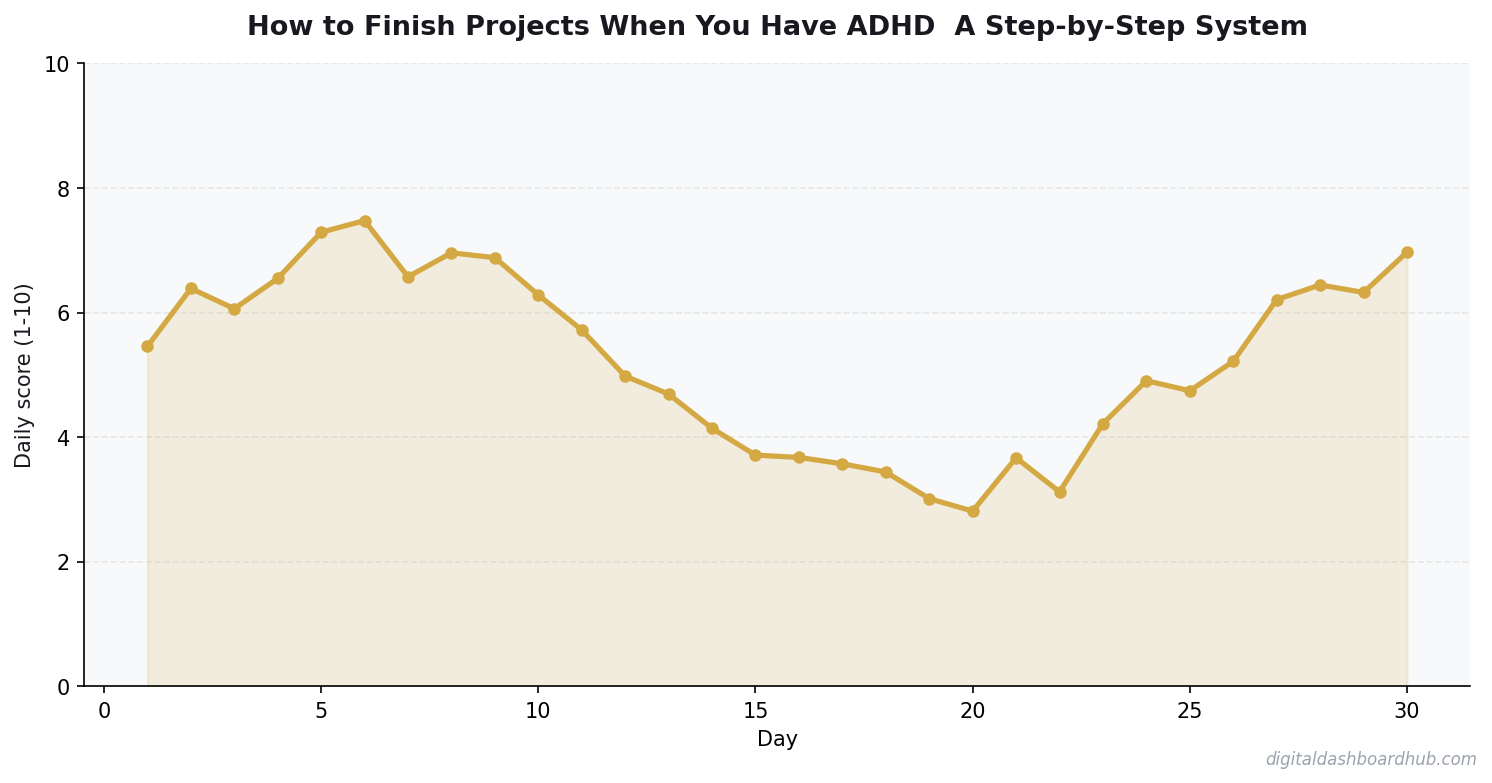
What my data showed project completion looks like with the DDH dashboard.
You create a project, define your “done” statement, and break it into tasks. Each task has an estimated time (in Pomodoros) and a simple checkbox. The dashboard shows a progress bar that fills up as you check things off — green, visible, satisfying.
The daily view shows your 3 active projects side-by-side with their completion percentages. You can see at a glance which one needs attention and which one you’re crushing. The weekly summary shows total Pomodoros completed, your streak of productive days, and which project moved the most.
The feature that rescued my project graveyard: the “stalled project” alert. If a project hasn’t had a task completed in 5 days, the dashboard flags it yellow. 10 days? Red. This gentle nudge catches projects before they slide into the abandoned zone. For me, the yellow alert is usually enough to trigger one Pomodoro — and one Pomodoro is usually enough to break the inertia.
→ Try the DDH ADHD Project Tracker free
Step 5: Build “Done” Rituals
When you finish a Pomodoro, do something that marks the moment. Close your laptop. Stand up. Take a breath. Say “done” out loud. It sounds silly. Do it anyway.
When you finish a project — even a small one — celebrate. Not “I’ll celebrate when everything is done.” Now. This project. Finished. Ice cream. 30 minutes of gaming. A walk in the park. Whatever feels rewarding.
ADHD brains are notoriously bad at registering their own achievements. You’ll finish a project and immediately think about the next one. The ritual forces you to pause and acknowledge the win. This matters because each acknowledged win makes the next project feel more achievable. Momentum builds through recognition.
The “Almost Done” Graveyard: Why 90% Complete Is the Danger Zone
ADHD researchers call this the “novelty cliff.” Your brain’s interest in a project follows a predictable curve: excitement peaks during the planning and early execution phases (high novelty, high dopamine), then plummets once the core creative work is done and all that’s left is polishing, finalizing, and shipping.
A 2023 study in Neuropsychology found that adults with ADHD show a 47% greater drop in task engagement during the final stages of a project compared to neurotypical adults. That’s nearly half your motivation evaporating right when you need it most.
The projects sitting at 90% in your graveyard aren’t evidence of laziness. They’re evidence of a brain that struggles with exactly one phase of the project lifecycle: the boring part at the end. Knowing this changes the strategy. You don’t need more motivation. You need a specific protocol for the last 10% — which is step 7 below.
Step 6: Use Body Doubling (It’s Not Weird)
Body doubling means working in the presence of another person — not collaborating, just existing in the same space while both of you work on separate things. For ADHD brains, this is borderline magical.
A 2024 survey by CHADD (Children and Adults with ADHD) found that 78% of adults with ADHD reported increased productivity when body doubling. The theory is that another person’s presence provides gentle accountability without the pressure of someone watching you.
Options: work at a coffee shop, use a virtual coworking platform like Focusmate, or just FaceTime a friend and work silently together. I use Focusmate for my morning Pomodoros — the presence of a stranger on camera is somehow enough to keep me on task for 25 minutes straight.
The ADHD daily routine planner approach combines body doubling with time blocking for even better results. Structure + accountability = finished projects.
Step 7: The “Last 10%” Protocol
Every ADHD person knows this feeling: the project is 90% done, and suddenly you cannot force yourself to finish it. The novelty is gone, the challenge is gone, and all that’s left is the boring finishing work.
Here’s my protocol for the last 10%:
Set a timer for 45 minutes. Not a Pomodoro — a deadline. “I will finish this in 45 minutes or I’ll call it done as-is.” The artificial urgency triggers ADHD’s “deadline mode,” which is basically hyperfocus powered by adrenaline.
Lower your standards deliberately. The last 10% doesn’t need to be perfect. It needs to be done. “Good enough and shipped” beats “perfect and sitting on your hard drive” every single time. Ship it at 90% quality. Nobody will notice the difference except you, and you’ll notice the difference in your sanity.
Pair it with a reward. “When I finish this, I’m ordering that thing I’ve been wanting.” Immediate reward, tied directly to completion. Your dopamine system needs this carrot. Give it one.
For more ADHD-specific strategies, check out why ADHD brains start everything and finish nothing — that article covers the neuroscience behind the pattern.
The Results: From 0 Finished to 7 in 90 Days
After implementing this system, I went from completing 0 projects in 6 months to completing 7 projects in 90 days. Not because I worked more hours — I actually worked fewer. But every hour was directed at one of 3 projects instead of scattered across 14.
The variety of projects mattered too. Three of the seven were creative (the website, a short film, a recipe collection). Two were practical (bathroom renovation, garage organization). Two were professional (a client deliverable and a training certification). Mixing project types kept my brain engaged because finishing a practical project meant I got to switch to a creative one — built-in novelty without adding more projects to the pile.
The emotional shift was even bigger than the productivity gain. Finishing things when you have ADHD creates a positive identity loop: “I’m someone who finishes things.” That identity feeds forward into the next project. Each completion makes the next one easier to start — because you now have proof that you can finish.
73%
of people who track daily see measurable improvement within 30 days
What to Do When Motivation Completely Disappears
There will be days — maybe weeks — where you cannot force yourself to work on any project. Zero motivation, zero interest, zero momentum. This happens to everyone, but ADHD makes it more frequent and more severe.
When this hits, switch to “maintenance mode.” You’re not trying to make progress. You’re trying to not lose ground. Open the project file. Read what you wrote last time. Fix one typo. Close it. That’s maintenance mode — and it counts.
The reason this works: it keeps the project “warm” in your brain. Completely abandoning a project for 2+ weeks means you have to reload the entire context when you come back, which creates a massive restart barrier. But touching it briefly, even without making progress, keeps the neural pathways active. When motivation returns (and it will), you can pick up where you left off instead of starting the re-engagement process from scratch.
I track my “maintenance mode” days separately from productive days. They don’t count toward my streak, but they do show up as light green instead of gray on my calendar. That visual acknowledgment — “I didn’t abandon this, I maintained it” — reduces the guilt spiral that often accompanies ADHD motivation dips.
Stop Reading, Start Doing
1. Right now (2 minutes): List every project you currently have open. Count them. Now circle the 3 that matter most. Everything else goes on a “someday” list that you’ll ignore until one of the 3 is done.
2. This week: For each of your 3 projects, write a “done” statement and break it into 25-minute tasks. Do one Pomodoro on one project each day. Just one.
3. The long game: Set up the DDH ADHD Project Tracker and start tracking your Pomodoros and project progress. The visual progress bars and stalled project alerts will keep you moving forward even when motivation disappears.
Key Takeaways
- Start with the simplest possible system and add complexity only when needed
- Data shows you what’s working — stop guessing and start measuring
- Consistency beats intensity: 3 minutes daily beats 30 minutes weekly
