Use the free Acupuncture Practice Revenue Calculator below — plug in your real numbers and get instant results. No signup required for the lite version.
Try the Acupuncture Practice Revenue Calculator
Acupuncture Practice Revenue Calculator
Enter your numbers below — results update instantly
Want the full Acupuncture Practice dashboard with expense tracking, break-even analysis, and growth projections?
Why This Matters
Running numbers in your head is how bad financial decisions happen. A quick calculation with real data beats a gut feeling every single time. I built this tool because I was tired of spreadsheet gymnastics just to answer basic questions about my finances.
The calculator above handles the basics. But if you need trend tracking, scenario comparison, and exportable reports — the full version inside Digital Dashboard Hub does all of that and more.
What You Get in the Full Dashboard
| Approach | Startup Cost | Time Investment | Revenue Potential | Best For |
|---|---|---|---|---|
| Solo operator | Low ($1K-$10K) | Full time | $60K-$200K/yr | Maximum margins, full control |
| Small team (2-5) | Medium ($10K-$50K) | Management + some fieldwork | $200K-$800K/yr | Scaling without losing control |
| DDH Revenue Tracker | Free trial | 5 min setup | N/A (profit tool) | Know your real numbers in real time |
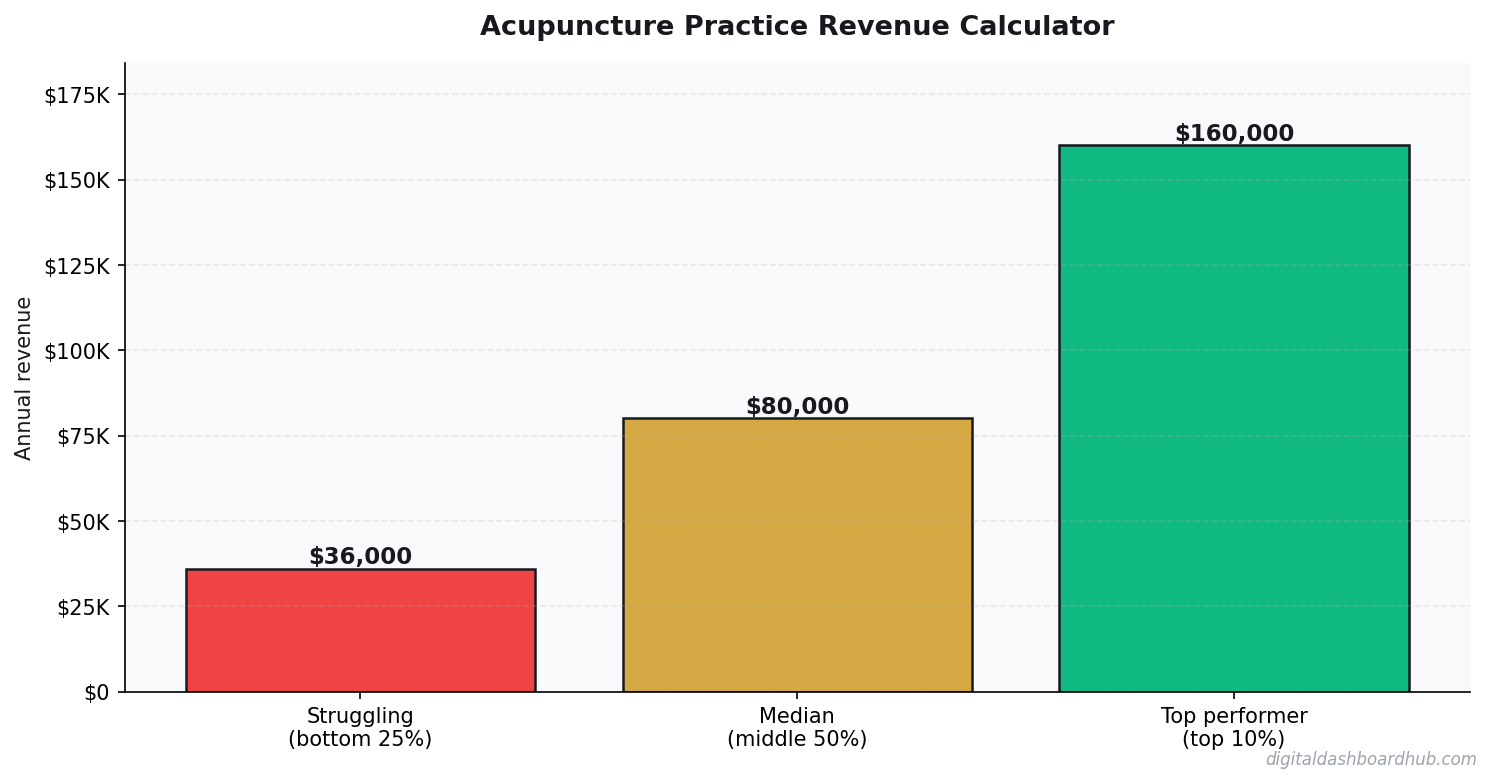
The full Acupuncture Practice Revenue Calculator inside DDH includes features the lite version above can’t offer:
- Historical tracking — see your numbers change over weeks and months
- Visual charts — bar graphs, trend lines, and breakdowns that make patterns obvious
- Scenario modeling — “what if I change X?” comparisons side by side
- PDF reports — export professional reports for partners, lenders, or your own records
- — one subscription covers every calculator and tracker in the library
How to Use This Tool
Step 1: Enter your actual numbers in the fields above. Don’t guess — pull from your bank statements or business records for the most accurate results.
Step 2: Read the output cards. They update instantly as you type. Play with different scenarios to see how small changes affect your bottom line.
Step 3: If you want to save your results, track changes over time, or run more advanced projections — start a free 14-day trial of the full dashboard. No credit card required.
Your Next Move
You’ve already done the hardest part — you looked at your numbers instead of avoiding them. Here’s what to do with that momentum:
- Right now (30 seconds): Bookmark this page so you can rerun the calculation next month
- This week: Pull your real numbers from your accounts and run them through the calculator above
- Long game: Try the full DDH dashboard — 261 tools, 14 days free, cancel anytime
Continue Reading
- How to Budget as a Couple Without Fighting About Money (A Real Talk Guide)
- Etsy Revenue Tracker: How to Know Which Products Are Actually Worth Your Time
- Debt Snowball vs Avalanche Calculator: Which Method Saves You More Money
Common Questions About Acupuncture Practice Revenue Calculator
How long does it take to see results?
Most people see meaningful progress within 30-90 days when they apply these strategies consistently. The key is tracking your numbers from day one so you have a baseline to measure against.
What’s the biggest mistake people make?
Trying to do everything at once. Pick one or two strategies from this guide, implement them fully, then layer in additional tactics. Spreading yourself thin is the fastest way to see no results from any of it.
Do I need special tools or software?
Not necessarily to start — but the right tools eliminate hours of manual work. Our free calculators and trackers at Digital Dashboard Hub are a good starting point before you invest in paid software.
What a Real Acupuncture Practice Earns: The Worked Numbers
A solo acupuncture practice in a mid-size city (think Raleigh or Denver), operating 4 days a week. Eight appointments per day, 48 weeks of actual operating weeks per year. Average session rate: $95 (a mix of new patient intakes at $130 and follow-ups at $85). That’s $760/day, $36,480 for 48 weeks — or $174,720 gross annually.
Subtract rent for a single treatment room ($1,200/month), malpractice insurance ($800/year), supplies and needles ($3,000/year), scheduling software ($1,200/year), and CE requirements ($1,500/year). You’re clearing roughly $146,000 before taxes. As a solo operator, that’s not bad — and you’re working a 32-hour week.
The practices hitting $200K+ are the ones that have moved beyond one-on-one sessions. Community acupuncture (group room model at $30-$45/session) can nearly double patient volume without doubling your hours. Herbal supplement sales add 15-25% margin revenue to existing patient relationships.
The 3 Levers That Drive Acupuncture Revenue
1. Package pricing over per-session billing. A patient buying sessions one at a time has zero commitment friction to cancel. A patient who bought a 10-session package is coming back. The cash flow is better, the revenue is more predictable, and retention is dramatically higher. Most practices that switch to package-forward pricing see 20-30% revenue increases within 6 months.
2. Insurance vs. cash-pay mix. This is genuinely complex. Insurance billing can unlock a larger patient pool but adds significant administrative overhead and often lower reimbursement rates. Many practitioners find a hybrid model works best: take a few key plans (Blue Cross, Aetna in markets where they reimburse well) and cash-pay everything else. Know your actual reimbursement rates before relying on insurance for more than 40% of revenue.
3. Specialty focus. A generalist acupuncturist competes on price. A practitioner known specifically for fertility support, sports recovery, or chronic pain in a defined patient population can charge 20-40% more per session and has a referral network that feeds itself. Specialization is the single fastest path to both higher revenue and lower marketing spend.
Common Mistakes Acupuncturists Make With Revenue
Underpricing from the start. New practitioners often set rates based on what feels comfortable to charge rather than what the market supports. In most mid-size US cities, $85-$120 for a follow-up session and $130-$175 for a new patient intake is well within market range and what patients expect. Starting at $65 and trying to raise rates later is harder than starting at fair market value and delivering on it.
The other big one: not building a referral system. Primary care physicians, OBGYNs, physical therapists, chiropractors, and orthopedic surgeons all have patients who could benefit from acupuncture — and many of them actively want referral partners. But they don’t refer to people they don’t know. A systematic outreach effort — 2-3 provider visits per month with educational materials and a clear communication process for shared patients — can build a referral network that generates 8-15 new patients per month within a year.
Third: no clear patient re-engagement system. A patient who came in 6 months ago and stopped is not a lost patient — they’re a warm lead. A simple sequence (email at 3 months, personal note at 6 months) brings 15-25% of lapsed patients back without any advertising spend. Most practices do none of this systematically.
Should You Add Associates or Stay Solo?
The math on adding an associate practitioner: a second practitioner on a booth rent model ($800-$1,400/month) adds guaranteed income immediately. An employee practitioner on commission (40-50% of collections) adds revenue proportional to their productivity with no fixed cost. The downside is management overhead and the risk of them eventually leaving and taking patients.
Most solo acupuncturists who stay solo cap out at $150K-$200K — hard ceiling set by available hours in the week. To break that, you need either premium pricing, a group/community model, or additional practitioners. The calculator above helps you model both scenarios side by side so the decision is based on numbers, not intuition.
Keep reading (related guides):
14 days free · No charge today · 2-click cancel

Andy Gaber is the founder of Digital Dashboard Hub, a suite of 255+ interactive financial, productivity, and wellness tools. He built DDH after getting frustrated with financial apps that gave outputs without context. Follow along for tool tutorials, revenue analytics breakdowns, and honest takes on personal finance.