My psychiatrist changed my medication based on data I collected in this tool. That conversation took 5 minutes instead of 45. Mental health is hard enough to manage. Trying to communicate your progress — or lack of it — to a therapist, psychiatrist, or even yourself? That’s where most people get stuck.
Why Data Helps Mental Health Recovery
Jump in: the tool below is live and free to play with. Upgrade to a dashboard account when you want to save scenarios and track over time.
I built Digital Dashboard Hub after spending years looking for tools that actually worked without a spreadsheet degree. Here’s what I’ve learned:
There’s a cognitive bias called the “peak-end rule” — your brain remembers the most intense moment and the most recent moment, and averages those to form your overall memory. For mental health, this means:
- You had 25 decent days and 5 terrible ones. You remember the month as terrible.
- Your medication is working for 6 out of 7 days. You focus on the one bad day and think it isn’t helping.
- Your anxiety dropped by 30% over 3 months. You can’t feel the difference because it happened gradually.
Tracking breaks through that bias. Numbers don’t have mood-congruent recall. They show you what actually happened, not what your brain decided to save. For more on how tracking supports mental health, see ADHD Life Management: Track Tasks, Time, and Energy in One Place.
What to Track for Adhd (Without Making It Worse)
The biggest concern with mental health tracking is valid: won’t focusing on symptoms make me feel worse? Research says no — but only if you track the right way.
The Healthy Tracking Framework
- Keep it brief: 60 seconds max per entry. Long journal entries can become rumination.
- Track positive data too: Log what helped, what went well, what you’re grateful for alongside symptoms.
- Use numbers, not narratives: A 1-10 scale captures your state without forcing you to relive the details.
- Look at trends, not single days: Any single data point is noise. The trend over weeks tells the real story.
The goal isn’t to analyze yourself into a hole. It’s to gather enough information that you and your care team can make better decisions.
How the DDH ADHD Life Management Tracker Supports Your Journey
I designed this tool with two principles: it should take less than 90 seconds, and it should never feel like homework.
Step 1: Quick daily check-in. Mood score, energy level, and up to 3 optional fields you customize (sleep quality, medication notes, coping strategies used). Tap-based, not type-based.
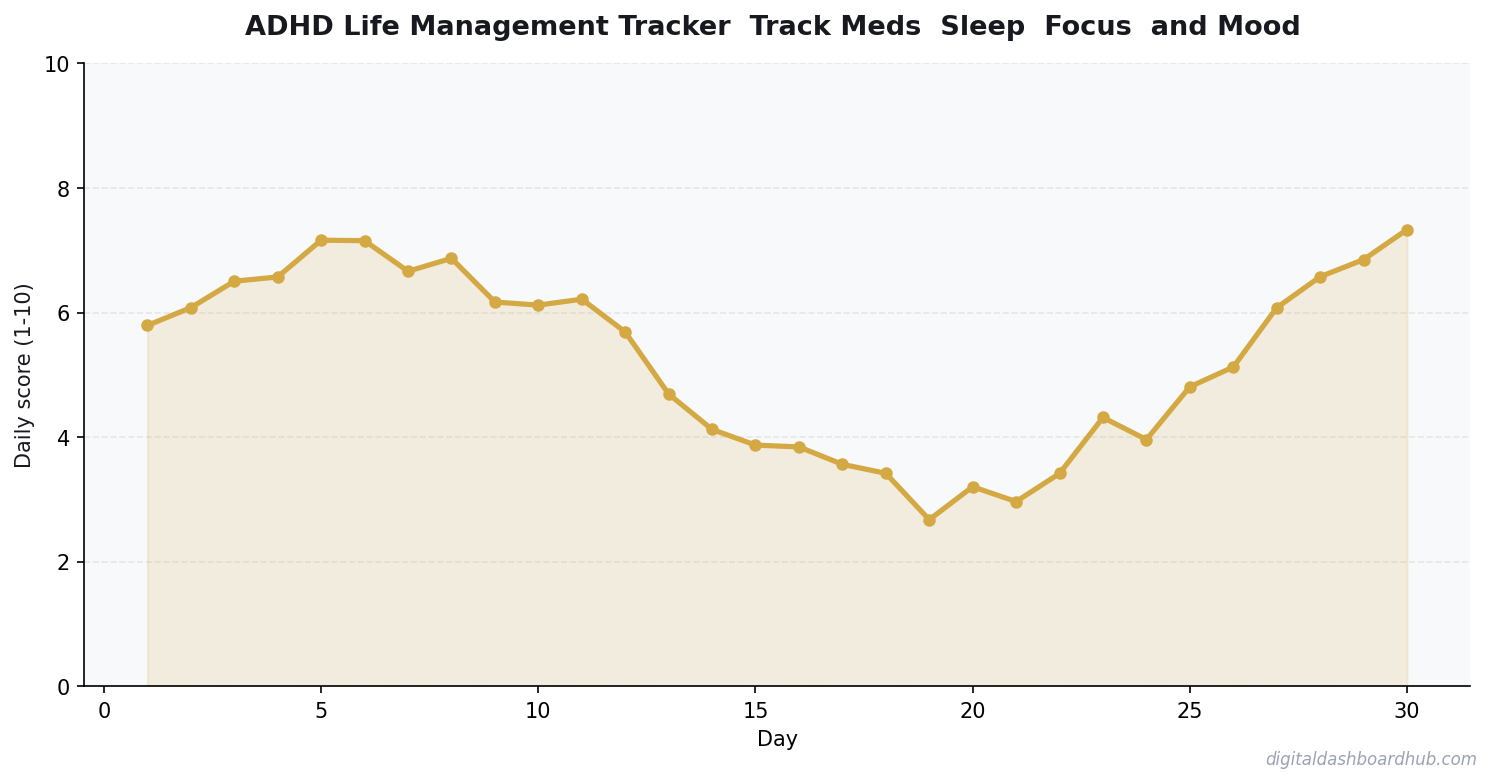
Step 2: Visual trend dashboard updates in real time. See your mood trajectory over 7, 14, 30, and 90 days. Color-coded so improvement is immediately visible — you don’t need to interpret charts.
Step 3: Between-session summaries for your therapist or provider. One-tap export shows patterns, triggers, and your own notes. This turns a 15-minute catch-up appointment into a targeted working session.
The feature that people message me about most: the “small wins” counter. It highlights positive data points you might have missed — a week where your score improved slightly, a coping strategy that worked 4 out of 5 times, a trigger you successfully avoided. Mental health progress is slow. This helps you see it.
Ready to start? Try the ADHD Life Management Tracker free for 14 days → No credit card, no commitment. It’s one of 255+ tools in the DDH wellness platform.
Mental Health Tracking Tools Compared
| Feature | Therapy Apps | Mood Apps | DDH Tracker |
|---|---|---|---|
| Provider-ready reports | No | Some | Built-in |
| Positive data tracking | Varies | Rare | Core feature |
| Daily time | 10-20 min | 2-5 min | 60-90 sec |
| Cost | $60-300/mo | Free-$10/mo | Free trial |
FREE BONUS: Adhd Tracking Quick-Start Guide
A 1-page printable with the exact metrics to track daily, what patterns to watch for, and how to share data with your provider.
What To Do When Your ADHD Numbers Look Off
You’ve been tracking for a week and the data looks rough — poor sleep, missed meds twice, mood tanking on Wednesday and Thursday. Here’s how to actually read that and respond, instead of just feeling bad about it.
Missed medication patterns: If you’re missing meds 2+ times per week, it’s usually not forgetting — it’s friction. The medication is in the wrong place, the alarm fires at a time when you’re already distracted, or the side effects are bad enough that you’re unconsciously avoiding it. Fix the friction, don’t add willpower.
Sleep below 6.5 hours: For ADHD brains, sleep deprivation hits executive function 30-40% harder than it does for neurotypical people. If your focus scores crater on low-sleep days, that’s not a moral failing — that’s your nervous system running on empty. Track the sleep-focus correlation for 2 weeks. Once you see the data, protecting sleep becomes less abstract.
Pattern Interpretation: What the Data Actually Means
The most valuable insight from ADHD tracking isn’t the bad days — it’s the patterns. Look for:
- Day-of-week patterns: Most ADHD adults have specific hard days (often Monday and Wednesday). If yours are consistent, that’s a signal about external triggers, not random mood swings.
- Med + sleep combos: Medication on 5 hours of sleep often performs worse than no medication on 7.5 hours. Track this combination specifically.
- Time-to-focus after waking: If it consistently takes 90+ minutes to get cognitive traction in the morning, that’s information about your optimal start time — and possibly about when your medication should be timed.
When To Bring Data to Your Doctor
Most ADHD medication conversations happen from memory (“I think it’s been working okay?”). That’s a terrible data source for a prescription adjustment. Bring 3-4 weeks of tracked focus, mood, and sleep data to your next appointment. Doctors make better decisions with objective patterns. The tracking isn’t just self-awareness — it’s clinical data that most people never collect.
What To Do When Your ADHD Numbers Look Off
You’ve been tracking for a week and the data looks rough — poor sleep, missed meds twice, mood tanking on Wednesday and Thursday. Here’s how to actually read that and respond, instead of just feeling bad about it.
Missed medication patterns: If you’re missing meds 2+ times per week, it’s usually not forgetting — it’s friction. The medication is in the wrong place, the alarm fires at a time when you’re already distracted, or the side effects are bad enough that you’re unconsciously avoiding it. Fix the friction, don’t add willpower.
Sleep below 6.5 hours: For ADHD brains, sleep deprivation hits executive function 30-40% harder than it does for neurotypical people. If your focus scores crater on low-sleep days, that’s not a moral failing — that’s your nervous system running on empty. Track the sleep-focus correlation for 2 weeks. Once you see the data, protecting sleep becomes less abstract.
Pattern Interpretation: What the Data Actually Means
The most valuable insight from ADHD tracking isn’t the bad days — it’s the patterns. Look for:
- Day-of-week patterns: Most ADHD adults have specific hard days (often Monday and Wednesday). If yours are consistent, that’s a signal about external triggers, not random mood swings.
- Med + sleep combos: Medication on 5 hours of sleep often performs worse than no medication on 7.5 hours. Track this combination specifically.
- Time-to-focus after waking: If it consistently takes 90+ minutes to get cognitive traction in the morning, that’s information about your optimal start time — and possibly about when your medication should be timed.
When To Bring Data to Your Doctor
Most ADHD medication conversations happen from memory (“I think it’s been working okay?”). That’s a terrible data source for a prescription adjustment. Bring 3-4 weeks of tracked focus, mood, and sleep data to your next appointment. Doctors make better decisions with objective patterns. The tracking isn’t just self-awareness — it’s clinical data that most people never collect.
Keep reading (related guides):
- How Much Does Therapy Cost in 2026? A State-by-State Breakdown
- Free ADHD Impulse Spending Tracker — Try It Now
- ADHD Focus Sprint System: Work With Your Hyperfocus Instead of Fighting It
- Therapy Companion Tracker: Make Every Session Count With Better Data
- Mortgage Comparison Calculator: Find the Best Rate and Term
255+ interactive tools for your money, time, and health.
Instant signup · Stripe-secure · Cancel in one click
⚡ Quick Focus Score Calculator
See how your focus stacks up today.
Basic score only. Get the full ADHD toolkit with 255+ tools →
Your Next Move
Right now (60 seconds): Rate your current mood on a 1-10 scale and write down one thing that influenced it today. That’s your first data point.
This week: Do that same check-in for 5 days. Don’t aim for perfect — 3 out of 5 still gives you useful baseline data.
The long play: Start using the DDH ADHD Life Management Tracker. Free for 14 days, takes 60 seconds to set up. After a month, you’ll have data that makes every therapy session more productive and every medication check more precise.
Questions people ask before using this tool
Can a ADHD Life Management replace therapy or coaching?
No, and it should not try. A tool gives structure and visibility. A coach or therapist helps you work through the why behind the patterns. Most ADHDers get the best results from pairing a light-touch daily tool with a monthly or weekly human conversation.
What do I do when I abandon the ADHD Life Management for a week?
Open it, log today, move on. Do not backfill. Do not apologize. The ‘restart without shame’ move is the single most predictive habit in long-term ADHD tool usage. Abandonment is a feature of ADHD, not a failure of the tool — the only requirement is a low-friction re-entry.
Do I need medication to get value from a ADHD Life Management?
No. Medication amplifies what a system already provides — it does not create structure on its own. Plenty of undiagnosed or unmedicated ADHDers get meaningful traction from tools like this one. The point is external scaffolding so your brain does less load-bearing work.
Will a ADHD Life Management actually help someone with ADHD?
It will if it is designed around ADHD patterns — short inputs, visible progress, no perfect-setup expectations. The trap is tools that require 30 minutes of configuration. This ADHD Life Management is built to open, use in under two minutes, and close without guilt when you get distracted.
What makes a ADHD Life Management ADHD-friendly vs. generic productivity bloat?
Three things: it works at the ‘worst ten minutes of your day’ not the best, it forgives gaps instead of punishing streaks, and it renders state visually so you do not have to hold the model in your head. Generic tools assume working memory and calendar discipline ADHD brains cannot rent.
How often should I actually use a ADHD Life Management?
Daily is the goal, but 3-4 days a week beats ‘perfect for a month then zero.’ Build the habit around an existing anchor — morning coffee, post-lunch reset, or a 7pm wind-down. The research on ADHD habit formation points to anchored cues, not motivation.
Seven mistakes to avoid with this ADHD Life Management tool
- Treating streaks as the goal. ADHD brains break streaks; systems that reward ‘log today even if yesterday was blank’ outlast ones that reset to zero.
- Logging at the end of the day. End-of-day executive function is the worst it gets; log mid-day or right after the event instead.
- Using the ADHD Life Management in isolation. ADHD thrives on external anchors — pair it with a standing coffee moment, not ‘when I remember.’
- Reading ADHD productivity content instead of using any tool at all. The 20-minute scroll is a stalling pattern; opening a bare-bones tool and logging once beats it.
- Hiding the tool in a folder. Out of sight, out of ADHD working memory. Bookmark it, pin the tab, make it the first thing your eye lands on.
- Setting up elaborate categories on day one. Every extra field is friction; friction is where ADHD follow-through dies.
- Switching tools every two weeks. The right ADHD Life Management is the one you keep opening — not the one with the prettiest onboarding screens.
The only version of a ADHD Life Management tool that works long-term is the one that survives your worst week. Optimize for ‘still usable when I feel like garbage,’ not ‘perfect when motivated.’
When to use this ADHD Life Management tool (and when to skip it)
This ADHD Life Management tool works best in two windows: the first 20 minutes of your working day (when executive function is highest) and the 15-minute reset after a transition — finishing a meeting, returning from a walk, eating lunch. Those anchor points give your ADHD brain a natural cue to open the tool and close the loop without willpower.
Skip the tool when you are in a hyperfocus window. Hyperfocus is rare and expensive — don’t interrupt it to log or plan. Use the tool on either side of the hyperfocus, not during. Also skip it on days when the friction of opening the tab feels like too much; force-opening it breeds resentment and breaks the long-term habit. Miss a day, open it tomorrow, keep going.
If you are trying to build consistency, commit to the tool for 21 days before deciding whether it is working. Shorter than that and you are judging the tool on noise. ADHD brains need the ‘novelty wears off, is there still value here?’ window, and that window is three weeks — not three days.
ADHD Life Management quick reference checklist
When the ADHD Life Management feels overwhelming, reset with this short checklist. It takes under a minute.
- You have one visible anchor cue (coffee, meal, bedtime) paired with this tool.
- The entry took under 2 minutes — if it took longer, cut a field before your next session.
- You noticed one pattern, even a small one, in the last 7 days of entries.
- You have a recovery move for abandonment weeks: open, log today, keep going — no backfill, no apology.
- You opened the tool today — gap days do not compound against you.
- You are not trying to log perfectly — 3-4 days a week beats perfect for a month then zero.
What to do next
Once you have walked the checklist, scroll back up and run your real inputs in the interactive ADHD Life Management tool — it takes about 60 seconds. If you want to compare this against the other 254+ calculators, trackers, and planners in the DDH library, the full set lives at app.digitaldashboardhub.com. Free tier covers the core version of every tool; upgrades unlock cross-tool dashboards, scenario saving, and team sharing.
If you are brand new to the DDH toolkit, start with three tools: one that directly serves your primary goal this quarter, one that catches problems before they compound, and one just for fun. That mix prevents the usual fate of productivity tools — great first month, forgotten by month three.
Keep Reading
- ADHD Life Management: Track Tasks, Time, and Energy in One Place
- I Tracked My ADHD Life for 30 Days — Here’s What the Data Showed
- ADHD Dopamine Seeking: 9 Healthy Ways to Feed Your Brain Without Wrecking Your Life
- ADHD Impulse Spending Tracker: The Free Visual Dashboard Built for Your Brain
Common Questions About ADHD Life Management Tracker: Track Meds, Sleep, Focus, and Mood in One Place
How long does it take to see results?
Most people see meaningful progress within 30-90 days when they apply these strategies consistently. The key is tracking your numbers from day one so you have a baseline to measure against.
What’s the biggest mistake people make?
Trying to do everything at once. Pick one or two strategies from this guide, implement them fully, then layer in additional tactics. Spreading yourself thin is the fastest way to see no results from any of it.
Do I need special tools or software?
Not necessarily to start — but the right tools eliminate hours of manual work. Our free calculators and trackers at Digital Dashboard Hub are a good starting point before you invest in paid software.

Andy Gaber is the founder of Digital Dashboard Hub, a suite of 255+ interactive financial, productivity, and wellness tools. He built DDH after getting frustrated with financial apps that gave outputs without context. Follow along for tool tutorials, revenue analytics breakdowns, and honest takes on personal finance.