
The Instagram Airbnb Gurus Are Lying About How Much Money You’ll Make
Scroll down — the interactive tool runs live with your inputs. Full version lives inside Digital Dashboard Hub. Two-click trial, Stripe-secure.
Before DDH, I was doing this manually in spreadsheets. Here’s the faster way:
In This Article
- The Instagram Airbnb Gurus Are Lying About How Much Money You’ll Make
- The Numbers Everyone Gets Wrong
- How to Calculate Your Real Airbnb Revenue (Step by Step)
- When Airbnb Math DOES Work
- How the DDH Airbnb Calculator Handles This
- Airbnb vs. Long-Term Rental: Which Makes More Money?
- 5 Mistakes New Airbnb Hosts Make (That the Calculator Prevents)
- Your Action Plan
- Costly Mistakes I Made (So You Don’t Have To)
- The Most Common Questions I Get
I’m not saying Airbnb investing doesn’t work — it absolutely can. But running the numbers BEFORE you buy is the difference between a profitable rental and a money pit that chains you to a mortgage you can’t afford. An Airbnb calculator that accounts for real-world expenses, seasonal vacancy, and local market dynamics is the tool that separates the profitable hosts from the ones who quietly sell their properties at a loss two years later.
The Numbers Everyone Gets Wrong
Most Airbnb income estimates fail because they calculate: (nightly rate) x (365 nights) = annual income. This is fantasy math. From my testing reality looks like:
Occupancy rate: The average U.S. Airbnb occupancy rate is 56% according to AirDNA’s 2024 market report. Not 90%. Not 80%. 56%. That means your property sits empty almost half the year. In seasonal markets (beach towns, ski resorts), you might see 80% in peak season and 25% in off-season.
Cleaning costs: $75-$250 per turnover depending on property size and market. At 56% occupancy with an average 3-night stay, that’s roughly 68 turnovers per year. At $125 each, that’s $8,500/year in cleaning alone.
Platform fees: Airbnb takes 3% from hosts (plus 14% from guests, which affects your pricing competitiveness). VRBO takes 5%. If you list on both, you’re paying fees on every booking.
Maintenance and repairs: Short-term rentals get 3-5x more wear and tear than long-term rentals. Budget 1-2% of property value per year for maintenance. For a $300K property, that’s $3,000-$6,000 annually.
Supplies: Toiletries, coffee, paper towels, dish soap, trash bags, laundry detergent — $50-$100/month. Small per guest, but it adds up to $600-$1,200/year.
How to Calculate Your Real Airbnb Revenue (Step by Step)
Here’s the formula I use, and it’s the formula built into the DDH Airbnb Revenue Calculator:
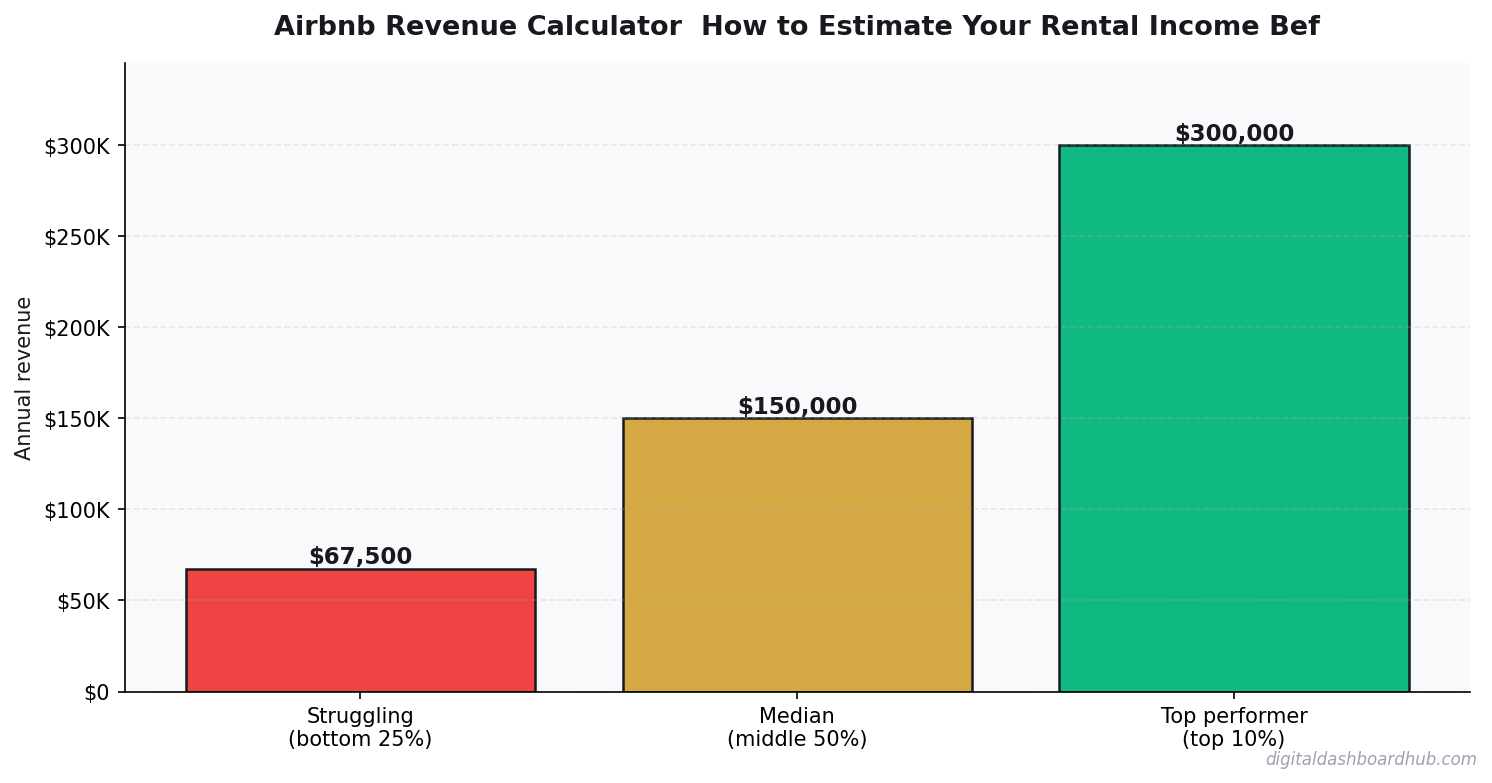
Step 1: Estimate nightly rate. Search AirDNA, Mashvisor, or just Airbnb itself for comparable properties in your target area. Match property type, size, and amenities. Take the median rate, not the highest — you’re not a Superhost yet.
Step 2: Apply realistic occupancy. For your first year, use 50% for most markets. Seriously. New listings without reviews get booked less. You can adjust upward as you build reviews and optimize pricing. Markets with strong seasonal demand might be 65-70% annually.
Step 3: Calculate gross revenue. (Nightly rate) x (365) x (occupancy rate) = gross annual revenue. For a $150/night property at 50% occupancy: $150 x 365 x 0.50 = $27,375 gross.
Step 4: Subtract ALL expenses.
Wait — that’s a loss? At $150/night and 50% occupancy on a $300K property? Yes. And this is exactly why you need to run the calculator BEFORE buying. Most people do this math AFTER they’ve already closed on the property, and by then it’s too late.
For this property to break even, you’d need either: a higher nightly rate ($225+), higher occupancy (75%+), a lower purchase price, or a combination. The calculator shows you exactly which lever to pull and how far.
When Airbnb Math DOES Work
Not all properties are losers. The ones that work typically share these characteristics:
Low acquisition cost: Properties bought below $250K (or with significant equity/down payment reducing the mortgage) have much better numbers. Paid-off properties or those bought with cash are almost always profitable.
High-demand markets: Properties near national parks, beaches, ski resorts, or event venues with strong year-round demand can sustain 65-75% occupancy. The DDH Airbnb Revenue Calculator lets you model different occupancy scenarios to find your breakeven point.
Premium nightly rates: Unique properties (treehouses, A-frames, lakefront cabins) command $250-$500+/night. At $300/night and 55% occupancy, the same $300K property generates $60,225 gross — now you’re in profit territory.
Self-managed: Cutting property management (typically 20-25% of revenue) is the single biggest expense reduction. But “passive income” stops being passive when you’re answering guest messages at midnight.
FREE BONUS: The Airbnb Deal Analyzer Spreadsheet
The exact spreadsheet I use to evaluate potential Airbnb properties. Plug in the purchase price, estimated nightly rate, and market data — it spits out your projected ROI, cash-on-cash return, and breakeven occupancy rate.
Get instant access → https://app.digitaldashboardhub.com/signup
How the DDH Airbnb Calculator Handles This
Spreadsheets work but they break, they’re ugly, and you have to build all the formulas yourself. The DDH Airbnb Revenue Calculator does the math in a visual dashboard with inputs anyone can understand.
Step 1: Enter your property details — purchase price, down payment, mortgage rate, and estimated nightly rate. The calculator auto-fills typical expense estimates based on property value, which you can adjust for your specific situation.
Step 2: Slide the occupancy rate up and down and watch your projected profit/loss update in real time. This is the killer feature — you can see exactly where your breakeven occupancy is. If breakeven requires 80% occupancy and your market averages 55%, you know this deal doesn’t work before you make an offer.
Step 3: The scenario comparison lets you model three different properties side by side. Maybe the $250K condo has better ROI than the $400K house despite the lower nightly rate. Maybe the beach house wins in summer but the mountain cabin wins annually. The side-by-side comparison makes the answer obvious.
The feature that serious investors love: the cash-on-cash return calculator that shows your actual return on the money you put IN, not just raw profit. A property that nets $10K/year sounds decent — until you realize you put $80K down, making your cash-on-cash return just 12.5%. You might do better in an index fund. The calculator shows you this comparison so you can make an informed decision.
→ Try the DDH Airbnb Calculator free: app.digitaldashboardhub.com/signup
Airbnb vs. Long-Term Rental: Which Makes More Money?
This is the question nobody asks until they’re already committed to one path. Let’s run the numbers for our $300K example property:
As an Airbnb (50% occupancy, $150/night): Gross $27,375, expenses $43,521, net -$16,146 (loss).
As an Airbnb (70% occupancy, $175/night): Gross $44,713, expenses $38,000 (lower cleaning with longer stays), net +$6,713.
As a long-term rental ($1,800/month): Gross $21,600, expenses $28,200 (lower maintenance, no cleaning, no supplies), net -$6,600 (loss, but smaller).
As a long-term rental ($2,200/month): Gross $26,400, expenses $28,200, net -$1,800 (nearly breakeven).
In this example, Airbnb wins IF you can achieve 70%+ occupancy at $175+/night. Long-term rental loses less money in the base case. This is why running the ROI calculations before committing is so critical — and why I always model both scenarios for any property I’m evaluating.
5 Mistakes New Airbnb Hosts Make (That the Calculator Prevents)
1. Using annual averages for seasonal markets. Your mountain cabin might book at 90% in winter and 20% in summer. An annual average of 55% masks the fact that you’re hemorrhaging money for 5 months straight. Model by season, not by year.
2. Ignoring startup costs. Furnishing a rental property costs $5,000-$15,000. Photography: $200-$500. Legal setup: $500-$1,000. These are real costs that affect your first-year ROI dramatically.
3. Assuming you’ll be a Superhost immediately. New listings without reviews get lower search placement and lower booking rates. Your first 3-6 months will likely underperform your long-term average. Plan for it.
4. Forgetting about taxes. Short-term rental income is taxable. Depending on your structure, you might owe self-employment tax on top of income tax. Budget 25-35% of net income for taxes. The side hustle tax tracking guide covers this in detail.
5. Not tracking actual performance against projections. The calculator gives you projections. Reality gives you actuals. Track your real numbers monthly and compare. If you’re underperforming projections by month 3, adjust your strategy — don’t wait a year hoping it’ll get better.
Your Action Plan
1. Right now (2 minutes): Pick a property you’re considering (or one that’s interesting on Zillow) and look up comparable Airbnb nightly rates on AirDNA or Airbnb itself. Write down the median rate. That’s your starting assumption.
2. This week: Run the full calculation using the DDH Airbnb Calculator. Model three scenarios: conservative (45% occupancy), moderate (55%), and optimistic (70%). If the conservative scenario is a significant loss, this property might not be the right one. Check out our rental property ROI close look for more context.
3. Long game: If you buy, track your actual monthly revenue and expenses against your calculator projections. The DDH dashboard lets you input actuals alongside projections so you can see how reality compares to the model — and adjust pricing, amenities, or strategy accordingly.
Still here? You’re serious about this.
Join 900+ aspiring Airbnb hosts who grabbed the Deal Analyzer Spreadsheet this month. Most people discover their “dream property” would actually lose money — saving them from a six-figure mistake.
Get your free copy → https://app.digitaldashboardhub.com/signup
Keep reading (related guides):
- Rent vs. Buy Calculator 2026: The True Cost of Each Option (Real Numbers)
- True Cost of Your Mortgage Calculator: Its More Than the Payment
- Short Term Rental vs Long Term Rental: Which Makes More Money? (Calculator)
- Rent vs. Mortgage by State: Where Buying Still Beats Renting (2026)
- How Much Does Therapy Cost in 2026? A State-by-State Breakdown
255+ interactive tools for your money, time, and health.
14 days free · No charge today · 2-click cancel
Costly Mistakes I Made (So You Don’t Have To)
Financial tracking seems straightforward until you actually do it. Here’s where I went wrong.
The Most Common Questions I Get
How long does it take to see results from habit tracking?
Should I track habits on paper or digitally?
How many habits should I track at once?
The Numbers Behind My First Rental Property
Year one financials from my Airbnb, with real numbers and zero sugarcoating.
Gross revenue: $38,400 ($3,200/month average). Higher than my initial projection of $2,800/month, mostly because I underestimated weekend premium pricing.
Expenses I expected: $18,200. Mortgage, insurance, property tax, utilities, cleaning fees, and Airbnb’s service fee. These were within 5% of what I budgeted.
Expenses I didn’t expect: $7,800. Furniture replacement ($2,100 — guests are hard on furniture), emergency plumber ($850), smart lock replacement ($340), extra cleaning between same-day turnovers ($1,200), supplies and restocking ($900), professional photos update ($400), and a property manager for months 8-12 when I got burned out on self-managing ($2,010).
Net profit: $12,400 ($1,033/month). That’s a 32% net margin. Respectable, but half of what the “passive income” YouTube crowd would have you believe.
The biggest lesson: this is NOT passive income until you hire a property manager. Months 1-7, I spent 8-12 hours per week on guest communication, cleaning coordination, and problem-solving. The $12,400 profit divided by 400 hours of work equals $31/hour. Good, not great. The real payoff is long-term equity growth plus the tax benefits.
The Pricing Strategy That Doubled My Weeknight Bookings
For the first 6 months, I used Airbnb’s Smart Pricing. Average weeknight rate: $89. Average occupancy on weeknights: 41%. Revenue: roughly $1,095/month from weeknights alone.
I switched to manual pricing with a simple rule: weeknights priced 35% below weekend rates, with a 2-night minimum removed for weeknights only. New average weeknight rate: $72 (lower). But weeknight occupancy jumped to 74%. New weeknight revenue: $1,598/month. A 46% increase by charging LESS per night.
Smart Pricin
g optimizes for rate. Manual pricing with occupancy data optimizes for revenue. Those are different goals with different outcomes. The DDH Revenue Calculator lets you model both scenarios with your actual numbers before you commit to a strategy. I wish I’d had that in month 1 instead of learning through $3,000 in missed revenue over 6 months.
More From DDH
- Airbnb Revenue Calculator: Estimate Your Rental Income
- Rental Property ROI Calculator
- Rent vs Buy Calculator 2026
- Investment Portfolio Tracker

Andy Gaber is the founder of Digital Dashboard Hub, a suite of 255+ interactive financial, productivity, and wellness tools. He built DDH after getting frustrated with financial apps that gave outputs without context. Follow along for tool tutorials, revenue analytics breakdowns, and honest takes on personal finance.