Your chest is tight. You can’t focus. You snapped at someone you love over nothing. But is this stress or anxiety? Because the fix for each one is completely different, and treating anxiety like stress (or vice versa) is why you’re stuck in the same loop.
In This Article
Understanding the anxiety vs stress difference isn’t academic — it determines whether you need to change your workload or rewire your thought patterns. I spent months confusing the two until I started tracking both separately, and the data made the distinction painfully obvious.
The Core Difference Most People Miss
Before you scroll: the calculator below is running in your browser right now. For the full feature set — saved scenarios, history, exports — open the dashboard.
Stress has an identifiable cause. Anxiety often doesn’t. That’s the simplest dividing line.
Stress is your body’s response to a real external demand — a deadline, a fight with your partner, a car repair bill you can’t afford. Remove the stressor, and the symptoms fade. Anxiety is your body’s alarm system firing when there’s no clear threat, or when the threat is disproportionate to your response.
The American Psychological Association puts it this way: stress is typically caused by an external trigger, while anxiety is characterized by persistent, excessive worry that doesn’t go away even when stressors are removed.
Why This Matters More Than You Think
If you’re stressed and you try to “think your way out of it” with cognitive reframing, you’ll get frustrated — because the problem is external, not in your head. You need to change your situation.
❤️ Real talk: the tracking itself changes your behavior. That’s not a bug — it’s the feature.
If you’re anxious and you try to fix it by reducing your workload, you’ll feel temporarily better… and then the anxiety will latch onto something else. Because the issue isn’t the situation — it’s how your nervous system is processing it.
I spent six months trying to “reduce stress” by saying no to projects and taking weekends off. My schedule got lighter, but the chest tightness and 3 AM wake-ups didn’t budge. That’s when I realized I wasn’t dealing with stress at all. I was dealing with generalized anxiety that was using work as its excuse.
How to Track the Difference With Data
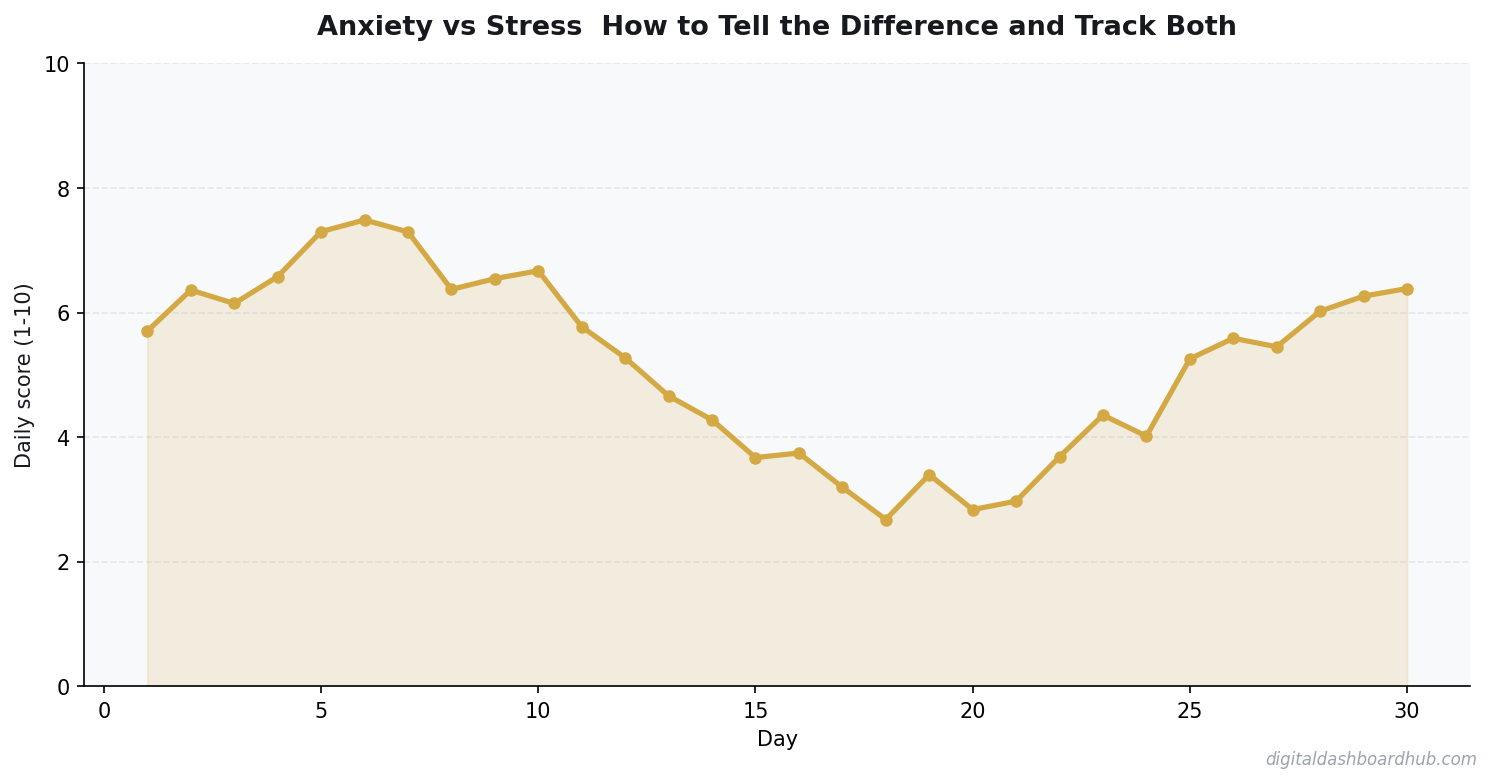
Here’s the tracking method that finally made this click for me. Every evening, I logged three things:
1. Symptom intensity (1-10): How bad did I feel physically and mentally today?
2. Stressor present? (Yes/No): Was there a specific, identifiable cause?
3. Duration: Did symptoms last during the event, or did they linger hours after?
After two weeks, the pattern was undeniable. On days with a clear “yes” to #2 and symptoms that resolved by evening — that was stress. On days where I scored 7+ on intensity with “no” or “sort of” to #2, and symptoms carried into the next morning — that was anxiety.
About 60% of my bad days turned out to be anxiety, not stress. That completely changed my approach.
How the DDH Anxiety & Stress Tracker Handles This
This is where manual journaling falls short and data does the heavy lifting.
The DDH tracker asks you to log symptoms, triggers (or lack thereof), and duration each day. Over time, it separates your entries into stress-pattern days and anxiety-pattern days based on your own data — not a generic quiz.
After 14 days, the dashboard shows you a split view: stress days on the left, anxiety days on the right, with your average symptom scores for each. You can see at a glance which one is dominating your month.
What sold me was the trigger analysis. The tracker cross-references your high-symptom days with whether you logged a trigger. When I saw that 8 of my 10 worst days had no identifiable trigger, I stopped trying to fix my schedule and started working on my thought patterns instead. That shift made more difference than six months of “self-care.”
Try the DDH Stress & Anxiety Tracker free and see your own pattern after 14 days.
FREE BONUS: The Stress vs Anxiety Self-Assessment Worksheet
A printable worksheet with 15 questions to help you identify your primary pattern right now — before you start tracking.
Get instant access → Start Your Free Trial
When Stress Becomes Anxiety (The Crossover Problem)
Here’s the tricky part: chronic stress can become anxiety. If you’re stressed for long enough, your nervous system starts treating “normal” as “dangerous.” The National Institute of Mental Health notes that prolonged stress is one of the primary risk factors for developing generalized anxiety disorder.
This is why tracking matters from the start. If you catch the crossover early — when stress responses start lingering longer than the stressor — you can intervene before it becomes a chronic pattern.
The warning signs of crossover: symptoms lasting 24+ hours after the stressor resolves, worrying about things that haven’t happened yet, physical symptoms (nausea, chest tightness) appearing on “good” days, and sleep disruption on nights when nothing stressful happened.
$1,524/yr
average amount lost to forgotten subscriptions without expense tracking
What Actually Helps Each One
For stress: The fix is environmental. Delegate tasks, set boundaries, take breaks that actually recharge you (not doom-scrolling — that’s avoidance). Time management and building a daily structure work because you’re addressing the external cause.
For anxiety: The fix is internal. Cognitive reframing and journaling work because you’re addressing how your brain processes threats. Exposure therapy, breathwork, and — yes — data tracking all help because they give your rational brain evidence to counter your anxious brain’s catastrophizing.
Your Weekend Project
Right now (2 minutes): Think about your worst day this week. Was there a clear, specific trigger? Did your symptoms resolve when the situation ended? Your answers tell you which pattern you’re dealing with.
This week: Log your symptoms, triggers, and duration for 7 days. You can
Key Takeaways
- Your patterns are unique — don’t rely on averages or others’ experiences
- The tracking itself changes behavior, even before you act on insights
- Share your data with professionals to get more targeted advice
use a notes app, a spreadsheet, or pen and paper. Just be consistent.
For the long haul: Set up the DDH Stress & Anxiety Tracker to automate the pattern recognition. Two weeks of data is usually enough to see which pattern dominates — and that clarity alone is a relief.
Keep reading (related guides):
255+ interactive tools for your money, time, and health.
14-day trial · Stripe checkout · Cancel anytime
3 Brands
One Platform
Finance, Creator, and Wellness tools
You Might Also Like
- How to Track Your Anxiety and Actually Reduce It
- Stress Level Tracker: How Measuring Your Stress Helps You Manage It
- Stress Management Isn’t Just Bubble Baths: A Data-Driven Approach
- How to Regulate Your Nervous System: 8 Steps to Calm
Common Questions About Anxiety Vs Stress Difference
How long before I see results?
Most people notice meaningful patterns within 2 to 4 weeks of consistent tracking. The first week is almost always noisy — you’re still learning what to record, when to record it, and how honest to be with yourself. By week two, baselines emerge. By week four, you can start testing changes against data instead of guessing. Don’t judge the system in the first seven days. Give it a full month before deciding whether the system is worth keeping or whether the approach needs a rethink.
What should I track first?
Start with one metric that is both objective and daily. Objective means a number, not a feeling. Daily means once every 24 hours, not “whenever I remember.” Two metrics is fine; three is too many to sustain for someone new. You can always add more once the habit is locked in. The goal of the first month is consistency, not coverage. It’s better to track one thing perfectly for thirty days than six things sloppily for five, and the data will be far more useful.
What if I miss a day?
Miss one day, no problem — tracking is a long game and single-day gaps don’t break the trend. Miss two days in a row, and your brain starts negotiating you out of the system entirely. The rule most people use: never miss twice. Log something — even a single data point — on the second day, then resume the full routine the next morning. Streaks matter less than quick recovery after a miss, and nobody maintains an unbroken record forever. The goal is resilience, not perfection.
Do I need a paid app to do this?
No. A notebook, a spreadsheet, or a free tool all work. The paid-app question should come after 4 weeks of consistent tracking, not before. If you’re going to quit inside the first two weeks, you’ll quit a free tool and a paid one at roughly the same rate. Prove the habit first, then decide whether a paid tool removes enough friction to be worth the subscription. Don’t use “finding the perfect app” as a way to avoid starting the system this week.
How do I know the data is accurate?
Two rules. First, log at the same time each day — morning before coffee, or evening before bed — so you control the biggest variable. Second, write down the conditions, not just the number. A reading without the time, posture, and recent activity is almost useless. A check-in without the context of sleep or stress is just noise. Structure your log so the conditions travel with the measurement. Data without context is decoration, not signal, and won’t help you make better choices.
When should I review the data?
Weekly for noticing; monthly for deciding. A weekly review is a five-minute scan for surprises: what changed, what stayed the same, what correlates with what. A monthly review is longer and ends with a decision — keep the system, change one variable, or scrap the experiment and try a different approach. Don’t try to decide anything meaningful from a single week of data. And don’t wait a full quarter to look back, either — trends go stale fast when you’re not watching.
Is it worth tracking if my data is imperfect?
Yes. Imperfect data beats no data every time, as long as you know where the imperfections are. A log with a few missing days and honest notes about what went wrong is more useful than a complete but fabricated record. The goal isn’t a museum-quality dataset — it’s enough signal to make better decisions next month than you made last month. Perfect is the enemy of done, especially in week one when the habit itself is fragile.
How do I stay consistent past the first month?
Motivation isn’t the goal — structure is. The people who keep going past 30 days don’t feel more motivated than anyone else; they’ve just wired the tracking into their day so it runs without willpower. Pair it with an existing habit (morning coffee, evening teeth-brushing), keep the entry under 30 seconds, and review weekly so you can see your own progress. Motivation will spike and crash; structure keeps running through both phases without drama.

Andy Gaber is the founder of Digital Dashboard Hub, a suite of 255+ interactive financial, productivity, and wellness tools. He built DDH after getting frustrated with financial apps that gave outputs without context. Follow along for tool tutorials, revenue analytics breakdowns, and honest takes on personal finance.