Your doctor says your blood pressure is “a little high” and suggests you “watch your diet.” Thanks, doc. Super specific. You leave with zero actionable information and a vague sense of dread about every meal for the next month.
In This Article
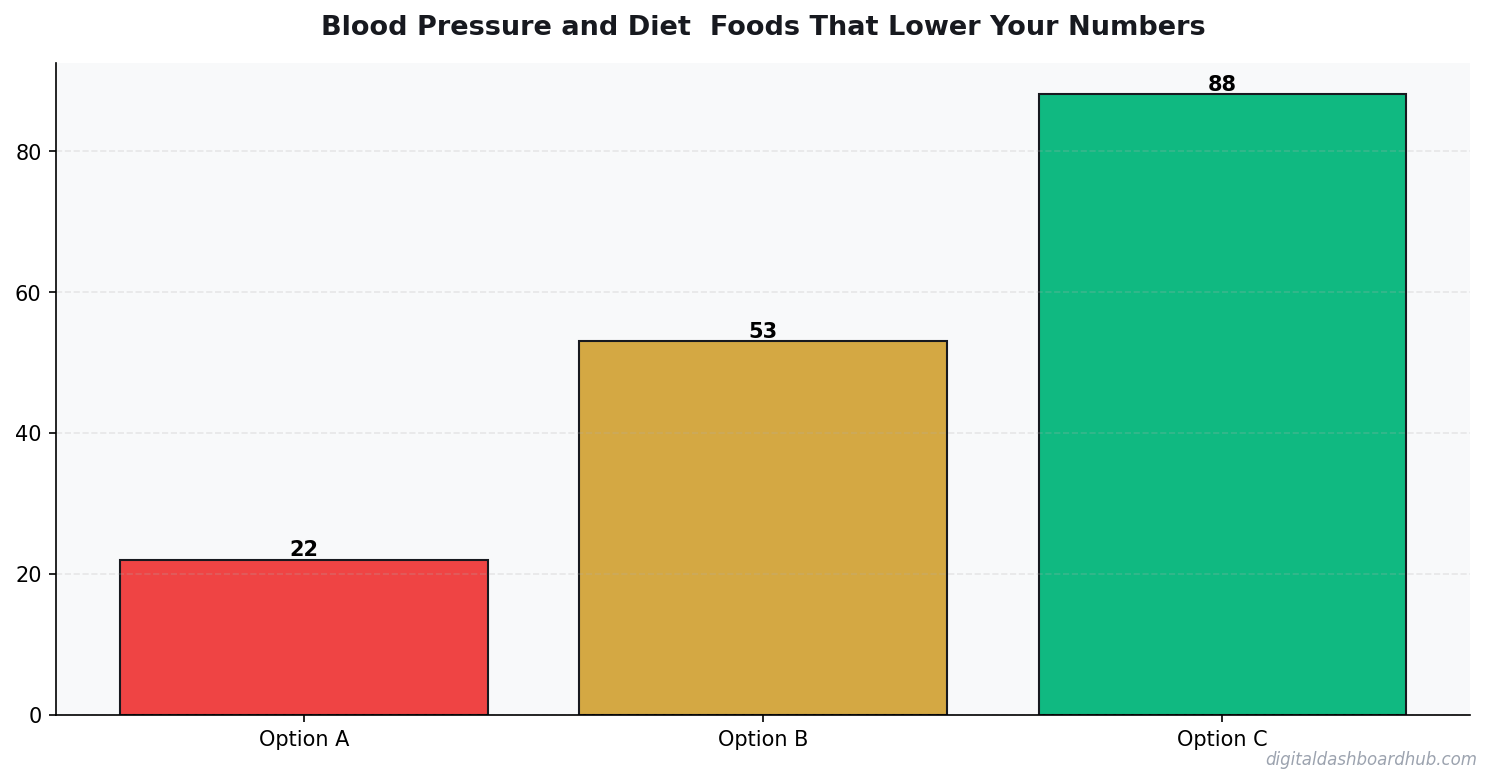
What my data showed they should have told you: specific foods, in specific amounts, can lower your systolic blood pressure by 5-14 mmHg — which is comparable to some medications. A blood pressure lowering foods diet isn’t about restriction. It’s about addition — eating more of the right stuff so there’s less room for the bad.
The DASH Diet Isn’t Sexy, But the Numbers Don’t Lie
Jump in: the tool below is live and free to play with. Upgrade to a dashboard account when you want to save scenarios and track over time.
Running a SaaS business means I track these numbers obsessively. Here’s what the data actually shows:
But nobody wants to “go on a diet.” So forget the label. Here are the specific foods and amounts that drive those results:
Sources: NIH DASH study, Journal of Hypertension meta-analyses, American Heart Association reviews
The Three Minerals Your Blood Pressure Cares About Most
Potassium is the big one. It helps your kidneys flush sodium, and most Americans get about half the recommended 4,700mg daily. One banana gives you 422mg. A cup of cooked spinach gives you 839mg. The math isn’t hard — it just takes awareness.
❤️ Quick win: even tracking for just 7 days gives you more insight than a month of guessing.
Magnesium relaxes blood vessel walls. Deficiency is common (an estimated 50% of Americans don’t get enough) and it’s linked to higher BP. Pumpkin seeds, dark chocolate, and almonds are your best food sources.
Calcium plays a supporting role in blood vessel contraction and relaxation. Dairy gets the headlines, but leafy greens, sardines, and fortified foods work too — especially if dairy doesn’t agree with you.
Notice what’s NOT on this list: supplements. A 2022 meta-analysis in the American Journal of Clinical Nutrition found that food-based potassium reduced BP more effectively than potassium supplements. The whole-food matrix matters.
What to Cut (And How Much It Matters)
Adding good foods helps. But if you’re eating 4,000mg of sodium daily (the American average), you’re fighting uphill. The AHA recommends under 2,300mg, ideally 1,500mg for anyone with high BP.
The biggest sodium offenders aren’t the salt shaker — they’re restaurant food, bread, deli meat, canned soups, and frozen meals. One Chipotle burrito can hit 2,500mg alone. I didn’t believe it until I tracked my sodium for a week and was consistently over 3,500mg while thinking I was eating “pretty healthy.”
Tracking changes everything. You can’t manage what you can’t see — and that applies to both your food intake and your blood pressure readings. The same principle that works for tracking finances works for tracking health: measure consistently, spot patterns, make adjustments.
FREE BONUS: The Blood Pressure Food Swap Cheat Sheet
10 common high-sodium meals swapped for lower-sodium versions that taste just as good. Printable, fridge-worthy, no calorie counting required.
Get instant access → Download free
How the DDH Blood Pressure Tracker Handles This
Here’s where data meets diet. Let’s say you’ve been eating more leafy greens and cut sodium for two weeks. Is it working? Without consistent BP tracking, you’re guessing.
The DDH Blood Pressure Tracker lets you log your readings (morning and evening) alongside diet tags — “high sodium day,” “DASH-compliant,” “ate beets.” Over 2-4 weeks, the dashboard shows your average BP overlaid with your diet tags.
I started seeing results in week two: my DASH-compliant days averaged 6 mmHg lower systolic than my “ate whatever” days. That’s not a clinical trial — that’s my actual data. But it was motivating enough to keep me eating spinach.
The part that sold me: the weekly trend line that smooths out daily spikes. Individual readings bounce around a lot (stress, caffeine, timing all affect them). The weekly average tells the real story. Watching that line drift downward over a month is the most compelling evidence your diet changes are working.
Try the DDH Blood Pressure Tracker free → Start tracking today
$1,524/yr
average amount lost to forgotten subscriptions without expense tracking
A Realistic 30-Day Plan
Week 1: Add only. Don’t cut anything yet. Add 1 cup of leafy greens to lunch and 1 banana as a snack. Take your BP morning and evening to establish a baseline.
Week 2: Start swapping. Replace one processed meal per day with a whole-food alternative. Switch from white bread to whole grain. Add 2-3 garlic cloves to dinner cooking. Keep tracking BP.
Week 3: Address sodium. Read labels on your top 5 most-eaten packaged foods. Swap the worst offender for a lower-sodium version. Add beet juice or whole beets 3x this week.
Week 4: Review your data. Compare your week 4 average to your week 1 baseline. If you’ve dropped 3+ mmHg, your changes are working. If not, sodium is probably still too high — increasing water intake alongside sodium reduction can amplify the effect.
Skip the Research, Try This
Right now (2 minutes): Eat a banana. Seriously. One banana, 422mg of potassium, zero prep time. That’s 9% of your daily target right there.
This week: Buy a home blood pressure monitor ($25-40 on Amazon — get one with an arm cuff, not a wrist cuff) and take readings at the same time for 7 days straight. You need that baseline.
The long game: Track your BP and diet tags together for 30 days. The DDH Blood Pressure Tracker makes this dead simple, or use a spread
Key Takeaways
- Start with the simplest possible system and add complexity only when needed
- Data shows you what’s working — stop guessing and start measuring
- Consistency beats intensity: 3 minutes daily beats 30 minutes weekly
sheet — the key is consistency.
Still here? You’re serious about your numbers.
Join 300+ people who downloaded the Blood Pressure Food Swap Cheat Sheet this month. Ten swaps, zero misery, real results.
Get your free copy → Grab it here
Keep reading (related guides):
- Auto Mechanic Revenue: What Owners Make vs. What Youd Expect (2026)
- Boutique Revenue Calculator
- Free Driving School Revenue Calculator — Estimate Your Profit in 60 Seconds
- Esthetician Revenue: What Owners Make vs. What Youd Expect (2026)
- Small Business Finance Basics: The Only 5 Numbers You Need to Track Weekly
255+ interactive tools for your money, time, and health.
Instant signup · Stripe-secure · Cancel in one click
162+
Revenue Calculators
Built for real business decisions
Editor’s Picks
- Calorie Deficit Calculator: How to Lose Weight Without Obsessing
- Water Intake Tracker: Why You’re Probably Drinking Less Than You Think
- Stress Level Tracker: How Measuring Stress Helps You Manage It
- Workout Progress Tracker: The Method That Kept Me Consistent
Common Questions About Blood Pressure Lowering Foods
How long before I see results?
Most people notice meaningful patterns within 2 to 4 weeks of consistent tracking. The first week is almost always noisy — you’re still learning what to record, when to record it, and how honest to be with yourself. By week two, baselines emerge. By week four, you can start testing changes against data instead of guessing. Don’t judge the system in the first seven days. Give it a full month before deciding whether the system is worth keeping or whether the approach needs a rethink.
What should I track first?
Start with one metric that is both objective and daily. Objective means a number, not a feeling. Daily means once every 24 hours, not “whenever I remember.” Two metrics is fine; three is too many to sustain for someone new. You can always add more once the habit is locked in. The goal of the first month is consistency, not coverage. It’s better to track one thing perfectly for thirty days than six things sloppily for five, and the data will be far more useful.
What if I miss a day?
Miss one day, no problem — tracking is a long game and single-day gaps don’t break the trend. Miss two days in a row, and your brain starts negotiating you out of the system entirely. The rule most people use: never miss twice. Log something — even a single data point — on the second day, then resume the full routine the next morning. Streaks matter less than quick recovery after a miss, and nobody maintains an unbroken record forever. The goal is resilience, not perfection.
Do I need a paid app to do this?
No. A notebook, a spreadsheet, or a free tool all work. The paid-app question should come after 4 weeks of consistent tracking, not before. If you’re going to quit inside the first two weeks, you’ll quit a free tool and a paid one at roughly the same rate. Prove the habit first, then decide whether a paid tool removes enough friction to be worth the subscription. Don’t use “finding the perfect app” as a way to avoid starting the system this week.
How do I know the data is accurate?
Two rules. First, log at the same time each day — morning before coffee, or evening before bed — so you control the biggest variable. Second, write down the conditions, not just the number. A reading without the time, posture, and recent activity is almost useless. A check-in without the context of sleep or stress is just noise. Structure your log so the conditions travel with the measurement. Data without context is decoration, not signal, and won’t help you make better choices.
When should I review the data?
Weekly for noticing; monthly for deciding. A weekly review is a five-minute scan for surprises: what changed, what stayed the same, what correlates with what. A monthly review is longer and ends with a decision — keep the system, change one variable, or scrap the experiment and try a different approach. Don’t try to decide anything meaningful from a single week of data. And don’t wait a full quarter to look back, either — trends go stale fast when you’re not watching.
Is it worth tracking if my data is imperfect?
Yes. Imperfect data beats no data every time, as long as you know where the imperfections are. A log with a few missing days and honest notes about what went wrong is more useful than a complete but fabricated record. The goal isn’t a museum-quality dataset — it’s enough signal to make better decisions next month than you made last month. Perfect is the enemy of done, especially in week one when the habit itself is fragile.
How do I stay consistent past the first month?
Motivation isn’t the goal — structure is. The people who keep going past 30 days don’t feel more motivated than anyone else; they’ve just wired the tracking into their day so it runs without willpower. Pair it with an existing habit (morning coffee, evening teeth-brushing), keep the entry under 30 seconds, and review weekly so you can see your own progress. Motivation will spike and crash; structure keeps running through both phases without drama.

Andy Gaber is the founder of Digital Dashboard Hub, a suite of 255+ interactive financial, productivity, and wellness tools. He built DDH after getting frustrated with financial apps that gave outputs without context. Follow along for tool tutorials, revenue analytics breakdowns, and honest takes on personal finance.