If you’ve got ADHD and you’re reading this, you’ve probably tried six other systems that didn’t stick. The standard advice — “just make a plan” or “set reminders” — isn’t wrong. It’s just designed for brains that work differently than ours.
I needed a adhd focus sprint system that worked with ADHD, not against it. Something that didn’t punish inconsistency, didn’t require daily perfection, and actually matched how my brain processes information. Here’s what I found — and built.
Why Standard Focus Tools Fail the ADHD Brain
Enter your own numbers in the interactive tool below and get a real-time read. The dashboard version adds saved scenarios, history, and full feature access.
Standard focus tools assume you can:
- Remember to check the app daily (working memory issue)
- Start tasks without external triggers (initiation issue)
- Maintain consistent effort over weeks (sustained attention issue)
- Resist the urge to abandon the system when something shiny appears (impulse control issue)
That’s four ADHD-specific challenges baked into a single “simple” tool. No wonder the drawer full of abandoned planners keeps growing. For more on how ADHD affects daily systems, see Best ADHD Focus Sprint Tools in 2026 (Free Option Included).
What Actually Works for ADHD Focus
After testing dozens of approaches (and abandoning most of them — hi, ADHD), three principles consistently worked:
The 3 ADHD-Friendly Design Rules
- Reduce decisions to near-zero. Every choice point is a dropout point. The tool should tell you what to do next, not ask you to figure it out.
- Make progress visible immediately. ADHD brains need dopamine hits. Show streaks, percentages, and progress bars. Make the data colorful and satisfying.
- Build in forgiveness. Missed a day? The tool shouldn’t guilt you. It should say “welcome back” and pick up where you left off.
These principles are why generic productivity apps feel like punishment for people with ADHD. They’re designed for consistency, and ADHD operates in bursts.
How the DDH ADHD Focus Sprint System Actually Works
I’ll walk you through what this looks like day-to-day, because screenshots and feature lists don’t capture the experience.
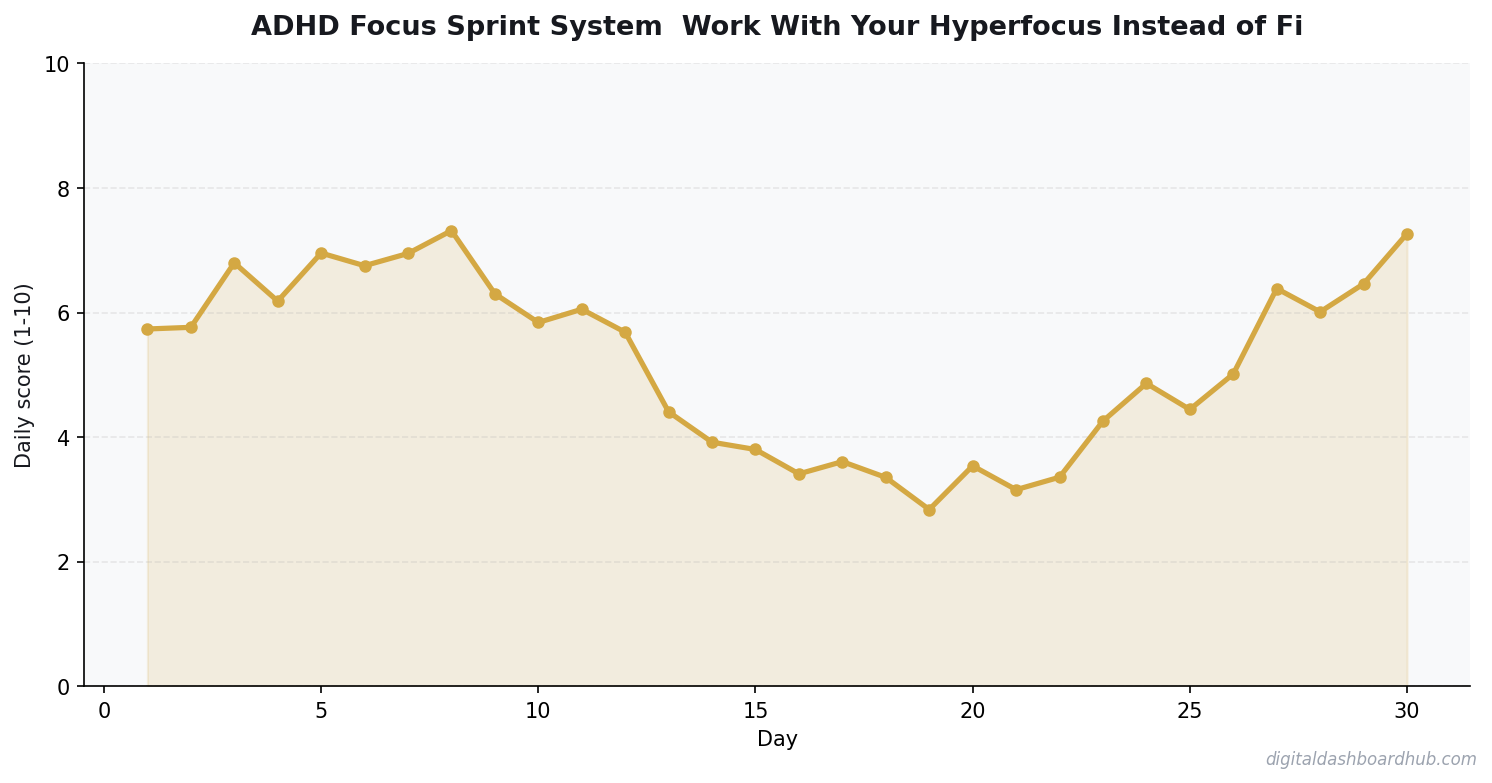
Step 1: Open the tool and you see exactly one thing: today’s focus area. Not a list of 47 things you should be doing. One thing. You can expand if your brain is feeling ambitious, but the default is radical simplicity.
Step 2: Interact with the tool for 30-60 seconds. Log what matters, skip what doesn’t. There’s no “wrong” way to use it — partial data is still useful data. The system adapts to your input patterns over time.
Step 3: Get visual feedback that actually feels good. Color-coded progress, streak counters (that don’t reset to zero when you miss a day), and trend lines that show improvement even when individual days vary wildly.
The ADHD-specific feature that matters most: the gentle re-engagement prompt. If you disappear for three days, the tool doesn’t send guilt-trip notifications. It sends a low-pressure nudge that acknowledges the gap and makes returning feel easy, not shameful.
Want to test it yourself? Try the ADHD Focus Sprint System free for 14 days → No credit card. Setup takes about 60 seconds. It’s one of 255+ tools in the DDH platform, and several are specifically designed for ADHD brains.
DDH vs Other ADHD Focus Tools
| Feature | Generic Apps | ADHD Coaches | DDH Tool |
|---|---|---|---|
| ADHD-specific design | No | Yes | Yes |
| Forgiveness for missed days | Resets to zero | Varies | Built-in |
| Cost | $5-15/mo | $200-400/mo | Free trial |
| Visual dopamine feedback | Minimal | None (verbal) | Core feature |
FREE BONUS: ADHD Focus Quick-Start Guide
A 1-page setup guide designed for the ADHD brain. No 20-page manual. Just the 3 things to do first.
Why Standard Productivity Advice Makes ADHD Worse
The classic Pomodoro method — 25 minutes on, 5 minutes off — was designed for neurotypical attention patterns. For ADHD, it often creates a worse outcome: the 5-minute break interrupts hyperfocus, and the 25-minute sprint is too short to build real momentum before you stop.
ADHD productivity runs in two modes: scattered and struggling, or locked-in and hyperfocused. The goal of a sprint system isn’t to force one mode — it’s to build the conditions where hyperfocus can kick in, and then get out of the way.
What “Working With Hyperfocus” Actually Looks Like
Three things predict whether a session will lock in: task clarity (you know exactly what the output is), environmental setup (distractions removed before you start), and interest activation (some aspect of the task hooks your brain — novelty, challenge, urgency, or meaning).
If all three are present, start the sprint and don’t set a timer. Interrupting hyperfocus is like yanking a plant out of the ground to check its roots. Let it run until natural fatigue sets in.
The Trap: Confusing Busyness With Productivity
ADHD adults often feel most productive during scattered, high-stimulation work — switching between tabs, handling messages, doing small tasks. This feels like flow but produces very little. One locked-in 90-minute sprint on a single hard task will outperform a full day of scattered busyness by a factor of 3-5x in real output.
Your sprint log will make this visible. Track what you actually shipped per sprint, not how many sprints you ran. The data usually shows 2-3 deep sprints per day as the real ceiling for sustainable ADHD output — not 8 hours of constant effort.
Recovery Is Not Optional
ADHD brains pay an energy tax on task-switching and self-regulation that neurotypical brains don’t. A 90-minute hyperfocus sprint may need a full 30-minute recovery — not a 5-minute break — before quality output is possible again.
Building recovery time into your sprint system isn’t laziness. It’s load management. Athletes who overtrain get injured. ADHD workers who skip recovery get scattered, irritable, and unproductive by 2pm. The sprint log helps you find your real sustainable rhythm — which for most ADHD adults looks very different from what they expect.
Keep reading (related guides):
- How Much Does Therapy Cost in 2026? A State-by-State Breakdown
- Free ADHD Impulse Spending Tracker — Try It Now
- BetterHelp vs DDH Therapy Tracker: Which Actually Helps Your Mental Health?
- Why People with ADHD Start Everything and Finish Nothing (And 7 Systems That Actually Help)
- Etsy Seller Revenue Calculator: Project Your Monthly Shop Income
255+ interactive tools for your money, time, and health.
Full features for 14 days · Secure payment · Stop anytime
⚡ Quick Focus Score Calculator
See how your focus stacks up today.
Basic score only. Get the full ADHD toolkit with 255+ tools →
Your Next Move
Right now (2 minutes): Write down the one focus task that keeps falling through the cracks. Not five things. One thing. Naming it is the first step.
This week: Try tracking just that one thing for 5 days. Don’t aim for perfection — aim for awareness. Even 3 out of 5 days gives you useful data about your patterns.
The long play: Set up the DDH ADHD Focus Sprint System. 14 days free, 60-second setup. It’s built for brains like ours — messy, brilliant, and tired of systems that assume we’re neurotypical.
Questions people ask before using this tool
Can a ADHD Focus Sprint replace therapy or coaching?
No, and it should not try. A tool gives structure and visibility. A coach or therapist helps you work through the why behind the patterns. Most ADHDers get the best results from pairing a light-touch daily tool with a monthly or weekly human conversation.
How often should I actually use a ADHD Focus Sprint?
Daily is the goal, but 3-4 days a week beats ‘perfect for a month then zero.’ Build the habit around an existing anchor — morning coffee, post-lunch reset, or a 7pm wind-down. The research on ADHD habit formation points to anchored cues, not motivation.
What makes a ADHD Focus Sprint ADHD-friendly vs. generic productivity bloat?
Three things: it works at the ‘worst ten minutes of your day’ not the best, it forgives gaps instead of punishing streaks, and it renders state visually so you do not have to hold the model in your head. Generic tools assume working memory and calendar discipline ADHD brains cannot rent.
Will a ADHD Focus Sprint actually help someone with ADHD?
It will if it is designed around ADHD patterns — short inputs, visible progress, no perfect-setup expectations. The trap is tools that require 30 minutes of configuration. This ADHD Focus Sprint is built to open, use in under two minutes, and close without guilt when you get distracted.
Do I need medication to get value from a ADHD Focus Sprint?
No. Medication amplifies what a system already provides — it does not create structure on its own. Plenty of undiagnosed or unmedicated ADHDers get meaningful traction from tools like this one. The point is external scaffolding so your brain does less load-bearing work.
What do I do when I abandon the ADHD Focus Sprint for a week?
Open it, log today, move on. Do not backfill. Do not apologize. The ‘restart without shame’ move is the single most predictive habit in long-term ADHD tool usage. Abandonment is a feature of ADHD, not a failure of the tool — the only requirement is a low-friction re-entry.
Seven mistakes to avoid with this ADHD Focus Sprint tool
- Reading ADHD productivity content instead of using any tool at all. The 20-minute scroll is a stalling pattern; opening a bare-bones tool and logging once beats it.
- Hiding the tool in a folder. Out of sight, out of ADHD working memory. Bookmark it, pin the tab, make it the first thing your eye lands on.
- Treating streaks as the goal. ADHD brains break streaks; systems that reward ‘log today even if yesterday was blank’ outlast ones that reset to zero.
- Logging at the end of the day. End-of-day executive function is the worst it gets; log mid-day or right after the event instead.
- Setting up elaborate categories on day one. Every extra field is friction; friction is where ADHD follow-through dies.
- Using the ADHD Focus Sprint in isolation. ADHD thrives on external anchors — pair it with a standing coffee moment, not ‘when I remember.’
- Switching tools every two weeks. The right ADHD Focus Sprint is the one you keep opening — not the one with the prettiest onboarding screens.
The only version of a ADHD Focus Sprint tool that works long-term is the one that survives your worst week. Optimize for ‘still usable when I feel like garbage,’ not ‘perfect when motivated.’
When to use this ADHD Focus Sprint tool (and when to skip it)
This ADHD Focus Sprint tool works best in two windows: the first 20 minutes of your working day (when executive function is highest) and the 15-minute reset after a transition — finishing a meeting, returning from a walk, eating lunch. Those anchor points give your ADHD brain a natural cue to open the tool and close the loop without willpower.
Skip the tool when you are in a hyperfocus window. Hyperfocus is rare and expensive — don’t interrupt it to log or plan. Use the tool on either side of the hyperfocus, not during. Also skip it on days when the friction of opening the tab feels like too much; force-opening it breeds resentment and breaks the long-term habit. Miss a day, open it tomorrow, keep going.
If you are trying to build consistency, commit to the tool for 21 days before deciding whether it is working. Shorter than that and you are judging the tool on noise. ADHD brains need the ‘novelty wears off, is there still value here?’ window, and that window is three weeks — not three days.
ADHD Focus Sprint quick reference checklist
When the ADHD Focus Sprint feels overwhelming, reset with this short checklist. It takes under a minute.
- You are not trying to log perfectly — 3-4 days a week beats perfect for a month then zero.
- You have a recovery move for abandonment weeks: open, log today, keep going — no backfill, no apology.
- The entry took under 2 minutes — if it took longer, cut a field before your next session.
- You have one visible anchor cue (coffee, meal, bedtime) paired with this tool.
- You opened the tool today — gap days do not compound against you.
- You noticed one pattern, even a small one, in the last 7 days of entries.
What to do next
Once you have walked the checklist, scroll back up and run your real inputs in the interactive ADHD Focus Sprint tool — it takes about 60 seconds. If you want to compare this against the other 254+ calculators, trackers, and planners in the DDH library, the full set lives at app.digitaldashboardhub.com. Free tier covers the core version of every tool; upgrades unlock cross-tool dashboards, scenario saving, and team sharing.
If you are brand new to the DDH toolkit, start with three tools: one that directly serves your primary goal this quarter, one that catches problems before they compound, and one just for fun. That mix prevents the usual fate of productivity tools — great first month, forgotten by month three.
Keep Reading
- Best ADHD Focus Sprint Tools in 2026 (Free Option Included)
- ADHD Body Doubling: What It Is and How to Use It for Focus
- How to Finish Projects When You Have ADHD: A Step-by-Step System
- I Have ADHD and Forget Everything: Here’s My System That Actually Works
Common Questions About ADHD Focus Sprint System: Work With Your Hyperfocus Instead of Fighting It
How long does it take to see results?
Most people see meaningful progress within 30-90 days when they apply these strategies consistently. The key is tracking your numbers from day one so you have a baseline to measure against.
What’s the biggest mistake people make?
Trying to do everything at once. Pick one or two strategies from this guide, implement them fully, then layer in additional tactics. Spreading yourself thin is the fastest way to see no results from any of it.
Do I need special tools or software?
Not necessarily to start — but the right tools eliminate hours of manual work. Our free calculators and trackers at Digital Dashboard Hub are a good starting point before you invest in paid software.

Andy Gaber is the founder of Digital Dashboard Hub, a suite of 255+ interactive financial, productivity, and wellness tools. He built DDH after getting frustrated with financial apps that gave outputs without context. Follow along for tool tutorials, revenue analytics breakdowns, and honest takes on personal finance.