You make decent money. Not rich, but enough that you shouldn’t be checking your bank balance with one eye closed every Friday. Yet here you are — $47 in checking, payday is Tuesday, and you genuinely have no idea where $3,200 went this month.
In This Article
That feeling — “I should be fine but I’m not” — is what I call the expense tracking awareness gap. You’re not bad with money. You’re just blind to where it goes. And the fix isn’t a budget (you’ve tried those). It’s a spending tracker that makes invisible money visible.
The $743 I Found in 14 Days
Before you scroll: the calculator below is running in your browser right now. For the full feature set — saved scenarios, history, exports — open the dashboard.
What surprised me was hit me hardest: I would have sworn I spent about $200 on restaurants that month. The actual number was $487. My brain was off by 143%. That gap between what you think you spend and what you actually spend is the entire problem.
C+R Research found that the average American spends $219/month on subscriptions but estimates they spend about $86. That’s not a rounding error. That’s financial amnesia.
Why Budgets Fail But Tracking Works
A budget says “spend $300 on food this month.” Tracking says “you’ve spent $187 on food and it’s the 15th.” See the difference? Budgets are plans. Tracking is awareness.
Plans fall apart because life is messy. Your car breaks down, your kid needs new shoes, your friend’s birthday party costs $80 you didn’t plan for. A rigid budget can’t absorb that. But tracking doesn’t care about your plan — it just shows you reality.
And reality is where behavior change happens. When you see “$487 restaurants” staring back at you, something shifts. Not guilt — awareness. You don’t need someone to tell you that’s too much. The right expense tracker shows you, and your brain does the rest.
The 5 Categories Where Money Disappears
1. Subscriptions. You signed up for a free trial 8 months ago. It’s been charging you $14.99/month since. Multiply that by 3-5 forgotten subscriptions and you’re bleeding $50-100/month on autopilot.
2. Convenience food. DoorDash, Uber Eats, coffee shops, vending machines. Each transaction feels small. In aggregate, it’s often the single biggest discretionary expense category.
3. Amazon one-click purchases. That $12 thing you needed. And the $8 add-on. And the $24 thing you didn’t need but Prime said free delivery. It adds up to $100-200/month for most people.
4. ATM withdrawals. Cash vanishes without a trace. $60 from the ATM on Friday, and by Monday you have $7 left and zero memory of what happened.
5. “Small” recurring costs. Premium Spotify, cloud storage upgrades, app subscriptions, Patreon pledges. Each one is $5-15/month. Stack ten of them and you’re at $100/month for things you barely use.
FREE BONUS: The 30-Day Spending Awareness Challenge Template
A daily log with pre-built categories and a weekly review template. Most people find $200-500 in “invisible” spending within the first two weeks.
Get instant access → Download free
How the DDH Expense Dashboard Handles This
Most expense trackers are spreadsheets with a better UI. The DDH dashboard is built around one idea: make the invisible visible in under 2 minutes a day.
Each day, you log your spending in a quick-entry form. Category, amount, one-word note. No receipt scanning, no bank syncing complexity. Just: “Food, $14, Chipotle.”
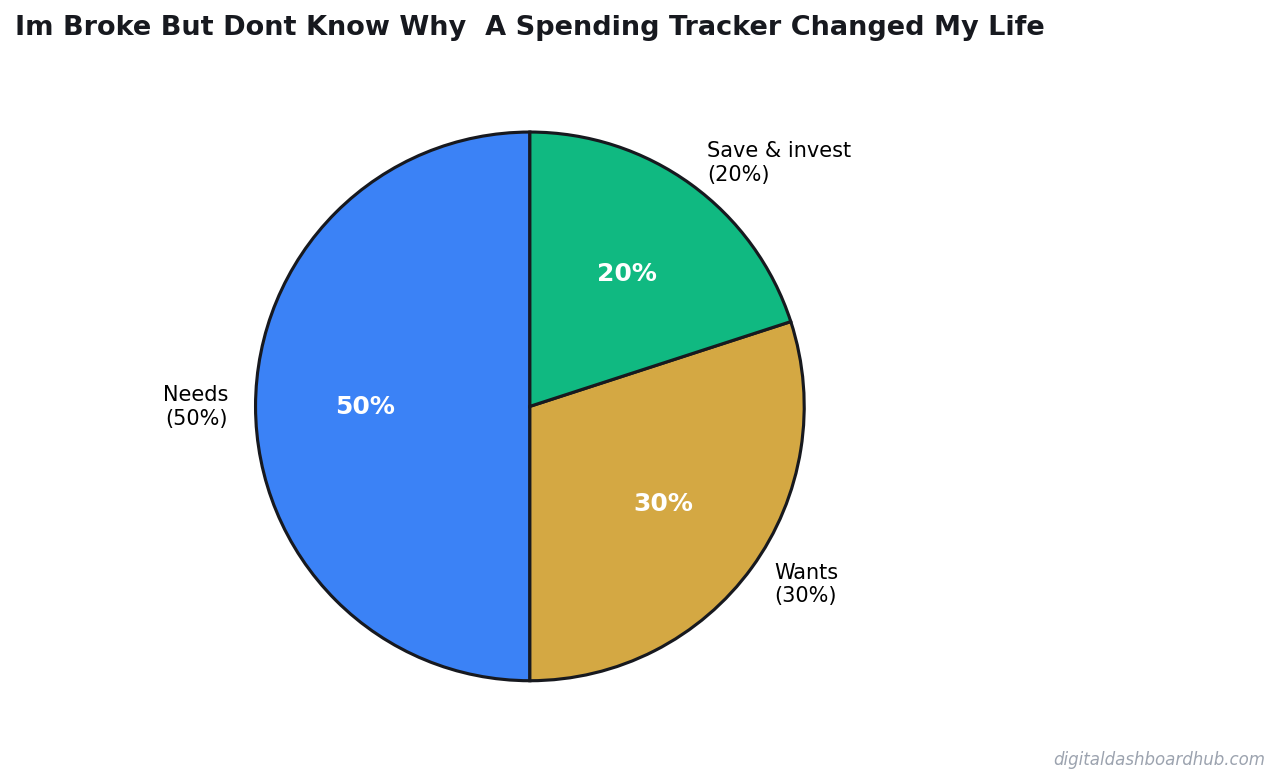
The dashboard converts this into a visual breakdown — a color-coded wheel showing where your money actually went. After one week, the picture is already revealing. My “I barely eat out” narrative collapsed when the food wedge took up 31% of my spending wheel.
The part that sold me: the weekly comparison view. It stacks this week against last week, same categories, side by side. I could literally see the $64 jump in convenience food the week I had a stressful project deadline. Stress spending — I never would have connected those dots without the visual.
Try the DDH Expense Dashboard free → See where your money goes
The 14-Day Experiment That Changes Everything
Don’t commit to tracking forever. That sounds miserable. Commit to 14 days. That’s it. Track every dollar for two weeks — no judgment, no behavior change required. Just observe.
My experience shows will happen: by day 4, you’ll start noticing spending you would have ignored. By day 7, you’ll have a “holy crap” moment about one category. By day 14, you’ll have enough data to make one smart decision that saves you $50-200/month without changing your lifestyle.
That’s the power of awareness. You don’t need discipline. You need data. And data comes from tracking. The 50/30/20 framework is great once you know where you stand — but you have to see reality before you can organize it.
The 3-Minute Action Plan
Right now (2 minutes): Open your bank app and look at the last 7 days of transactions. Mentally add up just the food and drink charges. Is it higher than you thought? (It always is.)
This week: Start a 14-day tracking experiment. Use the DDH Expense Dashboard, a notes app, or a literal piece of paper. The format doesn’t matter. The consistency does.
The long game: After 14 days, pick your biggest surprise category and cut it by 20%. Not 50%, not to zero — just 20%. That’s sustainable, painless, and probably frees up $100-300/month.
Join 500+ people who started the 14-Day Spending Awareness Challenge this month. Most found at least $200 in spending they didn’t know about.
Get your free template → Start the challenge
The Real Reason People Don’t Know Where Their Money Goes
It’s not irresponsibility. It’s a system design problem. Most people have income arriving in 1–2 chunks per month and expenses that scatter across 30 days in dozens of small transactions. Your brain is not built to track 47 transactions a month mentally. Nobody’s is.
The moment you start logging expenses — even imperfectly, even missing some days — you start to see the shape of your spending. And for most people, the shape is surprising. Not because they’re spending on extravagant things, but because the sheer volume of sub-$30 transactions adds up to a number nobody ever consciously decided to spend.
What Actually Changes When You Start Tracking
Here’s the pattern I see consistently: in the first week of tracking, spending drops 10–15% without any conscious effort. You don’t cancel subscriptions, don’t cook more, don’t change your behavior intentionally — you just have slightly more friction before spending because you know you’ll have to log it. That friction is the whole point.
By week three, you start to see categories. Not just “food” — but the split between groceries (fine), sit-down restaurants (manageable), and delivery apps (where the money actually went). Almost everyone who tracks for 30 days discovers one category that’s 2–3x what they thought it was. Usually it’s delivery apps, subscriptions, or coffee — not because these are bad choices but because they’re invisible choices made dozens of times a month.
The Before/After That Convinced Me
One month before tracking: I thought I spent about $400/month on food. One month after tracking: I spent $680. The gap was almost entirely DoorDash on nights when I was too tired to cook. That’s not a moral failure — it’s information. Once I saw it, I set a $100/month cap on delivery apps and that $280 difference went directly into savings. The tracker didn’t change my values. It aligned my spending with values I already had.
Keep reading (related guides):
- Business Expense Tracker: Categorize and Export for Tax Time
- How Much Money You Need to Retire Early at 40, 45, and 50 (Real Numbers by Age)
- How to Budget on a Biweekly Paycheck (Without Running Out Before Payday)
- QuickBooks vs DDH Expense Tracker: Which Fits Your Business?
- Debt Snowball vs Avalanche Calculator: Which Method Saves You More Money
255+ interactive tools for your money, time, and health.
14-day trial · Stripe checkout · Cancel anytime
Keep Reading
- I Tested 9 Expense Tracker Apps — I found something interesting Actually Works
- You’re Probably Wasting $200/Month on Subscriptions You Forgot About
- How to Use the 50/30/20 Budget Rule
- Zero-Based Budgeting: Give Every Dollar a Job
Common Questions About Expense Tracking Awareness
How long before I see results?
Most people notice meaningful patterns within 2 to 4 weeks of consistent tracking. The first week is almost always noisy — you’re still learning what to record, when to record it, and how honest to be with yourself. By week two, baselines emerge. By week four, you can start testing changes against data instead of guessing. Don’t judge the system in the first seven days. Give it a full month before deciding whether the system is worth keeping or whether the approach needs a rethink.
What should I track first?
Start with one metric that is both objective and daily. Objective means a number, not a feeling. Daily means once every 24 hours, not “whenever I remember.” Two metrics is fine; three is too many to sustain for someone new. You can always add more once the habit is locked in. The goal of the first month is consistency, not coverage. It’s better to track one thing perfectly for thirty days than six things sloppily for five, and the data will be far more useful.
What if I miss a day?
Miss one day, no problem — tracking is a long game and single-day gaps don’t break the trend. Miss two days in a row, and your brain starts negotiating you out of the system entirely. The rule most people use: never miss twice. Log something — even a single data point — on the second day, then resume the full routine the next morning. Streaks matter less than quick recovery after a miss, and nobody maintains an unbroken record forever. The goal is resilience, not perfection.
Do I need a paid app to do this?
No. A notebook, a spreadsheet, or a free tool all work. The paid-app question should come after 4 weeks of consistent tracking, not before. If you’re going to quit inside the first two weeks, you’ll quit a free tool and a paid one at roughly the same rate. Prove the habit first, then decide whether a paid tool removes enough friction to be worth the subscription. Don’t use “finding the perfect app” as a way to avoid starting the system this week.

Andy Gaber is the founder of Digital Dashboard Hub, a suite of 255+ interactive financial, productivity, and wellness tools. He built DDH after getting frustrated with financial apps that gave outputs without context. Follow along for tool tutorials, revenue analytics breakdowns, and honest takes on personal finance.