Three Outdoor Businesses, One Race to $10K/Month
Enter your own numbers in the interactive tool below and get a real-time read. The dashboard version adds saved scenarios, history, and full feature access.
I launched Digital Dashboard Hub because the tools I found online were either too generic or too complicated. Here’s the honest breakdown:
The Takeaway
In This Article
- Three Outdoor Businesses, One Race to $10K/Month
- Defining the Three Models (They’re Not the Same Thing)
- Startup Cost Comparison (Real Numbers)
- Speed to $10K/Month: The Race
- How the DDH Service Business Revenue Calculator Handles This
- The Winter Revenue Problem
- Scaling Beyond Solo: Adding Crews
- Revenue Ceilings: Where Each Model Tops Out
- The Honest Verdict on Scaling Speed
- Try This Today
- You Might Also Like
Here’s how each model typically reaches $10,000/month in gross revenue for a solo operator:
If you’ve got $5,000-$15,000 and a willingness to work outside, three business models keep coming up: full-service landscaping, pressure washing, and lawn care (mow-and-go maintenance). All three are legitimate paths to $10,000+/month in revenue. But they scale at completely different speeds, for completely different reasons.
Reality Check
Most online calculators oversimplify. This one includes variables that actually affect your outcome.
I’m not going to tell you which one is “best” because that depends on your market, your capital, and your tolerance for physical labor at 2 PM in August. What I will do is show you the data on which one reaches $10K/month fastest, which scales beyond that most efficiently, and which ones stall out at certain revenue ceilings.
Defining the Three Models (They’re Not the Same Thing)
People use “landscaping” and “lawn care” interchangeably, but they’re different businesses with different economics.
Lawn Care (Mow & Maintain): Mowing, edging, trimming, blowing. Weekly service, residential clients. Low skill barrier. Equipment: mower, trimmer, edger, blower, truck, trailer. Revenue model is volume — lots of yards, weekly recurring.
Full-Service Landscaping: Design, installation, and maintenance. Hardscaping (patios, walls), softscaping (plantings, sod), irrigation. Higher skill requirement, higher per-job revenue, less frequent jobs. Mix of project-based and maintenance contracts.
Pressure Washing: Residential (driveways, houses, decks, fences) and commercial (parking lots, buildings, fleet washing). Higher per-job revenue, one-time service (typically annual). Equipment: commercial pressure washer, surface cleaner, chemical injection system, truck/van.
Startup Cost Comparison (Real Numbers)
Pressure washing has the lowest equipment barrier if you already own a truck or van. Lawn care is mid-range. Full-service landscaping requires the most capital because the range of services demands a wider equipment inventory.
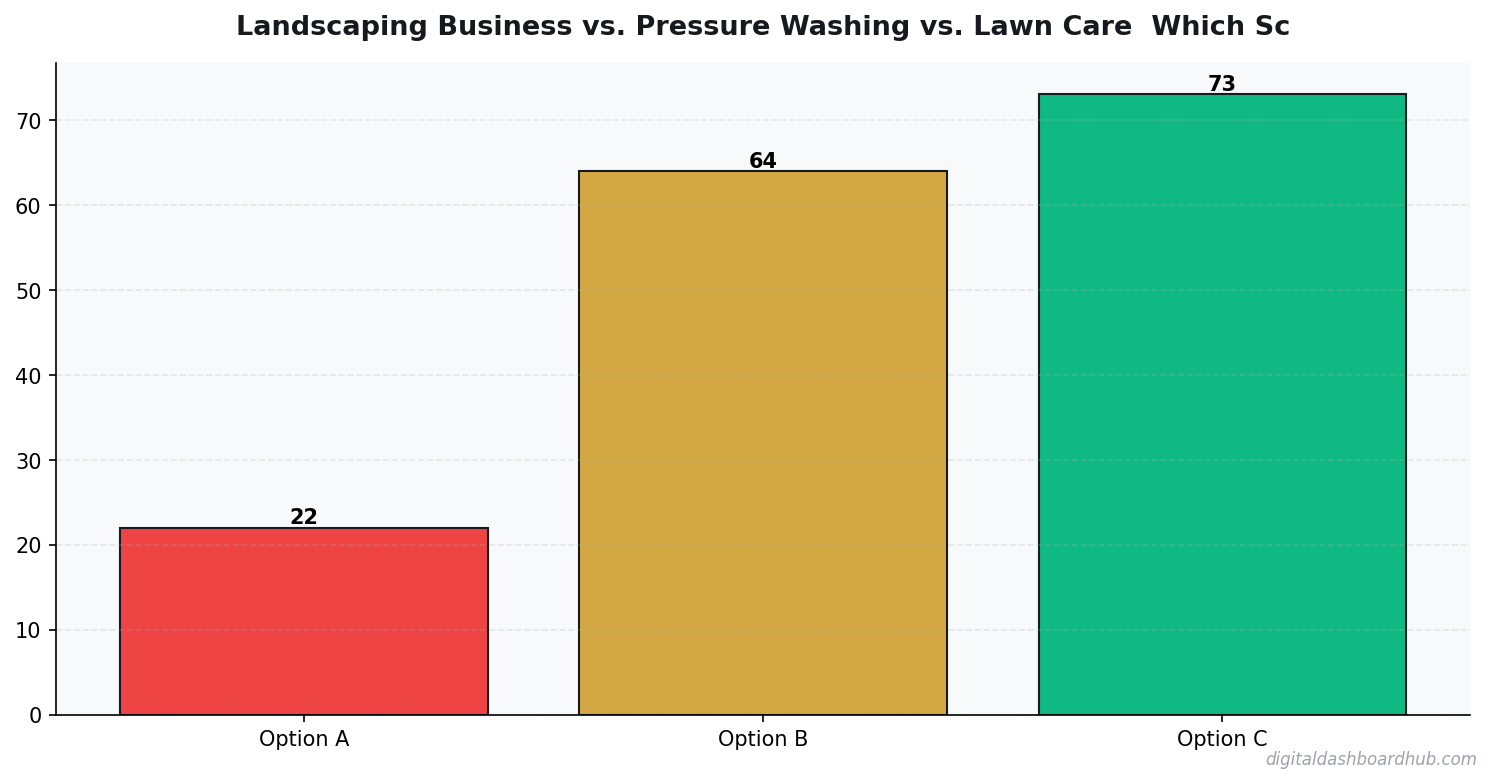
Speed to $10K/Month: The Race
Here’s how each model typically reaches $10,000/month in gross revenue for a solo operator:
Lawn Care: At an average of $45/yard and 10 yards per day, 5 days per week = $2,250/week = $9,000/month. You need approximately 50 weekly clients to hit $10K/month. Time to reach 50 clients: typically 6-12 months of door knocking, flyers, and referrals. Every client you add is sticky — weekly mowing is habit, not a one-time purchase. The revenue builds and stays.
Pressure Washing: At an average of $350/residential job and 2-3 jobs per day, 5 days per week = $3,500-5,250/week = $14,000-21,000/month. Wait — that seems fast. And it can be, IF you can book 10-15 jobs per week consistently. The challenge: these are one-time jobs. You need a constant flow of new customers. Operators report that reaching consistent $10K months takes 4-8 months, but maintaining it requires aggressive ongoing marketing. A bad marketing month = a bad revenue month.
Full-Service Landscaping: Mixed model. Maintenance contracts ($150-400/month each) provide the base. Installation projects ($2,000-$15,000 each) spike revenue. Most operators reach $10K/month with a combination of 15-20 maintenance accounts plus 2-3 installation projects per month. Timeline: 8-18 months, because building a reputation for installation work takes longer than mowing or washing.
How the DDH Service Business Revenue Calculator Handles This
The race to $10K/month plays out differently in every market. The DDH Service Business Revenue Calculator lets you model each path with your specific pricing, client acquisition rate, and seasonal factors.
The key insight the calculator surfaces: it shows you the difference between peak-season $10K months and year-round average $10K months. A pressure washing operator might hit $15K in July but drop to $4K in January. The calculator’s 12-month view shows you whether “$10K/month” means consistently or only in summer — and that distinction matters enormously for planning your life around this business.
The Winter Revenue Problem
If you’re in a four-season climate, this is the conversation that separates daydreamers from operators.
Lawn care operators have four strategies for winter: snow plowing (requires a plow — $3,000-$6,000 installed), holiday lighting installation (lower capital, $1,000-$2,000 in supplies), leaf cleanup extending into December, or simply saving enough in summer to coast through winter.
Pressure washing operators face a similar seasonal dip. Some shift to soft washing (which can be done in cooler weather), commercial work (less seasonal), or interior services like floor cleaning. Others accept the 3-4 month slow period and budget accordingly.
Full-service landscaping has a slight advantage here because design work and project planning can happen in winter, even if installation waits for spring. Smart spacers fill their spring installation calendar during January and February meetings, creating a pipeline that hits hard when the ground thaws.
In southern markets (Texas, Florida, Arizona, the Carolinas), seasonality is much less severe for all three. Lawn care is nearly year-round. Pressure washing slows slightly but never stops. Landscaping installation continues through winter. If you’re choosing between these businesses and you live in the South, this section barely applies to you.
Scaling Beyond Solo: Adding Crews
This is where the three models diverge dramatically.
Lawn Care scales the most predictably. Each crew needs: truck ($15K-$30K used), trailer ($2K-$4K), mower and hand equipment ($3K-$6K), and 2-3 employees ($15-$20/hour each). Total cost to add a crew: $25K-$45K including equipment and first month’s payroll. A crew can handle 30-50 accounts, generating $6,000-$10,000/month in revenue. Margins with crews: 20-35%. Lawn care businesses with 3-5 crews commonly hit $40,000-$80,000/month in revenue.
Pressure Washing scales with more friction. Training is the bottleneck — an untrained employee can damage property, and that liability is expensive. Most pressure washing companies grow to 2-3 trucks with trained lead operators, then focus on optimizing revenue per truck rather than adding more. Equipment per truck: $5K-$12K. Revenue per truck: $15K-$25K/month in season. Margins with crews: 25-35%.
Landscaping scales the widest but with the most complexity. You need different crew compositions for maintenance vs. installation. Installation crews need specialized skills (operating equipment, reading plans, understanding drainage). Finding reliable workers is the biggest pain point — every landscaping business owner I’ve talked to says labor is their #1 challenge. Equipment costs per crew are the highest of the three because of the range of tools needed. Revenue per crew: $12K-$25K/month. Margins with crews: 15-25%.
Revenue Ceilings: Where Each Model Tops Out
Solo lawn care operator: $80K-$120K/year. You’re limited by the number of yards you can physically mow in a day (8-12) and the number of working days (weather permitting).
Solo pressure washer: $100K-$180K/year. Higher per-job revenue means a higher solo ceiling, but it’s still a one-person-one-truck operation. Marketing time eats into job time.
Solo spacer (maintenance + installation): $80K-$150K/year. Installation projects create revenue spikes, but they also create project management headaches and require more diverse skills.
With crews, the ceilings shift dramatically. Multi-crew lawn care operations regularly reach $500K-$1M+. Multi-truck pressure washing businesses hit $300K-$600K. Full-service landscaping companies can reach $1M-$5M+ but require significant management infrastructure.
The Honest Verdict on Scaling Speed
Fastest to $10K/month (solo): Pressure washing. Higher per-job revenue means fewer jobs needed. If you can market effectively, you can hit $10K/month within 4-6 months.
Fastest to $10K/month (sustainable): Lawn care. Once you have 50 recurring clients, the revenue is automatic. Pressure washing’s $10K months can vanish with a bad marketing week. Lawn care’s $10K months are locked in by contracts.
Highest ceiling: Full-service landscaping. Installation projects and commercial contracts push revenue well beyond what mowing or washing can achieve. But the management complexity scales too.
Easiest to sell/exit: Lawn care. Recurring client lists with documented routes sell for 1-3x annual net profit. Buyers want predictable cash flow, and a mowing route with 80 weekly clients is as predictable as service businesses get.
Try This Today
- Model all three in your market. Use the DDH Service Business Revenue Calculator to plug in local pricing, your available startup capital, and your seasonal calendar. The right choice depends entirely on where you live and what you can invest.
- Start with the one that matches your cash. Under $5K? Pressure washing with a basic setup. $5K-$10K? Lawn care with a reliable mower and trailer. $15K+? Consider landscaping if you have the skills, or a beefier lawn care setup that can handle more volume.
- Set a 6-month revenue target. Write it down. If you haven’t hit it by month 6, diagnose whether it’s a marketing problem, a pricing problem, or a market problem — then adjust.
All three businesses work. The question is which one works fastest for YOUR starting point. Run the numbers and stop guessing.
Real-Time
Calculations
Results update as you type your numbers
You Might Also Like
- The Side Hustle Tax Trap: Track Every Dollar
- Side Hustle Income & Tax Tracker Free Tool
- Freelancer Finance Dashboard: Track Income, Taxes, and Cash Flow in One Visual Hub
Keep reading (related guides):
- Small Business Finance Basics: The Only 5 Numbers You Need to Track Weekly
- Freelancer Finance Dashboard: Track Income, Taxes, and Cash Flow in One Visual Hub
- Social Media ROI for Small Businesses: How to Know If Your Posts Are Actually Making Money
- The Small Business Owners Guide to Expense Tracking (Without Losing Your Mind at Tax Time)
- Auto Mechanic Revenue: What Owners Make vs. What Youd Expect (2026)
Picking the Right Outdoor Service Business to Scale
The “best” outdoor service business depends on what you mean by scale. Revenue per hour? Total ceiling? Ease of hiring? Each model optimizes for something different.
If you want to stay solo
Pressure washing is the cleanest solo play. One person with $8K in equipment can gross $90K-$140K at 55-70% margin. Driveways, decks, and commercial storefronts all have premium pricing. No employees, no payroll headaches, clean route planning.
If you want to hire 2-3 employees
Lawn care with a tight route wins. Route density is everything — if you can do 18-24 lawns per crew per day in a 5-mile radius, the economics work beautifully. Revenue $300K-$500K, margin 28-38%, and employee training takes days, not months.
If you want to hit $1M+
Full-service landscaping wins. Design/install jobs run $15K-$80K, and you can carry multiple crews doing different work types. Barrier to entry is higher — you need a foreman, a decent truck fleet, and a sales process. Top landscapers clear $2M+ with 15-22% net margins.
If you want the fastest ramp
Start pressure washing. $3K-$8K gets you operational in a weekend, and residential demand is consistent from March to November in most markets. Use it as a cash-generating foundation while you figure out whether you want to stay solo or expand.
The commercial contract play
Across all three models, the single biggest unlock is signing commercial maintenance contracts — HOAs, property managers, commercial buildings. Commercial contracts pay monthly, sign annually, and turn a lumpy residential business into a reliable subscription-style cash flow.
Quick FAQ: Outdoor Service Business Scaling
Which has the best recurring revenue?
Lawn care wins on recurring revenue because cutting happens weekly for 28-32 weeks per year. Pressure washing is typically annual or twice-yearly. Landscaping design/install is mostly project-based. If you want predictable MRR, lawn care is the clear pick.
Which requires the most specialized skill?
Landscaping design/install, by a wide margin. Hardscaping, drainage, plant selection, and project management all require real expertise. Lawn care is mostly efficiency — routes and equipment. Pressure washing is mostly surface knowledge and chemistry.
Which is best for a solo operator?
Pressure washing. One person with a good setup can gross $90K-$140K at 55-70% margin without ever hiring. Route density matters less than it does for lawn care, and ticket sizes are larger.
Which scales best to $1M+?
Landscaping, particularly design/build plus maintenance. High ticket sizes, lots of ways to specialize, and commercial contracts compound. Pressure washing caps out around $400K for most single-market operators. Lawn care hits $600K-$900K before management overhead bites.
Can I start one and pivot to another?
Yes, and many successful outdoor service businesses evolve. Common path: start with pressure washing (low barrier, good cash flow), add lawn care once you have a truck and client list, then expand into full landscaping once you have 2-3 crews. Each step re-uses the prior client base.
255+ interactive tools for your money, time, and health.
Full features for 14 days · Secure payment · Stop anytime
Related Reads From Digital Dashboard Hub
- Ab Testing Your Etsy Listings How To Know Whats Actually Working
- Acupuncture Practice Revenue Calculator
- Adhd And Money Why Your Brain Makes Budgeting Feel Impossible
- Adhd Budget Tracker Impulse Spending
- Adhd Daily Routine Planner How To Build Structure That Works With Your Brain Not Against It
- Adhd Impulse Spending Tracker Free Tool
- Airbnb Revenue Calculator Estimate
- Amazon Fba Revenue Calculator 2026
- Auto Detailing Revenue Calculator
- Auto Mechanic Revenue Calculator

Andy Gaber is the founder of Digital Dashboard Hub, a suite of 255+ interactive financial, productivity, and wellness tools. He built DDH after getting frustrated with financial apps that gave outputs without context. Follow along for tool tutorials, revenue analytics breakdowns, and honest takes on personal finance.